DeepSeek v3.2

Search documents
大摩开门会:中国AI算力的供给及需求
2025-12-15 01:55
Summary of Conference Call on China's Computing Power Supply and Demand Industry Overview - The discussion focuses on the Chinese computing power supply (CSP) and demand, particularly in relation to AI and semiconductor industries [1] - The call features insights from analysts specializing in internet and hardware sectors, emphasizing the dynamics of chip imports and domestic production [1] Key Points and Arguments - **Demand for AI Chips**: There is a significant demand for AI chips in China, particularly for training and inference tasks. Training chips have higher performance requirements compared to inference chips [2] - **H200 Chip Import Policy**: The regulatory environment is expected to allow Chinese companies to procure the H200 chip, albeit through an approval process. This is seen as a balance between meeting AI model demands and supporting domestic chip development [3] - **Capital Expenditure Growth**: Major Chinese hyperscalers are projected to increase their capital expenditures (CapEx) by approximately 25% annually over the next three years, reaching nearly 450 billion by 2027. However, this figure remains significantly lower than that of major US firms [4] - **Supply Constraints**: The demand for AI computing power in China is currently outstripping supply, leading to adjustments in capital expenditures by companies like Tencent due to GPU supply limitations [3][4] - **Domestic Chip Development**: Domestic chips are reportedly capable of meeting the performance needs for inference tasks, but there is still a gap in training chip capabilities compared to imported options like the H200 [2][4] - **Long-term Demand for H200**: The H200 chip is expected to remain in demand despite a 25% import fee, as its performance and speed are currently unmatched by domestic alternatives [7] - **Local Production and Supply Chain**: The local semiconductor supply chain is anticipated to grow, with projections indicating that domestic chip production could reach 48 million units by 2027, with significant increases in monthly production rates from SMIC [9] Additional Important Insights - **Cloud Providers' Strategies**: Chinese cloud providers are likely to utilize overseas data centers for training needs while domestic centers will focus more on inference tasks due to chip availability [5] - **Market Fragmentation**: The market for H200-related components is fragmented, with multiple suppliers involved in the production of PCBs and assembly, indicating a diverse supply chain landscape [10][11] - **Potential Beneficiaries**: Companies like Inspur and other domestic assembly firms are expected to benefit from the demand for H200 systems, although the overall impact on larger firms like Lenovo may be less pronounced [11] - **Emerging Domestic Chips**: There is growing interest in domestic NeoKin chips, which may not face the same regulatory constraints as other chips, potentially boosting local semiconductor performance and production [12] This summary encapsulates the key discussions and insights from the conference call, highlighting the current state and future outlook of the Chinese computing power supply and demand landscape.
AI 价值链-Google Gemini 3 Pro、Claude Opus 4.5、Grok 4.1 与 DeepSeek 3.2…… 谁才是真正的领导者?这意味着什么
2025-12-12 02:19
Summary of Key Points from the Conference Call Industry Overview - The conference call discusses the U.S. semiconductor and internet industries, focusing on the AI value chain and the competition among leading AI models: Google Gemini 3 Pro, Claude Opus 4.5, Grok 4.1, and DeepSeek 3.2 [1][2][3]. Core Insights and Arguments - **Model Performance Comparison**: - Gemini 3 Pro and Claude Opus 4.5 are viewed as closely matched, while skepticism surrounds DeepSeek's claim to leadership. All three models have published benchmarks that favor their performance, but third-party benchmarking is still ongoing [3][4][14]. - Early results indicate that Gemini and Claude are neck and neck, with Grok 4.1 outperforming GPT-5 [3][14]. - **Scaling Laws**: - The scaling laws for AI models remain intact, suggesting renewed confidence among AI labs and their investors to expand AI infrastructure. Continued access to superior compute resources and unique data is essential for scaling [4][15]. - **OpenAI's Challenges**: - OpenAI is reportedly lagging behind its competitors, facing issues such as disappointing GPT-5 performance, failed pre-training runs, and significant talent departures. This situation raises concerns about its future leadership in the AI space [6][18][19]. - **Compute Infrastructure**: - The competition between GPUs and TPUs is highlighted, with concerns about Nvidia's market position. The defining theme is compute scarcity, which benefits both GPU and ASIC technologies [7][20][22]. - **Market Dynamics**: - There is a potential shift from model benchmarking to product adoption and monetization, as evidenced by Gemini's inability to displace ChatGPT despite superior performance [8][21]. Important but Overlooked Content - **DeepSeek's Position**: - DeepSeek's ability to quickly follow leading models raises concerns about the sustainability of frontier model economics if model improvement slows down. However, current model improvements are still strong [5][17]. - **Investment Implications**: - Nvidia (NVDA) is rated as outperforming with a target price of $275, citing a significant datacenter opportunity. Broadcom (AVGO) is also rated outperforming with a target price of $400, driven by a strong AI trajectory. AMD (AMD) is rated market perform with a target price of $200, contingent on OpenAI's success [10][11][12]. - **Consumer Behavior**: - OpenAI's large user base, with 800 million monthly active users, may provide a competitive moat despite its current challenges. The sticky nature of consumer behavior in technology could offer OpenAI some breathing room [18][19]. - **Future Monitoring**: - Investors are advised to closely monitor developments in the AI space, particularly regarding OpenAI's performance and the broader implications for the semiconductor and AI infrastructure markets [19][21]. This summary encapsulates the key points discussed in the conference call, providing insights into the competitive landscape of AI models, the challenges faced by leading companies, and the implications for investors in the semiconductor and AI sectors.





加速了!刚刚,重大突破!发生了什么?
Zheng Quan Shi Bao Wang· 2025-10-09 05:03
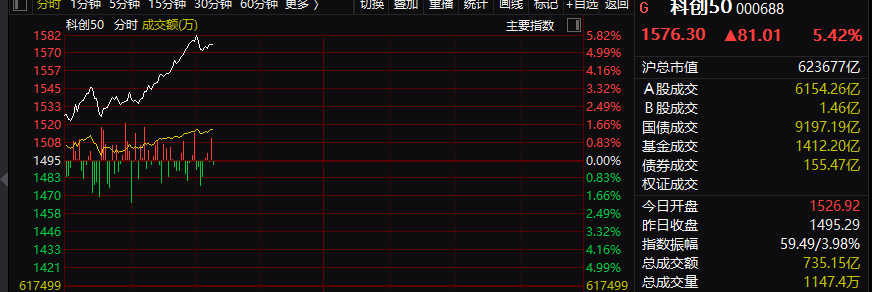
Market Overview - The Shanghai Composite Index broke through the 3900-point mark for the first time in 10 years, with a daily increase of 0.58% on October 9 [1] - The ChiNext Index and Shenzhen Component Index both rose over 1%, while the STAR Market Index surged over 5% [1] - The A-share market's performance positively influenced the Hong Kong market, which turned from decline to increase, with the A50 Index rising over 1% [1] Driving Factors - Analysts attribute the market's acceleration to two main reasons: the rapid replenishment of margin financing and the positive performance of overseas markets post-holiday [1][4] - Margin financing in the two markets decreased by nearly 33.8 billion yuan before the holiday, indicating a potential influx of capital into the market [4] - The resurgence of artificial intelligence products and the continuous highs in non-ferrous metals provided fertile ground for market speculation [5] Sector Performance - The semiconductor industry saw significant gains, with the STAR Market Index rising over 5% and individual stocks like Chipone Technology and Huahong Semiconductor experiencing increases of over 15% [2] - Storage chips emerged as a key focus, with several companies hitting their daily price limits, including Hua Hong Semiconductor nearing a 20% limit up [2] - The technology sector was the primary driver behind the index's acceleration, with notable contributions from companies like Industrial Fulian and Zijin Mining [3] Future Market Outlook - Analysts expect the market to maintain a generally upward trend in October, supported by favorable external conditions and historical patterns of post-holiday performance [6][8] - The focus is anticipated to shift towards sectors with strong growth potential and lower valuation constraints, particularly in technology and cyclical industries [7][8] - The "14th Five-Year Plan" is expected to attract market attention, with a continued emphasis on technology as a primary investment theme [8]

大盘加速突破,发生了什么?
Zheng Quan Shi Bao· 2025-10-09 04:23
Market Overview - The Shanghai Composite Index broke through the 3900-point mark for the first time in 10 years, with an intraday increase of 0.58% [1] - The Shenzhen Component Index rose over 1%, and the ChiNext Index also increased by more than 1% [1] - The STAR Market 50 Index surged over 5%, driven by a significant rally in the semiconductor industry [1][2] Driving Factors - Analysts attribute the market's acceleration to two main reasons: the rapid replenishment of margin financing and the positive performance of overseas markets post-holiday [1][4] - Margin financing in the two markets decreased by nearly 33.8 billion yuan before the holiday, indicating a potential influx of capital into the market [4] - The surge in artificial intelligence products and the continuous highs in non-ferrous metals provided fertile ground for market speculation [5] Sector Performance - The semiconductor sector saw substantial gains, with companies like Chipone Technology rising over 15% and Huahong Semiconductor nearing a 20% limit-up [2] - Storage chips emerged as a key focus, with multiple companies hitting their upper trading limits, including Zhaoyi Innovation reaching a historical high [2] - The technology sector was the primary driver behind the index's acceleration, with significant contributions from companies like Industrial Fulian, Zijin Mining, and others [3][4] Future Outlook - Analysts predict that the market will likely maintain a trend of oscillating upwards in October, supported by historical patterns of post-holiday performance [7] - The focus is expected to shift towards sectors with strong growth potential and lower valuation constraints, particularly in technology and cyclical industries [7] - The upcoming "14th Five-Year Plan" is anticipated to attract market attention, with a continued emphasis on technological advancements and innovation [7]

DeepSeek突然拥抱国产GPU语言,TileLang对标CUDA替代Triton,华为昇腾Day0官宣支持适配
3 6 Ke· 2025-09-30 02:52
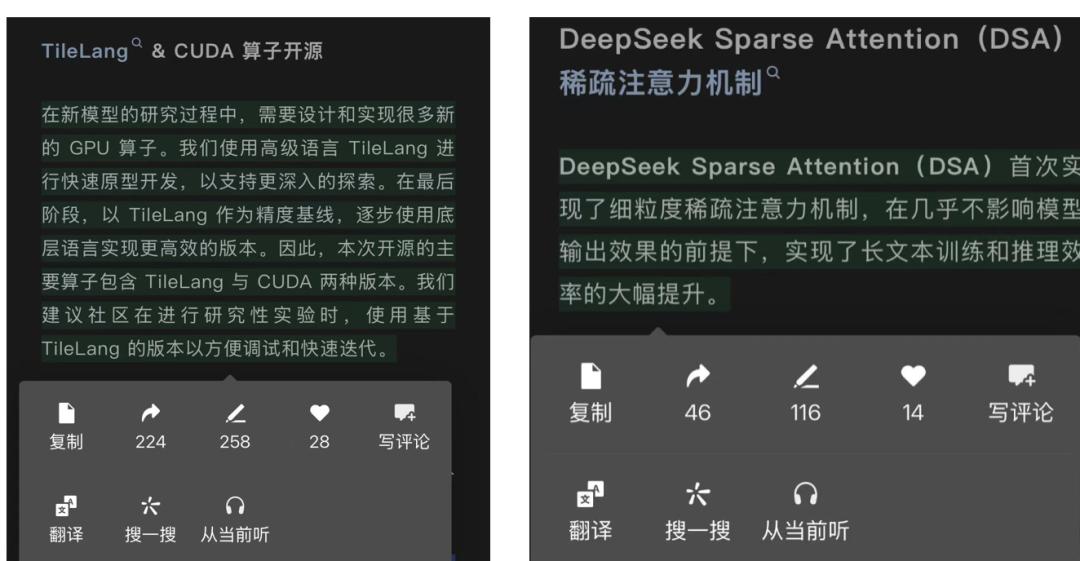
Core Insights - DeepSeek v3.2 introduces a significant change by adopting TileLang, a domain-specific language for GPU kernel development, which has garnered substantial attention in the tech community [1][4][6] - TileLang is noted for its performance, allowing developers to implement attention mechanisms faster than existing solutions, with claims of achieving a 30% speed increase over Flash Attention 2 [3][5] Group 1: TileLang Overview - TileLang is designed to simplify the development of high-performance GPU/CPU kernels, comparable to NVIDIA's CUDA, and is recommended by DeepSeek for experiments due to its debugging and rapid iteration advantages [4][13] - The language is built on a Python-like syntax and operates on top of the TVM compiler infrastructure, enabling developers to focus on productivity without sacrificing performance [13] - TileLang features three programming interfaces catering to different developer skill levels, from high-level abstractions for beginners to low-level controls for performance experts [15] Group 2: DeepSeek's Adoption of TileLang - DeepSeek's collaboration with TileLang was first highlighted at the Beijing Zhiyuan Conference in June, where a report indicated that TileLang's operator implementation could be faster [6][19] - The DeepSeek team has utilized TileLang for rapid prototype development, subsequently optimizing performance with lower-level methods [17][23] - Following the release of DeepSeek v3.2, TileLang's capabilities were validated, demonstrating its effectiveness in model training [23]
DeepSeek突然拥抱国产GPU语言!TileLang对标CUDA替代Triton,华为昇腾Day0官宣支持适配
量子位· 2025-09-30 00:57
Core Viewpoint - The article highlights the significance of TileLang, a domain-specific language for GPU kernel development, which has been adopted by DeepSeek in its v3.2 update, showcasing its performance advantages over traditional methods like Flash Attention 2 [1][6][26]. Group 1: TileLang Overview - TileLang is designed to simplify the development of high-performance GPU/CPU kernels, comparable to NVIDIA's CUDA, and is recommended by DeepSeek for experiments due to its debugging and rapid iteration advantages [6][10]. - The language allows developers to write efficient code with significantly reduced lines, achieving performance parity with existing implementations [5][8]. - TileLang's development is led by a team from Peking University, including key figures such as Wang Lei and Dong Yuqi [15][19]. Group 2: DeepSeek's Adoption of TileLang - DeepSeek's choice to use TileLang was first showcased at the Beijing Zhiyuan Conference in June, where its potential for faster operator implementation was discussed [10][11]. - The integration of TileLang has been recognized by industry leaders, including Huawei, which announced support for the language [7][4]. - DeepSeek's v3.2 release demonstrates that TileLang can effectively be used for model training, validating its capabilities in real-world applications [34][26]. Group 3: Performance and Technical Aspects - TileLang provides three programming interfaces catering to different developer expertise levels, from beginners to performance-focused experts [20][21][23]. - The language's architecture allows for decoupling scheduling space from data flow, enabling more efficient optimization by the compiler [19]. - DeepSeek's implementation of TileLang has resulted in significant performance improvements, with claims of achieving a 30% speed increase over traditional methods [5][27].