Dojo人工智能超算系统

Search documents
韩国散户质疑特斯拉“牛市叙事” 蜂拥至比特币与以太坊
Zhi Tong Cai Jing· 2025-09-01 07:08
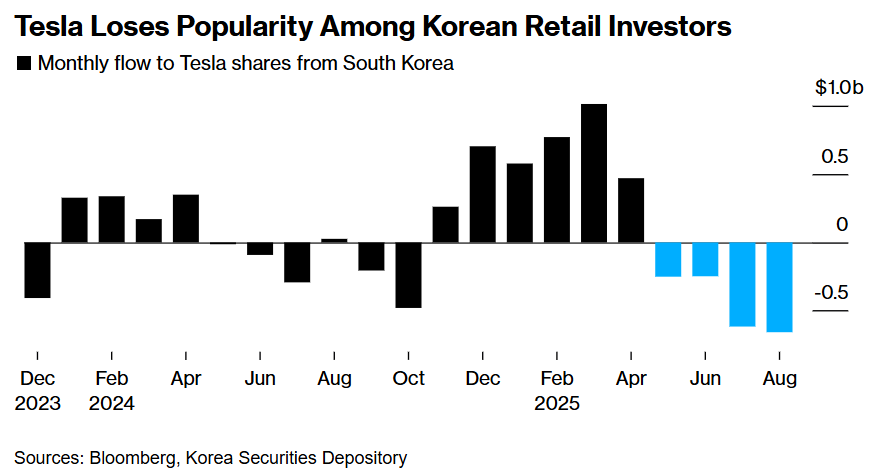
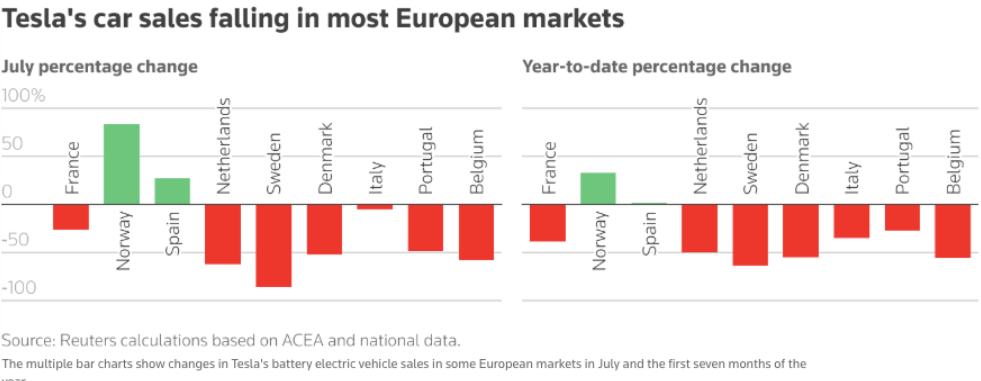
Group 1: Market Sentiment and Investment Shifts - Korean retail investors, known for their aggressive investment strategies, are shifting their focus from Tesla to cryptocurrencies like Bitcoin and Ethereum, indicating a significant decline in their long-term bullish sentiment towards Tesla [1][2] - In August, Korean retail investors net sold Tesla shares worth approximately $657 million, marking the largest outflow since the beginning of 2023, while showing a strong preference for more volatile stocks such as Bitmine Immersion Technologies, which saw a net buy of $253 million [2][5] - The recent trend of selling Tesla shares reflects a diminishing belief in the bullish narrative surrounding the company, as investors are now looking for stocks with greater upside potential, such as Nvidia and Broadcom [5][8] Group 2: Tesla's Performance and Challenges - Tesla's performance and valuation have faced significant pressure this year due to various factors, including declining sales in Europe, which saw a more than 40% drop in new car sales in July, and a reduction in market share from 1.4% to 0.8% [8][9] - Despite the challenges, Tesla remains a core holding for Korean retail investors, with an overall value of approximately $21.9 billion in Tesla shares, although interest in other tech stocks is rising [5][6] - Analysts emphasize that Tesla's core business still relies heavily on automotive sales, which account for 75% of its revenue, and the contributions from future AI-driven projects remain uncertain [9]


汽车卖不动 何来AI梦? 特斯拉(TSLA.US)纯靠信仰撑起的估值来到“清算时刻”?
智通财经网· 2025-08-06 07:38
Core Viewpoint - Despite Elon Musk's ambitious claims regarding Tesla's AI supercomputing system, fully autonomous driving, Robotaxi, and humanoid robot applications, the company fundamentally remains an electric vehicle manufacturer, with automotive sales contributing 75% of its revenue, while the contributions from AI-driven initiatives are minimal and uncertain [1][2][3] Group 1: Financial Performance - Tesla's automotive business generated $167 billion in revenue for the second quarter of fiscal year 2025, down from $199 billion in the same period last year, reflecting a 12% year-over-year decline [3][6] - The company's gross margin fell to 17.2%, a decrease of 71 basis points year-over-year, attributed to declining sales and increased discounts [6] - The second quarter vehicle deliveries unexpectedly dropped by 13% year-over-year, with Model 3/Y deliveries down 12% and luxury models down 52% [6] Group 2: Market Challenges - Tesla's market share in Europe has been significantly eroded, with sales continuously declining due to increased competition from established automakers like Volkswagen and Renault [3][7] - The company's market share in the UK has plummeted to below 1% this year, indicating a substantial loss of presence in a key market [3][7] - The political backlash against Musk has negatively impacted Tesla's sales in Europe, as many customers are reluctant to associate with his values [8] Group 3: Valuation Insights - Analyst Gytis Zizys estimates that even under the most optimistic discounted cash flow (DCF) assumptions, Tesla's intrinsic value is only $233 per share, suggesting that the current trading price of approximately $310 is overvalued [3][10] - The DCF model used by Zizys incorporates a weighted average cost of capital (WACC) of 10.8% and a terminal growth rate of 2.5%, leading to a significant downside potential of 24.3% from the current share price [10] Group 4: Future Business Prospects - The revenue contribution from AI-driven initiatives like Full Self-Driving (FSD) and Robotaxi remains below 10% of Tesla's total revenue, indicating limited current financial impact [2][3] - The anticipated growth in Tesla's energy storage systems is projected to reach $10 billion in 2024, but current deployment rates suggest that the long-term goals set by Musk may not be achievable [9]
大摩力挺特斯拉(TSLA.US):马斯克手里的牌非常多! “特马闹剧”无碍牛市叙事
Zhi Tong Cai Jing· 2025-06-09 07:13
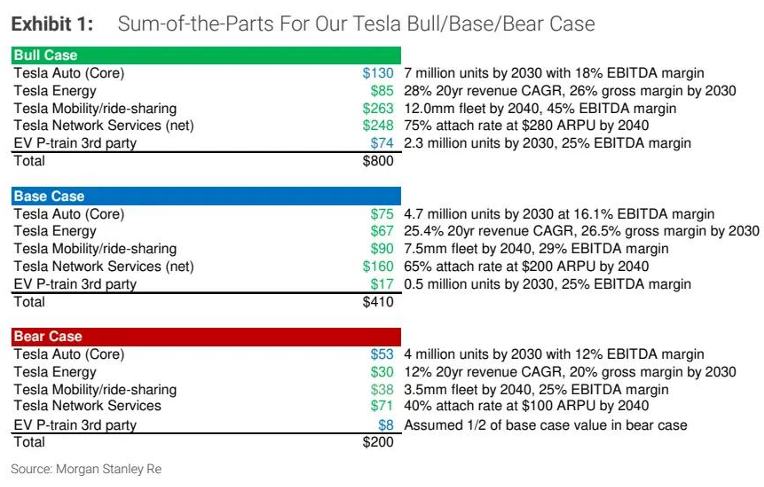
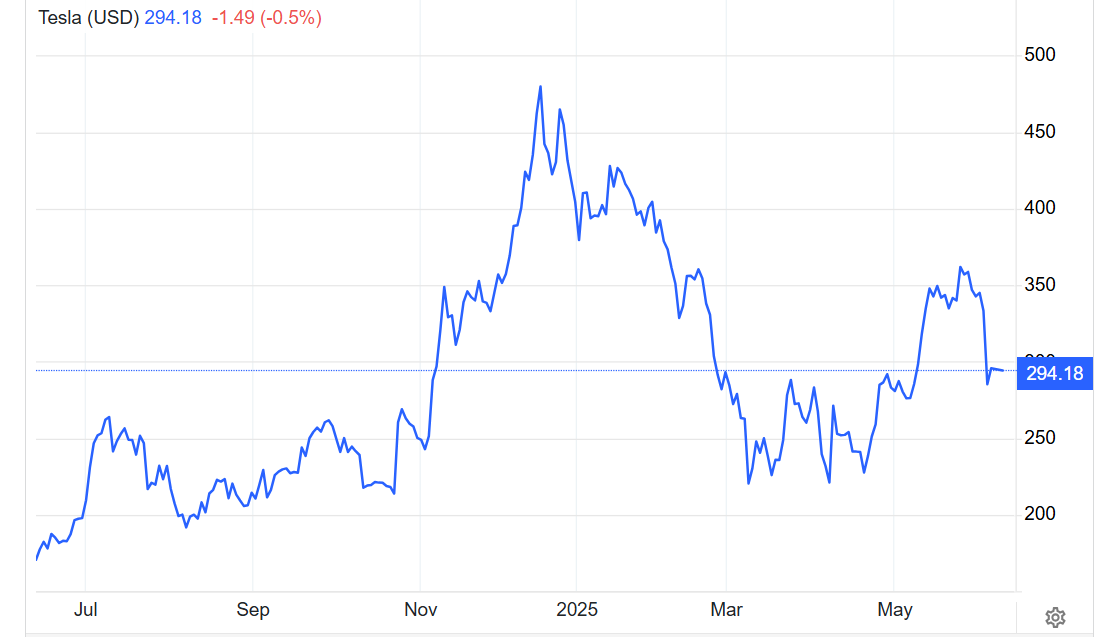
Core Viewpoint - Morgan Stanley maintains a bullish outlook on Tesla, reiterating an "Overweight" rating and a target price of $410, despite recent volatility due to public disputes involving CEO Elon Musk and former President Donald Trump [1][5]. Group 1: Market Performance - Tesla's stock experienced a significant decline of nearly 15% last week, with a record single-day loss exceeding 14% on Thursday, impacting major indices like the S&P 500 and Nasdaq [2]. - As of 2025, Tesla's stock has dropped over 25% year-to-date [2]. Group 2: Long-term Outlook - Morgan Stanley emphasizes that the recent political tensions and the potential removal of electric vehicle tax credits will not significantly affect Tesla's long-term fundamentals [5]. - The firm believes that Tesla's leadership in AI, autonomous driving, and robotics positions it favorably for future growth, despite short-term market fluctuations [6][8]. Group 3: Key Growth Drivers - The core growth drivers identified by Morgan Stanley include Full Self-Driving (FSD) technology, the Robotaxi network, and the Optimus AI humanoid robot, with the potential for the robotics market to surpass the global automotive market [8][11]. - The analysis suggests that the integration of advanced AI models and Tesla's Dojo supercomputer will enhance the capabilities of its products, further solidifying its market position [10][11]. Group 4: Financial Projections - Morgan Stanley's bull case estimates a total valuation of $800 per share for Tesla, driven by various segments including automotive, energy, and mobility services [9]. - The base case valuation stands at $410, while the bear case estimates a value of $200, reflecting the potential volatility in Tesla's stock price based on market conditions [9].
大摩深度解码特斯拉(TSLA.US)股价冲800美元的催化剂:AI与中美自动驾驶博弈
智通财经网· 2025-05-21 10:21
Group 1: Core Insights - Morgan Stanley reaffirms a bullish outlook on Tesla, setting a base target price of $410 and a bullish scenario target of $800, indicating strong potential for stock price appreciation within the next 12 months [1][8] - The analysis highlights Tesla's position as a key beneficiary in the AI era and the U.S.-China autonomous driving technology competition, driven by the widespread adoption of its Full Self-Driving (FSD) system and the development of a Robotaxi network [1][6] Group 2: Valuation and Business Segments - Morgan Stanley suggests that Tesla's high market valuation cannot be solely justified by traditional automotive profits, as investors currently value its automotive business at $50-100 per share, similar to how Amazon and Apple were undervalued in their early days [2][8] - The analysis breaks down Tesla's potential revenue streams, estimating a total valuation of $800 in a bullish case, with significant contributions from Tesla Auto, Tesla Energy, Mobility services, and Network Services [3] Group 3: AI and Robotics Potential - Tesla is positioned to benefit significantly from advancements in AI, particularly through its Dojo supercomputer and Optimus humanoid robot, which are expected to integrate with its FSD technology [5][10] - The humanoid robot market is projected to be larger than the current global automotive market, with estimates suggesting a potential market size of $1 trillion by 2050 [10][19] Group 4: Competitive Landscape - The ongoing U.S.-China competition in autonomous driving is seen as a major catalyst for Tesla's valuation and growth, with Tesla's FSD system expected to penetrate the market through subscription models [6][22] - Traditional Western automakers are increasingly looking to collaborate with Chinese EV manufacturers, which could enhance Tesla's position in the market by leveraging its extensive data and AI capabilities [23]