FSD(全自动驾驶系统)

Search documents
马斯克大度开放FSD授权,为何其他车企不买账?
Feng Huang Wang· 2026-01-21 02:51
Core Viewpoint - Traditional automakers are hesitant to adopt Tesla's Full Self-Driving (FSD) system, which Elon Musk describes as "unreasonable," but this hesitation is rooted in strategic considerations [1][2]. Group 1: Industry Trends - More automakers are opting to develop key modules for autonomous driving systems in-house rather than outsourcing, as automotive technology is seen as a crucial part of brand identity [1]. - Rivian is deepening vertical integration by designing proprietary chips for its autonomous driving computer, indicating a shift towards self-reliance in technology development [1]. - Ford announced plans to develop a "hands-free driving" system by 2028, stating that in-house development could reduce costs by 30% and provide better control over software integration [2]. Group 2: Reasons for In-House Development - Experts indicate that traditional automakers' choice to develop technology internally is driven by the need to meet specific customer demands and the competitive nature of the industry [3]. - The differentiation in consumer needs between brands like Ford and Mercedes necessitates a tailored approach to advanced driver-assistance systems (ADAS) [3]. - The integration of software, sensors, and braking systems is complex and costly when relying on multiple suppliers, making in-house development more cost-effective [3]. Group 3: Technological Advancements - NVIDIA has introduced Alpamayo, a suite of AI inference models and simulation tools that make it easier for automakers to develop autonomous driving technologies, reducing the commercial appeal of Tesla's FSD licensing [5][6]. - Mercedes has become the first major customer of NVIDIA's Alpamayo, planning to launch an advanced driver-assistance system by the end of the year that meets Tesla's FSD standards [6]. - The Alpamayo platform aims to democratize the development of autonomous driving systems by lowering training costs and time, although automakers still need proprietary data and talent for implementation [6].


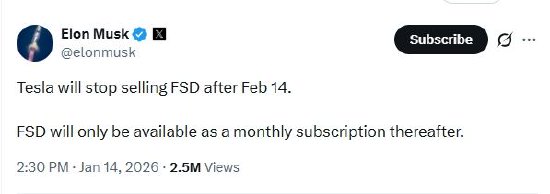
马斯克:特斯拉将于2月14日后停止销售FSD
Xin Lang Cai Jing· 2026-01-14 07:37
特斯拉CEO埃隆·马斯克发文宣布:"特斯拉将于2月14日后停止销售FSD(全自动驾驶系统)。此后, FSD将仅提供月度订阅服务。" 特斯拉CEO埃隆·马斯克发文宣布:"特斯拉将于2月14日后停止销售FSD(全自动驾驶系统)。此后, FSD将仅提供月度订阅服务。" 责任编辑:陈钰嘉 责任编辑:陈钰嘉 ...
特斯拉中国销量暴跌63%,马斯克遭遇滑铁卢
Tai Mei Ti A P P· 2025-11-18 03:19
Core Insights - Tesla's sales in China plummeted by 63.6% in October, marking a significant decline in its market position and raising concerns about its product competitiveness and strategic direction [1][2][3] Sales Performance - In October 2025, Tesla's retail sales in China were 26,006 units, a drastic drop from 71,525 units in September, and a decline of 43.9% compared to the same month in 2024 and 34.2% from 2023, setting a three-year low [2] - Tesla's market share in China's new energy market fell from 5.5% to 2%, dropping from 7th to 27th place [2] - The Model Y and Model 3, once key sales drivers, saw sales drop to 19,488 units (down 62%) and 6,518 units (down 68%) respectively [2] Global Market Trends - Tesla's sales decline is not limited to China; it is experiencing a systemic collapse globally, with a 36.3% drop in overall registrations in Europe despite a 36% increase in total electric vehicle sales [2][3] - In Sweden, Tesla's registrations fell by 88.7%, while sales in the UK, Germany, Norway, and Italy also halved [2][3] Competitive Landscape - The primary reason for Tesla's market share loss in China is the aggressive competition from local brands like BYD, Xiaomi, and Li Auto, which are rapidly innovating and offering superior features [4][5][6] - In Europe, local brands and Chinese competitors are gaining market share due to better product innovation and value for money, while Tesla's aggressive pricing strategy has negatively impacted its used car values [8] Strategic Response - In response to declining sales, Tesla has launched a revamped Model 3 in Europe and specific variants of the Model Y in China [10] - The company is also undergoing internal management changes, with key project leaders departing, indicating potential organizational challenges [11] - Tesla is accelerating the development of new low-cost models to regain entry-level market share and combat local competitors [11] Future Outlook - Elon Musk is focusing on the rollout of the Full Self-Driving (FSD) system in China, which could serve as a technological differentiator if regulatory approval is achieved [11][12] - Musk's broader strategy includes shifting the company's focus from traditional automotive sales to AI and robotics, positioning Tesla as a technology company rather than just an automaker [13]
特斯拉:一场被 “完美定价” 的翻身仗
美股研究社· 2025-09-28 11:28
Core Viewpoint - The discussion around Tesla's valuation is intense, with concerns about stagnating electric vehicle sales and the potential loss of regulatory credit income, while some investors believe Tesla will lead in robotics and AI [1] Group 1: Electric Vehicle Business - Tesla's electric vehicle sales are projected to stagnate in 2024, with a potential double-digit decline in Q2 2025 [1] - In 2024, Tesla's automotive revenue decreased by 6% from $82.42 billion to $77.07 billion, with a more severe drop of 16% in Q2 2025 [6] - Tesla's market share has fallen from a peak of 80% to 38% in the U.S. by August 2024, indicating increased competition [7] Group 2: Regulatory Credits - Approximately 40% of Tesla's net income in 2024 came from regulatory credits, which is expected to decline significantly by 2027 [9] - Regulatory credit income was over $2.7 billion in 2024 but dropped by more than 50% to $438 million in Q2 2025 [9][10] - Analysts predict a 21% decline in regulatory credit income for the current year, with projections of $1.5 billion in 2025 and potentially zero by 2027 [10][11] Group 3: Robotics and AI - Tesla's humanoid robot, Optimus, is projected to be priced around $25,000, but the demand for 100 million units seems unrealistic [4] - Elon Musk claims that Optimus could contribute 80% of Tesla's revenue, but achieving this goal appears uncertain [4][5] - The potential market for autonomous ride-hailing is estimated to reach $43.8 billion by 2030, with Tesla's share yielding only $2 billion in net income, which is insignificant compared to its $1.3 trillion market cap [1] Group 4: Competitive Landscape - Tesla's Full Self-Driving (FSD) system is currently at Level 2, requiring human oversight, and has the highest accident rate among all brands [3] - Competitors like Waymo utilize advanced technologies such as LiDAR, which may give them an edge over Tesla's camera-only approach [3] - Tesla's automotive gross margin has shrunk from over 25% in 2022 to 16.7% in the first half of 2025, indicating pricing pressures from competitors [8] Group 5: Energy Business - Tesla's energy business has shown significant growth, with revenue increasing from $3.9 billion in 2022 to over $10 billion in 2024, and a gross margin of 26% [15] - The energy division's value is estimated at $88 billion, contributing positively to Tesla's overall valuation [16][17] Group 6: Service Business - The service business generated $10.53 billion in revenue in 2024, with a low gross margin of 6% but a growth rate of 13% [18] - Analysts estimate the service business's value at approximately $10.72 billion, reflecting its rapid growth despite lower profitability [19] Group 7: Overall Valuation - The combined value of Tesla's automotive, energy, and service businesses is estimated at around $192 billion, with a valuation range of $160 billion to $220 billion reflecting uncertainties in future growth [20][21] - Tesla's current market capitalization exceeds the estimated value of its existing businesses by more than six times, indicating a speculative investment environment [22]
特斯拉(TSLA.US)再获多头力挺!Baird予“增持”评级,定义为“实体AI”领导者
智通财经网· 2025-09-19 12:36
关键在于,卡洛及其团队提出,投资界正越来越普遍地将特斯拉视为"实体人工智能"(physical AI)领域 的领导者。他们认为,特斯拉未来的核心催化剂包括:下一代Optimus人形机器人的发布、自动驾驶出 租车(robotaxi)在美国市场的扩张、更亲民价格车型的推出,以及即将就埃隆·马斯克(Elon Musk)薪酬方 案举行的股东投票。 本周,Wedbush Securities重申对特斯拉(TSLA.US)的"跑赢大盘"(Outperform)评级,其核心观点在于投资 者正逐步看透公司短期面临的需求问题,着眼于长期价值。 智通财经APP获悉,周五盘前交易中,特斯拉(TSLA.US)股价走高。此前,Baird将这家电动汽车制造商 的评级从"中性"上调至"增持"。该机构认为,尽管特斯拉短期内基本面或有波动,但市场情绪已呈现积 极倾向。 分析师本·卡洛(Ben Kallo)强调:"过去几个季度,特斯拉业绩表现欠佳,股价对此反应相对平淡;同时, 投资者对公司长期规划的关注度持续上升——这两点让我们认为,市场对特斯拉的关注重心正日益转向 其未来发展潜力。" 摩根士丹利分析师也于近日发布研报,分享了其使用特斯拉(TS ...
大摩分析师亲测特斯拉(TSLA.US)FSD后盛赞:彻底改变长途出行体验 未来或成标配功能
Zhi Tong Cai Jing· 2025-09-16 08:53
Group 1 - Morgan Stanley analysts shared their experience using Tesla's FSD on a 1400 km journey, noting that over 99% of the trip was completed autonomously by the Model Y, highlighting a significant shift in travel experience [1] - The analyst emphasized the safety and confidence of FSD on highways, with no recorded errors or dangerous situations during the nearly 12-hour drive [1] - The convenience of Tesla's Supercharger network was praised, with charging stations located near toll roads and highways, providing easy access to amenities and rest areas [1] Group 2 - The analyst rated Tesla's stock as "Overweight" with a target price of $410, which includes components from core automotive business, network services, mobility services, energy business, and third-party supplier revenue [2] - The breakdown of the target price includes $76 from core automotive, $159 from network services assuming a 65% penetration rate by 2040, $90 from mobility services, $68 from energy business, and $17 from third-party supplier revenue [2]
为何各大车企都要扎堆做机器人?
机器人大讲堂· 2025-09-01 13:37
Core Viewpoint - The automotive industry is undergoing a significant transformation from traditional manufacturing to embodied intelligence driven by AI technology, with humanoid robots becoming a key direction for automakers to break business boundaries and achieve valuation restructuring [1][5]. Group 1: Industry Transformation - The automotive sector is evolving into a core application of AI, transitioning from traditional manufacturing to a fusion of "smart vehicles + robots" [1]. - Historical technological revolutions have consistently disrupted existing competitive landscapes, leading to valuation restructuring in cyclical industries, as seen in the rapid increase of new energy vehicle penetration from below 10% to 20% between 2019 and 2021 [1]. Group 2: Cross-Industry Synergy - The core components of automobiles and humanoid robots share high commonality in design logic, production processes, and cost control systems, facilitating the transition from automotive parts to robot components [6]. - Leading automotive parts companies are entering the core component field of robotics, leveraging their existing manufacturing capabilities for industry upgrades [6]. Group 3: Advantages of Automotive Companies - Automotive manufacturers have natural advantages in developing robot bodies, as they can deploy robots in their own factories for real-world performance validation and technology iteration [8]. - The extensive data and algorithm models accumulated from smart vehicle operations can support the perception, decision-making, and execution capabilities of robots [8]. Group 4: Market Developments - Domestic automakers are actively establishing robotics divisions and partnerships to advance their robotics business, with companies like BYD and XPeng making significant strides in humanoid robot development [10][11]. - The long-term demand for both automobiles and humanoid robots is projected to be in the millions, with deep commonalities in supply chain management and production processes [13]. Group 5: Industry Growth and Innovation - The humanoid robot industry is transitioning from "cognitive formation + product iteration" to "mass production + cost reduction + performance upgrades," with multiple stakeholders accelerating their layouts [15]. - Major technology companies are becoming key drivers of the robotics industry, leveraging large model algorithms and computational platforms to enhance robot capabilities [18]. Group 6: Policy and Capital Support - Government policies are increasingly supportive of the robotics industry, with initiatives aimed at achieving core technological breakthroughs and fostering globally influential enterprises by 2025 [21]. - The financing landscape for humanoid robotics is active, with leading companies receiving substantial funding to enhance their production capabilities [23]. Group 7: Future Outlook - The transformation of the automotive industry towards embodied intelligence and the development of humanoid robots is an irreversible trend, with ongoing technological iterations and policy support expected to drive value reconstruction and new growth cycles in the industry [23].

硅谷观察:马斯克画了九年的大饼,特斯拉无人车终于上路载客了
Xin Lang Ke Ji· 2025-06-22 23:09
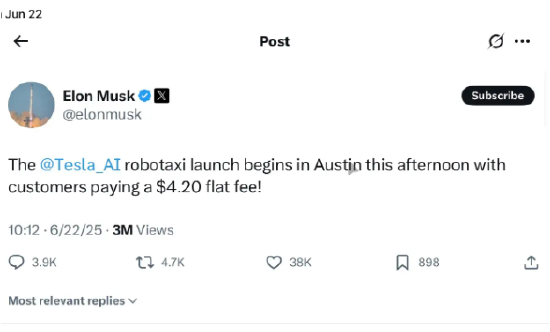
Core Viewpoint - Tesla has officially launched its Robotaxi service in Austin, Texas, marking a significant milestone after nearly a decade of promises from CEO Elon Musk, with rides priced at $4.2 each [1][14]. Group 1: Launch Details - The Robotaxi service was announced by Musk on June 22, 2023, with initial operations featuring only 10 vehicles, emphasizing a cautious approach to deployment [1][15]. - The vehicles used for the service are standard Model Y cars equipped with Tesla's Full Self-Driving (FSD) technology, rather than the newly designed Cybercab [1][17]. - The service is currently limited to a small group of invited Tesla users, with a safety operator present in the front seat during rides [1][17]. Group 2: Historical Context - Musk has been promoting the concept of Tesla vehicles as part of a shared fleet since 2016, with earlier projections suggesting significant income potential for vehicle owners [5][7]. - Despite the long-standing vision, the commercial rollout of Robotaxi has faced delays due to both technological and regulatory challenges [7][9]. Group 3: Financial Implications - Tesla's electric vehicle business has seen a decline in sales and revenue, prompting a strategic shift towards AI-driven services like Robotaxi and robotics for future valuation [14]. - In Q1 2023, Tesla reported a 13% drop in delivery volume, a 20% decrease in electric vehicle revenue, and a 71% decline in net profit, highlighting the urgency for new revenue streams [14]. Group 4: Safety and Regulatory Considerations - The FSD technology has faced scrutiny, with ongoing investigations into its safety, particularly in low-visibility conditions [28][31]. - The National Highway Traffic Safety Administration (NHTSA) has raised concerns about Tesla's ability to operate safely in adverse weather, which has led to calls for a pause in the Robotaxi rollout until new regulations are in place [31][32]. Group 5: Competitive Landscape - The autonomous taxi sector is highly competitive, with companies like Waymo and Cruise having faced significant challenges, including accidents that have impacted their operations [21][23]. - Waymo has successfully operated a fleet of over 1,500 autonomous vehicles, while Cruise has exited the market following a serious incident [21][23].