IRON人形机器人

Search documents
游资“投降”——A股一周走势研判及事件提醒
Datayes· 2026-03-22 14:13
Group 1 - The core viewpoint of the article highlights the significant shift in trading strategies, with retail investors, particularly short-term traders, withdrawing from the market in favor of quantitative trading strategies, which are becoming dominant in the A-share market [1][5] - Retail trading seats have seen a decline in transaction volume, reaching a three-year low, indicating a potential shift in market dynamics as notable traders exit or pause their operations [1][5] - Quantitative private equity funds have expanded significantly, surpassing traditional subjective long-only funds for the first time, indicating a shift in market influence [5] Group 2 - The market's recent decline is attributed to absolute return-oriented funds reducing their positions, rather than institutional reallocation, with certain sectors experiencing mismatched performance [7] - Investors are advised to remain patient and calm amid market fluctuations, as the period from April to May is expected to be crucial for decision-making [7] - Certain sectors, such as energy storage and domestic AIDC chains, are recommended for investment due to their potential resilience against geopolitical tensions and high oil prices [8] Group 3 - In the Hong Kong market, the short-selling volume has reached historical highs, similar to the bear market of 2021-2022, indicating limited upward potential [11] - However, high short-selling does not necessarily predict market declines; a market recovery could trigger a short squeeze, enhancing rebound strength [11] Group 4 - The article discusses the geopolitical tensions in the Middle East, with both the U.S. and Iran signaling a willingness to negotiate, which could impact market sentiment and investment strategies [12][15] - The U.S. seeks to include specific conditions in any agreement, while Iran has outlined six demands that must be met for negotiations to proceed [15] Group 5 - The article outlines various sectors that are expected to perform well, including renewable energy, particularly in wind and solar, as well as energy storage technologies, which are anticipated to benefit from ongoing geopolitical tensions and market demands [23][24] - The semiconductor and AI sectors are also highlighted, with significant investments and developments expected in the coming years, particularly in chip manufacturing and AI infrastructure [17][19][20]



七巨头齐挫,美股连跌四周
财联社· 2026-03-21 02:14
Core Viewpoint - The article discusses the impact of geopolitical tensions in the Middle East on the U.S. stock market, highlighting significant declines in major indices and concerns over rising oil prices due to military actions and potential U.S. troop deployments [1][4][5]. Market Performance - On March 20, U.S. stock indices opened lower and closed down, with the S&P 500 falling by 1.51% to 6506.48 points, the Nasdaq Composite down 2.01% to 21647.61 points, and the Dow Jones Industrial Average down 0.96% to 45577.47 points, marking the lowest closing prices since October of the previous year [1][2]. - For the week, the Dow fell 2.11%, the S&P 500 dropped 1.9%, and the Nasdaq declined 2.07%, with all three indices experiencing four consecutive weeks of decline [2]. Geopolitical Impact - The Dow and Nasdaq indices entered a "correction zone," being down 10% from their historical highs, influenced by reports of the U.S. military increasing its presence in the Middle East [4]. - Brent crude oil futures rose by 3.26% to $112.19 per barrel due to concerns over oil field operations in Iraq being affected by "force majeure" measures [4]. Analyst Commentary - Baird investment strategist Ross Mayfield indicated that if the conflict escalates to ground troop deployments, there could be several weeks of rising oil and gas prices, suggesting that the market has not yet fully reflected the potential for further declines [5]. - Art Hogan, chief market strategist at B. Riley, noted that a 10% correction in any index is not uncommon in uncertain environments, with the S&P 500 showing a smaller decline due to its broader and more diversified composition [7]. Stock Performance - Major tech stocks, referred to as the "Seven Giants," all experienced declines: Nvidia down 3.28%, Apple down 0.39%, Google down 2.27%, Microsoft down 1.84%, Amazon down 1.63%, Meta down 2.15%, and Tesla down 3.24% [7][8]. - The Philadelphia Semiconductor Index fell by 2.45%, with only three of its 30 components gaining, while several storage and optical communication stocks saw significant declines [9][10]. Company News - Amazon is reportedly planning to launch a new smartphone, marking its return to the market after over a decade, aimed at integrating with its Alexa voice assistant [13]. - Eightco announced an additional $40 million investment in OpenAI, bringing its total investment to $90 million, which now constitutes about 30% of Eightco's total holdings [14]. - Xiaopeng Motors' CEO announced plans for mass production of the new IRON humanoid robot by the end of 2026, with a monthly production target of over a thousand units [15]. - Tencent has disbanded its AILab, reallocating personnel to other departments, indicating a strategic shift in its AI research focus [16].

【太平洋科技-每日观点&资讯】(2026-03-17)
远峰电子· 2026-03-16 12:02
Market Performance - The ChiNext Index increased by 1.41%, while the Shanghai Composite Index decreased by 0.26% [1] - TMT sectors led the gains, with SW Printed Circuit Boards up by 3.38% and SW Digital Chip Design up by 3.26% [1] - TMT sectors also saw declines, with SW Communication Cables down by 3.46% and SW Panels down by 1.66% [1] Domestic News - Hon Hai Precision stated that due to the continuous explosion of global AI computing demand, AI cabinet shipments are expected to see exponential growth by 2026 [2] - Zhiyu announced the release of the world's first general-purpose large model GLM-5-Turbo optimized for lobster scenarios, with a 20% increase in API pricing [2] - SEMI reported that Kaiwei intends to acquire control of Jingyi Semiconductor, which focuses on high-end power devices and integrated circuits [2] - World Advanced announced a price increase for wafer foundry services starting April 2026, driven by rising costs in semiconductor equipment, materials, and labor [2] Overseas News - Micron Technology completed the acquisition of Powerchip's facility in Taiwan, which will enhance its advanced DRAM supply capabilities to meet AI-driven demand [3] - IDC forecasts that the global AI glasses market in China will reach 22.67 million units by 2026, with a year-on-year growth of 56.3% [3] - Russia has integrated a new photolithography system into its national industrial information system for semiconductor manufacturing [3] - Amazon Web Services plans to deploy processors designed by Cerebras in its data centers to support AI model inference capabilities [3] AI News - Wankang Technology launched the AI comic creation platform "Wankang Drama Factory," integrating various generative models for full-chain AI production [4] - Zhiyu released the GLM-5-Turbo model optimized for OpenClaw Agent scenarios, achieving significant enhancements in core capabilities [4] - JVS Claw introduced a mobile app allowing users to remotely control a dedicated cloud computer for complex tasks [4] - Stanford and Princeton released LabClaw, an open-source research skill library for biomedical applications [4] Industry Tracking - The successful launch of multiple satellites by the Kuaizhou-11 solid rocket marks a significant achievement in the deep space economy [5] - A Chinese team released the first multimodal brain decoding model, NOBEL, which unifies heterogeneous signals in its semantic embedding space [5] - XPeng launched its second-generation end-to-end autonomous driving system and initiated nationwide testing [5] - A new breakthrough in high-end chemical new materials was achieved with the successful production of a 30-ton annual capacity line for cyclic olefin polymer in Jiangsu [5] High-Frequency Data Updates - The international DRAM spot prices showed slight fluctuations, with DDR5 16G maintaining a stable price of $39.333 [6] - Semiconductor material prices were updated, with 4N zinc oxide powder priced at 1,675 yuan per kilogram [6]

小鹏人形机器人年底启动规模量产,机器人ETF(562500)盘中翻红
Mei Ri Jing Ji Xin Wen· 2026-02-27 15:08
Group 1 - The core viewpoint of the news highlights the positive performance of the robotics sector, particularly the rise of the Zhongzheng Robotics Index and the significant gains of key component stocks such as Yuntian Lifa and Dazhu Laser [1] - The latest data shows that the Robotics ETF (562500) has experienced a net outflow of 358 million yuan, but over the past four trading days, it has attracted a total of 372 million yuan [2] - The Robotics ETF has seen a notable increase in scale, with a growth of 1.181 billion yuan over the past month, ranking first among comparable funds [2] Group 2 - The CEO of Xiaopeng, He Xiaopeng, announced that the company's humanoid robot, IRON, is set to begin mass production by the end of this year, aiming to be the first high-end humanoid robot in mass production globally [1] - The industry is transitioning from technology validation to large-scale production, with expectations for sustainable development opportunities as leading manufacturers finalize products and expand application scenarios [2] - The Robotics ETF is the only robotics-themed ETF in the market with a scale exceeding 20 billion yuan, covering various segments such as humanoid robots, industrial robots, and service robots, providing investors with a comprehensive investment option [2]

特斯拉、小鹏、奇瑞……车企扎堆跨界“造人”
Mei Ri Shang Bao· 2026-02-25 22:23
Core Viewpoint - The performance of humanoid robots during the Spring Festival Gala has shifted public perception, indicating that these robots are moving beyond mere demonstrations to potential real-world applications, with 2026 identified as a critical year for mass production [1][2][6] Group 1: Industry Developments - Several leading automotive companies are entering the humanoid robot sector, with 2026 set as a key milestone for mass production [2][6] - Xiaopeng Motors plans to start mass production of its IRON humanoid robot by the end of this year, aiming to be the first to achieve large-scale production of advanced humanoid robots [2] - Tesla announced that its third-generation Optimus robot will be released in the first quarter of this year, with plans for mass production by the end of the year [2] - BYD and Changan are also actively developing humanoid robots, with BYD focusing on production for its own factories and Changan planning to release a prototype by 2027 [3] Group 2: Application and Pricing - Current humanoid robots are primarily being developed for industrial applications, with plans to expand into consumer markets later [4] - Initial applications include factory work, automotive showrooms, and traffic assistance, with future potential for home care and cleaning [4] - The pricing of humanoid robots is expected to decrease significantly, with BYD targeting a price below 100,000 yuan and Tesla estimating around 140,000 yuan after scaling production [4] - The commonality of core components between humanoid robots and smart vehicles is over 60%, allowing for cost reductions and shorter development cycles [4]



2026年,人形机器人、飞行汽车与Robotaxi的“量产分水岭”
Hua Xia Shi Bao· 2026-02-25 15:31
Core Insights - Xiaopeng Motors has outlined its strategic plan for 2026, emphasizing a shift from "capable" to "mass production" with a focus on "physical AI" [2][3] - The company aims to launch three super-extended range models in Q1 and introduce at least four new vehicles to overseas markets throughout the year, while also increasing its global workforce by 8,000 [2][4] Strategic Goals - The year 2026 is defined as a pivotal year for Xiaopeng, with a clear timeline for scaling up production based on accumulated technological reserves [2][3] - Xiaopeng plans to achieve mass production and delivery of its split-type flying car and the next-generation IRON humanoid robot within the year, with the latter targeting commercial applications in shopping malls and stores [3][5] Market Expansion - Xiaopeng's overseas sales target for 2026 is set at 90,000 units, doubling last year's figure, with a focus on key markets such as Israel, Germany, Norway, Thailand, and France [3][4] - The company aims for overseas sales to contribute over 70% of its profits by 2030, with a long-term goal of reaching 1 million units sold internationally [3][4] Workforce Development - To support its ambitious goals, Xiaopeng plans to hire 8,000 new employees, with 5,000 positions reserved for campus recruitment, highlighting the importance of talent acquisition in achieving its strategic objectives [4][5] - The company emphasizes a cultural shift towards AI literacy among all employees, integrating technology and decision-making processes [4][5] Industry Context - The competitive landscape for "physical AI" is intensifying, with other players like Yushu Technology and Volant Aerotech also making strides in humanoid robots and flying cars, respectively [5][6] - The timeline for commercializing eVTOL and Robotaxi services is critical, with 2026-2027 seen as a decisive period for these technologies [6][7]
人形机器人狂奔2026:谁为盛宴买单?
Hua Er Jie Jian Wen· 2026-02-18 02:20
Core Insights - The 2026 Spring Festival Gala showcased four domestic robot companies, marking a significant moment for the humanoid robot industry in China, highlighting their technological advancements and market positioning [2][3][5] - The event served as a platform for these companies to transition from technical demonstrations to commercial realities, emphasizing the need for robots to be included in major clients' capital expenditure lists [3][5][31] Group 1: Company Performances - Yushu Technology presented the G1 and H2 humanoid robots, achieving multiple global firsts in their martial arts performance, including a height of over 3 meters in aerial flips and a speed of 4m/s in group coordination [6][11] - Galaxy General's robot showcased its interactive capabilities, performing tasks like walnut cracking and clothing folding, emphasizing its potential for commercial applications [8][9] - Songyan Power's bionic robot demonstrated near-human facial expressions and fluid movements, aiming to push humanoid robots into consumer markets [10][24] - Magic Atom highlighted its dual role in performance and practical tasks, showcasing multiple robot types in various scenarios, validating its engineering reliability [10][11] Group 2: Market Dynamics - The Spring Festival Gala significantly boosted market interest, with JD.com reporting a 300% increase in robot search volume and a 150% increase in orders within two hours of the event [11] - Despite the excitement, the industry faces challenges in converting high-profile performances into actual sales and market penetration, with many companies struggling to balance marketing costs and R&D investments [11][12][16] - The humanoid robot industry is in a critical phase of commercialization, with significant orders and investments indicating a shift towards practical applications [13][14] Group 3: Commercialization Paths - The industry is exploring multiple commercialization paths, including manufacturing, service sectors, research applications, and direct consumer sales [17][20][24] - Manufacturing is seen as the most viable path, with robots being integrated into controlled environments like factories for tasks such as assembly and quality inspection [18][19] - Service applications in public spaces are gaining traction, with companies developing flexible business models to promote usage in various sectors [19][20] Group 4: Future Outlook - The humanoid robot market is projected to grow significantly, with estimates suggesting sales could reach 28,000 units by 2026, reflecting a 133% year-on-year increase [29][30] - The industry is expected to face rigorous scrutiny regarding delivery capabilities and product stability as it transitions from hype to practical applications [16][31] - The long-term success of humanoid robots will depend on their integration into corporate asset management and their ability to demonstrate tangible ROI [25][26][31]
机械设备行业动态跟踪:装备新科技挖掘-顺应人形机器人拟人化趋势,关注AMR传感器应用拓展
Orient Securities· 2026-02-06 10:24
Investment Rating - The report maintains a "Positive" investment rating for the mechanical equipment industry, indicating an expectation of returns exceeding the market benchmark by more than 5% [7]. Core Insights - The trend towards more human-like robots is expected to enhance the overall freedom of movement, leading to an expansion in the encoder market. Related component manufacturers are likely to benefit, including companies such as Huichuan Technology, Hechuan Technology, and Xinjie Electric [4]. - Tesla's V3 version of the Optimus robot is anticipated to achieve breakthroughs in joint numbers and hand freedom, contributing to the goal of increased human-like characteristics in robots [10]. - Magnetic encoders are expected to benefit more than optical encoders from the increase in robot freedom of movement, as they are more cost-effective for mass production [10]. - AMR sensors are highlighted for their advantages in high-precision and compact designs, making them suitable for applications in dexterous robotic hands, which could lead to revenue growth for domestic manufacturers [10]. Summary by Sections Industry Overview - The report focuses on the mechanical equipment industry, particularly the advancements in humanoid robots and the application of AMR sensors [6]. Market Dynamics - The demand for agricultural machinery is expected to face pressure in 2025, with a potential improvement in 2026 [9]. - Tesla plans to increase investment in its robot production line, enhancing the certainty of mass production for the Optimus robot [9]. Technology Insights - AMR sensors are noted for their higher sensitivity and suitability for compact designs compared to Hall sensors, which are currently used in some robotic applications [11].
装备新科技挖掘:顺应人形机器人拟人化趋势,关注AMR传感器应用拓展
Orient Securities· 2026-02-06 08:47
Investment Rating - The report maintains a "Positive" investment rating for the mechanical equipment industry, indicating an expected return that is stronger than the market benchmark by over 5% [7]. Core Insights - The trend towards more human-like robots is expected to enhance the degrees of freedom in humanoid robots, leading to an expanded market for encoders. Related component manufacturers are likely to benefit, including companies such as Inovance Technology (300124, not rated), Hechuan Technology (688320, not rated), and Xinjie Electric (603416, not rated) [4]. - Tesla's V3 version of the Optimus robot is anticipated to achieve breakthroughs in joint numbers and hand flexibility, contributing to the goal of increased human-like characteristics in robots [10]. - Magnetic encoders are expected to benefit more than optical encoders from the increase in degrees of freedom in humanoid robots. The demand for encoders is projected to grow as humanoid robots become more advanced [10]. - AMR sensors are highlighted for their advantages in high-precision and compact applications, particularly in dexterous hands, which could lead to increased revenue and market share for domestic manufacturers [10]. Summary by Sections Humanoid Robot Development - The humanoid robot's design is evolving towards greater human-like features, with advancements in joint flexibility and overall design [10]. - Domestic manufacturers are making progress in humanoid design, with examples like Xiaopeng's IRON robot featuring 82 degrees of freedom [10]. Encoder Market Expansion - The report emphasizes the growing demand for encoders as humanoid robots achieve higher degrees of freedom, with magnetic encoders being more cost-effective for mass production [10]. - AMR sensors are noted for their higher sensitivity and suitability for compact designs, making them preferable in high-precision applications [11]. Application of AMR Sensors - AMR sensors are expected to see broader application in the core joint components of robots, which will drive revenue growth for domestic manufacturers [10].



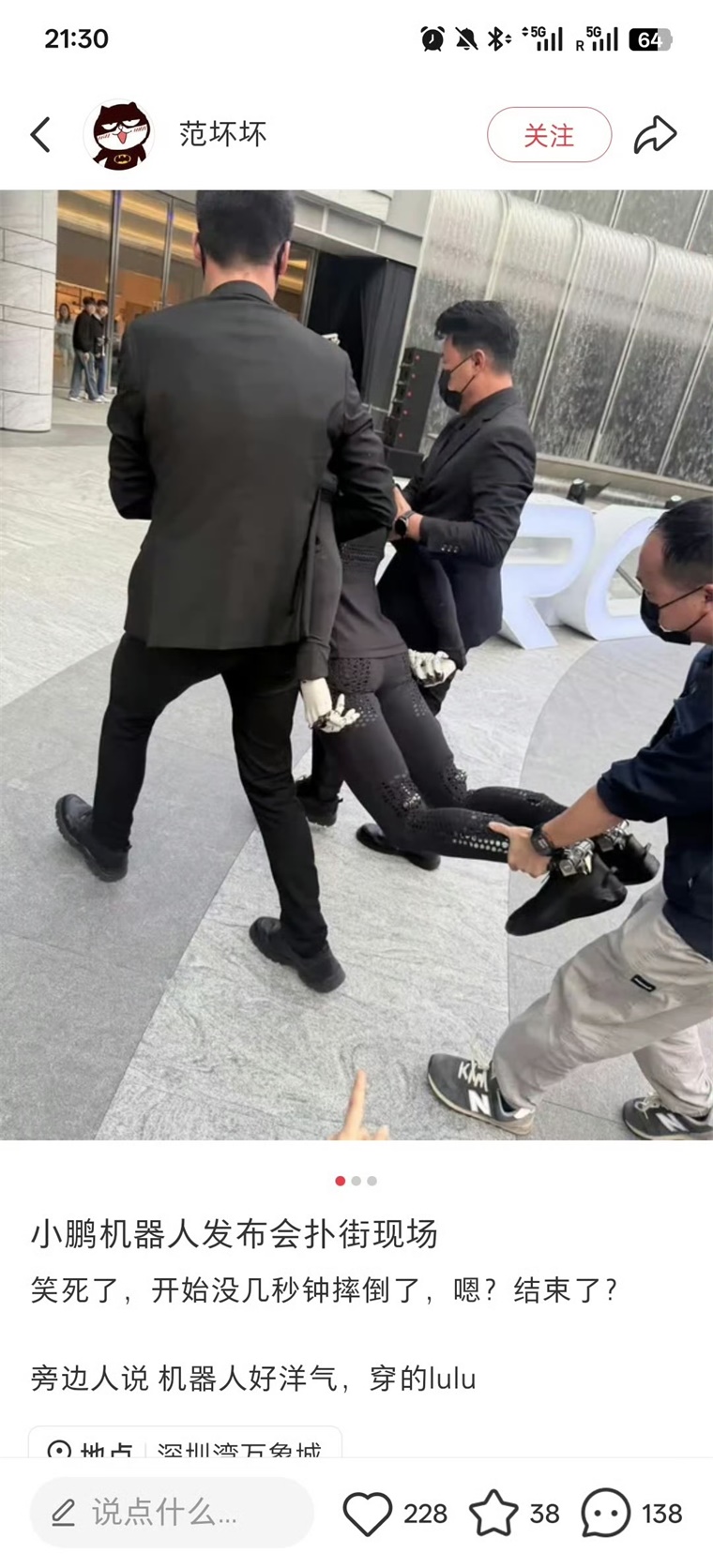
再也没人怀疑是真人扮演!小鹏IRON机器人“首摔”被抬走,何小鹏回应来了【附人形机器人行业市场分析】
Qian Zhan Wang· 2026-02-02 08:53
Core Viewpoint - The incident of the IRON humanoid robot falling during its first public showcase in Shenzhen has sparked significant attention, highlighting both the challenges and advancements in humanoid robotics technology [1][11]. Group 1: Incident Overview - The IRON robot, developed by XPeng Motors, fell once during its walking demonstration at a public event, which drew immediate public interest [1]. - XPeng's Vice President, "Thomas Electric Train" (Yu Tao), provided a quick explanation and noted that the event's host cleverly alleviated the awkwardness by reflecting on the importance of overcoming setbacks in life [1]. - XPeng's Chairman, He Xiaopeng, shared a metaphor on social media, likening the robot's fall to a child's learning to walk, emphasizing resilience and progress [5][7]. Group 2: Product Specifications - IRON is XPeng's first mass-production humanoid robot, set to debut in November 2024, with plans for large-scale production by the end of 2026 [10]. - The robot is designed at a 1:1 human scale, standing 178 cm tall and weighing 70 kg, featuring a bionic structure with 82 degrees of freedom, including 22 in the hands [10]. - It is equipped with three self-developed Turing AI chips, achieving a total computing power of 2250 TOPS, and can run a 30 billion parameter model locally [10]. Group 3: Market Context - The humanoid robot market is experiencing significant growth, with major companies like Yushun and Zhi Yuan achieving annual shipments exceeding 5,000 units, indicating a substantial increase in production capacity [14]. - The market concentration is high, with the top three companies holding a combined market share of 79.63% as of the first half of 2025 [15]. - The Chinese humanoid robot market is projected to reach sales of 122,700 units by 2030, supported by government policies and substantial funding [17].