
GB300机柜

Search documents
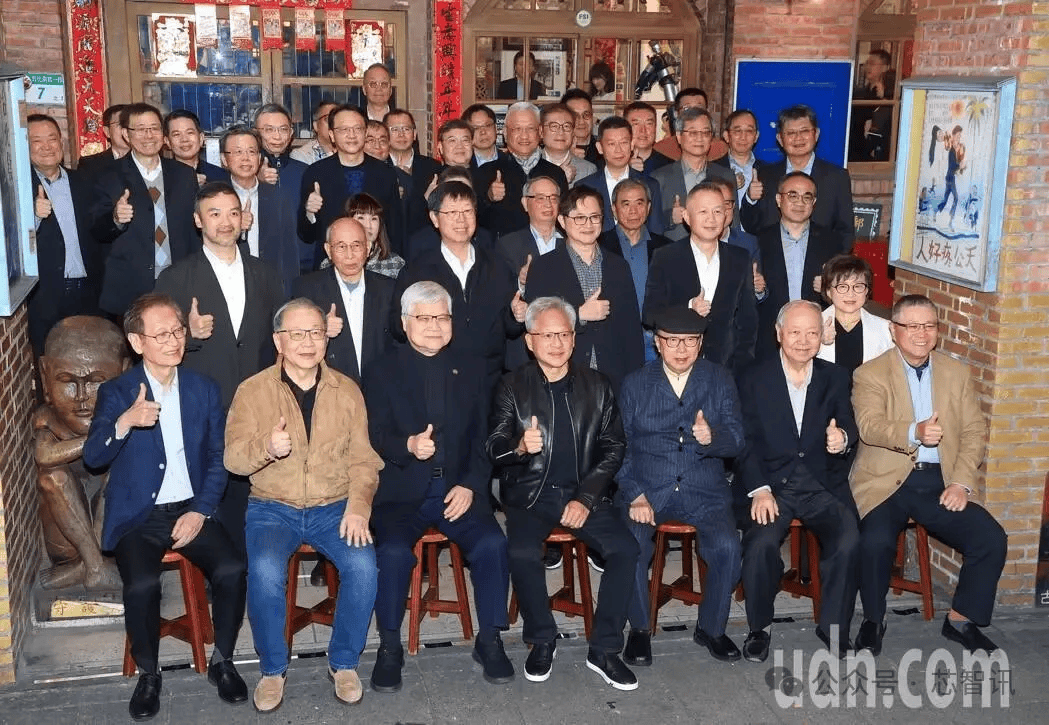
黄仁勋赞台湾供应链独一无二 新面孔首度出席「兆元宴」
Jing Ji Ri Bao· 2026-01-31 23:03
Group 1 - NVIDIA's CEO Jensen Huang hosted a "trillion-dollar banquet" in Taiwan, attended by key supply chain partners and industry leaders, indicating strong collaboration and networking within the semiconductor industry [1][2] - Huang emphasized the challenges ahead in 2025 with the production of the Grace Blackwell semiconductor system, which has faced significant design modifications and supply chain disruptions [2][3] - The GB300 cabinet has entered the initial production phase, while the GB200 product is in smooth mass production, showcasing NVIDIA's advancements in technology [2] Group 2 - Huang noted a significant shift in the AI industry, highlighting the profitability of tokens as AI technology has become more effective, suggesting a positive outlook for AI-driven business models [3][4] - The banquet featured a diverse array of industry leaders, including representatives from major companies like ASUS, MediaTek, and TSMC, reflecting the importance of NVIDIA's partnerships in the tech ecosystem [3][4] - The event underscored NVIDIA's commitment to innovation and collaboration, with companies like Advantech transitioning to edge AI solutions, indicating a broader industry trend towards integrating AI into various sectors [4][5]
黄仁勋台北“夜宴”:汇聚近40位台企高管,还有1位陆企董事长!
Sou Hu Cai Jing· 2026-01-31 14:56
Core Viewpoint - Nvidia's CEO Jensen Huang hosted a dinner in Taipei with key supply chain executives, emphasizing the importance of collaboration and the challenges ahead in AI technology development [1][4][10]. Group 1: Event Details - The dinner included approximately 40 executives from Taiwanese companies, with only one representative from a mainland Chinese firm [1]. - Notable attendees included leaders from Asus, MediaTek, TSMC, Quanta, and Wistron, highlighting the significance of these partnerships [1][3]. Group 2: Nvidia's Future Plans - Huang discussed the upcoming challenges in 2025 with the production of the Grace Blackwell architecture, indicating that it presents more difficulties than previous models [7]. - The GB300 cabinet has entered initial mass production, and the GB200 product is being produced smoothly, while the Vera Rubin platform is expected to simplify future production processes [8][9]. Group 3: AI Industry Insights - Huang noted that AI has become increasingly useful, with large language models now generating revenue, contrasting with previous years when AI was less effective [8]. - He projected that 2026 will be a critical year for the AI industry, with unprecedented demand for high-bandwidth memory (HBM) and LPDDR, leading to significant supply chain pressures [9]. Group 4: Nvidia's Strategic Investments - Nvidia plans to participate in OpenAI's next funding round, potentially marking its largest strategic investment to date, reflecting the company's commitment to AI development [9]. - Huang emphasized that Nvidia's comprehensive AI infrastructure, which includes CPUs, GPUs, and networking chips, cannot be easily replaced by specialized AI chips (ASICs) [9]. Group 5: Importance of Taiwanese Supply Chain - Huang stated that Nvidia's existence is heavily reliant on Taiwan's technological capabilities and engineering culture, particularly praising TSMC's role in advanced manufacturing processes [10]. - He anticipates that TSMC's capacity will grow significantly over the next decade, contributing to a major expansion in global technology infrastructure [10][12].


确认2026年停更新品 华硕“失守”游戏手机
Zhong Guo Jing Ying Bao· 2026-01-08 00:54
Core Viewpoint - ASUS will suspend the launch of new smartphones, including ZenFone and ROG Phone, in 2026 due to regular business adjustments and rising component costs, particularly storage prices [1][4][5]. Group 1: Business Adjustments - ASUS confirmed that it will not release new smartphones in 2026, emphasizing that after-sales service and software updates will remain unchanged [1]. - The decision is attributed to significant increases in upstream component costs, making it difficult for ASUS to sustain its smartphone business [1][4]. - Industry insiders speculate that the rising storage prices are a primary factor behind this decision [1][4]. Group 2: Historical Context - ASUS began its mobile journey in 2003 with the launch of the J100 3G flip phone and gained traction with the ZenFone series in 2014, which was well-received in emerging markets [2]. - The ROG Phone series, launched in 2018, positioned ASUS among the top gaming phone brands, but the company has faced challenges due to market saturation and increased competition [2]. - ASUS's smartphone revenue has significantly declined, dropping from 18% in 2016 to approximately 1% in 2023, leading to a strategic focus on the ZenFone and ROG Phone lines [3]. Group 3: Market Conditions - The global smartphone market is experiencing a downturn, with forecasts for 2026 showing reduced shipment volumes, further pressuring manufacturers [5]. - The rising costs of DRAM have increased the bill of materials (BoM) for smartphones by approximately 25% for low-end, 15% for mid-range, and 10% for high-end devices [4]. - ASUS's smartphone shipments are projected to be only in the tens of thousands in 2025, with a significant portion concentrated in the Asia-Pacific region [5]. Group 4: Financial Performance - Despite the challenges in the smartphone sector, ASUS's overall performance remains strong, driven by AI servers and gaming products, with a revenue of 535.98 billion New Taiwan Dollars in the first three quarters of 2025, a 24% year-on-year increase [5]. - However, the rising costs have impacted profitability, with a 9% decline in gross profit year-on-year, leading to a net profit decrease of 16% [5]. Group 5: Future Directions - ASUS is shifting its focus towards AI infrastructure, with plans to enhance its server business, which is approaching 20% of total revenue [6]. - The company is also considering price adjustments for its PC products due to rising storage costs, indicating a broader trend in the industry [7]. - There are rumors about ASUS entering the DRAM manufacturing market to stabilize its supply chain, although the company has denied these claims [7].
比特狂奔,瓦特乏力:AI算力危机与储能的“供血”革命
高工锂电· 2025-10-27 11:52
Core Insights - The article emphasizes that the competition for computing power in the AI era is fundamentally about securing stable and large-scale electricity supply [5][18][19] - It highlights the structural disconnect between the exponential growth of AI computing power and the linear growth of power supply infrastructure, which poses significant challenges for the industry [4][15] Group 1: AI and Power Supply Challenges - AI computing power is experiencing explosive growth, with single-chip power consumption expected to exceed 2 kW and rack power reaching up to 600 kW or more by 2027 [9][10] - The average age of the U.S. power grid exceeds 40 years, leading to slow infrastructure upgrades and challenges in meeting the increasing power demands of AI [3][15] - High volatility in power consumption from AI workloads poses risks to data center stability and the overall power grid [11][12] Group 2: Energy Storage as a Solution - Energy storage is becoming a critical component in the power architecture for AI data centers, transitioning from a backup system to an active component [6][11] - The dual-layer energy storage strategy proposed by NVIDIA includes supercapacitors for rapid response and large lithium batteries for longer energy buffering [12] - The demand for energy storage solutions is expected to rise significantly, with companies like CATL, Huawei, and BYD emerging as key players in the market [21] Group 3: Future Projections and Industry Trends - By 2030, global data center electricity consumption is projected to reach 1500 TWh, with a 160% increase in power demand [14][17] - The article notes that the global AI competition will increasingly focus on breakthroughs in renewable energy, energy storage, and smart grid technologies [19][20] - China's "East Data West Computing" initiative aims to direct computing demands to energy-rich regions, supported by large-scale energy storage facilities [20]

大行评级|花旗:上调英伟达目标价至210美元 上调今明财年每股盈利预测
Ge Long Hui· 2025-08-29 02:27
Core Viewpoint - Citigroup's report indicates that NVIDIA's Q2 sales of $46.5 billion and Q3 sales forecast of $54 billion meet investor expectations, with a notable gross margin guidance of 73.5%, exceeding market expectations by 70 basis points [1] Group 1: Financial Performance - NVIDIA's gross margin guidance of 73.5% aligns with Citigroup's expectations and is higher than market forecasts [1] - The company anticipates maintaining a gross margin of approximately 75% by the end of the year [1] Group 2: Market Outlook - NVIDIA projects that AI infrastructure spending will reach $3 to $4 trillion by the end of 2030, significantly higher than Citigroup and market's 2029 forecast of $2.3 trillion [1] - There is potential for data center sales to increase, particularly as NVIDIA has secured some export licenses for Chinese customers, which could yield an additional $2 to $5 billion per quarter [1] Group 3: Earnings Forecast - Citigroup has raised NVIDIA's earnings per share forecasts for fiscal years 2025 and 2026 by 2% and 10% respectively, reflecting an increase in weekly GB300 cabinet capacity by 10,000 units and improved network equipment compatibility [1] - The target price for NVIDIA has been increased from $190 to $210, maintaining a "buy" rating [1]
研报掘金丨民生证券:维持工业富联“推荐”评级,AI业务带动公司业务高速增长
Ge Long Hui A P P· 2025-08-13 06:40
Core Viewpoint - The report from Minsheng Securities indicates that Industrial Fulian has shown strong operational performance in the first half of the year, driven by its AI business, leading to rapid business growth [1] Financial Performance - In Q2 2025, the company achieved a gross margin of 6.50%, with a quarter-over-quarter decrease of 0.23 percentage points, and a net profit margin of 3.43%, with a quarter-over-quarter increase of 0.16 percentage points [1] Business Growth - Revenue from 800G switches in the first half of the year increased nearly threefold compared to 2024, confirming the product's competitiveness amid the demand for data center bandwidth upgrades [1] - The company is leading in AI sector layout, continuously optimizing its product structure, and further highlighting its advantages in the global supply chain [1] Strategic Alliances - On July 30, 2025, Dongyuan Electric and Hon Hai Technology formed a strategic alliance to provide comprehensive data center construction solutions, including servers, cooling systems, and power infrastructure, to meet the substantial market demand across Taiwan, the United States, Southeast Asia, and the Middle East [1] Product Development - The company is collaborating closely with clients to develop key technologies for the next generation of liquid-cooled cabinets, which is expected to enhance profitability in the GB300 cabinet [1] - With the rapid ramp-up of AI servers and 800G switches, the GB200 is anticipated to bring significant performance growth to the company [1]
