
Gemini 模型

Search documents
云计算进入分水岭:AWS重新加速,Azure掉队,阿里云的窗口期来了
美股研究社· 2026-03-23 12:32
Core Insights - The article emphasizes a shift in the cloud computing narrative from "scale" to "transformation," focusing on the ability to convert AI computing power into sustainable cash flow by Q4 2025 [1][2]. Group 1: Market Dynamics - By Q4 2025, the financial reports of the four major cloud providers will reveal significant differentiation, with some companies generating profits through technological barriers while others are burning cash to maintain ecosystems [2]. - The cloud computing industry is transitioning from an "infrastructure era" to an "intelligent era," indicating a fundamental change in competitive dynamics [2]. Group 2: Performance Analysis - AWS reported a 24% revenue growth, Google Cloud led with a 48% increase, and Azure maintained a 39% growth, but these figures mask deeper structural changes in profitability and capacity allocation [5]. - AWS's cloud revenue, while only 17% of total revenue, contributes over 50% of operating profit, showcasing its control over underlying computing costs through proprietary chips [5]. - Google Cloud's growth is driven by a high adoption rate of AI products, with 70% of customers using AI-related services, indicating a strong demand [6]. Group 3: Capital Expenditure Trends - Capital expenditures for cloud providers are projected to reach unprecedented levels, with AWS expected to spend $200 billion by 2026, Google between $175 billion and $185 billion, and Microsoft reporting $37.5 billion in a single quarter [8][9]. - The competition has shifted to controlling energy and computing power, with AWS planning to double its power capacity by 2027 [9]. Group 4: Strategic Approaches - AWS adopts an "extreme external supply model," focusing on selling AI computing power directly to customers, which ensures strong cash flow but carries risks of asset underutilization [10]. - Microsoft prioritizes internal needs for its AI products, which may limit the growth of its cloud business and raise questions about its profitability [10]. - Google emphasizes a "technology-driven model," focusing on proprietary TPU systems, but may face challenges in monetization speed [10]. Group 5: Alibaba Cloud's Position - Alibaba Cloud is taking a more restrained approach, with a 36% revenue growth and a focus on ROI, avoiding the heavy capital expenditures seen in Western counterparts [12][13]. - The Chinese market presents significant growth opportunities, allowing Alibaba Cloud to focus on emerging demand rather than competing for existing market share [13]. - Alibaba Cloud's shift towards "Model as a Service" (MaaS) indicates a strategic pivot to participate in value distribution rather than just infrastructure leasing [13][14]. Group 6: Future Outlook - The future winners in cloud computing will be those who can efficiently convert AI capabilities into profits, rather than merely possessing the most computing power [15][16]. - The industry may evolve into a dichotomy between "heavy asset computing empires" and "light model + application ecosystems," with the latter potentially offering better risk management and value realization [16].






马斯克真没吹牛!世界模型 Genie 3 一键打造 GTA6 不是梦
Sou Hu Cai Jing· 2026-01-30 09:25
Core Concept - Project Genie is a real-time rendering interactive environment that combines three main technologies: Nano Banana Pro for image control, Gemini model for understanding language commands, and Genie 3 for physical feedback [1] Group 1: Mechanism and Functionality - The mechanism of Project Genie resembles human dreaming, creating a virtual world with strong immersion, allowing users to interact within it [3] - Unlike text-based models like ChatGPT, Genie 3 operates as a "physical world model," learning physical rules through extensive video observation rather than formal physics education [3] - Users can easily experience Project Genie by uploading images and generating interactive scenarios, such as exploring a desert as a cowboy [5] Group 2: Limitations and Development Stage - Currently, Project Genie is in an experimental phase with limitations, such as a maximum playtime of 60 seconds to prevent logical breakdowns in the generated visuals [6] - The Google development team acknowledges that Genie 3 is still early in its development, with issues like inaccurate physical simulations and visual glitches [11] Group 3: Future Potential and Applications - Project Genie aims to address significant challenges in AI development, particularly data scarcity and the need for embodied intelligence [12] - It can serve as an infinite synthetic data generator, allowing robots to accumulate "muscle memory" in simulated environments, which is crucial for real-world applications [13] - Potential applications include therapeutic settings and educational experiences, such as creating controlled environments for desensitization therapy or immersive historical lessons [15]

马斯克向OpenAI微软索赔千亿美元,奥特曼回怼/韩国「自研AI」被抓包用中国模型代码/机器人将再登春晚|Hunt Good 周报
Sou Hu Cai Jing· 2026-01-18 07:04
Group 1 - South Korea's initiative to develop a fully domestic AI model has faced controversy as three out of five finalists were found to have used foreign open-source code, including from China [1][3] - Upstage admitted to using elements from a Chinese open-source model, while other competitors like Naver and SK Telecom also acknowledged similarities with foreign technologies but claimed their core engines were independently developed [3][4] - The competition rules did not explicitly prohibit the use of foreign open-source code, raising questions about the integrity of the initiative [3] Group 2 - OpenAI has reportedly chosen to forgo a partnership with Apple to focus on developing its own AI hardware, which has implications for Apple's recent collaboration with Google [4][7] - The deal between Apple and Google could be worth tens of billions, with estimates suggesting it may add up to $5 billion in value for Google [4] - OpenAI's hardware ambitions may have influenced Apple's decision to partner with Google, as the latter has narrowed the gap with OpenAI in model capabilities [7] Group 3 - Elon Musk is suing OpenAI and Microsoft for damages ranging from $79 billion to $134 billion, claiming that OpenAI has deviated from its non-profit mission [8][10] - Musk's claims are based on an analysis suggesting he is entitled to a significant share of OpenAI's current valuation due to his initial investment of $38 million [8][10] - OpenAI has dismissed Musk's lawsuit as a form of harassment rather than a legitimate economic claim [11] Group 4 - Meta has announced significant layoffs, cutting approximately 1,500 jobs from its Reality Labs division and closing three VR game studios, indicating a shift in focus from the metaverse to AI wearable devices [16][18] - The Reality Labs division has incurred over $70 billion in losses since early 2021, prompting a budget reduction and a pivot towards mobile devices and AI glasses [18] - Meta's collaboration with EssilorLuxottica on Ray-Ban AI smart glasses has exceeded expectations, with plans to double production capacity by the end of the year [18] Group 5 - AI-native startups have seen their annualized revenue double in just seven months, reaching over $30 billion, although OpenAI and Anthropic dominate the market, capturing nearly 85% of the revenue [19][22] - Despite the revenue growth, many AI startups are burning over $20 billion annually, raising concerns about their long-term viability [19][23] - Some successful applications, like Suno and Cognition, have surpassed $1 billion in annualized revenue, but they face increasing competition from model providers like OpenAI and Anthropic [22][23] Group 6 - Neuralink's first human subject reported that the brain chip can be updated wirelessly, marking a significant advancement in brain-computer interface technology [25][26] - The device can evolve through cloud updates, enhancing performance without the need for surgical intervention, and may allow for dual-chip implantation in the future [26] - Approximately 20 patients have undergone the brain-machine surgery, with a significant number waiting for the procedure [26] Group 7 - Zhizhu's GLM-Image model has topped the Hugging Face Trending chart, marking a breakthrough for domestically developed AI models trained entirely on Chinese chips [27] - The model showcases the feasibility of training state-of-the-art models using domestic computing power and has demonstrated superior performance in specific tasks [27] - GLM-Image is now available for public use on various platforms, highlighting advancements in China's AI capabilities [27][28]


Manus 加入 Meta,1 年内公司价值 100 倍增长,他们做对了什么?
Founder Park· 2025-12-30 01:01
Core Insights - Manus has achieved a valuation of $2 billion and is nearing an annual recurring revenue (ARR) of $100 million, showcasing significant growth in a short period [11] - The company has received positive recognition from major tech players like Google and Microsoft, indicating its potential in the AI ecosystem [11][12] - Manus's approach of not relying on proprietary models has been criticized domestically but is viewed positively by international tech giants, highlighting a difference in perception [13][14] Group 1: Company Performance and Recognition - Manus's valuation has increased dramatically, with a reported ARR close to $100 million, reflecting its rapid growth and market acceptance [11] - The company has garnered attention from major tech firms, with Google and Microsoft actively engaging with Manus, indicating its relevance in the AI landscape [11][12] - Despite initial skepticism in the domestic market, Manus has found favor in international circles, particularly in Silicon Valley, where it is seen as a promising player [11][12] Group 2: Strategic Insights and Market Positioning - Manus's lack of a proprietary model has been a point of criticism, yet it has allowed the company to create applications that leverage existing models, thus contributing to the broader AI ecosystem [13][14] - The company’s strategy of focusing on application development rather than competing directly with model creators has positioned it uniquely in the market, allowing it to tap into the demand for diverse AI applications [13][14] - The concept of "quantum tunneling" is used to describe how Manus has managed to penetrate the market despite being a smaller player, suggesting that innovative approaches can lead to significant breakthroughs [18][19] Group 3: Future Challenges and Opportunities - Manus faces the challenge of continuously creating engaging applications that attract and retain users, similar to how successful platforms like TikTok have done [26][27] - The company must focus on optimizing user experiences and ensuring that its applications meet the evolving needs of users to maintain its competitive edge [28][29] - As Manus continues to grow, it will need to invest wisely in enhancing user engagement and delivering exceptional value to avoid the pitfalls of traditional business models [30][31]
挑战台积电:三星有望拿下谷歌 AI 芯片代工大单
Xin Lang Cai Jing· 2025-12-25 12:46
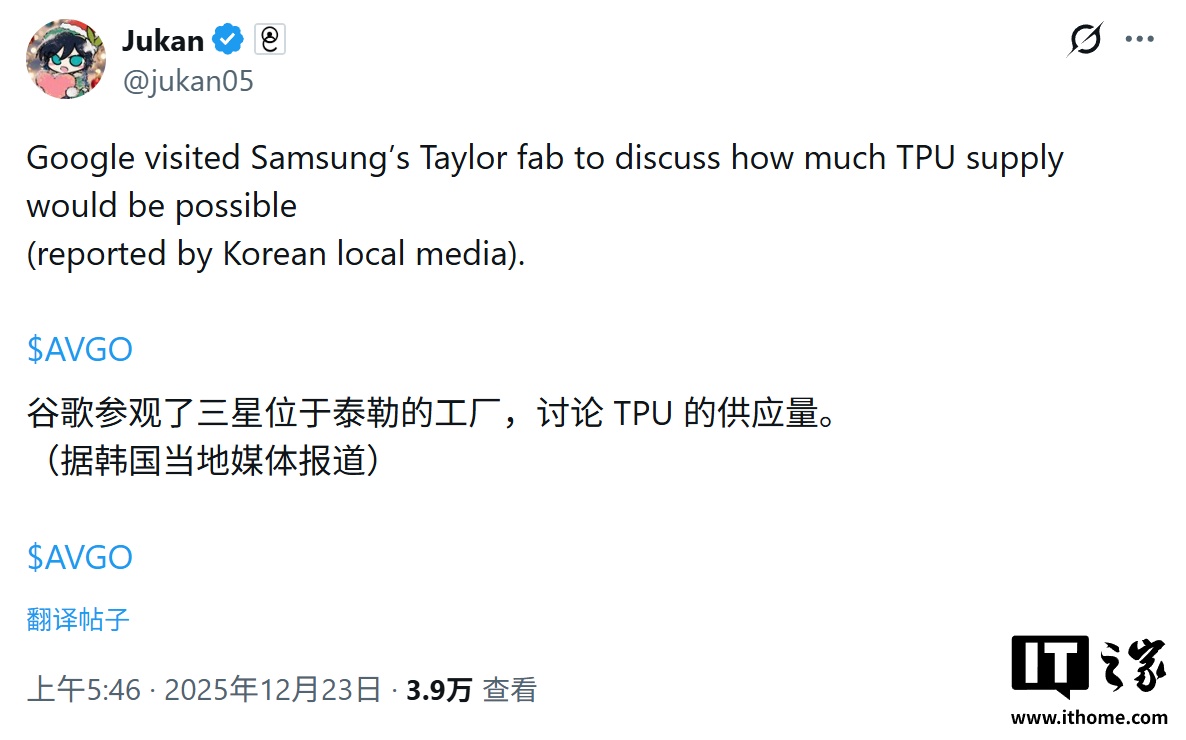
Core Viewpoint - Google executives recently visited Samsung's semiconductor factory in Taylor, Texas, to discuss outsourcing the production of Tensor Processing Units (TPUs), indicating a strategic move to enhance production capabilities and reduce costs in AI chip manufacturing [1][8]. Group 1: Google and TPU Production - Google is planning to outsource part of its self-developed AI chip manufacturing to Samsung, seeking more advantageous production solutions [1][8]. - The collaboration with Samsung could further lower chip manufacturing costs, potentially reducing overall expenses for building and upgrading data centers, which is crucial for establishing a profitable AI business model [3][9]. Group 2: Comparison with Competitors - Google's TPUs, developed in collaboration with Broadcom, reportedly cost 80% less than NVIDIA's H100 while maintaining comparable or superior performance [3][9]. - Unlike NVIDIA's GPUs, which are designed for a wide range of AI workloads, Google's TPUs are specifically tailored for neural network mathematical operations, making them more efficient for tasks like training the Gemini model and image recognition [4][9]. Group 3: Implications for Samsung - For Samsung, securing the TPU orders from Google would be a significant advantage, enhancing its client portfolio and demonstrating its technological capabilities [10]. - This partnership could attract more technology companies looking to diversify away from their reliance on TSMC for chip manufacturing [10].

三星有望拿下谷歌AI芯片大单!
国芯网· 2025-12-25 04:49
Core Viewpoint - Google is negotiating with Samsung to outsource the production of its Tensor Processing Units (TPUs), indicating a strategic move to enhance its AI chip manufacturing capabilities and reduce costs [2][4]. Group 1: Google and Samsung Collaboration - Google executives recently visited Samsung's semiconductor factory in Taylor, Texas, to discuss the outsourcing of TPU production [2]. - The discussions included technical details and the potential quantity of TPUs that Samsung could supply in the future [2]. - This collaboration aims to provide Google with a more advantageous production solution for its self-developed AI chips [2]. Group 2: Cost Efficiency and Market Impact - Google's TPUs, developed in collaboration with Broadcom, reportedly cost 80% less than NVIDIA's H100 while maintaining comparable or superior performance [4]. - If the partnership with Samsung is successful, it could significantly lower chip manufacturing costs, thereby reducing overall expenses for building and upgrading data centers [4]. - This move is expected to pave the way for a more profitable AI business model for Google [4]. Group 3: Technical Distinctions and Market Position - Google's TPUs are designed specifically for neural network mathematical operations, making them more efficient for machine learning tasks compared to NVIDIA's GPUs, which handle a broader range of AI workloads [4]. - For Samsung, securing the TPU orders from Google would enhance its client portfolio and demonstrate its technological capabilities, potentially attracting more companies looking to reduce reliance on TSMC [4].
全球AI:美股大跌背后的确定性与不确定性?
2025-12-15 01:55
Summary of Key Points from AI Industry Conference Call Industry Overview - The focus of global AI investment remains on infrastructure, with returns primarily benefiting large models and major companies, while traditional software and hardware firms see limited gains [1][4] - AI computing demand is strong, but infrastructure bottlenecks such as power supply, interconnect efficiency, and storage capacity are critical concerns [1][6] Core Insights and Arguments - The evolution of models is centered on pre-training and post-training, with Google optimizing pre-training through enhanced interconnect efficiency [1][10] - Investment strategies should focus on model parameter counts, dataset quality, and computing cluster developments, as inflation logic strengthens [1][11] - A significant token acceleration point is expected in 2026, which could lead to a substantial increase in AI computing capabilities [1][12] Key Trends and Developments - Recent fluctuations in the AI sector have seen dramatic market reactions, particularly in storage, optics, and power sectors, while companies like Google, Tesla, and Apple have shown relative stability [2] - The AI industry is expected to see continued growth in model capabilities and computing demands over the next 2-3 years, with breakthroughs anticipated in post-training reward paradigms [3][10] Supply Chain and Bottlenecks - Current bottlenecks in AI infrastructure investment are primarily in power supply, interconnect, and storage [8][9] - TSMC has significantly expanded its production capacity, increasing monthly output from 100K-110K to 120K-135K [14] - The U.S. power supply is constrained by inconsistent state policies, particularly regarding nuclear energy [12][13] Investment Strategy Recommendations - Investors should identify and focus on key bottlenecks within the AI industry, such as data walls, computing walls, interconnect, storage, and power supply [7][11] - Companies that can effectively address current bottlenecks and show potential breakthroughs in pre-training and post-training should be prioritized for investment [11][23] Market Sentiment and Future Outlook - The market anticipates a significant divergence in AI stock performance, with only about one-third of AI stocks expected to rise by 2025, and potentially even fewer by 2026 [16][18] - Concerns regarding profit margins and default risks are present, but these are viewed as secondary issues rather than core problems [17] Conclusion - The AI industry is at a pivotal point, with critical developments in model capabilities and infrastructure bottlenecks shaping future investment opportunities. Investors are advised to remain vigilant and strategic in their approach to capitalize on emerging trends and mitigate risks.
干掉同传?谷歌把AI同传放入所有耳机,顺手发了个颠覆性的AI浏览器
机器之心· 2025-12-14 02:49
Core Insights - Google is accelerating the integration of its Gemini model capabilities into its core product line, particularly Google Translate, enhancing real-time voice translation and contextual understanding of text translations [2][5][8]. Group 1: Google Translate Enhancements - Google Translate has introduced a new Beta feature that allows users to listen to real-time translations through any brand of headphones, transforming them into a simultaneous translation tool [5][6]. - The new feature supports over 70 languages and is currently available on the Android version of the Translate app, with plans to expand to iOS and more countries by 2026 [7]. - The Gemini model improves text translation by better understanding idioms and local expressions, providing contextually accurate translations rather than literal ones [8]. Group 2: Language Learning Tools - Google is enhancing its translation app's language learning features to resemble professional language learning software, expanding to nearly 20 new countries/regions [9][11]. - New features include an improved feedback mechanism for speaking practice and a "Streak" function to encourage consistent learning habits [12]. Group 3: Experimental Browser - Disco - Google Labs has launched an experimental browser named "Disco," which aims to redefine web browsing through a feature called "GenTabs" [3][14]. - GenTabs dynamically generates interactive interfaces based on user input and related web content, providing a more integrated browsing experience [15][16]. - Disco is currently in an experimental phase with a waiting list for the macOS version [17].

Coatue 最新报告:复盘 400 年、 30+ 次泡沫,我们离 AI 泡沫还很远
海外独角兽· 2025-10-29 12:33
Core Viewpoint - The article argues that AI is not a bubble but a genuine and long-term productivity revolution, supported by significant user growth and revenue from leading AI companies like OpenAI and Nvidia [2][3][7]. Market Analysis - This year marks the third year of the current AI bull market, with a historical probability of 48% for continued market growth next year [3][18]. - Investors should maintain patience regarding AI development, as significant returns often require time, as evidenced by Azure's six-year journey to positive ROIC [3][22]. - The AI sector has shown a remarkable return of 165% over the past three years, significantly outperforming the S&P 500 and non-AI companies [7][8]. AI Growth Dynamics - AI growth has diversified beyond the "Magnificent Seven" companies, with returns from AI sectors excluding these giants surpassing them for the first time in 2025 [10][13]. - New AI winners are emerging in sectors like energy, semiconductors, and software, with AI energy showing a 53% return year-to-date [13][15]. - The growth of AI is shifting towards energy, computing power, and foundational software, indicating a structural change in the industry [15]. Historical Context of "Bubble" - The article emphasizes the importance of long-term holding and understanding market cycles, suggesting that the probability of market growth remains significant even after multiple years of increases [17][20]. - A historical analysis indicates that the current market conditions do not exhibit the characteristics of a bubble, as the valuation metrics are not at extreme levels compared to past bubbles [38][40]. AI's Economic Impact - AI is expected to generate substantial revenue growth, with projections indicating a potential tenfold increase in AI-related profits over the next 5-10 years, reaching $1 trillion [3][90]. - The AI sector's revenue is anticipated to account for 4% of global corporate profits, highlighting its significant economic impact [3][90]. Investment Principles - The article outlines key investment principles for navigating the AI landscape, emphasizing the importance of not selling early during massive adoption phases and recognizing the distinct investment logic across different stages of AI development [117][119]. - Monitoring indicators such as OpenAI's progress and enterprise revenues is crucial for assessing the health and growth potential of the AI industry [122].



高盛闭门会-阿里的全栈ai战略和芯片,估值逻辑和数据中心
Goldman Sachs· 2025-10-09 02:00
Investment Rating - The investment rating for the industry is optimistic, with a target price for Alibaba set at $247, based on a 10x valuation multiple for core e-commerce and a 6x valuation for total revenue [1][5]. Core Insights - Alibaba's cloud revenue growth expectation has been raised to 30%-32%, driven by increased demand for AI model training and the attraction of enterprise customers through open-source models [1][3]. - The Chinese data center industry is experiencing accelerated capacity growth, with a year-on-year increase of approximately 30%, expected to reach 30 GW by year-end, primarily driven by AI demand [1][8]. - Alibaba's current valuation is around 18-19 times next year's earnings, which is lower than the 24 times seen in the US market, indicating potential for investment [2][17]. Summary by Sections Cloud Computing - Alibaba's cloud revenue grew by 26% last quarter, attracting new enterprise customers for AI model training, which lays a foundation for long-term revenue acceleration [3]. - The company occupies about 2 GW of the total data center capacity in China, which is expected to grow significantly in the coming years [8][9]. E-commerce Performance - The growth in retail business CMR and GMV is partly due to cross-selling, which may lead to savings in sales and marketing costs [4]. - The core e-commerce business is valued at a 10x multiple based on core revenue, while total revenue is valued at a 6x multiple, reflecting a strong performance [4][5]. Market Dynamics - Investors are increasingly focused on Alibaba's profitability, rapid business investment conversion rates, and cloud revenue growth, which will impact performance in the December quarter [1][14]. - The market is reassessing the self-sufficiency of China's chip supply and the growth prospects of cloud computing, with Alibaba's performance remaining tight and profit margins stable [14]. Competitive Landscape - Alibaba's full-stack AI products are seen as competitive against Google's offerings, attracting attention from US investors [7]. - The data center market in China is expected to maintain its competitive edge due to advancements in technology and efficiency [11]. Future Outlook - The overall sentiment for the next 12 months remains optimistic, driven by AI advancements and a stabilizing macroeconomic environment [2][18]. - Investors are particularly interested in the company's ability to convert business investments into user engagement and revenue growth, with expectations of continued performance improvements [15].