Genie 3

Search documents
AI 进了游戏公司,但还没开始改变游戏丨GDC 现场大讨论
晚点LatePost· 2026-03-29 14:25
Core Viewpoint - The gaming industry is facing significant challenges due to rising development costs, the impact of AI, and changing player preferences, leading to a potential crisis in traditional game production models [6][10][25]. Group 1: AI's Impact on the Gaming Industry - The introduction of generative AI in game development has sparked both excitement and anxiety among industry professionals, with many expressing concerns about its potential negative effects [5][25]. - A significant portion of game developers (52%) believe that generative AI is having a negative impact on the industry, a notable increase from previous years [25]. - AI is currently being utilized primarily for optimizing specific content production processes, rather than fundamentally changing the traditional game development workflow [11][12]. Group 2: Financial Challenges in Game Development - Investment in the gaming industry has decreased significantly, with funding to game studios dropping by 85% compared to the peak in 2021 [6]. - The cost of developing large-scale games has risen dramatically, with some projects requiring thousands of employees and budgets exceeding hundreds of millions of dollars, while game prices have not increased proportionately [6][10]. - The gaming industry's operating profits have been declining at a compound annual rate of approximately 7% since 2021, falling below pre-pandemic levels [6]. Group 3: Changing Player Preferences - New generations of players are increasingly gravitating towards user-generated content (UGC) platforms like Roblox and Minecraft, which have seen significant increases in playtime [8][9]. - Traditional game genres, such as battle royale and shooting games, are experiencing declines in player engagement, indicating a shift in player interests [8][9]. - The future of the gaming industry may hinge on whether players who grew up with UGC platforms will transition to traditional AAA games or remain within alternative entertainment ecosystems [9]. Group 4: AI Integration in Game Development - AI is being integrated into various stages of game production, with companies like Tencent using it to streamline processes such as 3D model generation and animation [16][18]. - The use of AI has led to significant reductions in production time for certain tasks, such as global illumination calculations, which can now be completed in minutes instead of days [15][16]. - Despite the advancements, the gaming industry still relies heavily on human creativity and oversight, with AI serving as a tool to enhance rather than replace human input [25][28]. Group 5: Future Directions and Concerns - The development of AI technologies like Google DeepMind's Genie 3 is still in its early stages, with many foundational issues yet to be resolved before they can be fully integrated into game development [23][24]. - Industry leaders emphasize the importance of maintaining human creativity in game design, arguing that AI should augment rather than dictate artistic direction [30][31]. - The consensus among industry professionals is that while AI can improve efficiency, the core of game development remains rooted in human creativity and collaboration [43].





GAN之父Ian Goodfellow病后归来,剑指高效世界模型
机器之心· 2026-03-07 11:20
Core Viewpoint - Ian Goodfellow, known as the father of GANs, has re-emerged in discussions about AI, particularly focusing on the development of multimodal world models that can predict and plan actions in complex environments [1][6][20]. Group 1: Importance of World Models - World models represent how environments operate, including their dynamics and causal structures, and are essential for predicting and planning actions without direct interaction with the real world [8][9]. - The goal of constructing world models is to unlock significant economic value in AI capabilities and help automate undesirable tasks, emphasizing the need for understanding causal relationships in complex environments [12][22]. Group 2: Multimodal World Models - Multimodal world models integrate various sensory modalities beyond text, such as visual and auditory data, to create a more comprehensive understanding of the environment [11][12]. - The construction of these models raises critical questions about the purpose of the model and the availability of scalable data sources for training [11][17]. Group 3: Data Sources and Efficiency - Data is crucial for building effective models, with current pixel-based models lacking action-conditional capabilities due to a scarcity of data that records actions and their outcomes [18]. - Utilizing software abstractions to create synthetic worlds can enhance model training efficiency, allowing for better data utilization [18][19]. Group 4: Cognitive Tools and Symbolic Representations - Human cognitive tools, such as natural language and symbolic representations, enable more efficient abstraction and expression of causal relationships, which can improve model performance [15][19]. - These symbolic systems facilitate a data feedback loop that combines actions and observations, essential for training effective world models [19]. Group 5: Future Directions - The article suggests starting the construction of multimodal world models in digital environments, such as interactive media and games, which can provide scalable data collection and engagement incentives [20][22]. - The design of world models should focus on learning strategies that prioritize key environmental factors, ensuring consistency and realism in long-term predictions [22].

深度|从 Genie 3 到 Yoroll,AI 视频原生游戏正在真正落地
Z Potentials· 2026-02-25 02:55
Core Insights - The article discusses the significant advancements in AI gaming, particularly the operational capabilities of AI models like Google’s Genie 3 and ByteDance’s Seedance 2.0, which have transformed the gaming landscape from mere demonstrations to practical applications [1][19]. - The emergence of platforms like LinearGame's Yoroll is highlighted, which integrates AI-generated content with interactive gaming, allowing creators to produce games without extensive programming knowledge [2][3]. Group 1: AI Gaming Advancements - In early 2026, AI gaming became operational with Google’s Genie 3 enabling real-time responses to player actions, marking a shift from demonstration to practical use [1]. - ByteDance's Seedance 2.0 launched on February 12, showcasing high usability in complex motion scenes and achieving a viral status on social media platforms [1][19]. - Traditional gaming companies experienced stock price declines, with Unity dropping 60% and Roblox and Take-Two down approximately 20%, indicating a market shift towards AI-driven game development [1]. Group 2: Yoroll's Innovative Approach - Yoroll's platform allows creators to generate interactive game content, enabling players to explore and engage with narratives without needing to know game engine coding [2][3]. - The platform aims to democratize game creation, shifting the focus from technical skills to storytelling, thus broadening the creator base [3][18]. - Yoroll's technology integrates video generation with a complete game system, allowing for the creation of playable, iterative games from AI-generated content [4][7]. Group 3: Market Dynamics and User Engagement - The transition from traditional game development to AI-generated content is expected to lower production costs significantly, with estimates suggesting a reduction to about 1/100 of traditional costs [23]. - The platform targets a wide range of creators, including independent developers and content creators, enabling them to produce interactive experiences quickly and efficiently [25][30]. - The rise of AI-generated content aligns with user preferences for interactive storytelling, as seen in popular titles that blend video and gameplay [9][10]. Group 4: Future Prospects - The successful launch of Seedance 2.0 serves as a catalyst for Yoroll, demonstrating the potential for high-quality AI-generated action content to evolve into playable games [19][20]. - The article suggests that the combination of advanced video generation capabilities and interactive frameworks will accelerate the development of AI gaming products [22]. - Yoroll's approach allows for rapid game development, enabling small teams or individual creators to produce content that traditionally required larger teams and longer timelines [18][25].

这次真的不是“狼来了”:AI主导下,码农职场彻底洗牌了
创业邦· 2026-02-13 14:13
Core Viewpoint - The article discusses the significant impact of AI programming tools on the tech industry, particularly the replacement of mid-level programmers with AI, leading to a transformation in employment dynamics within the sector [5][6][12]. Group 1: AI Impact on Employment - Companies are increasingly adopting AI tools like Cursor, Claude Code, and GPT-5.3-Codex to reduce costs and improve efficiency, resulting in the potential layoff of a significant portion of their programming workforce [5][6]. - The strategy involves replacing experienced mid-level programmers, who demand higher salaries but offer limited skill enhancement, with younger, less expensive talent that AI can support [5][6]. - The emergence of advanced AI tools has raised concerns about the sustainability of this employment strategy, as many programmers may find themselves obsolete [6][8]. Group 2: Technological Advancements - Claude Code and Codex represent a new generation of AI tools capable of automating application development, marking a shift from traditional programming methods [9][11]. - Claude Code excels in deep reasoning and complex program architecture, while Codex focuses on high automation and speed, indicating a divergence in capabilities among AI programming tools [12]. - The introduction of these tools is expected to disrupt the software outsourcing industry, as companies may no longer need large development teams, opting instead for smaller internal AI-focused departments [13]. Group 3: Market Reactions and Future Outlook - The release of new AI models has triggered market reactions, including panic selling among game companies and developers, highlighting the immediate impact of AI advancements on various sectors [14]. - The article suggests that the rapid evolution of AI tools will continue to reshape the tech landscape, with companies needing to adapt quickly to survive and thrive in this changing environment [15].

AppLovin -北美 CloudX 与 META、Genie 的协同布局
2026-02-10 03:24
Summary of AppLovin Corp Conference Call Company Overview - **Company**: AppLovin Corp (APP) - **Industry**: Mobile Advertising Technology - **Market Cap**: $157.458 billion - **Current Share Price**: $461.79 (as of February 3, 2026) - **Price Target**: $800.00 - **52-Week Range**: $745.61 - $200.50 - **EBITDA Growth**: 31% from 2025 to 2028 Key Investor Concerns 1. **Launch of CloudX's Mediation Tool**: - CloudX launched a new mobile mediation product that competes with AppLovin's MAX, U's LevelPlay, and GOOGL's AdMob - This is viewed as a misunderstood catalyst with limited negative implications for AppLovin and the industry [8][12] 2. **Potential Competition from Meta Audience Network**: - Meta is reportedly gaining share in in-game advertising on iOS, raising concerns about increased competition - However, there is limited evidence of a near-term launch from Meta, and the market may be overreacting [10][12] 3. **Impact of Genie 3 on the Gaming Industry**: - The launch of GOOGL's Genie 3 world model has raised concerns about its potential to disrupt game production - Despite this, it is expected that games will continue to monetize their ad inventory, and the impact on pure-play ad tech like AppLovin is not anticipated to be significant [11][12] Market Reaction - AppLovin shares have fallen approximately 30% since January 29, 2026, now trading at around 15x projected 2027 EBITDA - The current valuation reflects significant risks, but may also present a buying opportunity similar to the previous selloff to $219 in April 2025 [3][8] Investment Thesis - AppLovin is considered the strongest executor in the mobile app advertising market, expected to continue gaining market share even in a weaker macro environment - The company is anticipated to drive growth through expansion into new ad verticals, particularly in e-commerce [17] Financial Projections - **Bookings**: - 2024: $4.709 billion - 2025: $5.747 billion - 2026: $8.032 billion - 2027: $10.105 billion - **EBITDA**: - 2024: $2.720 billion - 2025: $4.501 billion - 2026: $6.635 billion - 2027: $8.371 billion - **EBITDA Margin**: - 2024: 57.8% - 2025: 78.3% - 2026: 82.6% - 2027: 82.8% [22] Risk Factors - Potential risks include intensified competition in the ad network space, macroeconomic pressures, and loss of access to critical data that drives performance [27] Conclusion - Despite current market concerns, AppLovin's strong execution capabilities and growth potential in new ad verticals position it favorably for future performance, warranting an Overweight rating from analysts [6][17]
美国观察 -AI 颠覆风险与软件股抛售-US Macroscope_ AI disruption risk and the Software sell-off
2026-02-10 03:24
Summary of Key Points from the Conference Call Industry Overview - The focus of the market has shifted towards the risk of AI disruption, particularly affecting software stocks, which have seen a significant decline of 15% in the past week and 29% from their highs in September 2025 [2][3] Core Insights and Arguments - **Valuation Multiples**: Software valuation multiples have decreased sharply, with the forward P/E multiple dropping from 35x in late 2025 to 20x currently, marking the lowest level since 2014. This decline indicates an expectation of reduced growth estimates [2][6] - **Profit Margins and Revenue Growth**: Despite the decline in valuations, current profit margins and consensus revenue growth estimates are at their highest levels in 20 years, approximately double the fundamentals of the average S&P 500 stock [2][6] - **Investor Positioning**: Hedge funds have reduced their exposure to software but remain net long, while large-cap mutual funds have moved to an underweight position in software since mid-2025 [2][18] - **Historical Context**: Historical examples of disruption risk, such as the decline of newspaper stocks, suggest that share price stabilization requires a stable earnings outlook. The uncertainty surrounding AI's impact means that near-term earnings will be critical signals of business resilience [2][38] Additional Important Insights - **Cyclical Rally**: The search for insulation from AI disruption has led to a rally in cyclical stocks, with a 13% increase in a basket of stocks linked to the US industrial cycle [39] - **Sector Rotation**: Investors are shifting focus from high AI exposure stocks to those in the "real economy," indicating a rotation towards industries less affected by AI disruption [2][39] - **Opportunities in Software**: Analysts see potential in certain software sub-industries, particularly Vertical Software, which is believed to be insulated from disruption risks [28] - **Correlation with Other Industries**: Various industries, including media, education, and business services, have also been negatively impacted by the sell-off in software stocks, indicating a broader market concern regarding AI disruption [2][26] Conclusion - The software industry is currently facing significant valuation pressures due to concerns over AI disruption, with historical patterns suggesting that recovery will depend on stabilizing earnings forecasts. Investors are advised to consider opportunities in less affected sectors while remaining cautious about the potential long-term impacts of AI on the software market [2][38][39]
From AI Darlings To Old Economy? Why Investors Flee Software And Chase Value Stocks Again
Yahoo Finance· 2026-02-09 23:31
Core Insights - Software stocks are experiencing a significant decline as investors reassess the potential winners in the AI sector, leading to a shift of capital from high-growth tech to value stocks and cyclical sectors [1][2] - The decline in software stocks is attributed to fears that generative AI models may disrupt the business models of companies previously viewed as beneficiaries of AI [2][3] Valuation and Market Trends - The forward P/E ratio for the software sector has decreased from 35x in late 2025 to approximately 20x, marking the lowest level since 2014 and only slightly above the broader S&P 500 [3] - This drop in valuation indicates the smallest premium over the broader market since 2010, despite a consensus expectation of 15% revenue growth for the sector, which is more than double the S&P 500's expected growth of 6% [3][4] - Price-to-sales ratios have fallen from 9x to 6x since September, although they still represent a 260% premium to the S&P 500 [4] Investor Behavior - Hedge funds have recently reduced their exposure to software stocks, although they remain net long, indicating a cautious approach [4] - Large-cap mutual funds have been underweight in software stocks since mid-2025, reflecting a broader trend of capital rotation towards sectors perceived as "AI-insulated" [4][6]
这次真的不是“狼来了”:AI主导下,码农职场彻底洗牌了
虎嗅APP· 2026-02-09 14:30
Core Viewpoint - The article discusses the significant impact of AI programming tools on the tech industry, particularly the replacement of mid-level programmers with AI, leading to a transformation in employment dynamics within the sector [5][6]. Group 1: AI Impact on Employment - A major internet company has reduced its programming team by one-third over two years due to AI tools, with plans for further reductions [5]. - The strategy involves replacing experienced mid-level programmers with younger, less expensive talent, as AI can effectively handle the tasks previously performed by these workers [5][6]. - The trend of using AI to replace lower-value human labor is prevalent across the tech industry, raising questions about the sustainability of this approach [6]. Group 2: New AI Tools - Recent releases of Claude Code and GPT-5.3-Codex have revolutionized programming capabilities, allowing for more automated and intelligent application development [6][9]. - Claude Code is noted for its strong reasoning abilities and support for long context windows, while Codex excels in execution speed and automation [10][11]. - The emergence of these tools signals a potential shift in the software outsourcing industry, as AI may replace human developers entirely [12]. Group 3: Market Reactions - The release of advanced AI models has caused panic in the capital markets, particularly among gaming companies and game engine developers [12]. - The introduction of new models like ByteDance's Seedance 2.0 has further intensified discussions about the impact of AI on various industries, including video production [13]. Group 4: Future Outlook - The article suggests that companies not primarily focused on software development will likely downsize their development teams, as AI tools become more user-friendly and capable [12]. - The tech industry is at a crossroads, with companies needing to adapt quickly to survive and thrive in an AI-driven landscape [14].
这次真的不是“狼来了”:AI主导下,码农职场彻底洗牌了
3 6 Ke· 2026-02-09 07:51
Core Insights - The article discusses the impact of AI programming tools on the workforce, particularly in the tech industry, highlighting significant job reductions and shifts in employment dynamics due to automation [1][2][3]. Group 1: AI Tools and Workforce Changes - A major internet company has reduced its programming team by one-third over two years due to AI programming tools, with plans for further reductions [1] - The strategy involves replacing experienced mid-level programmers with younger, less expensive talent, as AI can effectively handle the tasks previously performed by these workers [1][2] - The broader tech industry is adopting similar strategies, focusing on automating standardized programming tasks and replacing lower-cost human labor with AI [2][3] Group 2: New AI Developments - Recent releases of Claude Code and GPT-5.3-Codex have significantly changed the landscape, enabling more comprehensive automation in application development [2][4] - Claude Code excels in deep reasoning and complex architecture, while Codex focuses on high automation and speed, indicating a shift towards tools that can fully automate programming tasks [5][6] Group 3: Future of Software Development - The emergence of AI programming tools raises questions about the future of software outsourcing, as AI may replace human developers in many tasks [7] - Companies that do not primarily focus on software development are likely to downsize their development teams, potentially outsourcing to AI rather than human developers [7][8] - Major tech firms are adapting quickly to these changes, with a trend of aggressive layoffs among mid-level programmers who are often more familiar with technology [8] Group 4: Market Reactions and Industry Implications - The release of new AI models has caused panic in the market, particularly among gaming companies, reflecting the broader anxiety about AI's impact on various industries [8] - The article suggests that the rapid advancement of AI tools will lead to significant disruptions across multiple sectors, including video production and software development [8][9]
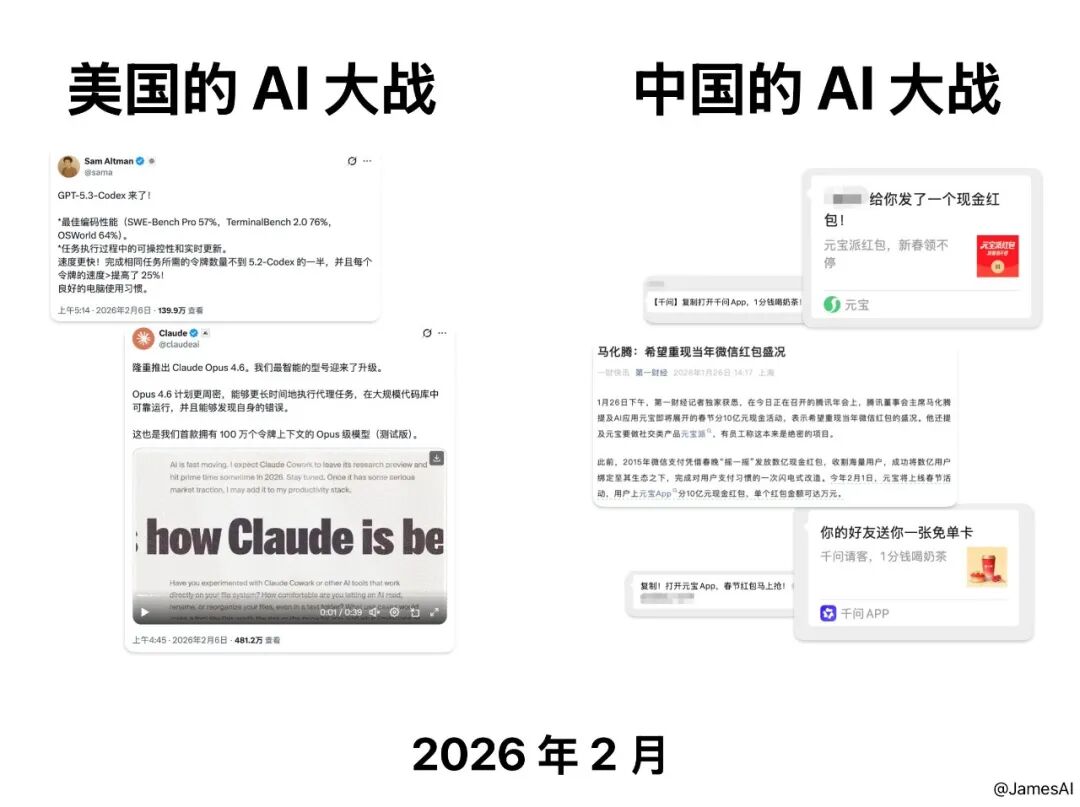
中国AI?美国AI?
3 6 Ke· 2026-02-08 07:56
Core Insights - The competition in the video model space is intensifying, with ByteDance's Seedance 2.0 and Kuaishou's Kling 3.0 emerging as significant players, each with distinct focuses on video creation and production capabilities [3][6][9] - The advancements in video models are expected to bridge the gap between real and virtual content, with the potential to revolutionize video production processes by 2026 [6][9] - The Chinese AI companies are leveraging their strengths in short video and live streaming ecosystems, which are globally leading, to drive the development of video models [9][10] Group 1 - ByteDance's Seedance 2.0 is noted for its innovative approach to video generation, enhancing the ecosystem for short video creators [3][10] - Kuaishou's Kling 3.0 is recognized for its focus on professional filmmaking and industrial capabilities, targeting directors and studios [3][4] - The competition between these two models is not just about technology but also about market positioning and user engagement [4][9] Group 2 - The release of new video models by major players like Elon Musk's Grok and Google's Genie 3 indicates a broader trend towards video-centric AI solutions [6][9] - The evolution of AI in coding and multi-modal applications is seen as a key factor in making AI more accessible to the general public [4][7] - The Chinese market's unique characteristics and the existing demand for video content provide a fertile ground for AI advancements, contrasting with the U.S. market's focus on AI coding [9][10] Group 3 - ByteDance is actively fostering internal competition to identify the next major product, with multiple teams vying for leadership in AI-driven applications [13][14] - The company's dynamic culture and strong desire for innovation are highlighted as key factors in its ongoing success [13][14] - Upcoming announcements in the AI space are anticipated, suggesting a continued wave of significant developments in the industry [14]