
Google TPU v7

Search documents
微软甩出3nm自研AI芯片!算力超10PFLOPS,干翻AWS谷歌
美股研究社· 2026-01-27 10:44
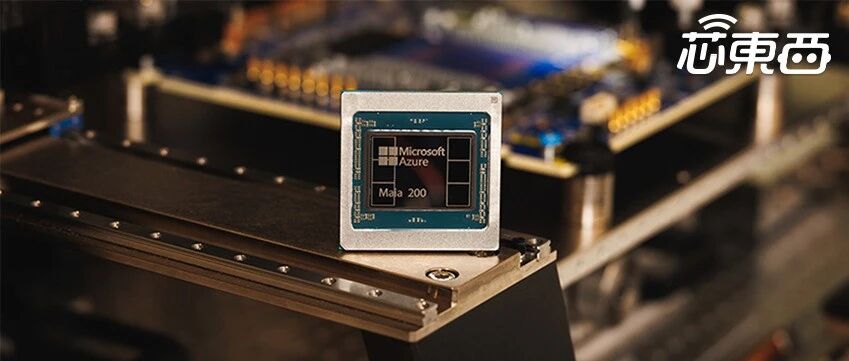
Core Viewpoint - Microsoft has announced the launch of its self-developed AI inference chip, Maia 200, claiming it to be the highest-performing self-developed chip in all large-scale data centers, aimed at significantly enhancing the economic efficiency of AI token generation [5]. Technical Specifications - Maia 200 is manufactured using TSMC's 3nm process and features over 140 billion transistors, with a memory subsystem that includes 216GB of HBM3e and a read/write speed of 7TB/s [5]. - The chip is designed for low-precision computing models, providing over 10 PFLOPS performance at FP4 precision and over 5 PFLOPS at FP8 precision, all within a 750W SoC TDP range [5]. - Its FP4 performance exceeds that of Amazon's AWS Trainium3 by more than three times, while its FP8 performance surpasses Google's TPU v7 [6]. Memory and Interconnect - The redesigned memory subsystem focuses on narrow precision data types and includes a dedicated DMA engine and on-chip SRAM, enhancing token throughput [8]. - Maia 200 offers a bidirectional bandwidth of 2.8TB/s, which is higher than AWS Trainium3's 2.56TB/s and Google's TPU v7's 1.2TB/s [9]. Performance and Efficiency - Maia 200 is the most efficient inference system deployed by Microsoft to date, with a performance improvement of 30% per dollar compared to the latest generation of hardware currently in use [10]. - The chip can run the largest models available today and is designed to support future models, including OpenAI's latest GPT-5.2 [11][12]. Integration and Development - Maia 200 integrates seamlessly with Microsoft Azure, and a software development kit (SDK) is in preview, providing tools for building and optimizing models [13]. - The architecture simplifies programming and enhances workload flexibility while reducing idle capacity, maintaining consistent performance and cost-effectiveness at cloud scale [21][22]. Deployment and Scalability - The deployment time for Maia 200 chips is halved compared to similar AI infrastructure projects, allowing AI models to run shortly after the first chips arrive [23]. - The architecture is designed for scalable performance in dense inference clusters while reducing power consumption and total cost of ownership for Azure's global clusters [22]. Future Outlook - Microsoft is positioning Maia 200 as a solution for the next generation of AI systems, aiming to set new benchmarks for performance and efficiency in critical AI workloads [28]. - The company invites developers, AI startups, and academia to explore early model and workload optimization using the new Maia 200 SDK [29].


全球存储技术-DRAM 现货市场暴跌、AWS 的 AI 芯片、存储指标-Global Memory Tech-Weekly theme DRAM spot hard-landing,AWS’s AI chip, memory indicator
2025-12-08 02:30
Summary of Key Points from the Conference Call Industry Overview - **DRAM Market Trends**: The price of 16Gb DDR5 has slightly declined by 1% this week, marking the first drop since August after a significant rally of over 300% from September to November. This decline has raised investor concerns about a potential hard landing, reminiscent of previous corrections in 1H19 and 1H23. However, the decline is viewed as a healthy trend, as OEMs cannot utilize DRAM at current spot prices of US$30-40, which are significantly higher than the normal range of US$5. Current selling prices from memory chipmakers are below US$10 on average, indicating a potential for spot prices to fall back to below US$20. Despite this, demand for DRAM remains strong, and a convergence of spot and contract prices is expected at US$10-15 by the end of 2026, supporting ASP strength for conventional DRAM [1][2][3]. AI Chip Demand - **Increased HBM Demand**: AWS's new AI chip, Trainium3, is expected to drive demand for HBM due to a 50% year-over-year increase in memory content (144GB HBM3e compared to 96GB for the previous generation). Each AWS UltraServer will utilize 144 units of Trainium3, and even 1 million units could be deployed for UltraClusters. Similarly, Google's TPU v7 has increased its HBM usage to 192GB, which is three times higher than its predecessor. While there are concerns about these ASICs cannibalizing GPU+HBM demand, memory chipmakers anticipate a complementary relationship between ASICs and GPUs, as they serve different AI functions [2][3]. BofA Memory Indicator - **Year-High Indicator**: BofA's memory indicator reached a year-high of 114 in October, up from a year-low of 101 in March. This increase is attributed to a rally in spot prices, a rise in Korea's semiconductor exports, and significant growth in global billings (DRAM +90% YoY, NAND +17%). Preliminary November results indicate even stronger growth, with DRAM spot prices increasing by 100% month-over-month and NAND spot prices up by 70% month-over-month [3][4]. Price Trends - **Spot and Contract Prices**: The current spot price for 16Gb DDR5 is US$26.8, reflecting a 344% increase year-over-year. In contrast, the 16Gb DDR4 spot price is US$46.5, which is up 381% year-over-year. NAND spot prices have also seen significant increases, with 1Tb wafers priced at US$12.6, up 148% year-over-year. The overall trend indicates a strong recovery in memory prices, with expectations of continued growth into 2026 [6][24][47]. Future Outlook - **Market Expectations**: The expectation is for a mild correction in the first quarter of 2026, but no significant hard landing is anticipated. The memory market is expected to remain robust, driven by ongoing demand for AI applications and the continued growth of hyperscalers committing to advanced memory technologies [15][24][49]. Additional Insights - **Production Cuts Impact**: The significant price increases in both DRAM and NAND are partly due to production cuts by major chipmakers, which have led to tighter supply conditions. This has resulted in a notable rally in prices, particularly for DDR4, which has seen a year-to-date increase of over 1000% [28][30][34]. - **Long-Term Price Trends**: Historical data indicates that current prices for both DDR4 and DDR5 are at all-time highs, significantly exceeding previous peaks. The long-term trend suggests that while spot prices may experience fluctuations, the overall trajectory remains upward due to sustained demand and supply constraints [13][19][21][26].
Counterpoint:需求强劲 台积电(TSM.US)3nm制程成为其史上最快达成全面利用的技术节点
智通财经网· 2025-05-15 12:39
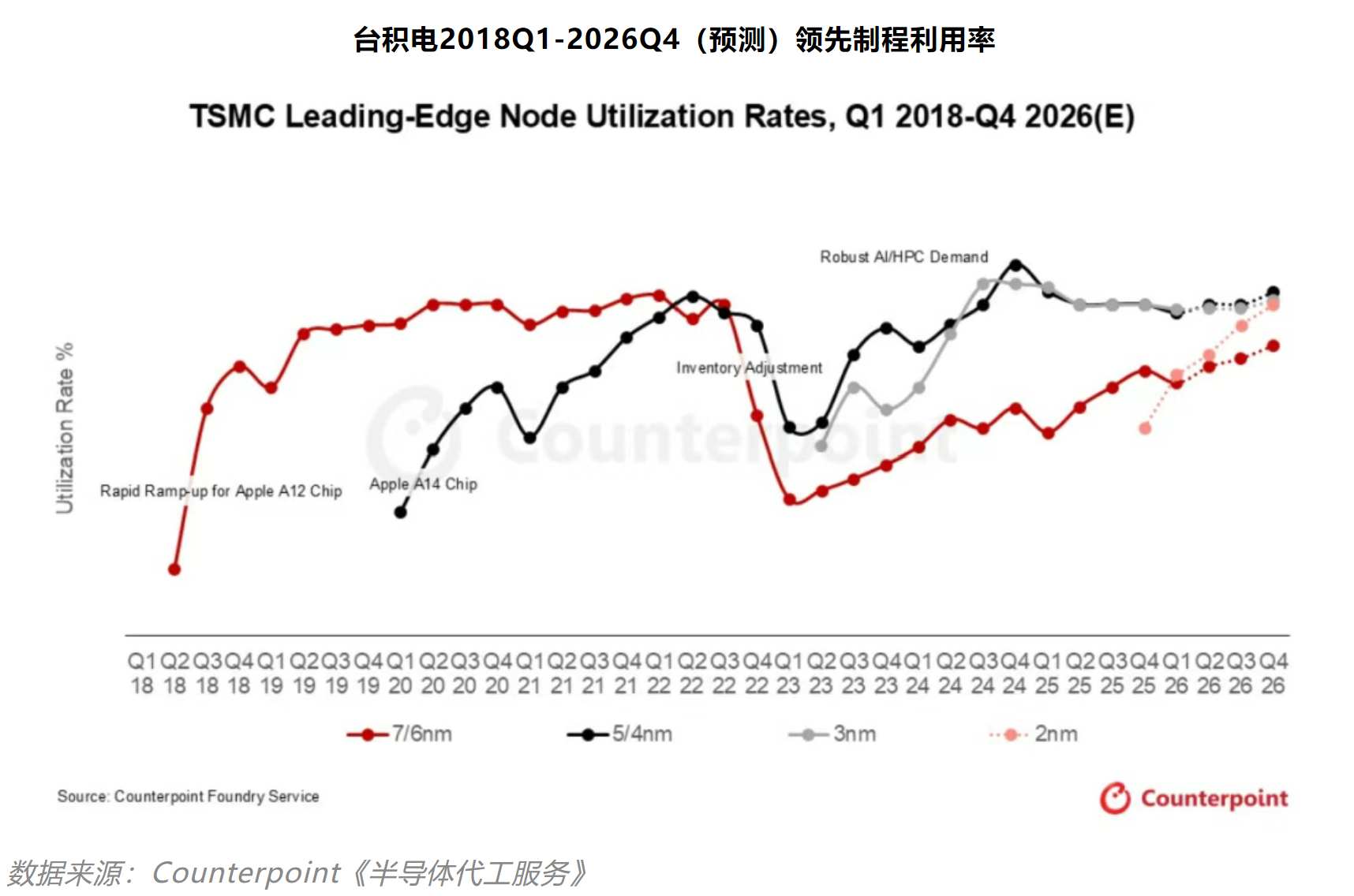
Group 1 - TSMC has solidified its leading position in the global foundry market after inventory adjustments at the end of 2022, with high utilization rates in advanced process technologies [1] - The 3nm process has achieved full capacity utilization in its fifth quarter of mass production, driven by strong demand for Apple A17 Pro/A18 Pro chips and other application processors, setting a new record for initial market demand [1] - Future growth is expected to continue due to the introduction of NVIDIA Rubin GPUs and specialized AI chips from Google and AWS, driven by increasing demand in AI and high-performance computing (HPC) applications [1] Group 2 - In contrast, the smartphone market has seen slower initial capacity growth for existing processes like 7/6nm and 5/4nm, with the latter experiencing a resurgence in 2023 due to surging demand for AI acceleration chips [2] - The demand for AI computing chips is accelerating the construction of AI data centers and significantly enhancing the overall capacity of the 5/4nm process [2] Group 3 - The 2nm process is projected to achieve full capacity utilization in its fourth quarter of mass production, driven by dual demand from smartphones and AI applications, aligning with TSMC's strategic outlook [5] - Potential customers for the 2nm technology include Qualcomm, MediaTek, Intel, and AMD, which is expected to maintain high utilization rates for the 2nm process [5] Group 4 - TSMC is investing $165 billion in its Arizona facility to meet growing U.S. consumer demand and mitigate geopolitical risks, with the facility covering 4nm, 3nm, and 2nm processes [11] - The dual-layout strategy enhances TSMC's geopolitical resilience and ensures capacity meets customer demand, particularly in AI and HPC, while maintaining high utilization rates for advanced processes beyond 2030 [11]

TSMC 先进制程产能利用率持续保持强劲
Counterpoint Research· 2025-05-15 09:50
Core Viewpoint - TSMC has solidified its leading position in the global foundry market following inventory adjustments at the end of 2022, with high utilization rates in advanced process nodes showcasing its technological superiority [1][4]. Group 1: Advanced Process Utilization - The 3nm process node has achieved full utilization within five quarters of mass production, driven by strong demand for Apple A17 Pro/A18 Pro chips and other application processors, setting a new record for initial market demand in advanced processes [1]. - TSMC's 5/4nm process is experiencing a resurgence in demand, particularly due to the surge in AI accelerator chips like NVIDIA's H100 and B100, which has significantly boosted overall capacity [2][4]. - TSMC's advanced process utilization rates are projected to remain high, with expectations that the 2nm process will reach full capacity within four quarters of mass production, driven by dual demand from smartphones and AI applications [7]. Group 2: Future Developments and Investments - TSMC plans to allocate 30% of its 2nm process capacity to its Arizona facility, enhancing geopolitical resilience while ensuring capacity meets customer demand, especially in AI and high-performance computing [9]. - The company anticipates that the diverse customer base for the 2nm technology, including major players like Qualcomm, MediaTek, Intel, and AMD, will help maintain high utilization rates [7]. - TSMC's investment of $165 billion in its Arizona plant will support advanced process technologies, including 4nm, 3nm, and 2nm, ensuring the company remains at the forefront of the semiconductor industry [9].
