MiniMax M2.1

Search documents
MiniMax M2.5发布
Xin Lang Cai Jing· 2026-02-12 23:43
Core Insights - The MiniMax M2.5 has been released, enhancing its ability to decompose complex tasks and optimize token consumption during the thought process [1] - In SWE-Bench Verified tests, M2.5 completed tasks 37% faster than its predecessor, M2.1 [1] Performance Metrics - At a token output rate of 100 tokens per second, the cost for continuous operation for one hour is $1 [1] - At a token output rate of 50 tokens per second, the cost for continuous operation for one hour is $0.3 [1] - A budget of $10 million can sustain 4 agents working continuously for one year [1]
2026年第一个爆款 Clawdbot现象背后是AGI更近了
2 1 Shi Ji Jing Ji Bao Dao· 2026-02-05 23:29
Core Insights - Clawdbot, now known as "OpenClaw," is an open-source AI assistant that has rapidly gained popularity in the tech community, achieving over 100,000 stars on GitHub within days and boosting sales of Apple Mac Mini [1][10] - The project signifies a shift from "conversational AI" to "agent-based AI," reflecting market expectations for next-generation AI applications capable of autonomous planning and execution of complex tasks [3][12] Technology and Functionality - Clawdbot operates on a three-part logic system: instructions, gateway, and execution, allowing users to issue commands via an app, which are processed locally through a gateway [3][12] - The AI assistant is designed to run locally, interact in real-time, possess memory, and evolve autonomously, functioning as a 24/7 assistant [3][12] - The MiniMax M2.1 model, praised for its capabilities in complex logical reasoning and coding, is a key component that enhances Clawdbot's performance [3][12] Market Impact - The launch of Clawdbot has triggered a surge in Mac Mini purchases, with notable figures in the tech industry, including Google's AI product head, purchasing the device to experience Clawdbot [14] - Major cloud service providers in China, such as Tencent Cloud and Alibaba Cloud, have quickly introduced one-click deployment services to facilitate rapid adoption among enterprises and developers [15] Industry Trends - Clawdbot's emergence accelerates the transition to the AI Agent era, with implications for hardware, cloud security, and AI infrastructure [17] - The project highlights the potential for private deployment models to drive growth in consumer hardware, VPS, and cloud security sectors [17] - The phenomenon of AI agents creating their own social forums, such as Moltbook, indicates a new dimension in AI interaction, where agents operate independently of human oversight [16] Future Perspectives - The development of Clawdbot raises questions about the future of AI programming, with its creator revealing that the project was nearly entirely generated by AI, suggesting a potential shortcut to achieving AGI [18] - The concept of "self-solving" capabilities in AI is gaining traction, with predictions that 2026 could mark a pivotal year for AGI, driven by the maturation of long-term intelligent agents [18]

2026年第一个爆款!Clawdbot现象背后是AGI更近了
2 1 Shi Ji Jing Ji Bao Dao· 2026-02-05 07:35
Core Insights - Clawdbot, now known as "OpenClaw," has rapidly gained popularity as an AI assistant, showcasing the shift from conversational AI to agent-based AI, marking a significant milestone in the industry [1][4] Group 1: Product Overview - Clawdbot operates on a three-part logic: instructions, gateway, and execution, allowing users to issue commands through an app, which are executed locally via a gateway [2] - The product has sparked a surge in Mac Mini sales, as users require local deployment for its functionality, indicating a strong market demand for AI agents [5] Group 2: Market Impact - The emergence of Clawdbot has accelerated the arrival of the AI agent era, prompting major cloud service providers in China to launch deployment services to attract developers [5] - The product's success has validated the feasibility of automating complex tasks, which is seen as a step towards achieving Artificial General Intelligence (AGI) [3][7] Group 3: Technical Aspects - Clawdbot's core technology includes a gateway architecture, permission management, and a memory system, similar to existing products like AutoGPT and LangChain, but its community and user engagement are its main competitive advantages [3] - The MiniMax M2.1 model, which powers Clawdbot, is optimized for agent scenarios, enhancing its ability to handle complex tasks with high accuracy and stability [2] Group 4: Future Prospects - The rise of Clawdbot is expected to drive advancements in hardware, cloud security, and privacy computing, as well as the evolution of enterprise-level agent paradigms [6] - The potential for AI to autonomously generate code raises questions about the future of programming and the path towards AGI, with predictions suggesting that 2026 could be a pivotal year for AGI development [7]
计算机行业事件点评:Clawdbot系列研究之核心受益方向:大模型篇
Guolian Minsheng Securities· 2026-02-04 01:04
Investment Rating - The report maintains a "Recommendation" rating for the industry, indicating an expected stock price increase of over 15% relative to the benchmark index within the next 12 months [5]. Core Insights - The report emphasizes that in the Agent era, the ability to transform strong capabilities into high-frequency productivity at lower costs is crucial, highlighting MiniMax's advantages in this regard [4][7]. - Clawdbot has rapidly gained traction, with over 130,000 stars on GitHub and more than 2 million visits to its official website, marking it as one of the fastest-growing open-source technology projects [7]. - The M2.1 model from MiniMax is noted for its efficiency and cost-effectiveness, addressing the high token costs faced by developers in automated programming [7][14]. - The report discusses the importance of multi-modal capabilities in understanding visual information, which enhances the functionality of Agents in various workflows [4][7]. Summary by Sections Industry Overview - The report highlights the transition of large models from mere chat tools to autonomous employees, suggesting that companies with core algorithms and industry interfaces will benefit significantly from the trend towards intelligent automation [14]. Model Performance - MiniMax's M2.1 model is designed to reduce token costs to approximately 8% of Claude Sonnet's pricing, with an innovative billing mechanism that allows for high-frequency usage [7][14]. - The model's long-text capabilities enable it to handle complex workflows, accommodating more extended documents and reducing logical breaks due to truncation [7]. Market Dynamics - The report notes a significant increase in API call frequency and token throughput, driven by the emergence of AI-only communities like Moltbook, which has rapidly amassed a million agent accounts [7]. - The M2.1 model's reasoning and programming capabilities make it a suitable choice for production systems, emphasizing its high cost-performance ratio [7].
电子行业跟踪报告:OpenClaw助力AI Agent技术范式升级
Shanghai Aijian Securities· 2026-02-03 12:24
Investment Rating - The report rates the electronic industry as "stronger than the market" [1]. Core Insights - OpenClaw, developed by Peter Steinberger, is an AI agent that enhances the capabilities of large language models by enabling autonomous decision-making and task execution, supported by a collaborative open-source community [2][5]. - The project has gained significant traction, with its GitHub stars rapidly increasing, indicating strong community interest and support [8]. - Major cloud service providers like Tencent Cloud and Alibaba Cloud have launched deployment solutions for OpenClaw, facilitating its integration into various applications [2][5]. Summary by Sections 1. Development and Evolution of OpenClaw - OpenClaw was initially conceived as a personal assistant AI project but was put on hold due to technological limitations of existing models [6]. - The project was relaunched in November 2025, leading to its open-source release and subsequent renaming to OpenClaw by January 2026 [8]. 2. AI Agent Capabilities - AI agents are defined as intelligent systems capable of perceiving their environment, analyzing information, making decisions, and executing actions, with a focus on long-term task planning and self-optimization [11]. - The foundational architecture of AI agents includes components such as large language models (LLM), planning skills, memory, and tool usage [11][16]. 3. OpenClaw's Breakthrough Features - OpenClaw allows for seamless interaction through common messaging platforms without the need for dedicated clients, and it has comprehensive access to file systems, browsers, and APIs [17][20]. - It emphasizes local data processing to enhance privacy and efficiency, distinguishing itself from traditional AI assistants that primarily focus on conversational capabilities [20]. 4. Technical Support from MiniMax - MiniMax, a leading AI company, provides technical support for OpenClaw, enhancing its model capabilities and performance metrics [22][26]. - MiniMax's products, including MiniMax M2.1, have shown significant revenue growth, indicating a robust business model and market presence [22].
电子行业跟踪报告:OpenClaw助力AIAgent技术范式升级
Shanghai Aijian Securities· 2026-02-03 11:16
Investment Rating - The report rates the electronic industry as "stronger than the market" [1]. Core Insights - OpenClaw, developed by Peter Steinberger, is an AI agent that enhances the capabilities of large language models by enabling autonomous decision-making and task execution, supported by a robust open-source community [2][5]. - The project has gained significant traction, with a rapid increase in GitHub stars, indicating strong community interest and support [8]. - Major cloud service providers like Tencent Cloud and Alibaba Cloud have launched deployment solutions for OpenClaw, facilitating easy installation and operation for users [2][5]. Summary by Sections 1. Development and Evolution of OpenClaw - OpenClaw was initially conceived as a personal assistant AI project but was put on hold due to technological limitations of existing models [6]. - The project was relaunched in November 2025, leading to its open-source release and subsequent renaming to OpenClaw in January 2026 [8]. 2. AI Agent Capabilities - AI agents are defined as intelligent systems capable of perceiving their environment, analyzing information, making decisions, and executing actions, with a focus on long-term task planning and self-optimization [11]. - The foundational architecture of AI agents includes components such as large language models (LLM), planning skills, memory, and tool usage [11][16]. 3. OpenClaw's Unique Features - OpenClaw allows interaction through common messaging platforms without the need for dedicated clients, providing extensive access to file systems, browsers, and APIs [17]. - It emphasizes local data processing to enhance privacy and efficiency, while also supporting long-term memory for cross-platform context sharing [20]. 4. Technical Support from MiniMax - MiniMax, a leading AI company, provides technical support for OpenClaw, enhancing its model capabilities and performance metrics [22]. - MiniMax's revenue has shown significant growth, with a reported 782.17% increase in 2024, indicating strong market demand for its AI solutions [22].
寻找桌面Agent红利下的卖铲人
Hua Er Jie Jian Wen· 2026-01-31 09:17
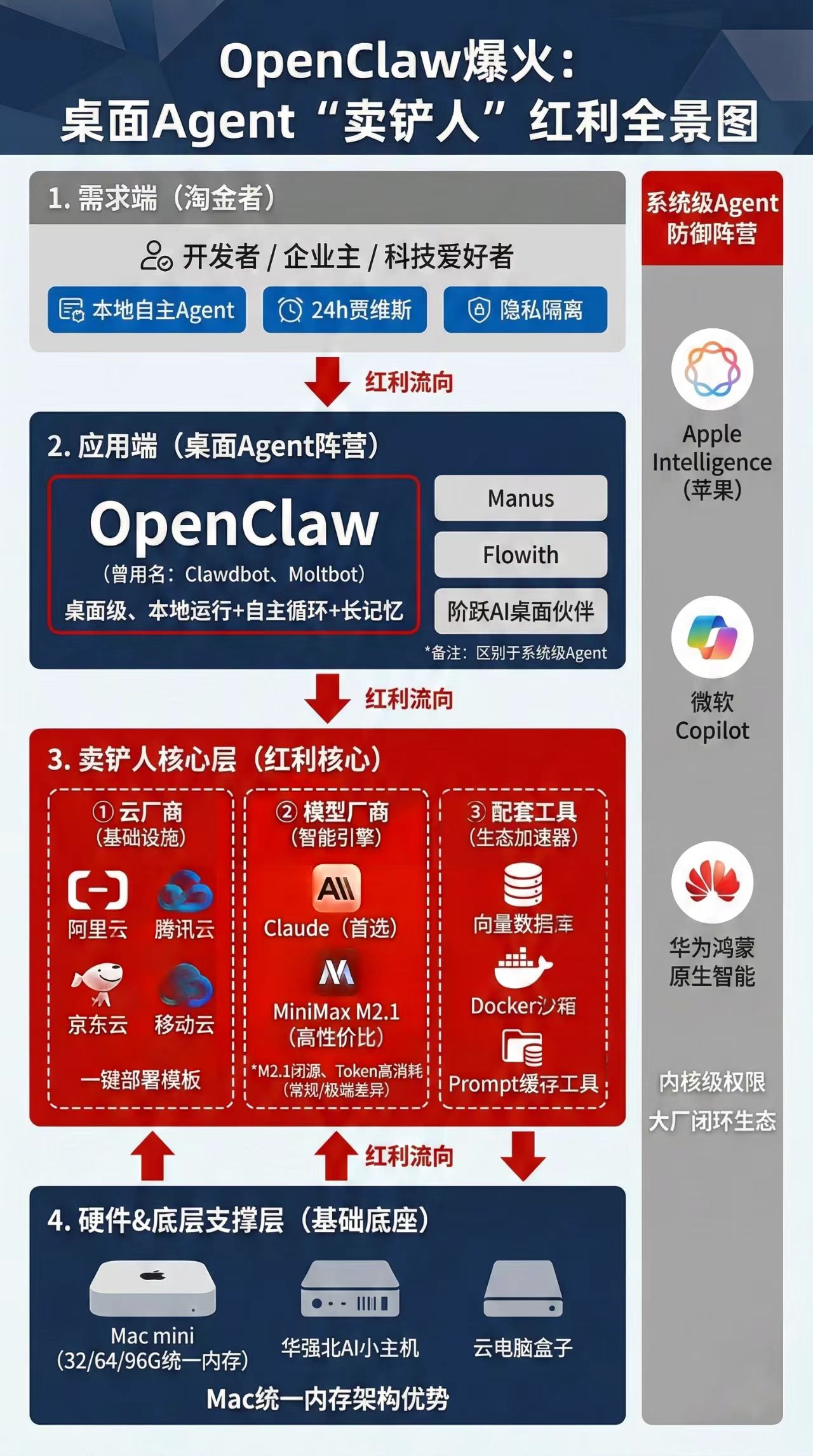
Core Insights - OpenClaw, a new desktop agent, has gained significant popularity in tech communities, enabling users to interact with AI in a natural chat interface and perform complex tasks [1][4] - The product's design allows for local operation, enhancing privacy and security, which has led to a surge in demand for MacMini as a dedicated device for running OpenClaw [4][17] - The rise of OpenClaw has sparked interest from cloud service providers, with companies like Alibaba Cloud and Tencent Cloud quickly launching dedicated services and templates for OpenClaw deployment [4][5] Group 1: Product Features and Market Response - OpenClaw can perform a variety of tasks, from comparing car dealership quotes to managing email subscriptions and flight bookings, showcasing its versatility [1] - The agent's ability to maintain long-term memory and context allows it to proactively send reminders and alerts, likened to a "24-hour standby Jarvis" [1] - The rapid adoption of OpenClaw has led to a proliferation of tutorials and guides, indicating strong community engagement and interest [1][4] Group 2: Financial Implications and Operational Costs - Users have reported high operational costs associated with OpenClaw, particularly due to its extensive use of API tokens, which can be quickly depleted [5][6] - Traditional chatbots consume fewer tokens per interaction compared to OpenClaw's autonomous operation, which can lead to significant expenses [6] - The need for efficient and cost-effective models is emphasized, as the performance of agents like OpenClaw heavily relies on underlying large models [6][7] Group 3: Competitive Landscape and Future Trends - The emergence of OpenClaw has intensified competition among desktop agents, with various players entering the market, including Manus and MiniMax [8] - The future of software is shifting towards a "thousand-end battle," where the focus will be on the capabilities of agents rather than just models [8] - Major tech companies like Apple and Microsoft are expected to evolve their AI offerings into comprehensive agents, leveraging their unique system-level access [10][11][12] Group 4: Hardware and Infrastructure Developments - The demand for dedicated hardware, such as MacMini, has surged due to its compatibility with OpenClaw, although it is not seen as a long-term solution [17][18] - New hardware solutions, including AI mini PCs and cloud-based "AI boxes," are emerging to provide cost-effective alternatives for users needing lightweight agents [20] - The competition for control over desktop agents is expected to intensify, with both software and hardware players vying for market share [20]
Clawdbot创始人Peter首次公开访谈 点赞国产开源模型M2.1
智通财经网· 2026-01-29 08:13
Core Insights - The developer Peter Steinberger, known for the popular AI project Clawdbot (now Moltbot), publicly praised the domestic open-source model MiniMax M2.1 during a live interview, highlighting its core competitiveness in the industry [1][2] - Peter's personal studio has deployed high-end equipment with 512GB capacity specifically for running and testing local AI models, with MiniMax M2.1 being the core model due to its stable performance and excellent adaptability [1] - The Moltbot project has seen a significant increase in GitHub stars, which has also boosted the popularity of related hardware products like Mac Mini [1] Industry Trends - Peter's team is exploring multi-device collaborative applications for AI models, with MiniMax M2.1's strong performance on single devices laying a solid foundation for future multi-device deployments [2] - The emphasis on local AI model deployment is seen as a crucial future trend in the industry, with MiniMax M2.1 addressing the needs for data privacy control and flexible, efficient deployment [2] - The recognition of MiniMax M2.1 by a leading developer is expected to enhance the market visibility of domestic open-source models and open up broader market opportunities for personal AI agents and enterprise-level local deployments [2]
MoltBot作者被Claude刁难后:MiniMax M2.1是最优秀的开源模型
量子位· 2026-01-29 05:03
Core Viewpoint - The article discusses the rise and impact of Moltbot, a tool that automates workflows and enhances productivity for developers, highlighting its practical applications and the excitement it has generated in the tech community [1][2][3][4]. Group 1: Moltbot's Features and Applications - Moltbot has been utilized by developers to automate various tasks, such as writing blogs, tracking work hours, and generating customized reports, showcasing its versatility and efficiency [3][4]. - Developers have integrated Moltbot with tools like Notion and Toggl, allowing for seamless workflow management and automation of routine tasks [4]. - The tool's ability to evolve, such as developing voice features and personalized designs, has surprised users and enhanced its functionality [3]. Group 2: Market Response and Competition - The demand for Moltbot has led to the rapid launch of cloud services by major providers like Alibaba Cloud and Tencent Cloud, which offer environments for running Moltbot [6][7]. - Competitors in the market are emerging, with one tool claiming to provide zero-configuration deployment and extensive compatibility with various applications [9][10]. Group 3: Developer Insights and Future Prospects - Peter Steinberger, the creator of Moltbot, shared insights on his journey into AI development, emphasizing the importance of passion and experimentation in creating innovative tools [12][14][17]. - The project has gained significant traction, with a growing community and interest from investors, indicating a strong market potential for personal AI agents [36][39]. - Steinberger believes that the future of AI tools will involve more personalized and user-friendly interactions, potentially leading to a shift in how applications are developed and utilized [50][51].

腾讯研究院AI速递 20260127
腾讯研究院· 2026-01-26 16:03
Group 1: Tencent's Innovations - Tencent launched the Mix Yuan 3.0 model with 80 billion parameters, utilizing MoE architecture for image editing and multi-image fusion, now available on Yuanbao and Mix Yuan official websites [1] - The model exhibits "thinking" capabilities, understanding content before reasoning for editing steps, enabling functions like adding, deleting, modifying, style changes, and old photo restoration [1] - Users can create memes, virtual character collaborations, and e-commerce poster designs, trained on millions of data points covering over 80 tasks [1] Group 2: Yuanbao's Social AI Features - Yuanbao initiated the internal testing of "Yuanbao Club," allowing users to create or join groups and interact with AI for chat summaries and interest tracking [2] - The platform will integrate Tencent Meeting's audio and video capabilities, supporting features like "watch together" and "listen together," with AI available for queries [2] - Tencent announced a 1 billion cash red envelope promotion for the Spring Festival, potentially reviving the popularity of WeChat red envelopes and encouraging users to transition from "single-player AI" to "social AI" [2] Group 3: Clawdbot and Open Source Developments - Clawdbot, an open-source project created by Peter Steinberger, can run locally and integrate with tools like WhatsApp, Telegram, and GitHub, receiving over 30,000 stars on GitHub [3] - MiniMax M2.1 serves as the core engine, demonstrating excellent performance in tool invocation at a low cost, enabling developers to implement complex workflows like car price comparison and email processing [3] - Users praise M2.1 for its remarkable "cost-performance ratio," allowing continuous operation of a super-intelligent workflow for just $10 per month [3] Group 4: Advances in AI Interaction - iFlytek's Starry Sky Intelligent Agent platform announced a major upgrade, fully integrating with the AIUI open platform for rapid customization of voice tones through natural language [4] - The upgrade enhances multimodal hyper-human interaction capabilities, allowing for voice replication and digital avatar creation from a single photo, with automatic expression and action generation [4] - RPA digital employees have upgraded intelligent components to assist with web automation and visual data processing, enabling non-programmers to quickly orchestrate automated workflows [4] Group 5: Insights from Toco AI - Toco AI, founded by former NetEase Cloud Music CTO, aims to introduce modeling methodologies into AI coding, addressing architecture and maintainability challenges [7] - The founder believes that standardized code will become less important, emphasizing the significance of business description, understanding, and long-term planning in the AI era [7] - Toco is positioned to redefine UML with an AI-native approach, embedding architect capabilities suitable for new projects and system restructuring, aiming to become an industry standard like Spring for Java [7] Group 6: Strategic Directions from Jiyue - Jiyue's new chairman, Yin Qi, focuses on foundational model development and terminal commercialization, dedicating over 80% of time to core product technology [8] - He asserts that AGI must interact with the physical world, identifying three core scenarios: individuals, transportation, and home, with vehicles as the primary entry point, ultimately leading to robotics [8] - Jiyue's 2026 strategy emphasizes breakthroughs in foundational models, multimodal integration of text, voice, and images, and differentiated VLA capabilities for terminal execution devices [8] Group 7: AI in Aerospace - The European Space Agency's FLPP program collaborates with German MT Aerospace to utilize AI-driven laser sensors for real-time defect detection, reducing carbon fiber tank weld analysis time by 95% [6] - NASA's Expedition 74 team tests AI-assisted tools for voice-to-text conversion, enhancing communication efficiency between crew members and ground control [6] - Research indicates that AI's "scientific autonomy" concept allows for real-time data analysis in extraterrestrial missions, though over-reliance on synthetic data may lead to "cognitive illusions" affecting reliability [6] Group 8: Palantir's Perspective on AI - Palantir's CEO critiques Silicon Valley's "dopamine economy" in his new work "Tech Republic," advocating a shift from consumer internet to "survival engineering," focusing on defense and energy sectors [11] - He argues that the strategic nature of AI prevents complete privatization, with the coupling of government and enterprise being a key variable in national competitiveness [11] - The article suggests using engineering thinking to combat corporate "spiritual hollowing," including clear objective functions, iterative cultural development, and retaining innovation redundancy [11]