
Oakley Meta Vanguard

Search documents
EssilorLuxottica and Meta Expand AI Glasses Portfolio with Ray-Ban Meta Optics Styles
Globenewswire· 2026-03-31 13:00
Core Insights - EssilorLuxottica and Meta are expanding their AI glasses portfolio with the introduction of new optical-first styles under the Ray-Ban Meta brand, specifically designed for prescription wearers [2][3] - The new collection includes Ray-Ban Meta Blayzer Optics (Gen 2) and Scriber Optics (Gen 2), featuring enhanced comfort, customization, and advanced AI capabilities [3][6] - The partnership aims to pioneer AI glasses for prescription wearers, enhancing user experience with features like live translation and nutrition tracking [6][7] Product Features - The Ray-Ban Meta collection offers a slimmer design with interchangeable nose pads, overextension hinges for an additional 10° of rotation, and adjustable temple tips [3] - Both new models support a wide range of lens designs, including advanced single-vision, progressive, and Transitions lenses, allowing seamless transition from day to night [3] - Oakley Meta products will also see new colorways and the introduction of Transitions lenses, which adapt to light conditions, enhancing visual clarity for athletes and consumers [4] Market Expansion - The AI glasses collection will expand to new regions including Japan, South Korea, Singapore, Chile, Peru, and Colombia later this year [5] - The Ray-Ban Meta collection will be available for pre-order in the U.S. starting March 31, with general availability from April 14 across various retail locations [9][10] Pricing - Suggested retail prices for the new Ray-Ban Meta Blayzer Optics (Gen 2) and Scriber Optics (Gen 2) are set at USD 499 and EUR 469 respectively [10]




2025 年下半年全球智能眼镜出货量同比增长 139%;Meta 市场份额扩大至 82%
Counterpoint Research· 2026-03-19 04:45
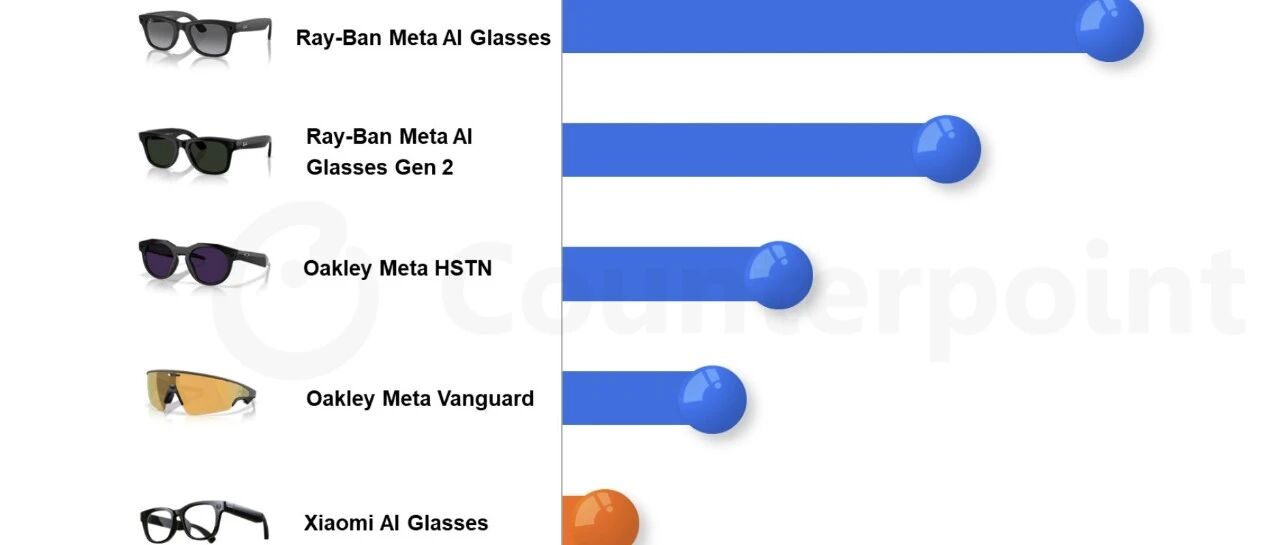
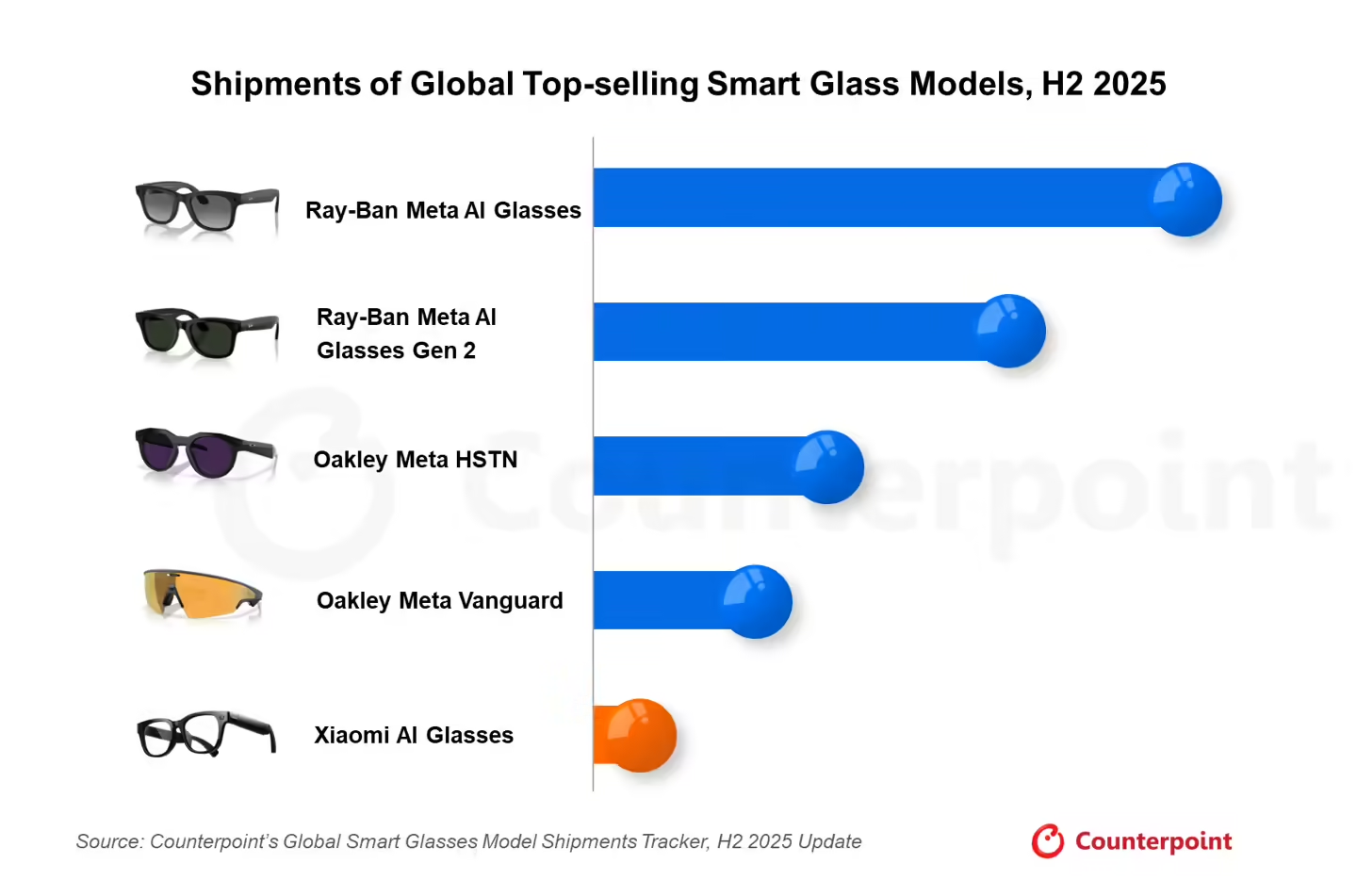
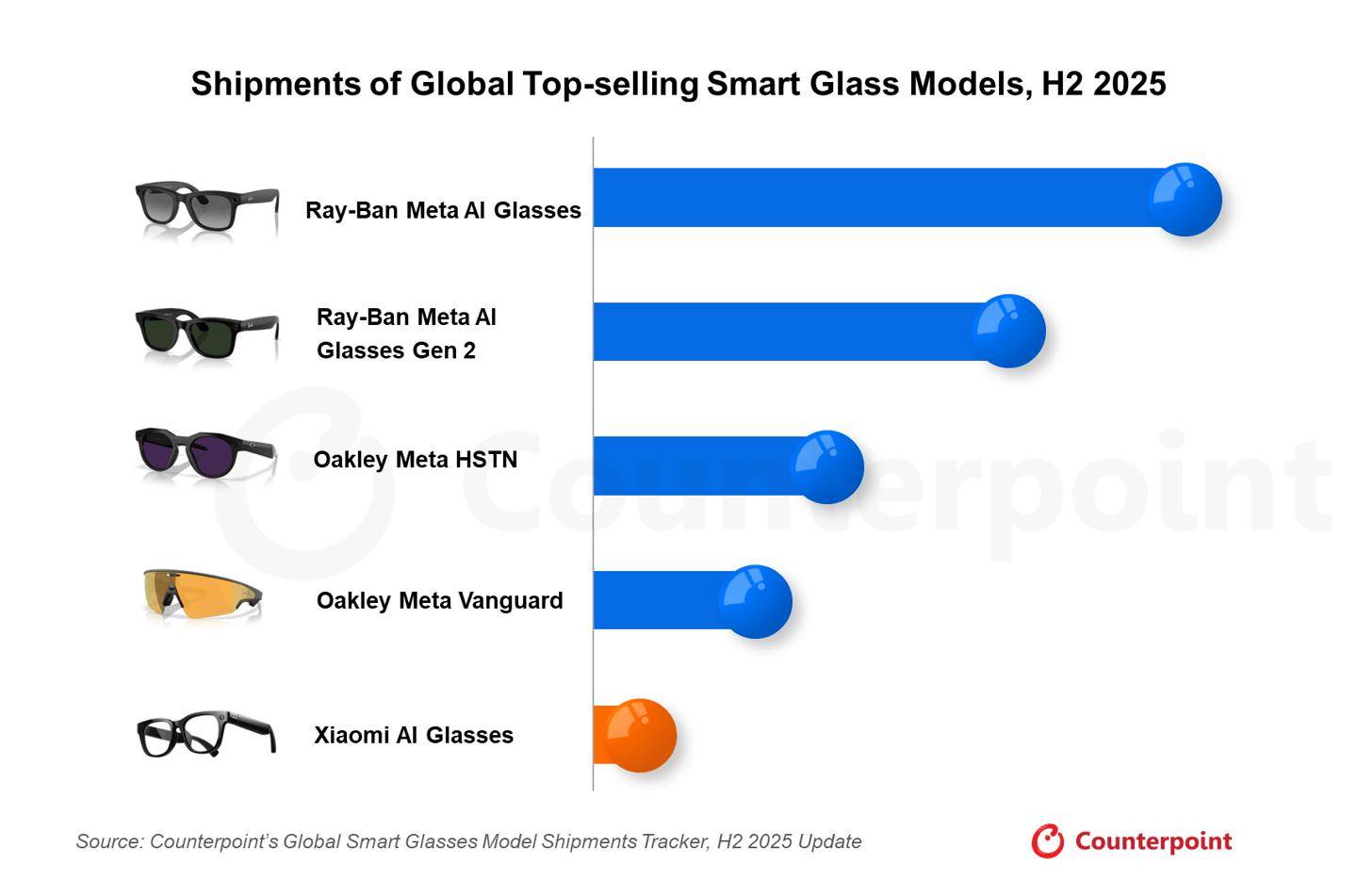
Core Insights - The global smart glasses market is expected to see a year-on-year growth of 139% in the second half of 2025, driven primarily by AI smart glasses, which will account for 88% of total shipments [4][5][10] - Meta has solidified its market leadership with an 82% share in the smart glasses market, largely due to its expanded product line and new product launches [5][7][10] - The average retail selling price (ASP) of AI smart glasses is projected to rise from $347 in the first half of 2025 to approximately $360 in the second half, influenced by Meta's pricing strategies [4][5] Market Dynamics - The demand for basic smart audio glasses has weakened, leading to a significant drop in their ASP to around $63, primarily due to reduced shipments from high-end manufacturers like Huawei and Amazon [4][5] - North America leads the market with a 37% share of total shipments in the second half of 2025, while China's market share has decreased to 6% despite numerous new product launches [5][11] - The Indian market has shown remarkable growth, with a 15-fold increase in shipments after Meta's entry, although it still only accounts for 2% of the global total [11][13] Competitive Landscape - Meta's new product, Ray-Ban Meta AI Glasses (second generation), has received positive feedback for its video capabilities, indicating a successful enhancement in user experience [10] - Xiaomi has emerged as a significant player in the Chinese market, ranking second after Meta, with its AI glasses shipments increasing by over 200% following a new product launch [10][11] - The overall market for other OEM manufacturers remains relatively small compared to Meta, which dominates the best-selling smart glasses rankings [7][10] Future Outlook - The smart glasses market is expected to maintain strong growth into 2026 and beyond, driven by aggressive expansion plans from leading manufacturers and the introduction of new brands [5][13] - Rising memory prices may pose challenges, but the overall impact is expected to be limited due to the high gross margins of AI glasses [13]
Counterpoint:2025 年下半年全球智能眼镜出货同比剧增139%,Meta独占 82%份额
Sou Hu Cai Jing· 2026-02-27 13:52
Core Insights - Global smart glasses shipments are expected to grow by 139% year-on-year in the second half of 2025, with AI smart glasses dominating the market, accounting for 88% of total shipments [1] - The average selling price of AI smart glasses increased from $347 to $360, primarily due to higher pricing of new Meta products [1] - Basic smart glasses saw a decline in average selling price to $63, driven by reduced shipments from companies like Huawei and Amazon, with a shift towards entry-level products priced below $50 [1] Company Performance - Meta continues to lead the market with a 82% market share in the second half of 2025, with the first generation of Ray-Ban Meta AI glasses reaching peak shipments in Q3 2025 [2] - The second generation of Ray-Ban Meta AI glasses launched in September 2025 received rapid market acceptance, while Oakley Meta HSTN and Vanguard accounted for over 30% of Meta's total shipments in Q4 2025 [2] User Feedback and Market Dynamics - User feedback indicates significant improvements in the video performance of the second generation Ray-Ban Meta AI glasses, including resolution upgrades and enhanced stabilization features [5] - Xiaomi ranks second globally, with its AI glasses seeing over 200% year-on-year shipment growth following software optimizations [5] - North America remains the largest market for smart glasses, accounting for 37% of shipments, while Western Europe follows at 30%. India experienced a 15-fold increase in shipments, but its overall market share is still only 2% [5] Future Outlook - The global smart glasses market is expected to maintain rapid growth in 2026 and beyond, driven by Meta's expansion and the entry of more manufacturers [5] - Rising storage chip prices may have some impact, but the high profit margins of AI smart glasses are expected to limit short-term effects [5]
Counterpoint:2025年下半年全球智能眼镜出货同比增长139%
Sou Hu Cai Jing· 2026-02-27 12:23
Core Insights - Global smart glasses shipments are expected to grow by 139% year-on-year in the second half of 2025, with AI smart glasses accounting for 88% of total shipments, driven by seasonal demand, Meta's product line expansion, and new product launches from Chinese manufacturers [1][3] - The average selling price (ASP) of AI smart glasses increased from $347 to $360, primarily due to higher pricing of new Meta products, while the ASP of basic smart glasses decreased to $63 due to reduced shipments from Huawei and Amazon [1][3] Group 1 - Meta continues to dominate the market with a 82% market share in the second half of 2025, with the first generation of Ray-Ban Meta AI glasses peaking in shipments in Q3 2025 and the second generation quickly gaining market acceptance after its launch in September 2025 [2][3] - The Oakley Meta HSTN and Vanguard models accounted for over 30% of Meta's total shipments in Q4 2025, reinforcing Meta's leadership in the global smart glasses market [2] Group 2 - User feedback indicates significant improvements in the video performance of the second generation Ray-Ban Meta AI glasses, including an upgrade in resolution from 1080p to 3K and enhanced stabilization features [3] - Xiaomi ranks second globally, with its AI glasses driving a shipment increase of over 200% following software optimizations [3] - North America is the largest market for smart glasses, accounting for 37% of shipments, followed by Western Europe at 30%. India saw a 15-fold increase in shipments, but its overall market share remains at only 2% [3] Group 3 - The global smart glasses market is expected to maintain rapid growth beyond 2026, driven by Meta's expansion and the entry of more manufacturers, although rising storage chip prices may have some impact [3]
未来五年复合增速有望达50%,AI眼镜有望成为AI应用落地的重要场景之一
Mei Ri Jing Ji Xin Wen· 2026-01-16 09:49
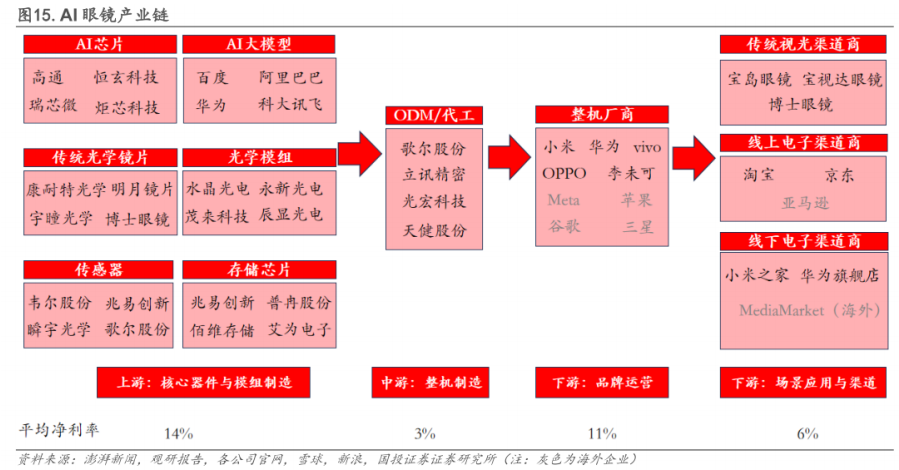
Core Insights - Meta has suggested that EssilorLuxottica SA increase the annual production capacity of its AI glasses, Ray-Ban, to 20 million units or more by the end of 2026, with discussions for further expansion to over 30 million units if demand is strong [1] - The AI glasses industry is seen as a key area for the application of AI technology, integrating features like voice assistance, real-time translation, and navigation reminders [2] Industry Overview - AI glasses are categorized into three types: 1. Non-camera AI glasses focusing on audio and communication features 2. Camera-equipped AI glasses that offer image capture and recognition capabilities 3. Display-equipped AI glasses (AI+AR) that integrate AR optical display technology for real-time output and gesture recognition [3] - The market penetration of AI glasses is currently very low, with a projected sales distribution in 2024 showing 96% for camera AI glasses, 3% for AR+AI glasses, and 1% for audio AI glasses [3] Market Potential - The AI glasses industry is expected to evolve into an AI+AR ultimate form, potentially replacing smartphones as the next generation of smart platforms, offering advantages such as enhanced user experience and immersive interaction [4] - The global market for AI glasses is projected to grow significantly, with shipments expected to rise from 9.93 million units in 2025 to 86.9 million units by 2030, corresponding to a market size increase from 19.7 billion yuan to 161.2 billion yuan, reflecting a compound annual growth rate of 50% [10] Competitive Landscape - Major companies are entering the AI glasses market, with notable product launches including: - Baidu's Xiaodu AI glasses, featuring first-person perspective photography and various smart functions [5] - Huawei's Smart Glasses 2, designed with a stylish aesthetic and advanced translation capabilities [5] - Xiaomi's AI glasses, which support video calls and live streaming [5] - Meta's new AR+AI glasses, marking a significant breakthrough in the field [6] Investment and Development Trends - The AI glasses sector is experiencing rapid investment, with state-owned capital leading the way, and 14 financing events reported in 2024, with nearly 80% from state-owned sources [7] - The industry is characterized by a value chain that includes upstream core components, midstream manufacturing, and downstream branding, with a "smile curve" distribution of value [8] - Companies like Songyuan Technology and Mingyue Lens are positioned to benefit from the growth in AI glasses, with advancements in chip design and optical components [11][12]
Meta pushes AI wearables into the future with jaw-dropping features
Youtube· 2025-12-25 19:30
Core Insights - Meta has launched three new pairs of AI-powered glasses, including the RayBan Generation 2 and two models in partnership with Oakley, aimed at enhancing user experience through hands-free technology [1][7]. Product Features - The RayBan Meta Gen 2 glasses feature 3K Ultra HD video capture, double the battery life lasting up to eight hours, and are priced at $379 [4]. - The Oakley Meta Hustons start at $399 and offer six frame and lens color combinations, built-in Meta AI for hands-free assistance, and performance insights [7][8]. - The Oakley Meta Vanguard glasses are designed for athletes and active lifestyles, featuring Oakley Prism lens technology, powerful open ear speakers, and compatibility with Garmin devices for health tracking [10][12]. User Benefits - The glasses allow users to perform tasks such as sending text messages, taking pictures, and listening to music without needing to use their hands or take out their phones [3][6]. - The AI functionality enhances the user experience by providing real-time information about the environment, making daily activities more engaging [5][6]. - The integration with Garmin devices allows users to monitor health metrics, such as heart rate, directly through the glasses [13][15]. Market Positioning - Meta's focus on stylish and functional wearables targets tech enthusiasts and fashion-forward consumers, expanding its presence in the wearable technology market [6][9]. - The partnership with Oakley signifies a strategic move to tap into the performance and sports market, appealing to a broader audience [7][10]. Future Outlook - Meta is optimistic about the upcoming holiday season, anticipating strong sales for its new AI wearables [17].

Mark Zuckerberg Delays Meta's 'Phoenix' Mixed Reality Glasses To 2027: 'Taking Extra Time To Deliver...' - Meta Platforms (NASDAQ:META)
Benzinga· 2025-12-07 06:17
Core Insights - Meta Platforms Inc. has delayed the launch of its "Phoenix" mixed reality glasses from the second half of 2026 to the first half of 2027 to ensure a polished and reliable product [2][3] Product Development - The decision to delay was influenced by discussions focused on making the business sustainable and delivering higher quality experiences [2] - The timeline shift is intended to provide teams with more time to refine the product without compromising on quality [3] Design and Features - The "Phoenix" glasses are reported to have a design similar to Google's products and Apple's Vision Pro, featuring an external power source to reduce weight and prevent overheating [4] - Meta launched two new models in September 2025: the $499 Oakley Meta Vanguard and the $799 Ray-Ban Meta Display, which have received mixed reviews regarding their everyday usefulness [5] Market Potential - CEO Mark Zuckerberg has expressed optimism about the profitability of Meta's wearables, highlighting the potential for AI and services to enhance hardware offerings [6]

Gene Munster Says Meta's New Display Glasses Deliver Impressive Tech But 'Not Much To Do,' Warning Mass Adoption Is Still Years Away - Meta Platforms (NASDAQ:META)
Benzinga· 2025-11-14 09:58
Core Insights - Gene Munster's review indicates that while Meta Platforms, Inc.'s new Display smart glasses have impressive technology, they lack practical utility for mainstream consumers [1][2][5] Product Evaluation - The hardware of the Meta Display initially impressed the reviewers, but they found limited functionality, stating there was "not much to do" with the product [2] - The glasses excel at displaying notifications but do not offer significant advantages over existing devices like smartphones or smartwatches [2] - Voice dictation was described as "buggy" and slower than using a phone, and photo quality was inferior to smartphone cameras [3] - The AI capabilities for object identification were criticized for being vague and inaccurate, falling behind competitors like OpenAI's ChatGPT and Google's Gemini [4] Investment Perspective - Despite the current limitations, Munster believes that Meta's $18 billion annual investment in Reality Labs is a strategic long-term decision, focusing on consumer wearables rather than enterprise headsets [5] - He predicts that mainstream adoption of such technology is still years away [5] Competitive Landscape - Meta recently launched two new smart glasses, the $499 Oakley Meta Vanguard and the $799 Ray-Ban Display, which are positioned against Apple's upcoming XR products, including smart glasses expected in 2027 [6] - Analyst Ming-Chi Kuo suggested that Apple could eventually surpass Meta's smart glasses lineup despite entering the market later [7]
电子通信行业2026年投资策略:星火肇始,征途无疆
EBSCN· 2025-11-11 08:33
Core Insights - The report highlights that AI is at the center of the global technology wave, with North American cloud providers' capital expenditures exceeding expectations, totaling $102.625 billion in Q3 2025, a 68% year-on-year increase [3][14] - The semiconductor market is projected to reach $800 billion by 2026, with a 9.9% year-on-year growth, driven significantly by AI demand [3][45] - Apple is expected to enter an innovation cycle in 2026, launching new products such as foldable phones and AR glasses, which could reshape the consumer electronics landscape [3][67] Group 1: AI Capital Expenditure - North American cloud providers' capital expenditures are projected to reach $408.6 billion in 2025, a 79% increase year-on-year, and $500 billion in 2026, a 22% increase [3][14] - The AI semiconductor market is expected to grow significantly, with GPU revenue projected to reach $129.7 billion by 2026, reflecting a compound annual growth rate of 26% [3][17] - NVIDIA has shipped approximately 6 million Blackwell GPUs and anticipates $500 billion in revenue from Blackwell and Rubin chips over the next two years [3][20] Group 2: Storage Market Dynamics - The NAND Flash market is entering a new upcycle driven by AI, with enterprise SSD contract prices expected to increase by 5%-10% in Q4 2025 due to tight supply [3][25] - DRAM manufacturers are shifting focus to higher-margin products like HBM and DDR5, leading to a structural shortage in DDR4, with new contract prices expected to rise by 20%-30% [3][30] - By 2030, the storage market is projected to account for 19% of the overall semiconductor market, which is expected to grow from $799.8 billion in 2025 to $1.22 trillion by 2030 [3][37] Group 3: Semiconductor Market Outlook - The global semiconductor market size is expected to grow by 15.4% in 2025, reaching $728 billion, with logic and storage chips seeing significant growth [3][45] - Advanced chip manufacturing capacity is projected to increase by 69% by 2028, driven by AI demand [3][49] - Global spending on 300mm wafer fab equipment is expected to reach $3.74 billion from 2026 to 2028, with significant investments in logic and micro components [3][53] Group 4: Consumer Electronics Innovations - Apple is accelerating its product innovation cycle, with plans to launch several new products, including AR glasses and foldable phones, in 2026-2027 [3][67] - Meta has positioned itself as a leader in AI glasses, with significant sales growth and market interest in AI eyewear [3][73] - The global AI glasses market is expected to see sales of 5.5 million units in 2025, driven by new product launches from major brands [3][79] Group 5: Investment Recommendations - The report suggests focusing on AI-related opportunities, particularly in North American and domestic computing power sectors, as well as storage and semiconductor segments [3][90] - Key companies to watch include major players in cloud computing, storage, and semiconductor manufacturing, as they are expected to benefit from the ongoing AI-driven market expansion [3][90]


天风证券:谷歌(GOOGL.US)正式发布第七代TPU 看好AI赛道成长性
Zhi Tong Cai Jing· 2025-11-10 23:52
Core Viewpoint - The ongoing US-China talks are easing relations, and the continued investment by three major tech giants indicates that global AI infrastructure development is accelerating, which is expected to drive demand in the computing supply chain for the long term [1][2]. Group 1: Cloud-side AI - The three major tech companies have significantly increased their capital expenditures (CapEx) to support AI infrastructure, with Meta raising its full-year CapEx forecast to $70-72 billion, and Microsoft reporting a 74% year-on-year increase in CapEx for Q1 FY2026 to $34.9 billion [2]. - Alphabet has also raised its full-year CapEx guidance to $91-93 billion, with Q3 capital expenditures exceeding market expectations, reinforcing its commitment to AI and cloud computing investments [2]. Group 2: Edge-side AI - The edge AI industry chain is heating up, with terminal manufacturers increasing investments in smart hardware and interactive innovations, leading to a rapid expansion of the ecosystem, with expectations for a significant year in edge AI by 2026 [3]. - Apple reported record earnings, with iPhone revenue expected to see double-digit growth in Q1 FY2026, driven by strong demand for the iPhone 17 series and ongoing investments in AI [4]. - Nvidia's GTC Washington Summit showcased the Vera Rubin super chip, with an adjusted GPU shipment target of 20 million units by 2026, indicating strong demand in the computing supply chain [5]. Group 3: Performance Highlights - Meta's smart glasses business exceeded expectations, with the AI glasses revenue becoming a key driver for Reality Labs' quarterly growth, prompting the company to increase production [6][7]. - Industrial Fulian reported a 62% year-on-year increase in net profit for Q3, driven by strong demand for AI servers and cloud computing, with overall revenue growth of 43% [8]. - Luxshare Precision showcased its leadership in the edge AI product innovation at the Optical Expo, highlighting breakthroughs in AI interconnection solutions [9]. Group 4: New Product Developments - Google officially launched the seventh-generation TPU "Ironwood," which is expected to enhance AI infrastructure capabilities significantly, with peak performance improvements of up to 10 times compared to previous models [10].

