
Optimus擎天柱

Search documents
目标年产百万台!特斯拉三代擎天柱即将亮相,Model S/X二季度停产为量产机器人让路
硬AI· 2026-02-02 11:24
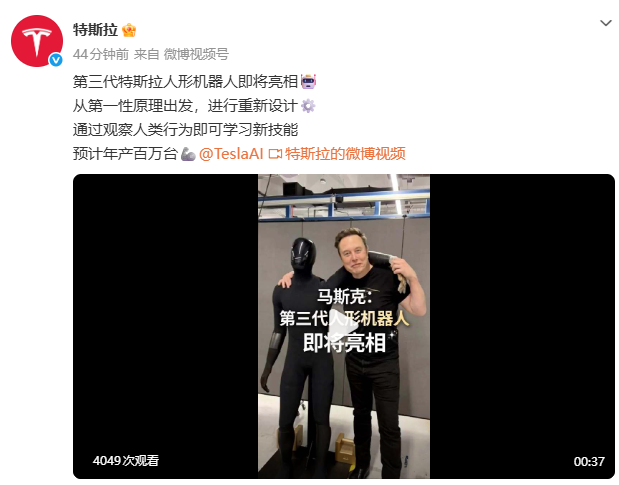
Core Viewpoint - Tesla is shifting its strategic focus towards humanoid robots, with the third-generation Optimus set to debut in Q1 2026 and a production target of 1 million units annually [2][3][12]. Group 1: Production Plans - The third-generation Optimus will be Tesla's first humanoid robot aimed at mass production, with a target annual capacity of 1 million units [2][7]. - To achieve this goal, Tesla plans to halt production of the Model S and Model X in Q2 2026 and convert the Fremont factory's production line for Optimus [3][12]. - The first production line for the third-generation Optimus is expected to be operational by the end of 2026 [3]. Group 2: Design and Technology - The third-generation Optimus will feature significant upgrades over the 2.5 version, including a new hand design, and will be developed from first principles to learn new skills by observing human behavior [4][9]. - The robot's components are designed based on first principles, leading to a longer ramp-up period for mass production compared to automotive products [4]. Group 3: Strategic Importance and Challenges - The humanoid robot project carries high expectations, but the path to realization is fraught with challenges, including previous operational issues and leadership changes within the robot division [12]. - Tesla's financial reliance on the success of the Optimus project is increasing, with CEO Elon Musk's $1 trillion compensation plan tied to the production of at least 1 million robots [12]. - The decision to repurpose the Fremont factory for robot production indicates a significant strategic bet on the Optimus project, sacrificing the capacity of two high-end vehicle models [12].


目标年产百万台!特斯拉三代擎天柱即将亮相,Model S/X二季度停产为量产机器人让路
Hua Er Jie Jian Wen· 2026-02-02 06:46
Core Insights - Tesla is transitioning its humanoid robot Optimus from concept to mass production, with the third generation set to debut in Q1 2026 and a target annual production capacity of 1 million units [1][5] - Significant production adjustments will be made, including halting Model S and Model X production in Q2 2026 to convert the Fremont factory's production line for Optimus [1][5] - The third generation of Optimus will feature major upgrades, including a new hand design, and the first production line is expected to be operational by the end of 2026 [1][5] Production Strategy - The shift to humanoid robots marks a strategic pivot for Tesla, emphasizing the importance of the Optimus project within the company's future plans [1][5] - Tesla's internal sources indicate that Optimus has a fully independent supply chain, and its mass production ramp-up period is expected to be longer than that of automotive products [1][5] Market Expectations and Challenges - The humanoid robot project carries high expectations but faces significant challenges, including previous operational issues and leadership changes within the robot division [5] - Elon Musk's ambitious targets include producing 5,000 robots by 2025 and selling Optimus to the public next year, with the potential for these robots to serve various roles beyond manufacturing [5] - The decision to repurpose the Fremont factory for Optimus production highlights Tesla's strategic commitment to this project, as it sacrifices the production capacity of two high-end models [5]

特斯拉(TSLA.US)Q4利润大降61% 马斯克用“科技宏图”撑起信仰:20亿美元押注xAI 太空算力与机器人掀起赛博狂欢
智通财经网· 2026-01-29 00:36
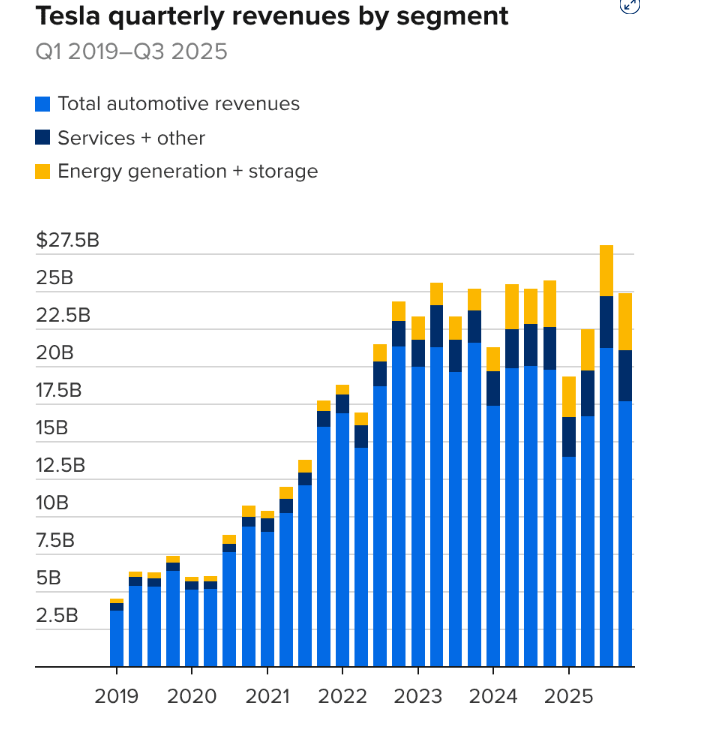
Core Insights - Tesla reported better-than-expected Q4 earnings, with record energy deployment, but faced a 3% decline in annual revenue for the first time in its history, and a significant 61% drop in Q4 net profit [1][5][12] - Despite the disappointing financials, CEO Elon Musk's optimistic outlook on AI, autonomous driving, and robotics has led to a post-earnings stock price increase of over 4% [2][13] - The company's automotive revenue fell by 11% year-over-year, while energy and storage revenue grew by 25%, indicating a shift in focus [5][15] Financial Performance - Q4 total revenue was approximately $24.9 billion, slightly above Wall Street's expectation of $24.79 billion, but down 3% year-over-year [2][5] - Adjusted earnings per share for Q4 were about $0.50, exceeding the expected $0.45 [2] - Tesla's gross margin for Q4 was approximately 20.1%, higher than the anticipated 17.1%, but net profit under GAAP standards saw a 61% year-over-year decline due to a 39% increase in operating expenses [5][12] Business Segments - The automotive segment, which has historically been the largest revenue contributor, saw a significant decline, dropping from approximately $19.8 billion to $17.7 billion year-over-year [5][12] - Energy generation and storage revenue reached about $3.84 billion, growing 25% year-over-year, which helped mitigate the decline in automotive revenue [15][18] - Tesla plans to invest $20 billion in xAI, a competitor to OpenAI, to enhance its AI capabilities [16][17] Strategic Initiatives - Tesla is transitioning its production lines to focus on the upcoming Optimus humanoid robot and plans to scale production significantly by 2026 [15][18] - The company is also expanding its Robotaxi service, with plans to roll out in several major U.S. cities [14][15] - Tesla's collaboration with SpaceX is expected to bolster its long-term growth narrative, as both companies are intertwined in Musk's broader vision for technology and infrastructure [19][20] Market Dynamics - Tesla faces increasing competition, particularly from BYD in the Chinese market, which has impacted its vehicle sales [2][9] - The decline in vehicle deliveries by 16% in Q4 and 8.6% for the year highlights ongoing challenges in the automotive sector [9][11] - Investors are increasingly viewing Tesla not just as an automotive company but as part of a larger ecosystem that includes SpaceX and AI technologies, which may support its valuation despite current struggles [2][19]
从造车到造“人”:奇瑞招商在即 车企抢占机器人赛道
Xin Jing Bao· 2025-09-16 09:37
Core Insights - Chery Automobile has introduced a humanoid robot named "Moyin" at the Jakarta International Auto Show, with plans for public release and potential sales to individual users in October [1][2] - The humanoid robot market is becoming a competitive arena for automakers, with companies like Tesla, Xpeng, and BYD also entering the field [3][4] Company Developments - Chery established a dedicated robotics company, "Mojia Zhichuang," in January 2023, with an initial investment of 100 million yuan [2] - The first batch of 220 "Moyin" robots was delivered in April 2023, and they are currently being used in Chery's dealerships in Malaysia for customer interaction [2] - Chery's strategy involves a phased approach: starting with 4S stores, expanding to shopping malls and public areas, and eventually targeting home use [2] Industry Trends - The humanoid robot market is projected to reach 8.239 billion yuan by 2025, representing about 50% of the global market [6] - The Chinese embodied intelligence market is expected to grow to 5.295 billion yuan, accounting for approximately 27% of the global market [6] Cost and Technology Challenges - Current costs for humanoid robots are high, with Chery's "Moyin" expected to drop to around 200,000 yuan per unit as key components become domestically sourced and production scales up [7][8] - The high costs are attributed to expensive core components such as high-precision servo joints and specialized AI chips, as well as significant R&D expenses [7][8] - Industry experts note that while automakers have advantages in manufacturing and supply chains, challenges remain in AI decision-making and adaptability to complex environments [7][8]