
RTX 50系显卡

Search documents
一周热榜精选:非农关闭本月降息大门!特朗普中期选举前发力?
Jin Shi Shu Ju· 2026-01-09 14:11
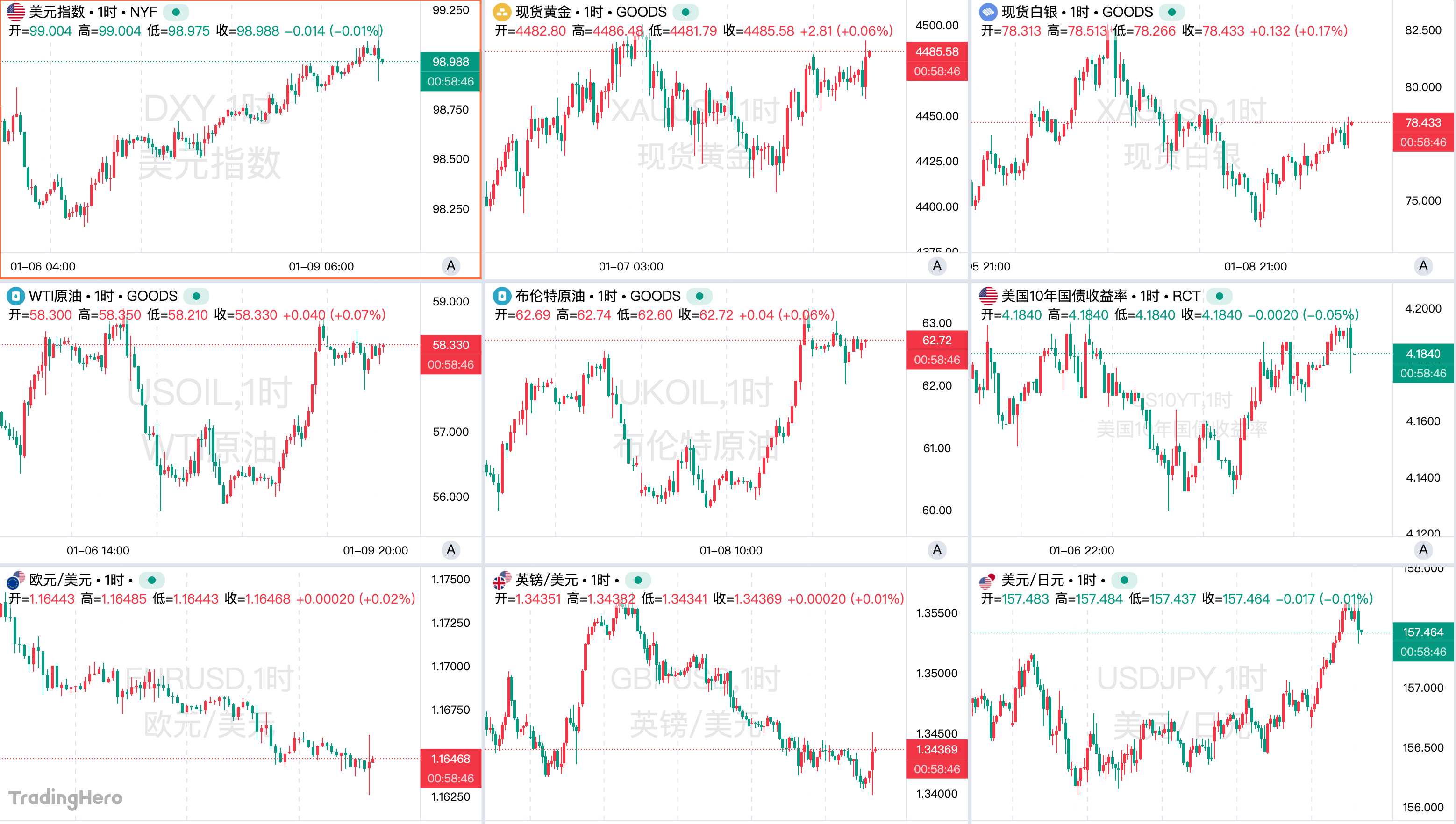
Group 1: Currency and Commodity Markets - The US dollar index has risen for four consecutive days, reaching a near one-month high above the 99 mark, supported by rising US Treasury yields and increased demand due to heightened risk aversion [1] - Gold prices experienced volatility, initially rising due to safe-haven demand from the Venezuela situation, peaking at $4500 per ounce before retreating, while silver showed even greater fluctuations [1] - The CME will raise margin requirements for gold, silver, platinum, and palladium futures on January 9, marking the third adjustment in a month, aimed at curbing speculation in the silver futures market [1] - Non-US currencies weakened overall, influenced by the stabilization of the dollar and market caution, with the euro and pound declining against the dollar for four consecutive days [1] Group 2: Oil Market Dynamics - International oil prices fluctuated significantly, initially rising due to uncertainty over supply from Venezuela, but later falling as Trump announced a deal with Venezuela, raising concerns over oversupply [2] - Oil prices rebounded on Thursday amid geopolitical crises raising supply disruption fears [2] Group 3: Investment Bank Predictions - Bank of America predicts the average gold price will reach $4538 per ounce by 2026, while silver could soar to between $135 and $309 per ounce [5] - Citigroup expects copper prices to potentially exceed $14,000 per ton in January [5] - Deutsche Bank suggests the energy sector may benefit the most from the BCOM index's annual rebalancing [5] Group 4: Economic Indicators and Employment Data - The US non-farm payroll report showed mixed results, with December adding 50,000 jobs, below the expected 60,000, while the unemployment rate fell to 4.4% [10] - The market perceives the drop in unemployment as closing the door on potential Fed rate cuts in January, with traders now pricing in a slower pace of rate reductions [11] Group 5: Commodity Index Rebalancing - The Bloomberg Commodity Index (BCOM) is undergoing annual rebalancing, with gold and silver facing significant sell-off pressures, estimated at $141 billion combined [13] - Gold's weight in the index will decrease from 20.4% to 14.9%, leading to a sell-off of approximately 2.4 million ounces of gold [13] Group 6: Geopolitical Events Impacting Markets - The situation in Venezuela has led to significant geopolitical tensions, with the US taking military action and controlling oil sales, which may impact global oil prices [6][7] - The ongoing protests in Iran, driven by economic hardships, have escalated, with significant implications for regional stability and potential international responses [18]




等离子散热“勇闯”CES2026:比纸薄、零噪音,但两座大山仍待翻越
3 6 Ke· 2026-01-09 11:23
Core Viewpoint - The introduction of YPlasma's DBD plasma cooling technology at CES 2026 represents a potential revolution in laptop cooling systems, aiming to replace traditional methods with a quieter, more efficient solution [3][22]. Group 1: Technology Overview - YPlasma's DBD technology utilizes a thin film, only 200 micrometers thick, to create airflow through ionized air, eliminating the need for traditional fans and mechanical components [4][6]. - The system operates at a noise level of approximately 17 decibels, significantly quieter than conventional gaming laptops, which can reach 50-60 decibels [7]. - The absence of moving parts makes the DBD system resistant to dust accumulation, potentially enhancing longevity and performance [8]. Group 2: Challenges and Considerations - The DBD technology faces challenges such as ozone production during operation, which can be harmful to human health, and the requirement for high voltage, complicating integration into consumer electronics [11][24]. - Reliability and safety concerns regarding high-voltage components must be addressed before widespread adoption can occur [24]. Group 3: Market Implications - If successful, DBD technology could liberate laptop design from the constraints of traditional cooling systems, allowing for larger batteries and thinner devices, thus enhancing user experience [22]. - The competition in solid-state cooling technologies is intensifying, with alternatives like Frore Systems' AirJet also emerging, each with distinct operational principles and market readiness [19][21].

英伟达吞下45亿美元“哑巴亏”
虎嗅APP· 2025-05-29 23:59
Core Viewpoint - Nvidia's Q1 FY2026 earnings report shows a 69% year-over-year revenue increase to $44.1 billion, exceeding market expectations, but net profit fell short of projections, leading to mixed market reactions [2][3]. Group 1: Financial Performance - Nvidia's revenue for the data center business reached $39.11 billion, a 73% year-over-year increase, with Blackwell chips contributing nearly 70% of this revenue [6][8]. - The gaming graphics card segment generated $3.8 billion in revenue, a 42% increase year-over-year, surpassing analyst expectations and setting a record for the division [9]. Group 2: Product Transition and Market Demand - The transition from Hopper to Blackwell architecture has been smoother than anticipated, with significant increases in GPU deliveries, from 30,000 units in Q4 to 72,000 units per week in Q1 [6][7]. - Despite initial concerns about demand, the AI industry's appetite for Nvidia's products remains strong, with expectations for further growth in Blackwell demand in the coming quarters [8]. Group 3: Challenges in the Chinese Market - Nvidia faces significant challenges in the Chinese market due to the H20 chip export ban, resulting in $2.5 billion in unfulfilled orders and $4.5 billion in inventory write-downs [11][12]. - The inability to access the Chinese AI chip market, projected to reach $50 billion in the next two to three years, poses a substantial loss for Nvidia [10][14]. - Nvidia's CEO expressed concerns that the loss of the Chinese market may be irreversible, complicating future product launches and market strategies [14][16].

英伟达吞下45亿美元“哑巴亏”
Hu Xiu· 2025-05-29 23:03
Core Viewpoint - Nvidia's Q1 2026 financial report shows a mixed performance, with revenue growth of 69% year-on-year to $44.1 billion, exceeding market expectations, but net profit of $18.775 billion fell short of forecasts, leading to a cautious market reaction [1][2]. Financial Performance - Nvidia's revenue for Q1 2026 reached $44.1 billion, a 69% increase compared to the previous year, surpassing the market expectation of $43.1 billion [1]. - The net profit for the quarter was $18.775 billion, which was below the market forecast of $20.767 billion [1]. Product Transition and Market Response - The successful transition from the Hopper architecture to the Blackwell architecture has been a key focus, with Blackwell contributing nearly 70% of data center revenue [4]. - Data center revenue for the quarter was $39.11 billion, reflecting a 73% year-on-year increase [4]. - Nvidia's stock price rose over 5% in after-hours trading following the earnings report, with Morgan Stanley raising its target price from $160 to $170 [2]. Production and Demand Insights - Nvidia's delivery of the B200 GPU has significantly increased, with weekly deliveries rising to 72,000 units in Q1 2026, up from 30,000 units in the previous quarter [4]. - The company’s strategy of sending sample chips to key clients like Microsoft and OpenAI has facilitated faster adoption of Blackwell [5]. Gaming Segment Performance - The gaming graphics card segment generated $3.8 billion in revenue, a 42% increase year-on-year, exceeding analyst expectations of $2.85 billion [7]. - The introduction of the RTX 50 series and the positive reception of its DLSS 4 technology have contributed to the growth in the gaming segment [7]. Challenges in the Chinese Market - Nvidia faces significant challenges in the Chinese market due to the H20 chip export ban, which has resulted in $2.5 billion in unfulfilled orders and $4.5 billion in inventory and procurement costs [8][12]. - The company has recognized that the inability to access the Chinese AI chip market could lead to substantial losses, estimating a potential revenue reduction of $8 billion in the next quarter due to these restrictions [11][12]. Profitability Impact - The non-GAAP gross margin for the quarter was reported at 61.0%, which could have reached 71.3% if not for the $4.5 billion costs associated with the H20 chips [9][10].