Rubin系列GPU

Search documents
H200获批出口中国,英伟达GPU:迎来新争议
创业邦· 2025-12-09 10:40
Group 1 - The U.S. Department of Commerce plans to approve a license allowing NVIDIA to sell its H200 chip to China, which has performance superior to the previously approved H20 but is not as advanced as the upcoming Blackwell and Rubin series chips [2] - This decision follows a meeting between former President Trump and NVIDIA CEO Jensen Huang, where they discussed the export of the H200 chip [2] - Some officials support the export of H200 as a compromise that allows NVIDIA to compete in China without enabling China to surpass the U.S. in AI capabilities [2][3] Group 2 - The H200 chip is estimated to have nearly six times the performance of the H20, and NVIDIA's new generation products typically show significant performance improvements [3] - Investors are keen to observe China's reaction to the anticipated approval of the H200 and what potential returns the U.S. might gain from this deal [3] Group 3 - The export of H200 could generate billions in sales for NVIDIA and assist Chinese tech giants struggling to access top-tier chips for training their models [4] - Huang emphasized the importance of allowing NVIDIA to compete in the Chinese market due to the country's substantial AI research talent [4] Group 4 - A blogger named Kakashii has raised doubts about NVIDIA's GPU shipment figures, specifically questioning Huang's claim of 6 million Blackwell GPUs shipped [6][8] - Kakashii's analysis suggests that the reported data center revenue of $111 billion does not align with the claimed shipment numbers, indicating a potential discrepancy [8][9] Group 5 - Michael Burry, known for predicting the 2008 housing crash, has called for evidence regarding NVIDIA's GPU inventory practices, expressing concerns about over-optimism in the tech sector [14][15] - Burry's analysis focuses on the rapid obsolescence of AI hardware, arguing that the depreciation period for these assets should be shorter than currently practiced, which could misrepresent economic realities [17][19] Group 6 - The Wall Street Journal highlights ongoing debates about NVIDIA's accounting practices, particularly regarding the depreciation of AI chips, which has garnered significant investor attention due to the substantial investments in AI infrastructure [20][21] - Companies like Meta have extended the expected lifespan of their assets, which can reduce depreciation expenses and inflate apparent profits, raising concerns about the accuracy of financial reporting in the tech sector [21][23]


H200获批出口中国,英伟达GPU:迎来新争议
半导体行业观察· 2025-12-09 01:50
Core Viewpoint - The U.S. government plans to allow Nvidia to export its H200 chips to China, marking a significant shift in the company's efforts to maintain market access in the world's second-largest economy [2][3]. Group 1: Export Approval and Market Impact - The U.S. Department of Commerce is expected to approve the export of Nvidia's H200 chips, which outperform the previously approved H20 but are less powerful than Nvidia's top-tier Blackwell and upcoming Rubin series chips [2]. - This decision follows a meeting between President Trump and Nvidia CEO Jensen Huang, where they discussed the H200 export issue [2]. - Officials, including AI Director David Sacks and Commerce Secretary Howard Lutnick, support the H200 export as a compromise that allows Nvidia to compete in China without enabling China to surpass the U.S. in AI [2]. Group 2: Performance and Sales Potential - The H200 chip's performance is estimated to be nearly six times that of the H20, which could lead to billions in sales for Nvidia and assist Chinese tech giants struggling to access top-tier chips for model training [3][4]. - Huang emphasized the importance of allowing Nvidia to compete in the Chinese market due to the country's significant AI demand and talent pool [4]. Group 3: GPU Shipment Controversy - A blogger named Kakashii has raised doubts about Nvidia's reported shipment of 6 million Blackwell GPUs, suggesting discrepancies between reported revenue and shipment numbers [6][8]. - Kakashii's analysis indicates that the reported $111 billion in data center revenue does not align with the claimed shipment figures, leading to questions about the actual number of GPUs sold [8][9]. Group 4: Accounting and Depreciation Concerns - Michael Burry has expressed concerns regarding the accounting practices related to AI hardware depreciation, arguing that companies may be overstating profits by extending the useful life of expensive GPUs [14][15]. - Burry suggests that the rapid pace of AI hardware development makes longer depreciation periods unrealistic, potentially masking the true economic performance of companies investing in AI [16][17]. - The ongoing debate about depreciation methods in the tech industry highlights the need for accurate accounting practices, especially as companies invest heavily in AI infrastructure [18][22].

黄仁勋赴台“要产能”背后:台积电N3产能增量有限,预计2026年供应保持高度紧张状态
Hua Er Jie Jian Wen· 2025-11-11 03:31
Core Viewpoint - Nvidia's CEO Jensen Huang is personally requesting increased chip supply from TSMC, indicating a critical demand for the next generation of AI chips, particularly the Rubin series, amidst a supply shortage in advanced chip manufacturing [1][2]. Group 1: Supply and Demand Dynamics - TSMC's current capacity for N3 chips is projected to reach only 140,000 to 145,000 wafers per month by the end of 2026, despite Nvidia's request for an expansion to 160,000 wafers per month [1][2]. - The supply-demand imbalance suggests that companies relying on advanced processes may face growth bottlenecks, while TSMC, having pricing power, is likely to see a significant increase in profit margins [1][6]. Group 2: Production Strategies - TSMC is not planning to build new N3 fabs but will prioritize existing facilities for next-generation nodes like N2 and A16, focusing on encouraging clients to migrate to leading nodes [2][4]. - The main increase in N3 capacity will come from converting production lines at the Tainan Fab 18, with an expected reduction in N4 utilization rates [2][4]. Group 3: Customer Demand - The demand for N3 process chips is expected to be extremely tight, with major tech companies like Nvidia, Broadcom, Amazon, Meta, and Microsoft all vying for capacity [5][6]. - Due to pre-booked capacity by primary clients, demand from cryptocurrency miners is likely to remain unmet in 2026 [5]. Group 4: Financial Implications for TSMC - The scarcity of capacity is translating into improved profitability for TSMC, with clients executing "hot-runs" and "super hot-runs" at prices 50% to 100% higher for expedited delivery [6]. - TSMC's gross margin is projected to reach the low to mid-60% range in the first half of 2026, exceeding current market expectations, supported by a planned price increase of 6% to 10% for advanced processes starting in Q1 2026 [6].


英伟达GTC大会后,再看光模块、PCB和SST
傅里叶的猫· 2025-10-29 12:35
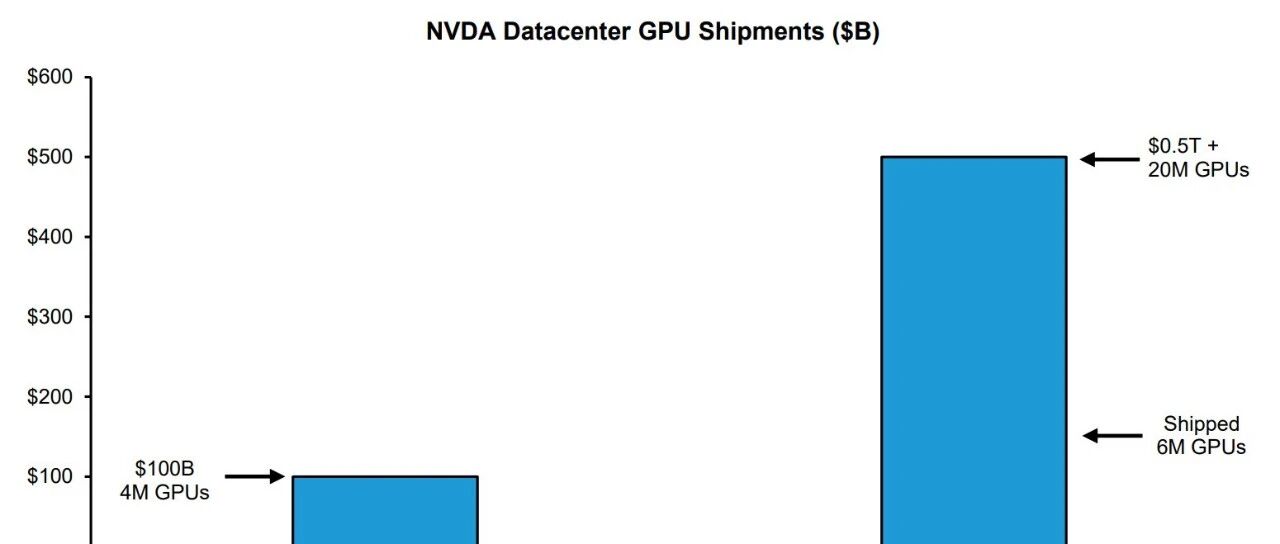
Core Insights - The article highlights the significant growth and future projections of NVIDIA's GPU series, particularly the Hopper, Blackwell, and Rubin series, indicating a strong revenue potential in the upcoming quarters [1][3]. GPU Shipment and Revenue - NVIDIA's Hopper series GPUs have shipped 4 million units, generating $100 billion in revenue [1] - The Blackwell series GPUs are expected to ship 20 million units over the next five quarters, with projected revenue of approximately $500 billion, marking a fivefold increase compared to the H series [3]. Optical Module Demand - Excluding the already shipped 6 million units, an additional 14 million optical modules are expected to be shipped in the next five quarters, averaging about 2.8 million units per quarter [4] - The demand for 1.6T optical modules is projected to exceed 34 million units, significantly surpassing previous market expectations of 20 million units by 2026 [6]. Pricing and Supply Dynamics - The anticipated supply shortage of 1.6T silicon optical chips is estimated at 10-20%, which may lead to order delays or shifts towards 800G optical modules [6] - The expected price for 1.6T optical modules has been adjusted to $1,000-$1,100 per unit, up from the previous forecast of $800-$900, potentially increasing revenue contributions by 15-20% [6]. Industry Valuation Concerns - The low valuation of the optical module industry is attributed to several factors, including reliance on North American markets, technological risks from new innovations, low manufacturing barriers, and uncertainty in long-term demand [8]. PCB Developments - The Rubin architecture will utilize M9 materials for its PCB designs, enhancing the value of the boards compared to previous generations [9][10]. - The total value of the PCB in the VR200 NVL144 CPX computing tray is projected to exceed $3,000, significantly higher than earlier models [11]. SST Implementation - The demand for SST (Smart Supply Technology) solutions is expected to accelerate, with major companies like Amazon seeking to test SST samples for potential integration in future products [16][17]. - The optimistic outlook for Rubin's shipment pace may enhance the valuation of the SST industry and the performance of related companies in the coming years [17].