
Zhong Guo Dian Li Bao

Search documents
中国能源传媒集团作品入选全国主流媒体新闻摄影展
Zhong Guo Dian Li Bao· 2025-10-22 03:41
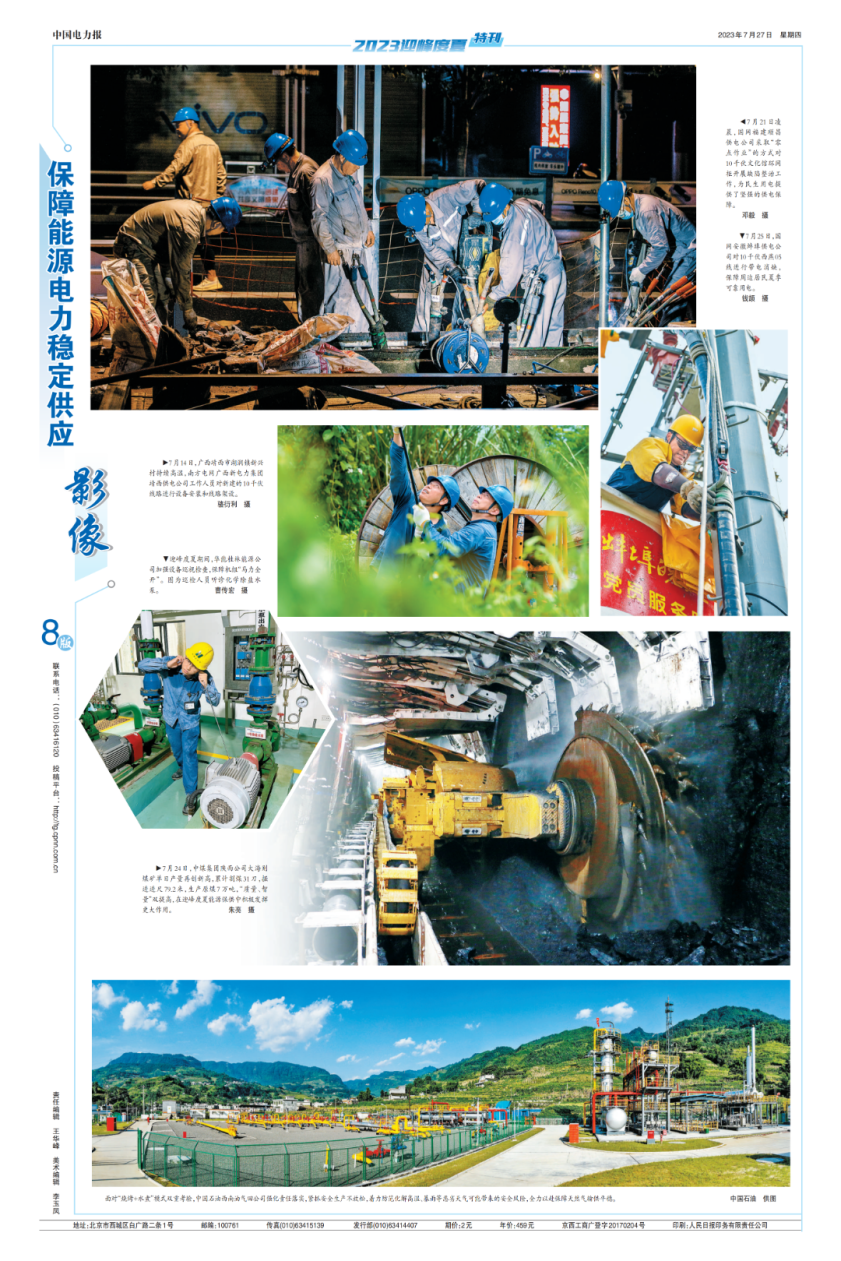
10月18日,由中国新闻摄影学会、中国行业报协会主办,科普时报社、人民摄影报社协办的"和平发展 逐梦同行"——全国主流媒体新闻摄影展在北京中 华世纪坛开幕。中国能源传媒集团1个摄影专题版面和4幅摄影作品在该摄影展展出。本次展览将持续10天,到10月27日结束。 ▲《中国电力报》摄影专题版面《保障能源电力稳定供应影像》。 ▲《巴渝铁军贯山河》2025年4月8日,在重庆市合川区沙鱼镇,国网重庆超高压公司输电运检人员完成 重庆段最后一段铁塔的登塔走线,标志着国家"十四五"电力发展规划重点项目——哈密—重庆±800千伏 特高压直流输电工程重庆段完成走线验收。林熙熙摄 ▲《洞庭湖堤防保卫战》2024年7月7日,在湖南岳阳市华容县团洲垸洞庭湖一线堤防决口封堵现场,经 中国安能建设集团有限公司技术专家组研究会商,采取"机械化双向立堵+船舶水上抛投"战法,按照"抢 筑裹头、双向立堵、水上抛投、突击合龙、加高加固、防渗闭气"的程序加紧进行封堵作业。马帅伟摄 责任编辑:闫弘旭 ▲《双机浇筑特高压》2025年5月,在四川阿坝州1000千伏阿坝—成都东特高压交流输电工程建设现场, 国网电力空间技术有限公司两架直升机经过5小时33分钟 ...

中国中煤与中国铁建高层会谈
Zhong Guo Dian Li Bao· 2025-10-21 11:25
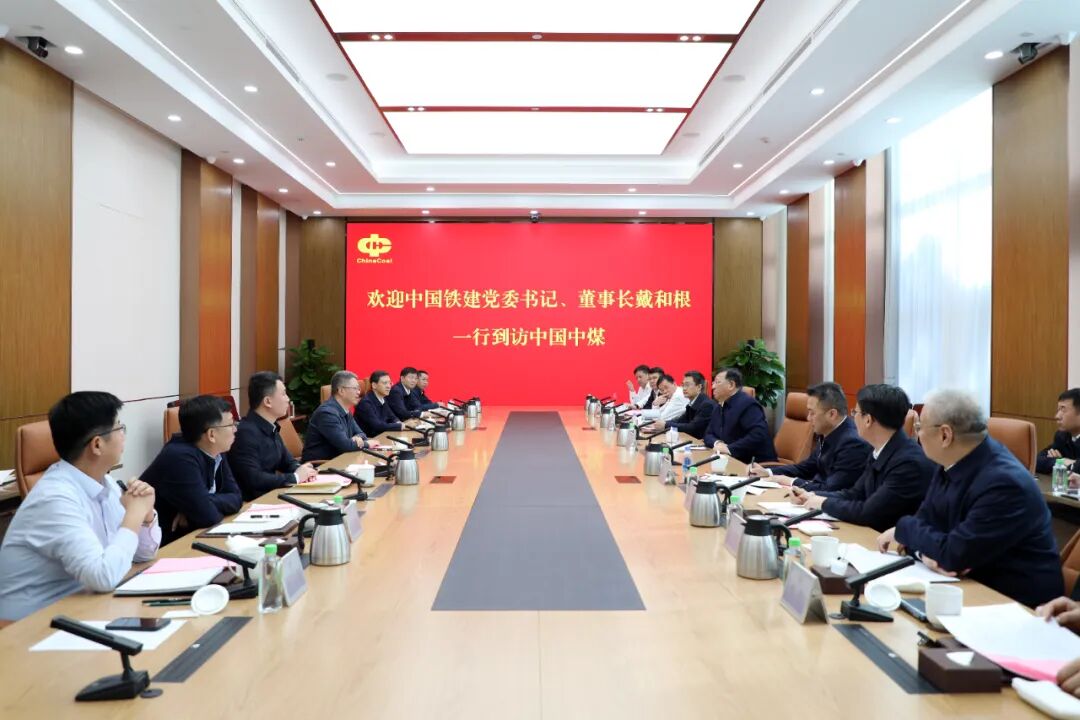
10月21日,中国中煤党委书记、董事长王树东在中国中煤总部会见中国铁建党委书记、董事长戴和根,双方就进一步深化合作展开交流。中国中煤党委常 委、副总经理倪嘉宇,中国铁建党委常委、副总裁黄昌富参加会见。 王树东对戴和根一行的到访表示欢迎,介绍了中国中煤发展历史、产业结构、生产经营、科技创新等基本情况,以及加快推进"两个联营+"、构建"两个对 冲"机制的思路举措,重点介绍了煤炭开采领域聚焦"少人无人",煤炭消费领域聚焦"少人少碳",煤基新材料领域聚焦"少人无碳"的发展思路。他表示, 中国铁建与中国中煤合作基础扎实、前景广阔,希望双方进一步加强对接与合作交流,延伸合作领域,共同推动央企间协同发展迈上更高水平、取得更实 成效。 中国中煤办公室、规划发展部、煤炭事业部、电力及新能源事业部、建设集团有关负责人,中国铁建总工程师代敬辉,相关部门、单位负责人参加会见。 来源:中国中煤 编辑:孔欣慰 校对:刘卓 戴和根对中国中煤近几年取得的成绩表示祝贺,感谢中国中煤对中国铁建的信任与支持,介绍了中国铁建历史沿革、业务结构、经营管理等基本情况,期 待双方进一步密切工作对接交流,加强在能源基础设施建设、绿色矿山、深部地下空间综合利 ...


中国华能首家抽水蓄能公司揭牌成立
Zhong Guo Dian Li Bao· 2025-10-21 08:27
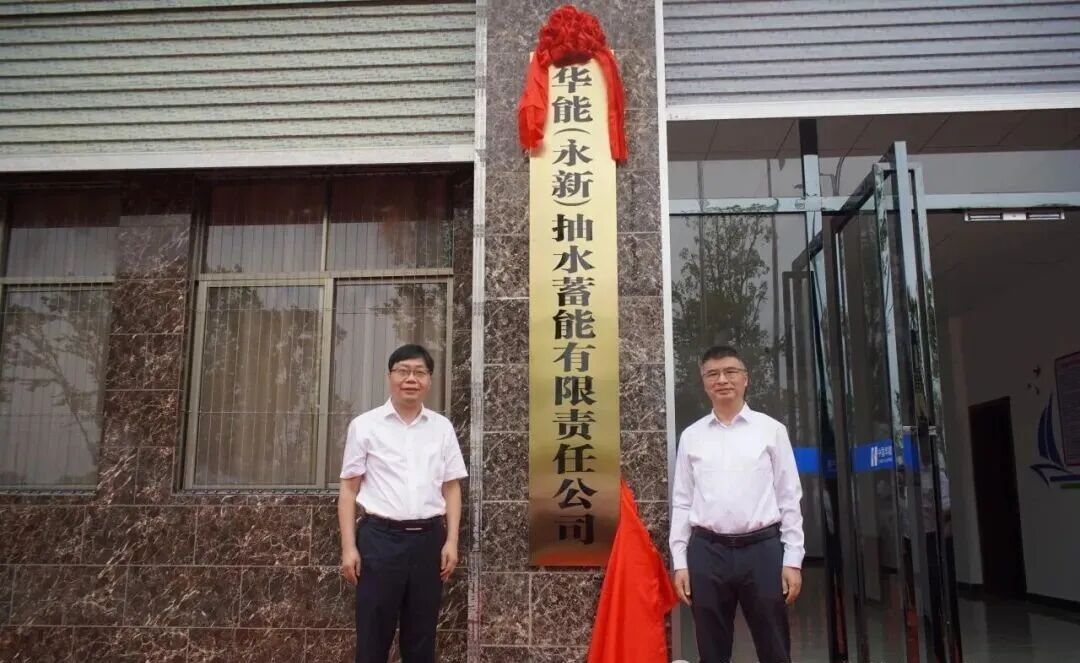
Core Insights - Huaneng (Yongxin) Pumped Storage Co., Ltd. was officially established in Yongxin County, Jiangxi Province, marking Huaneng's first pumped storage project and a key initiative under China's 14th Five-Year Plan [1][3] Group 1: Project Overview - The Yongxin pumped storage project has a total investment of 7.823 billion yuan, with an installed capacity of 1.2 million kilowatts (4×300,000 kilowatts) [4] - The project is designed as a daily regulation pure pumped storage power station, with a continuous full-load operation duration of 6 hours [4] - Upon completion, the power station is expected to generate an annual electricity output of 1.296 billion kilowatt-hours, saving approximately 420,000 tons of standard coal and reducing carbon dioxide emissions by about 1.06 million tons [4] Group 2: Strategic Importance - The project is a significant step for Huaneng in achieving its "dual carbon" goals and aligns with the new power system construction initiatives in Jiangxi Province [3] - Huaneng Jiangxi Branch aims to develop Yongxin into an important integrated clean energy base, combining wind, solar, and water storage [3] - The local government emphasizes its commitment to supporting the project through favorable policies and a conducive environment, aiming to make it a model project recognized by the community [3]

福建能源监管办排查输供电企业执行许可管理情况
Zhong Guo Dian Li Bao· 2025-10-21 08:18
福建能源监管办将坚持问题导向,强化许可服务规范化长效机制,进一步督促问题企业落实整改,限期 补办登记事项变更手续,持续提升资质许可管理工作质效。(杨懿) 责任编辑:于彤彤 为维护电力市场准入秩序,提升资质许可管理工作质效,按照国家能源局电力业务资质管理中心开展输 供电(含增量配电)企业执行电力业务许可管理制度情况排查工作的统一部署,福建能源监管办精心组 织、有序推进,顺利完成福建省输供电(含增量配电)企业执行许可管理情况排查工作。 本次排查主要针对省内输供电企业依法持证经营情况、登记事项及许可事项变更情况开展监管,重点排 查市、县级(含市辖区)供电企业经许可的供电营业区域范围与实际供电区域是否一致;持证企业是否 及时办理基本信息、主要供电设施、供电营业分支机构等登记事项变更申请,以及供电营业区域发生变 更后是否及时提出许可事项变更申请等问题。 福建能源监管办以此次排查工作为契机,加强与输供电企业的沟通联系,明确不同变更事项的责任主 体、申报频次、方式及时限,确保后续变更事项申报及时、准确。截至目前,累计排查1家输电企业、 79家供电企业和11家配售电企业,形成《输供电(含增量配电)企业执行许可管理制度情况排查 ...
中国海油周心怀辞任执行董事等职务
Zhong Guo Dian Li Bao· 2025-10-21 07:53
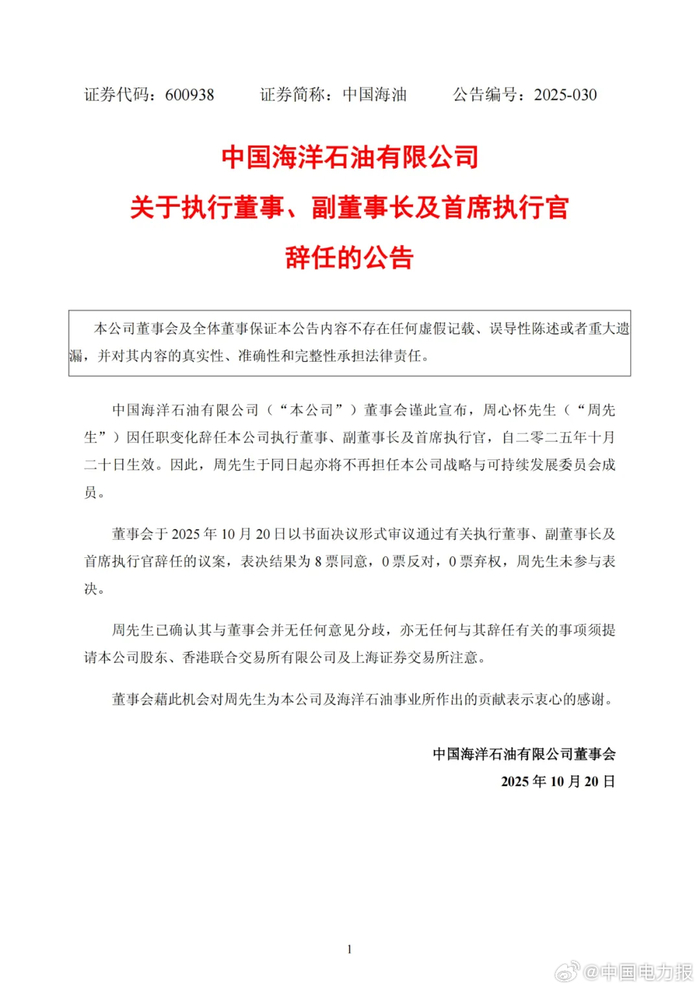
Core Points - Zhou Xinhai has resigned from his positions as Executive Director, Vice Chairman, and CEO of China National Offshore Oil Corporation (CNOOC), effective October 20, 2025 [1][2] - The board of directors approved the resignation with a unanimous vote of 8 in favor, with no opposition or abstentions [2] - Zhou has confirmed that there are no disagreements with the board and no matters related to his resignation that need to be brought to the attention of shareholders or stock exchanges [2] Company Contributions - The board expressed sincere gratitude for Zhou Xinhai's contributions to the company and the offshore oil industry [3]

中企海外首个地热电站EPC项目移交
Zhong Guo Dian Li Bao· 2025-10-21 07:44
Core Points - The EPC project of the Lumut Balai Phase II Geothermal Power Plant in Indonesia, undertaken by China Power Construction Group, has officially received the operation acceptance certificate from the owner, marking the successful handover of the project and its entry into the warranty period [1] - This project is the first successful handover of a geothermal power plant EPC project by a Chinese company overseas [1] Project Execution - Since the commencement of the project, the China Power Construction project team has adhered to scientific planning, strict control, and precise execution, overcoming challenges such as tight schedules, complex environments, and limited resources [1] - The project achieved key milestones including the start of operation (SLO), commercial operation (COD), 15 days of reliability operation, and completion certificate (CC), with performance test results exceeding contract indicators [1] Significance and Future Plans - The Lumut Balai Phase II Geothermal Power Plant project serves as an important demonstration of China-Indonesia energy cooperation, showcasing the engineering strength and technical standards of China Power Construction in complex environments [1] - The company will continue to uphold the principles of "high, strict, detailed, and practical" during the warranty period, ensuring operational support and expediting the handling of any remaining defects to achieve the final fulfillment goals [1]

“双碳”五周年的电力担当与未来展望
Zhong Guo Dian Li Bao· 2025-10-21 02:07
Core Viewpoint - The Chinese power industry has made significant progress in achieving the "dual carbon" goals over the past five years, with renewable energy surpassing coal power in installed capacity and increasing its share in the energy mix, while facing ongoing challenges and the need for further advancements [1][2][3]. Group 1: Achievements - Renewable energy installed capacity has historically surpassed coal power, with wind and solar power capacity expected to exceed 1.67 billion kilowatts by mid-2025, accounting for approximately 45.8% of total installed capacity [2]. - The carbon intensity of the power sector continues to decline, with a projected 11.6% reduction in energy consumption per unit of GDP by 2024 compared to 2020, equating to a decrease of 1.1 billion tons of CO2 emissions [2]. - Significant technological innovations have emerged, including smart grids and virtual power plants, enhancing the system's ability to accommodate a high proportion of renewable energy [2]. Group 2: Challenges - There is a structural tension between energy security and the rapid reduction of fossil fuels, as coal power remains a crucial backup source that cannot be fully replaced in the short term [3]. - Issues with renewable energy consumption and system adjustment capabilities persist, with some regions experiencing a rebound in renewable energy curtailment and low consumption rates [3]. - The industry faces bottlenecks in high-end materials and key components for solar and wind energy, as well as concerns over low-level redundant construction and overcapacity in certain areas [3]. Group 3: Future Pathways - The power industry must integrate safety and low-carbon goals, balancing the role of coal power during the transition period while promoting its transformation into a more flexible and supportive energy source [4]. - There is a need to accelerate the construction of a new power system dominated by renewable energy, enhancing the integration of various energy sources and improving cross-regional adjustment capabilities [4]. - The development of new energy storage technologies and the establishment of a multi-level adjustment system are essential for increasing system flexibility [5]. - Digitalization and smart technologies should be leveraged to enhance operational efficiency and renewable energy consumption capabilities [5]. - The market and policy mechanisms require improvement, including expanding the national carbon market and refining the electricity pricing mechanism to reflect green value [5]. - Strengthening international cooperation and setting standards will enhance China's influence in the global clean energy supply chain [5].
全球首个!在内蒙古
Zhong Guo Dian Li Bao· 2025-10-20 09:42
Core Insights - The world's first zero-carbon anode material factory has officially launched in Wuhai, Inner Mongolia, on October 19 [1][2] - The factory will operate entirely on green energy, significantly contributing to the reduction of carbon emissions and supporting the region's transition to a low-carbon economy [2] Group 1: Project Overview - The zero-carbon anode material factory is part of a larger project that aims to produce 400,000 tons of lithium-ion battery anode materials in three phases [3] - The first phase, which includes a graphite factory with an annual production capacity of 100,000 tons, has already commenced operations [3] Group 2: Environmental Impact - The project is expected to reduce carbon dioxide emissions by approximately 400,000 tons annually and decrease standard coal consumption by about 160,000 tons [2] - The initiative aligns with China's dual carbon goals, marking a significant shift for Wuhai, a city traditionally known for its coal industry, towards greener energy solutions [2] Group 3: Technological and Operational Aspects - The production process for lithium battery anode materials requires maintaining ultra-high temperatures of around 3000°C, resulting in an energy consumption of approximately 6000 kWh per ton of product [3] - The company is implementing five key strategies—green electricity supply, energy conservation, green logistics, circular ecology, and smart management—to systematically advance its zero-carbon transformation [3]


风能北京宣言2.0:风电年新增装机不低于1.2亿千瓦
Zhong Guo Dian Li Bao· 2025-10-20 09:39
Core Points - The "Wind Energy Beijing Declaration 2.0" was officially released during the 2025 Beijing International Wind Energy Conference, setting ambitious targets for wind power installation in China [1] - The declaration aims for an annual new installation of no less than 120 million kilowatts during the 14th Five-Year Plan period, with a cumulative installed capacity of 1.3 billion kilowatts by 2030, 2 billion kilowatts by 2035, and 5 billion kilowatts by 2060 [1] - The previous "Wind Energy Beijing Declaration 1.0" had set lower targets, which have been exceeded, indicating significant growth in China's wind power industry [1] Industry Insights - The declaration is based on consensus from over 1,000 wind energy companies globally and aligns with China's new round of national contributions to climate goals [2] - It emphasizes that China's onshore and offshore wind energy resource development potential exceeds 12.7 billion kilowatts, positioning wind power as a highly competitive low-carbon energy source [2] - The declaration outlines five key initiatives: aligning industrial planning with climate goals, improving market policies for high wind power ratios, collaborative research on key technologies, promoting integration with hydrogen and ammonia industries, and deepening international cooperation to build resilient supply chains [2] - The declaration is seen as a guiding framework for the long-term development of the wind power industry and highlights China's commitment to global energy transition [2]
