QYResearch

Search documents
全球压载水管理系统市场前10强生产商排名及市场占有率
QYResearch· 2025-05-09 10:05
Core Viewpoint - The Ballast Water Management System (BWMS) is essential for preventing harmful aquatic organisms from spreading through ships' ballast water, thus protecting marine ecosystems. The system processes ballast water using physical, chemical, or biological methods to eliminate or reduce harmful organisms [1][3]. Market Overview - The global BWMS market is projected to reach $1.51 billion by 2031, with a compound annual growth rate (CAGR) of -16.4% over the coming years [3]. - The leading manufacturers in the BWMS market include Alfa Laval, Qingdao Double Star Marine Environmental Engineering Co., Ltd., JFE Engineering, and others, with the top ten companies holding approximately 55.0% of the market share in 2024 [7][8]. Product Segmentation - The dominant product type in the BWMS market is the ballast water management system with a capacity of 1500-5000 m³, accounting for about 72.5% of the market share [10]. - In terms of application, retrofitting existing ships is the largest market segment, representing approximately 83.3% of the demand [13]. Market Drivers - Strict environmental regulations, such as the International Maritime Organization's (IMO) Ballast Water Management Convention, which requires all ships to install approved BWMS, have led to increased compliance demands [18]. - Growing environmental awareness among the public and governments has intensified the enforcement of environmental standards, promoting the development and adoption of advanced BWMS technologies [19]. - Government incentives, including subsidies and tax benefits, are encouraging the adoption of BWMS, easing the financial burden on shipowners [20]. - Technological advancements in BWMS, such as hybrid systems combining filtration, UV radiation, and electrochlorination, have improved treatment efficiency and flexibility [21]. Market Challenges - High installation and maintenance costs pose a significant barrier, with initial costs ranging from tens of thousands to over a million dollars depending on the system type and ship size [22]. - The technical adaptability and operational complexity of BWMS can hinder efficiency, especially in varying marine environments [23]. - Regulatory inconsistencies across different countries complicate compliance for shipowners, increasing operational costs and uncertainties [24].


2025-2031全球与中国激光武器市场现状及未来发展趋势
QYResearch· 2025-05-08 09:45
Core Viewpoint - Laser weapons utilize high-energy laser beams for attacks, providing high precision, speed, and low operational costs compared to traditional weapons [1][2][3][4] Development Stages - Early Exploration Stage (1960s-1980s): The first ruby laser was created in 1960, laying the foundation for laser weapon development, but initial power levels were too low for effective damage [6] - Technological Breakthrough Stage (1990s-early 2000s): Advancements in high-power lasers improved weapon performance, with significant developments in tactical laser systems by countries like the USA and Israel [7][8] - Rapid Development Stage (2010s-present): The emergence of advanced laser technologies, such as fiber lasers, has driven the growth of laser weapons, with countries increasing R&D investments and conducting practical tests [9][10] Current Technology Status - High Power: Research focuses on increasing output power, with some advanced systems achieving power levels in the tens of kilowatts [10] - Miniaturization and Integration: Advances in technology have led to smaller, lighter systems that can be integrated into various platforms [10] - Intelligence: Development towards smart laser weapons capable of automatic target recognition and engagement [11] Application Status - Military Applications: Laser weapons are used in air defense, electronic countermeasures, and space operations [12] Market Competition Landscape - USA: Leading in laser weapon technology with significant investments from military and research institutions, featuring companies like Lockheed Martin and Boeing [13] - Israel: Strong capabilities in tactical laser systems, focusing on air defense and electronic warfare [13] - China: Rapid advancements in laser weaponry with substantial investments and various developed systems [13] - Other Regions: Europe and Russia are also actively developing laser weapons, with emerging countries increasing their focus [13] Global Market Size and Growth Trends - The global laser weapon market is projected to reach $645 million in 2024 and $2.257 billion by 2031, with a CAGR of 20.35% from 2025 to 2031 [16] - China’s market is expected to grow from $1.149 million in 2024 to $5.182 million by 2031, increasing its global market share from 17.81% to 22.96% [16] - North America is currently the largest market, followed by Europe and China, with China expected to experience the fastest growth [16] Key Companies - Major global players include Lockheed Martin, Raytheon, Kord, NLight, and China Aerospace Science and Industry Corporation, with the top tier holding approximately 38.17% of the market share in 2024 [17][18]

全球冷却液控制阀市场前10强生产商排名及市场占有率
QYResearch· 2025-05-08 09:45
Core Viewpoint - The global coolant control valve market is projected to reach USD 570 million by 2031, with a compound annual growth rate (CAGR) of 11.0% in the coming years [2]. Market Overview - The coolant control valve is a critical component in automotive engine cooling systems, regulating coolant flow to maintain optimal engine temperatures [1]. - The market is dominated by 3-way coolant control valves, which hold approximately 63.1% of the global market share [8]. - Passenger vehicles represent the largest application market, accounting for about 75.4% of the total demand [11]. Market Drivers - Stricter environmental regulations and emission standards are increasing the demand for efficient cooling systems, with coolant control valves playing a key role in meeting these requirements [14]. - The rapid growth of electric vehicles (EVs) and hybrid electric vehicles (HEVs) is significantly impacting the coolant control valve market, as these vehicles have more complex cooling system needs [14]. - The push for vehicle lightweighting and energy efficiency is driving the demand for coolant control valves, which help manage coolant flow and improve fuel efficiency [14]. Market Challenges - High production costs and technical requirements pose barriers to entry for smaller manufacturers, as the production of high-performance coolant control valves demands advanced materials and complex manufacturing processes [15][16]. - Fluctuations in raw material prices, including metals and high-performance plastics, can directly affect production costs and market pricing [17]. - Intense market competition leads to product homogenization and price wars, challenging manufacturers to enhance product quality and reduce costs [18]. - Consumer acceptance of new technologies, such as smart coolant control valves, remains low, particularly in developing countries, which may hinder market penetration [19].

全球热喷涂设备市场前10强生产商排名及市场占有率
QYResearch· 2025-05-08 09:45
Core Insights - The global thermal spray equipment market is projected to reach USD 420 million by 2031, with a compound annual growth rate (CAGR) of 2.0% in the coming years [2]. Market Overview - The leading manufacturers in the global thermal spray equipment market include Oerlikon Metco, Praxair Surface Technologies, Lincotek Equipment, GTV Verschleißschutz GmbH, and United Coatings, with the top five companies holding approximately 63.0% market share in 2024 [6]. - Plasma spraying is the dominant product type, accounting for about 31.2% of the market share [9]. - The power generation sector is the largest downstream market, representing approximately 18.0% of demand [11]. Market Drivers - Industrial development demands: Thermal spray equipment enhances the performance and lifespan of aerospace engine components and improves the reliability and durability of automotive parts [15]. - Technological advantages: The equipment can spray on various substrates, ensuring high precision and uniformity in coatings, which can be tailored for specific applications [15]. - Environmental policy promotion: As traditional surface treatment processes face restrictions due to pollution, thermal spray technology emerges as a greener alternative [15]. - Emerging field developments: In renewable energy sectors, thermal spray equipment protects critical components from corrosion and wear, extending their lifespan [15]. Market Challenges - Cost constraints: The high price of equipment and operational costs due to the need for specialized machinery limit adoption, especially among small and medium enterprises [16]. - High technical requirements: Skilled personnel are necessary for operation, but there is a shortage of qualified technicians in the market [16]. - Environmental impact: The thermal spraying process generates smoke and dust, necessitating investment in environmental compliance, which increases production costs [16]. - Intense industry competition: Numerous companies are entering the thermal spray equipment market, leading to price reductions and compressed profit margins [16].

全球与中国半导体测试机市场现状及未来发展趋势(2025-2031)
QYResearch· 2025-05-07 09:06
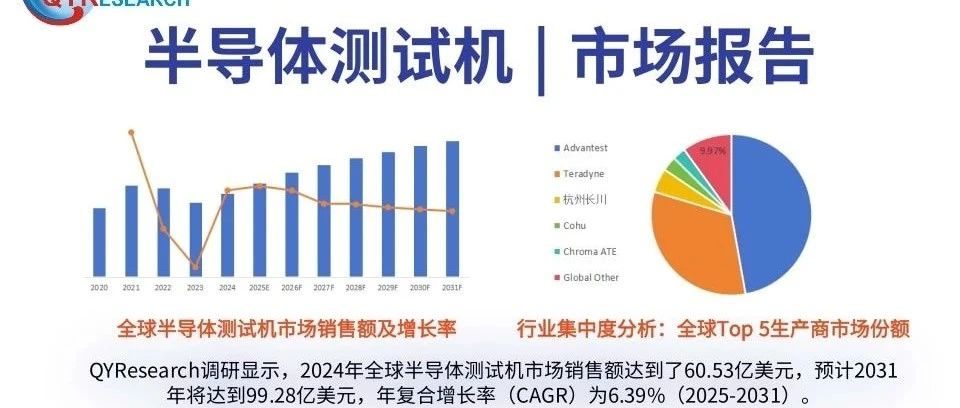
Core Viewpoint - The global semiconductor tester market is projected to grow from $6,053.36 million in 2024 to $9,927.50 million by 2031, with a CAGR of 6.39% [4]. Global Semiconductor Tester Market Overview - The semiconductor tester is essential for verifying the functionality, performance, and reliability of chips, with SoC testers holding a 52.23% market share [7]. - Major manufacturers include Advantest, Teradyne, and domestic companies like Hangzhou Changchuan and Beijing Huafeng, with the top five companies accounting for over 90% of the market [10]. - The Asia-Pacific region is the largest consumer market, accounting for over 78% of global sales, with China expected to grow from $1,782.97 million in 2024 to $3,734.76 million by 2031 [10]. Market Demand and Growth Drivers - The demand for semiconductor testers is driven by the increasing complexity and performance requirements of chips, particularly from packaging and testing companies, which account for 68.71% of the market [11]. - Key application areas include consumer electronics, automotive electronics, and AI, with rapid growth in smart driving and new energy vehicles driving the need for high-reliability testing equipment [11]. Industry Challenges - The semiconductor tester industry faces high technical barriers, requiring advanced signal processing and data transmission capabilities [11]. - High costs associated with core components like FPGA and ADC/DAC chips pose challenges for manufacturers [11]. - Geopolitical risks, particularly U.S. export controls on semiconductor equipment, significantly impact the global supply chain and Chinese market access [11]. Policy Analysis - The semiconductor tester industry is a focus for major economies, with the U.S. providing $52 billion in funding through the CHIPS Act to support domestic manufacturing and R&D [13]. - Europe plans to invest €43 billion in semiconductor R&D and production, while Japan is implementing policies to support domestic semiconductor industry upgrades [14]. - China is also promoting domestic semiconductor testing equipment development through its "14th Five-Year Plan" and investment funds [14].
全球半导体用氯硅烷市场前10强生产商排名及市场占有率
QYResearch· 2025-05-07 09:06
Core Insights - The global semiconductor chlorosilane market is projected to reach $1.26 billion by 2031, with a compound annual growth rate (CAGR) of 8.2% in the coming years [2] - The primary product in this market is trichlorosilane, which holds approximately 41.8% market share [9] - The main application for chlorosilane is in silicon wafer preparation, accounting for about 44.0% of the demand [11] Market Overview - The semiconductor chlorosilane market is driven by the rapid development of the semiconductor industry, with increasing demand for chips due to advancements in 5G, AI, IoT, and automotive electronics [15] - Technological innovations in chip manufacturing processes are pushing the need for high-quality silicon materials, which chlorosilane can provide [15] - The growth of the photovoltaic industry is also contributing to the demand for chlorosilane, as it is used to produce high-purity silicon for solar cells [15] Market Challenges - Chlorosilane poses safety risks due to its volatility and corrosiveness, necessitating strict safety protocols during production, storage, and transportation [16] - The high purity requirement for chlorosilane in semiconductor applications, often exceeding 99.9999%, presents significant technical and cost challenges [16] - The stability of raw material supply, such as silicon powder and chlorine gas, is crucial for chlorosilane production, as fluctuations can impact market stability [16] - The market is highly competitive, with both established international giants and emerging companies vying for market share, necessitating continuous R&D investment [16] Key Players - Major global manufacturers of semiconductor chlorosilane include Wacker, Air Liquide, Shin-Etsu, Tokuyama, and SK Specialty, with the top five companies holding approximately 45.0% of the market share in 2024 [5]

全球大气数据测试仪市场前10强生产商排名及市场占有率
QYResearch· 2025-05-07 09:06
全球 大气数据测试仪 市场前 10 强生产商排名及市场占有率(基于 2 024 年调研数据;目前最新数据以本公 司最新调研数据为准) 大气数据测试仪是一种用于检测各种国防航空工业及民航运输业飞行器飞行参数(高度、爬升率、指示空速、真空 速、马赫数、空速变化率等)仪表的专用检测仪器,飞行参数仪表包括大气数据机和各种膜盒高度表、空速表和马 赫数表等,这些飞行参数都与压力量值息息相关,这些参数是控制飞行器空中飞行姿态的重要信息,是飞行器和发 动机自动控制、导航、火控、空中管制、告警等系统必不可少的信息,是飞行器飞行安全可靠的重要保障。 大气数据测试仪,全球市场总体规模 据 QYResearch 调研团队最新报告"全球大气数据测试仪市场报告 2025-2031 "显示,预计 2031 年全球大气数据测试 仪市场规模将达到 2.2 亿美元,未来几年年复合增长率 CAGR 为 5.1% 。 如上图表 / 数据,摘自 QYResearch 报告"全球 大气数据测试仪 市场研究报告 2025-2031 ",排名基于 2 024 数据。目前最新数据,以本公司最新调研数据为 准。 根据 QYResearch 头部企业研究中心调研 ...

2025-2031全球及中国压滤机行业研究及十五五规划分析报告
QYResearch· 2025-05-06 09:47
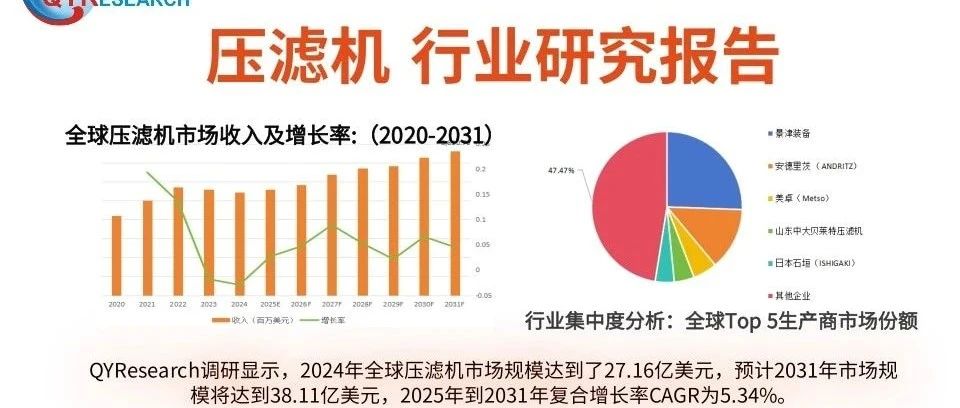
Core Viewpoint - The global filter press market is projected to grow from $2.103 billion in 2021 to $2.789 billion by 2025, with a CAGR of 2.67% during this period, and is expected to reach $3.81 billion by 2031, reflecting a CAGR of 5.34% from 2025 to 2031 [3][5]. Market Overview - The filter press is primarily used for solid-liquid separation and finds applications in various industries such as wastewater treatment, mining, chemicals, pharmaceuticals, food, and metallurgy [5][9]. - In 2024, the Chinese filter press market revenue is expected to reach $1.177 billion, with a projected CAGR of 6.53% from 2025 to 2031 [7]. Regional Insights - The Asia-Pacific region is the largest consumer market for filter presses, accounting for approximately 60% of global market revenue, driven by rapid economic growth and stringent environmental policies in countries like China and India [9]. - North America and Europe are also significant markets, but the demand in the Asia-Pacific region is expected to continue increasing due to industrialization and urbanization [9]. Market Segmentation - The main types of filter presses include chamber filter presses, diaphragm filter presses, and plate-frame filter presses, with diaphragm filter presses holding a significant market share of about 66% in 2024 [9]. - Wastewater treatment is the most important application market for filter presses, accounting for approximately 48% of the global market [9]. Growth Drivers - Stringent environmental regulations globally are driving the growth of the wastewater treatment industry, thereby increasing the demand for filter presses [10]. - Advances in automation technology have led to modern filter presses that offer higher efficiency, lower energy consumption, and longer service life, expanding market opportunities [10]. - Diverse demand from various industries such as mining, chemicals, and food and beverage is fostering technological innovation and market growth [10]. Challenges - High initial investment costs for filter presses can be a barrier for small and medium-sized enterprises, limiting their ability to procure advanced equipment [11]. - Increasing competition in the filter press market poses challenges for smaller companies in terms of technological innovation and quality assurance [11]. - The complexity of maintenance and operation, especially in high-load and high-pollution environments, can lead to higher costs and technical requirements [11]. Barriers to Entry - The filter press industry has high technical requirements, necessitating strong R&D capabilities and technical reserves to meet diverse industry needs [12]. - Capital barriers exist due to high costs associated with production equipment, R&D, and raw materials, requiring substantial financial backing for new entrants [12]. - Market barriers arise from the diverse applications of filter presses across various industries, necessitating in-depth market understanding for new entrants [12].
热烈祝贺:QYResearch印尼分公司正式成立
QYResearch· 2025-05-06 09:47
Core Insights - QYResearch, founded in 2007, has become a global leader in segmented industry research, providing services to over 65,000 companies across more than 160 countries [1][4][5] - The company specializes in high-tech industry segments including semiconductor, photovoltaic, new energy vehicles, telecommunications, advanced materials, and machinery manufacturing [5][6] - On its 18th anniversary, QYResearch established an Indonesian Research Center in Surabaya to cater to the ASEAN market, focusing on customized research needs [2][6] Company Overview - QYResearch has over 31 offices in major countries such as the USA, China, Japan, Germany, India, the UK, South Korea, Brazil, Russia, Singapore, and Egypt [1][4] - The firm aims to provide comprehensive market research reports, industry studies, feasibility analyses, IPO consulting, business plans, and certifications for niche sector enterprises [1][4][5] Strategic Development - The Indonesian Research Center was strategically located in Surabaya due to significant Chinese investments in East Java and its access to major international ports [2][6] - The center's mission is to deliver efficient and professional market research services while becoming a strategic think tank for industry development in the ASEAN region [2][6] - QYResearch emphasizes core values such as customer focus, teamwork, integrity, and practical diligence in its operations [2][6]

全球半导体测试服务市场前10生产商排名及市场占有率
QYResearch· 2025-05-06 09:47
Core Viewpoint - The global semiconductor testing services market is projected to reach $21.02 billion by 2031, with a compound annual growth rate (CAGR) of 6.9% from 2025 to 2031 [1]. Market Overview - Semiconductor testing services involve specialized techniques to detect defects and verify product compliance throughout the semiconductor supply chain, including wafer testing, finished product testing, and laboratory analysis [1]. - The market is dominated by wafer testing, which accounts for approximately 45.8% of the total market share [5][9]. - The primary application for semiconductor testing services is in computing and networking, representing about 52.8% of the market [11]. Market Players - Major global semiconductor testing service providers include ASE Group, TSMC, and Samsung, with the top five companies holding around 41.0% of the market share in 2024 [4][20]. Market Drivers - The shift in the global semiconductor supply chain and domestic substitution is driving growth in the semiconductor industry, particularly in China, which is the largest single regional market [14]. - Emerging industries such as 5G, smart vehicles, and AI are increasing demand for semiconductor products, necessitating enhanced testing services to ensure reliability and performance [14]. - The advancement of semiconductor processes requires stringent quality control, leading to higher demand for testing services [15]. - The trend towards specialization in the semiconductor industry, including the Fabless+Foundry+OSAT model, is fostering the growth of independent testing services [15]. Market Challenges - The semiconductor testing industry faces technical challenges due to the increasing complexity of integrated circuit processes, requiring advanced testing technologies [16][18]. - There is a high dependency on imported high-end measurement and testing equipment, with domestic production rates remaining low [18]. - Financial pressures arise from the need for expensive high-end equipment and ongoing investments in technology and talent development [18][19]. - A shortage of skilled professionals in the semiconductor testing field poses a risk to the industry's growth and competitiveness [19]. - The market is becoming increasingly competitive, with many new entrants, making it essential for companies to enhance their technological capabilities and service quality [19].