量子位

Search documents
量子位编辑作者招聘
量子位· 2026-01-11 04:02
Core Viewpoint - The article emphasizes the ongoing AI boom and invites individuals to join the company "Quantum Bit," which focuses on tracking AI advancements and has established itself as a leading content platform in the industry [1]. Job Opportunities - The company is hiring for three main directions: AI Industry, AI Finance, and AI Product, with positions available for both experienced professionals and fresh graduates [2][4]. AI Industry Direction - Responsibilities include monitoring innovations in infrastructure, such as chips, AI infrastructure, and cloud computing, as well as producing accessible interpretations of cutting-edge research and technical reports from major conferences [6][7]. - The company offers a dynamic work environment, opportunities for personal influence, and professional mentorship for newcomers [6]. AI Finance Direction - This role focuses on venture capital and financial reporting within the AI sector, tracking capital movements in the industry and producing analyses of investment trends and company strategies [9]. AI Product Direction - Responsibilities involve assessing AI applications and hardware, tracking new product releases across various platforms, and engaging with entrepreneurs and product experts in the AI space [10]. Company Growth and Impact - By 2025, Quantum Bit aims to have over 2.4 million subscribers on WeChat and more than 7 million users across all platforms, with a daily reading volume exceeding 2 million [12].


小模型层数好玄学:12/32/64层效果好,16/24/48/层效果糟
量子位· 2026-01-11 04:02
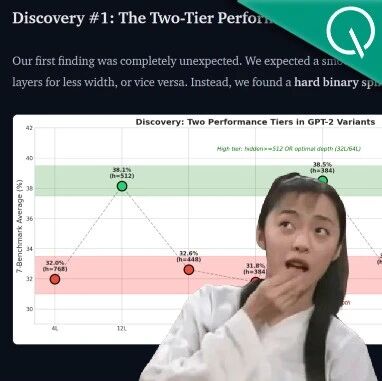
Core Insights - The article reveals significant findings regarding the 70M small model, emphasizing that the architecture's importance is lower than previously thought, while the model's "shape" (depth-width ratio) is more critical [1][2]. Group 1: Model Architecture and Performance - The optimal number of layers for small models is identified as 32, with 12 and 64 layers also performing well, while configurations with 16, 24, and 48 layers yield poor results [2][15]. - The performance gap between "good" and "bad" layer configurations exceeds 6 percentage points, with "good" configurations averaging around 38% accuracy and "bad" configurations around 32% [15][16]. - The hidden dimension must be at least 512 for optimal performance, with the 32-layer configuration achieving the highest score of 38.50% [18][23]. Group 2: Comparative Analysis of Architectures - A comparison of 12 different architectures, including LLaMA3 and Qwen3, shows that modern architectures perform similarly within the 70M parameter range, with average differences of less than 2% [25][26]. - The article notes that improvements in modern architectures are primarily designed for models with over 700 million parameters and do not provide measurable advantages for 70M models [27]. Group 3: Diffusion Models vs. Autoregressive Models - Diffusion models, while slightly lower in average accuracy (31-32%), demonstrate faster inference speeds (3.8 times faster) and lower hallucination rates compared to autoregressive models [28][30]. - The introduction of a "Canon layer" can enhance factual accuracy by 1% for autoregressive models and over 2% for diffusion models, with minimal additional parameter cost [35][36]. Group 4: New Model Development - The Dhara-70M model is introduced, combining the best features of autoregressive and diffusion models, built on the LLaMA3-Canon architecture and converted using the WSD method [41][42]. - The specifications of Dhara-70M include 71.34M parameters, 32 layers, and a hidden size of 384, designed for high throughput and factual accuracy [44]. Group 5: Recommendations for Model Builders - The article advises small language model builders to focus on the fundamental depth-width ratio rather than chasing the latest architectural trends, especially for applications requiring high-speed processing and factual accuracy [45].
「AI 100」榜单启动招募,AI产品“年会”不能停丨量子位智库
量子位· 2026-01-11 04:02
Core Insights - The article discusses the emergence of numerous keywords in the AI product sector by 2025, highlighting transformative AI products that are leading the market [4] - The "AI 100" list by Quantum Bit Think Tank aims to evaluate and recognize the top AI products in China, reflecting the industry's evolution and future trends [4][12] Group 1: AI 100 List Overview - The "AI 100" list is divided into three main categories: "Flagship AI 100," "Innovative AI 100," and the top three products in ten popular sub-sectors [6] - The "Flagship AI 100" focuses on the strongest AI products of 2025, emphasizing those that demonstrate significant technological breakthroughs and practical value [7] - The "Innovative AI 100" aims to identify products that are expected to emerge in 2026, representing cutting-edge AI technology and potential industry disruptors [8] Group 2: Sub-sector Focus - The ten sub-sectors for the top three products include AI Browser, AI Agent, AI Smart Assistant, AI Workbench, AI Creation, AI Education, AI Healthcare, AI Entertainment, Vibe Coding, and AI Consumer Hardware [9] - This categorization is designed to provide a more precise reflection of development trends within each specific field [9] Group 3: Application and Evaluation - The evaluation of the "AI 100" list employs a dual assessment system combining quantitative and qualitative measures, focusing on user data and expert evaluations [13] - Quantitative metrics include user scale, growth, activity, and retention, while qualitative assessments consider long-term potential, technology, market space, and user experience [13]

DeepSeek等8大产品都是意外?! 改变世界的项目们,最初都没被“当个事儿办”
量子位· 2026-01-11 04:02
Core Viewpoint - Side projects, often overlooked initially, can lead to groundbreaking products and innovations in the tech industry, demonstrating that exploration and experimentation can yield significant results [1][2][3]. Group 1: Definition and Characteristics of Side Projects - A side project is defined as a non-core, non-KPI driven initiative that is not strategically planned at its inception [2]. - These projects are less constrained by traditional business structures, allowing for more creative freedom and innovation [3][12]. - The lack of formal oversight enables these projects to evolve organically, often leading to unexpected successes [13][40]. Group 2: Examples of Successful Side Projects - DeepSeek, a side project of Huafang Quantitative, emerged from internal technical research and has become a significant tool in quantitative trading [4][11]. - Qwen, initially a side project at Alibaba, has successfully transitioned into a prominent open-source model, benefiting from reduced decision-making constraints [18][22]. - Claude Code started as an experimental project by engineer Boris Cherny and evolved into a key product for Anthropic, showcasing the potential of side projects to disrupt traditional product development [27][32]. Group 3: Advantages of Side Projects - Side projects can enhance the likelihood of success due to less bureaucratic interference, allowing teams to iterate quickly and adapt based on real-world feedback [22][25]. - The cost of experimentation is lower in the AI era, enabling individuals to validate ideas more swiftly without extensive resource coordination [37][44]. - The flexibility of side projects allows for rapid adjustments and improvements, ultimately leading to more robust and mature products [41][43]. Group 4: Implications for Future Projects - The trend indicates that early signals of future innovations may increasingly arise from projects initially deemed non-essential [53]. - While not all side projects guarantee success when scaled, they provide a foundation for larger initiatives once their value is proven [54][55].

姚顺雨对着唐杰杨植麟林俊旸贴大脸开讲!基模四杰中关村论英雄
量子位· 2026-01-10 13:17
Core Viewpoint - The AGI-Next summit organized by Tsinghua University highlights the rapid advancements in AI, emphasizing the transition from conversational AI to task-oriented AI, indicating a significant shift in the AI landscape [4][34]. Group 1: Key Insights from Speakers - Tang Jie stated that with the emergence of DeepSeek, the era of chatbots is largely over, and the focus should now be on actionable AI [7]. - Yang Zhilin emphasized that creating models is fundamentally about establishing a worldview [7]. - Lin Junyang expressed skepticism about China's ability to overtake in the AI race, suggesting that a 20% improvement in capabilities would be optimistic [7]. - Yao Shunyu noted that most consumers do not require highly intelligent AI for everyday tasks [7]. Group 2: Development Trajectory of Large Models - The development of large models has progressed from solving simple tasks to handling complex reasoning and real-world programming challenges, with expectations for continued improvement by 2025 [18][21]. - The evolution of models reflects human cognitive development, moving from basic reading and arithmetic to complex reasoning and real-world applications [19]. - The introduction of HLE (Human-Level Evaluation) tests models on their generalization capabilities, with many questions being beyond the reach of traditional search engines [20]. Group 3: Challenges and Innovations in AI - Current challenges include enhancing models' generalization abilities and transitioning from scaling to true generalization [22][25]. - The path to improving generalization involves scaling, aligning models with human intentions, and enhancing reasoning capabilities through reinforcement learning [28][29]. - The introduction of RLVR (Reinforcement Learning with Verified Rewards) aims to allow models to explore autonomously and improve through verified feedback, addressing the limitations of human feedback [29]. Group 4: Future Directions and Expectations - The future of AI development will focus on multi-modal capabilities, memory structures, and self-reflective abilities, which are essential for achieving AGI [59][61][64]. - The integration of self-learning mechanisms is seen as crucial for models to adapt and improve continuously [69][73]. - The exploration of new paradigms beyond scaling is necessary to achieve breakthroughs in AI capabilities [89]. Group 5: Open Source and Global Positioning - The open-source movement in China has gained significant traction, with many models emerging as influential in the global landscape [53]. - The ongoing development of models like KimiK2 aims to establish new standards in AI, particularly in agent-based tasks [110]. - The emphasis on creating a diverse range of models reflects a commitment to advancing AI technology while addressing various application needs [125][134].


离开马斯克后,他把人形机器人做成了这样
量子位· 2026-01-10 06:36
允中 发自 凹非寺 量子位 | 公众号 QbitAI 如果你对人形机器人的印象,还停留在——走两步就摔、抓东西像戴着拳击手套、干活前得先写一堆脚本…… 那么 MATRIX-3 的出现,可能要强行带你"翻篇"了。 显然想通过从底层算法到顶层应用的系统性重构,让机器人走得更远: 进工厂,飞入寻常百姓家。 作为一款主打 安全、自主、可泛化 的物理智能机器人,它更敢跟人待在同一个空间,更能自己做判断,也更不怕换任务、换环境。 做出这台机器人的,是一家去年才正式走到台前的公司—— 矩阵超智 。 能干的活更像人,目标也不止于专业场景"打工",而是开始往日常生活里迈。 但底子不轻、来头不算低调:公司团队背景横跨 特斯拉、英伟达、OpenAI 等顶级技术体系,目标也非常直给: AGI路线上的通用人形机器人。 可以说,一年前,MATRIX-1亮相时,外界更关注两点:全身复合材料带来的"观感完成度",以及实时语音对话的交互感。 但这次,创始人 张海星 ——这位有着30年消费电子实战经验的"老极客",2021年加入特斯拉, 参与Optimus人形机器人开发,并主导特斯 拉中国设计中心相关项目 —— △ 矩阵超智创始人兼CEO张海星 ...

量子位编辑作者招聘
量子位· 2026-01-10 03:07
Core Viewpoint - The article emphasizes the ongoing AI boom and invites individuals to join the company "Quantum Bit," which focuses on tracking AI advancements and has established itself as a leading content platform in the industry [1]. Group 1: Job Opportunities - The company is hiring for three main directions: AI Industry, AI Finance, and AI Product, with positions available for both experienced professionals and fresh graduates [2][4]. - Positions are open for various levels, including editors, lead writers, and chief editors, with a focus on matching roles to individual capabilities [6]. Group 2: Job Responsibilities - **AI Industry Direction**: Responsibilities include tracking innovations in infrastructure, such as chips, AI infrastructure, and cloud computing, as well as producing accessible reports on technical conferences and papers [6][7]. - **AI Finance Direction**: Focuses on venture capital, financial reports, and analyzing capital movements within the AI industry, including interviews with investors and entrepreneurs [11]. - **AI Product Direction**: Involves monitoring AI applications and hardware developments, writing in-depth product evaluations, and engaging with product experts [11]. Group 3: Benefits and Work Environment - Employees will have the opportunity to engage with cutting-edge AI technologies, enhance their work efficiency through new tools, and build personal influence in the AI field [6]. - The company offers competitive salaries, comprehensive benefits including social insurance, meal allowances, and performance bonuses, and promotes a dynamic and open work culture [6]. Group 4: Company Growth and Reach - By 2025, Quantum Bit aims to have over 2.4 million subscribers on WeChat and more than 7 million users across platforms, with a daily reading volume exceeding 2 million [12]. - The company is recognized as the top new media outlet in the AI and frontier technology sectors according to third-party data platforms [12].

吴恩达:图灵测试不够用了,我会设计一个AGI专用版
量子位· 2026-01-10 03:07
Core Viewpoint - The article discusses Andrew Ng's announcement of a new Turing test, termed the Turing-AGI test, aimed at evaluating Artificial General Intelligence (AGI) capabilities in a more practical and economically relevant manner [1][8][30]. Group 1: Turing-AGI Test Concept - The Turing-AGI test is designed specifically for AGI, addressing the inadequacies of the traditional Turing test which primarily focused on human-machine dialogue [2][10]. - The new test aims to measure AI's ability to perform knowledge-based work tasks, reflecting a more comprehensive definition of intelligence [14][19]. - Participants in the test will include AI systems or professionals, who will be tasked with real-world scenarios, such as customer service, requiring them to provide ongoing feedback [15][17]. Group 2: Industry Context and Trends - 2025 is anticipated to mark the beginning of the AI industrial era, with significant advancements in model performance and AI-driven applications becoming essential [4][5]. - The competition for top talent in the AI sector is intensifying, driven by the rapid development of AGI concepts in both academia and industry [6][5]. - Current benchmark tests often mislead the public by overestimating AI capabilities, as they are based on predetermined test sets that do not reflect real-world performance [7][20][21]. Group 3: Implications of the Turing-AGI Test - The Turing-AGI test will allow judges to create arbitrary tasks, enhancing the assessment of AI's general capabilities compared to fixed benchmark tests [28]. - Ng suggests that hosting a Turing-AGI test could help calibrate societal expectations of AI, potentially reducing hype around AGI while focusing on practical advancements [29][30]. - The test could set clear goals for AI teams, moving away from vague aspirations of achieving human-level intelligence [31].

「AI 100」榜单启动招募,AI产品“年会”不能停丨量子位智库
量子位· 2026-01-10 03:07
Core Insights - The article discusses the emergence of numerous keywords in the AI product sector by 2025, highlighting transformative AI products that are leading the market [4] - The "AI 100" list by Quantum Bit Think Tank aims to evaluate and recognize the top AI products in China, reflecting the industry's evolution and future trends [4][12] Group 1: AI 100 List Overview - The "AI 100" list is divided into three main categories: "Flagship AI 100," "Innovative AI 100," and the top three products in ten popular sub-sectors [6] - The "Flagship AI 100" will focus on the strongest AI products of 2025, showcasing those that have achieved significant technological breakthroughs and practical application value [7] - The "Innovative AI 100" aims to identify products that are expected to emerge in 2026, representing cutting-edge AI technology and potential industry disruptors [8] Group 2: Sub-sector Focus - The ten hottest sub-sectors for the top three products include AI browsers, AI agents, AI smart assistants, AI workstations, AI creation, AI education, AI healthcare, AI entertainment, Vibe Coding, and AI consumer hardware [9] Group 3: Application and Evaluation Criteria - The evaluation of the "AI 100" list employs a dual assessment system combining quantitative and qualitative measures, focusing on user data and expert evaluations [13] - Quantitative metrics include user scale, growth, activity, and retention, while qualitative assessments consider long-term potential, technology, market space, and user experience [13]

智能体「卷王」诞生!干活自动配结项报告,1.5张截图就把事说清了
量子位· 2026-01-10 03:07
Core Insights - The article discusses the concept of SmartSnap, which transforms GUI agents from passive executors to proactive self-verifiers, enabling them to collect evidence while completing tasks [7][12]. Group 1: Challenges in Current AI Verification - A significant challenge in LLM/VLM-driven agents is the uncertainty of task completion quality after execution [2]. - Existing verification methods require complex manual checks and robust trajectory-level validation, which can be inefficient and contextually noisy [4][5]. - These methods depend on continuous observable feedback, which can fail due to environmental changes [6]. Group 2: SmartSnap Overview - SmartSnap allows agents to actively collect and submit a "snapshot of evidence" while performing tasks, akin to a project completion report [8][9]. - The approach aims to reduce the verification burden on external validators by enabling agents to self-verify their actions [6][19]. Group 3: Key Innovations - SmartSnap introduces a dual mission for agents: executing tasks and self-verifying their completion [11][12]. - The 3C principle (Completeness, Conciseness, Creativity) is established to ensure evidence quality without overwhelming validators [15]. - The training utilizes the GRPO algorithm with intrinsic reward shaping to enhance evidence quality while minimizing reward hacking [14]. Group 4: Performance Improvements - SmartSnap has shown significant performance improvements across various models, with the highest increase reaching 26.08% [17]. - The average task now requires only 1.5 evidence snapshots, greatly reducing validation costs [18]. - Agents trained with SmartSnap demonstrate improved interaction efficiency, leading to fewer interaction rounds [18]. Group 5: Future Implications - The emergence of SmartSnap signifies a shift from brute-force execution to cognitive collaboration in GUI agents, enhancing AI reliability and paving the way for large-scale, low-cost AI deployment [21]. - Future AI systems must not only be capable but also trustworthy, emphasizing the importance of self-verification capabilities [22].