具身智能之心

Search documents
分析了102个VLA模型、26个数据集和12个仿真平台
具身智能之心· 2025-07-20 01:06
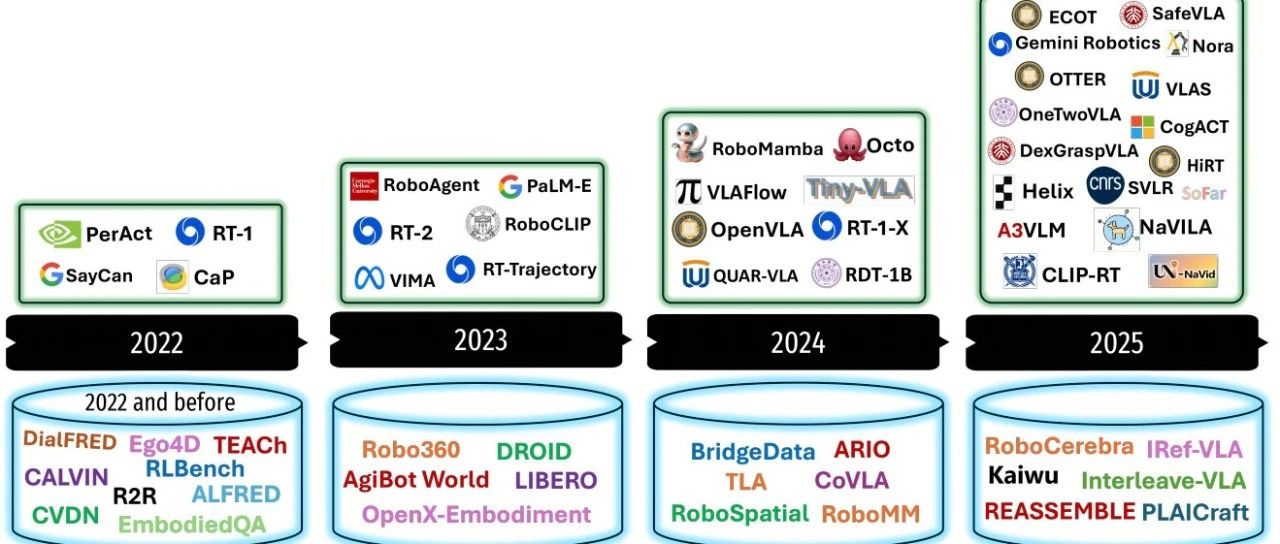
Core Viewpoint - The article discusses the transformative breakthrough of Visual-Language-Action (VLA) models in robotics, emphasizing their integration of visual perception, natural language understanding, and embodied control within a unified learning framework. It highlights the development and evaluation of 102 VLA models, 26 foundational datasets, and 12 simulation platforms, identifying current challenges and future directions for enhancing robotic autonomy and adaptability [3][4][6]. Group 1: VLA Models and Framework - VLA models represent a new frontier in robotic intelligence, enabling robots to perceive visual environments, understand natural language commands, and execute meaningful actions, bridging the semantic gap between various modalities [7][9]. - The architecture of VLA models integrates visual, language, and proprioceptive encoders into a diffusion backbone network, facilitating the generation of control commands [11][12]. - The evaluation of VLA architectures reveals a rich diversity in core component algorithms, with visual encoders predominantly based on CLIP and SigLIP, and language models primarily from the LLaMA family [16]. Group 2: Datasets and Training - High-quality, diverse training datasets are crucial for VLA model development, allowing models to learn complex cross-modal correlations without relying on manually crafted heuristics [17][22]. - The article categorizes major VLA datasets, noting a shift towards more complex, multimodal control challenges, with recent datasets like DROID and Open X-Embodiment embedding synchronized RGBD, language, and multi-skill trajectories [22][30]. - A benchmarking analysis maps each major VLA dataset based on task complexity and modality richness, highlighting gaps in current benchmarks, particularly in integrating complex tasks with extensive multimodal inputs [30][31]. Group 3: Simulation Tools - Simulation environments are essential for VLA research, generating large-scale, richly annotated data that exceeds physical world limitations. Platforms like AI2-THOR and Habitat provide realistic rendering and customizable multimodal sensors [32][35]. - The article outlines various simulation tools, emphasizing their capabilities in generating diverse datasets for VLA models, which are critical for advancing multimodal perception and control [35][36]. Group 4: Applications and Evaluation - VLA models are categorized into six broad application areas, including manipulation and task generalization, autonomous mobility, human assistance, and interaction, showcasing their versatility across different robotic tasks [36][37]. - The selection and evaluation of VLA models focus on their operational skills and task generalization capabilities, using standardized metrics such as success rate and zero-shot generalization ability [39][40]. Group 5: Challenges and Future Directions - The article identifies key architectural challenges for VLA models, including tokenization and vocabulary alignment, modality fusion, cross-entity generalization, and the smoothness of manipulator movements [42][43][44]. - Data challenges are also highlighted, such as task diversity, modality imbalance, annotation quality, and the trade-off between realism and scale in datasets, which hinder the robust development of general VLA models [45][46].

加利福尼亚大学!EgoVLA:从第一视角人类视频中学习VLA模型
具身智能之心· 2025-07-20 01:06
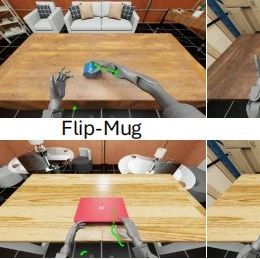
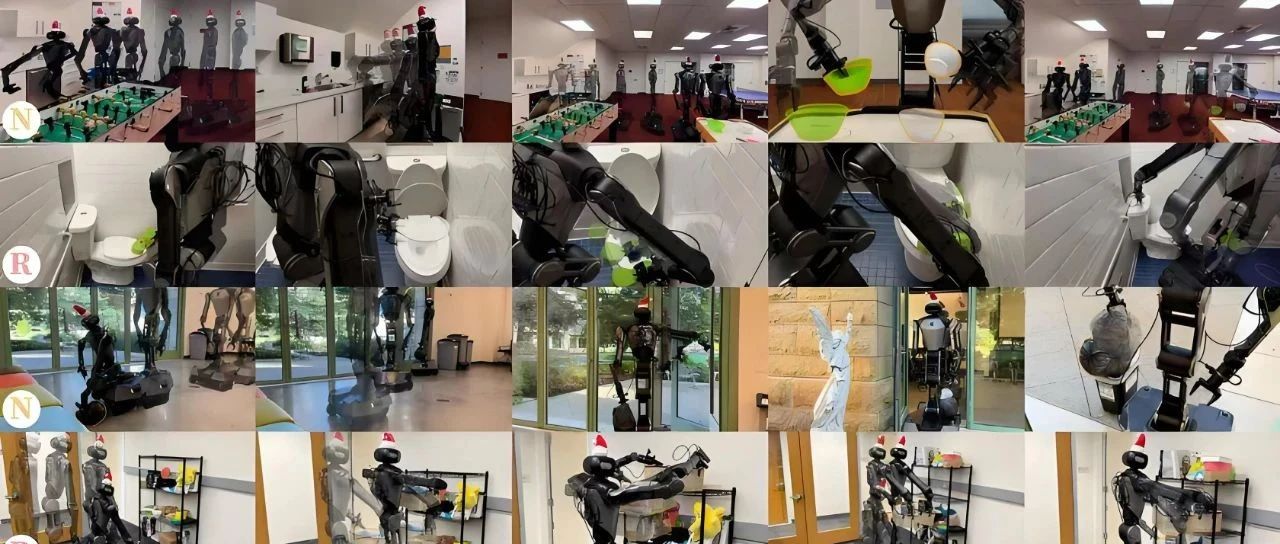
Core Insights - The article discusses a novel approach to robot learning that leverages egocentric human video data to enhance the training of Vision-Language-Action (VLA) models, overcoming limitations of traditional robot data collection methods [3][21]. Research Background and Core Ideas - Traditional robot learning relies heavily on large-scale real robot data, which is limited by hardware and operational costs. In contrast, human actions in various environments provide a vast amount of potential training data, as billions of people continuously engage in tasks where robots are expected to operate [3]. - The key breakthrough is the approximation of the action space difference between humans and robots through geometric transformations. This allows for training VLA models on human video data first, followed by fine-tuning with a small amount of robot demonstrations, facilitating skill transfer [3]. Model Architecture and Action Space Design - The framework is based on NVILA-2B, utilizing its visual-language understanding capabilities for efficient intent reasoning and fine-tuning. Inputs include current and historical first-person visual observations, language instructions, action query tokens, and human body sensations [5]. - The action space incorporates human wrist poses and the first 15 PCA components of the MANO hand model, balancing compactness and expressiveness for action transfer from humans to robots [8]. Training and Evaluation - A large-scale dataset of approximately 500,000 image-action pairs was created from four sources, covering various rigid objects and annotated with RGB observations, wrist poses, hand poses, and camera poses [12]. - The Ego Humanoid Manipulation Benchmark was established for unified evaluation of humanoid robot manipulation capabilities, consisting of 12 tasks and addressing data balance issues [14]. Experimental Results and Key Findings - Human pre-training significantly enhances core performance, with the EgoVLA model showing a success rate improvement of about 20% in fine manipulation tasks compared to models without pre-training [16][20]. - The model demonstrates robust performance across different visual configurations, with only a slight decrease in success rates for unseen visual backgrounds, indicating adaptability to new environments [20]. Impact of Data Scale and Diversity - Higher diversity in human data correlates with better model generalization, as evidenced by the combined model's superior performance in short-horizon tasks compared to those trained on single datasets [23]. - The performance of the EgoVLA model declines when relying solely on robot demonstration data, highlighting the necessity of combining human pre-training with a certain amount of robot data for optimal results [23].
IROS 2025 Oral|无界智慧推出3D-MoRe:助力空间理解,提升复杂三维环境中的推理能力
具身智能之心· 2025-07-19 09:46
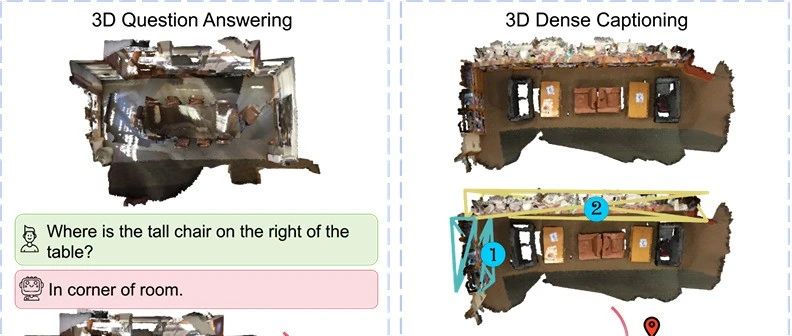
>> 点击进入→ 具身智能之心 技术交流群 更多干货,欢迎加入国内首个具身智能全栈学习社区 : 具身智能之心知识星球 (戳我) , 这里包含所有你想要 的。 本文一作:许镕涛 无界智慧联合创始人兼CTO,Rongtao-Xu.github.io。中科院自动化所博士, 在学期间曾获 得中科院院长奖、两次IEEE旗舰会议最佳论文提名奖、国奖、北京市和中科院优秀毕业生。华中科技大学 数学与计算机双学位。研究方向聚焦具身智能与机器人,提出首个基于空间可供性操作大模型A0,曾在银 河通用王鹤老师指导下提出首个基于视频的具身导航大模型NaVid。在相关领域学术期刊和会议上共发表论 文60余篇,其中以一作或通讯发表论文29篇,ESI高被引论文3篇。曾在NeurIPS、AAAI、ICRA、IROS等会 议上发表多篇Oral论文。 由无界智慧(Spatialtemporal AI),北京邮电大学、中科院自动化所、山东省计算中心及中山大学联合推出 的 3D-MoRe 模型,是一款专注于 3D 场景理解与多模态推理的创新框架。该模型通过整合多模态嵌入、跨 模态交互与语言模型解码器,能高效处理自然语言指令与 3D 场景数据,助力提升 ...
突破户外RGB SLAM尺度漂移难题,精确定位+高保真重建(ICCV'25)
具身智能之心· 2025-07-19 09:46
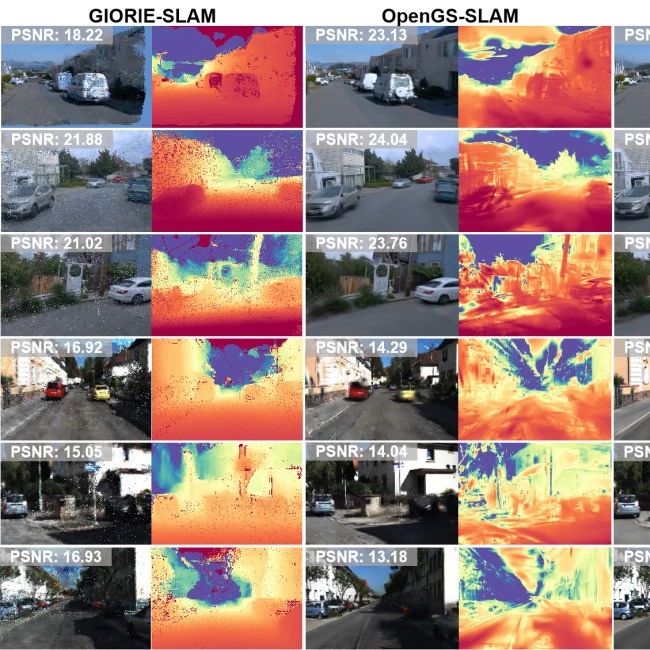
Core Viewpoint - The article discusses the innovative S3PO-GS framework developed by the Hong Kong University of Science and Technology (Guangzhou) to address the scale drift problem in outdoor monocular SLAM, achieving global scale consistency for RGB monocular SLAM [2][5][22]. Summary by Sections Introduction to SLAM - SLAM technology's robustness is crucial for performance in advanced fields such as autonomous driving, robot navigation, and AR/VR [3]. Challenges in Current SLAM Solutions - Existing 3D Gaussian-based SLAM solutions excel in indoor environments but struggle in unbounded outdoor settings due to the lack of depth prior in monocular systems, leading to geometric information insufficiency and scale drift issues [4][6]. S3PO-GS Framework - The S3PO-GS framework introduces three core technological breakthroughs: 1. A self-consistent tracking module that generates scale-consistent 3D point clouds and establishes accurate 2D-3D correspondences to eliminate drift errors in pose estimation [6]. 2. A dynamic mapping mechanism that employs a local patch-based scale alignment algorithm to dynamically calibrate the scale parameters of pre-trained point clouds with the 3D Gaussian scene [6]. 3. A joint optimization architecture that synchronously enhances localization accuracy and scene reconstruction quality through point cloud replacement strategies and geometric supervision loss functions [6]. Experimental Results - In benchmark tests on Waymo, KITTI, and DL3DV datasets, S3PO-GS demonstrated significant advantages, reducing tracking errors by 77.3% in the DL3DV scene and achieving a PSNR of 26.73 in the Waymo dataset, setting a new standard for real-time high-precision reconstruction in unbounded outdoor scenes [6][16][22]. Conclusion and Future Work - The S3PO-GS framework effectively addresses common issues of scale drift and geometric prior absence in outdoor scenes, reducing the number of iterations required for pose estimation to 10% of traditional methods [22][24]. Future research will explore loop detection and large-scale dynamic scene optimization to expand the application boundaries of this method in outdoor SLAM [24].
强化学习的两个「大坑」,终于被两篇ICLR论文给解决了
具身智能之心· 2025-07-19 09:46
Core Viewpoint - The article discusses the emergence of real-time reinforcement learning (RL) frameworks that address the limitations of traditional RL algorithms, particularly in dynamic environments where timely decision-making is crucial [2][6]. Group 1: Challenges in Traditional Reinforcement Learning - Existing RL algorithms often rely on idealized interaction models where the environment and agent take turns pausing, which does not reflect real-world scenarios [5][6]. - Two key difficulties in real-time environments are identified: inaction regret, where agents fail to act due to long reasoning times, and delay regret, where actions based on past states lead to delayed impacts [9][10]. Group 2: New Frameworks Proposed - Mila laboratory's two papers propose a new real-time RL framework to tackle reasoning delays and action omissions, enabling large models to respond instantly in high-frequency tasks [9][10]. - The first paper introduces a solution to minimize inaction regret through staggered asynchronous inference, allowing agents to utilize available computational power for asynchronous reasoning and learning [12][13][17]. - The second paper presents an architecture to minimize both inaction and delay regret by integrating parallel computation and temporal skip connections, enhancing the efficiency of deep networks [22][23][29]. Group 3: Performance and Applications - The proposed frameworks have been tested in real-time simulations, demonstrating significant performance improvements in environments like Game Boy and Atari, where agents must adapt quickly to new scenarios [18][19]. - The combination of staggered asynchronous inference and temporal skip connections allows for high-frequency decision-making without sacrificing model expressiveness, which is critical for applications in robotics, autonomous driving, and financial trading [33][34].

研二多发几篇论文,也不至于到现在这个地步……
具身智能之心· 2025-07-18 12:15
Core Viewpoint - The article emphasizes the importance of high-quality research papers for graduate students, especially those seeking to pursue doctoral studies or secure employment in competitive industries. It highlights the challenges faced by students in producing quality research and offers professional guidance to help them succeed [1]. Group 1: Challenges Faced by Students - Many students struggle to find jobs due to average research outcomes and are considering pursuing doctoral studies to alleviate employment pressure [1] - Students often face difficulties in selecting research topics, structuring their papers, and providing strong arguments, leading to delays in producing satisfactory work [1] Group 2: Professional Guidance Offered - The company provides specialized paper writing assistance, aiming to help students produce high-quality research papers efficiently [3][7] - The guidance includes a structured 12-week program that covers topic selection, literature review, experimental design, drafting, and submission processes [5] Group 3: Target Audience - The service is aimed at graduate students in computer science and related fields who lack guidance from their advisors and seek to enhance their research capabilities [8][9] - It also targets individuals looking to improve their academic credentials for job applications or further studies [9] Group 4: Unique Selling Points - The company boasts a team of over 300 specialized instructors from top global universities, ensuring high-quality mentorship [3] - A high acceptance rate of 96% for students who have received guidance from the company in the past three years [3] Group 5: Additional Benefits - Students may receive recommendations to prestigious institutions and job placements in leading tech companies based on their performance [12] - The company offers personalized matching with instructors based on students' research interests and goals [11]
一周年啦!我们做的具身智能社区,准备涨涨价了......(最后2天)
具身智能之心· 2025-07-18 03:21
Core Viewpoint - The article highlights the establishment and growth of the "Embodied Intelligence Heart" community, emphasizing its role as a platform for knowledge sharing and collaboration in the field of embodied intelligence, which has gathered various industry talents and resources over the past year [1][13]. Group 1: Community Development - The "Embodied Intelligence Heart" community has evolved from a small group to a larger network of professionals in the embodied intelligence field, focusing on advancing the capabilities of intelligent agents [1]. - The community offers a knowledge-sharing platform that includes Q&A, resource sharing, live streaming, and technical roadmaps, catering to both beginners and advanced learners [2][3]. Group 2: Resources and Learning Opportunities - The community has compiled over 30 technical roadmaps, significantly reducing the time needed for research and learning in the field [3]. - Members have access to numerous open-source projects, datasets, and mainstream simulation platforms related to embodied intelligence, facilitating both entry-level and advanced learning [13][28][32]. Group 3: Networking and Career Support - The community has established job referral mechanisms with various embodied intelligence companies, providing members with opportunities to connect with potential employers [8]. - Regular roundtable forums and live sessions are organized to discuss industry developments and address members' questions, fostering a collaborative learning environment [3][19]. Group 4: Comprehensive Knowledge Base - The community has gathered extensive resources, including research reports, academic papers, and books related to robotics and embodied intelligence, aiding members in their studies and projects [21][24]. - A variety of learning paths are available, covering topics such as reinforcement learning, multi-modal models, and robot navigation, ensuring a well-rounded educational experience [38][40][63].
为什么能落地?目标导航是怎么识别目标并导航的?
具身智能之心· 2025-07-18 03:21
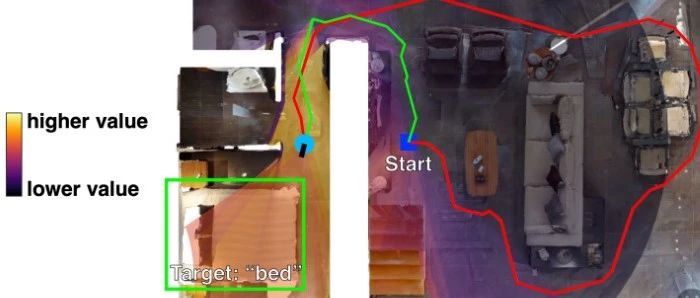
Core Viewpoint - Goal-Oriented Navigation empowers robots to autonomously complete navigation tasks based on goal descriptions, marking a significant shift from traditional visual language navigation systems [2][3]. Group 1: Technology Overview - Embodied navigation is a core area of embodied intelligence, relying on three technical pillars: language understanding, environmental perception, and path planning [2]. - Goal-Oriented Navigation requires robots to explore and plan paths in unfamiliar 3D environments using only goal descriptions such as coordinates, images, or natural language [2]. - The technology has been industrialized across various verticals, including delivery, healthcare, and hospitality, with companies like Meituan and Aethon deploying autonomous delivery robots [3]. Group 2: Technological Evolution - The evolution of Goal-Oriented Navigation can be categorized into three generations: 1. **First Generation**: End-to-end methods focusing on reinforcement learning and imitation learning, achieving breakthroughs in Point Navigation and closed-set image navigation tasks [5]. 2. **Second Generation**: Modular methods that explicitly construct semantic maps, breaking tasks into exploration and goal localization phases, showing significant advantages in zero-shot object navigation [5]. 3. **Third Generation**: Integration of large language models (LLMs) and visual language models (VLMs) to enhance knowledge reasoning and open-vocabulary target matching accuracy [7]. Group 3: Challenges and Learning Path - The complexity of embodied navigation requires knowledge from multiple fields, making it challenging for newcomers to extract frameworks and understand development trends [9]. - A new course has been developed to address these challenges, focusing on quick entry into the field, building a research framework, and combining theory with practice [10][11][12]. Group 4: Course Structure - The course includes six chapters covering semantic navigation frameworks, Habitat simulation ecology, end-to-end navigation methodologies, modular navigation architectures, and LLM/VLM-driven navigation systems [16][18][19][21][23]. - A significant project involves the reproduction of the VLFM algorithm and its deployment in real-world scenarios, allowing students to engage in algorithm improvement and practical application [25][29]. Group 5: Target Audience and Outcomes - The course is aimed at professionals in robotics, students in embodied intelligence research, and individuals transitioning from traditional computer vision or autonomous driving fields [33]. - Participants will gain skills in the Goal-Oriented Navigation framework, including end-to-end reinforcement learning, modular semantic map construction, and LLM/VLM integration methods [33].
真香!一台机器搞定人形运控、强化学习、VLN/VLA
具身智能之心· 2025-07-18 02:28
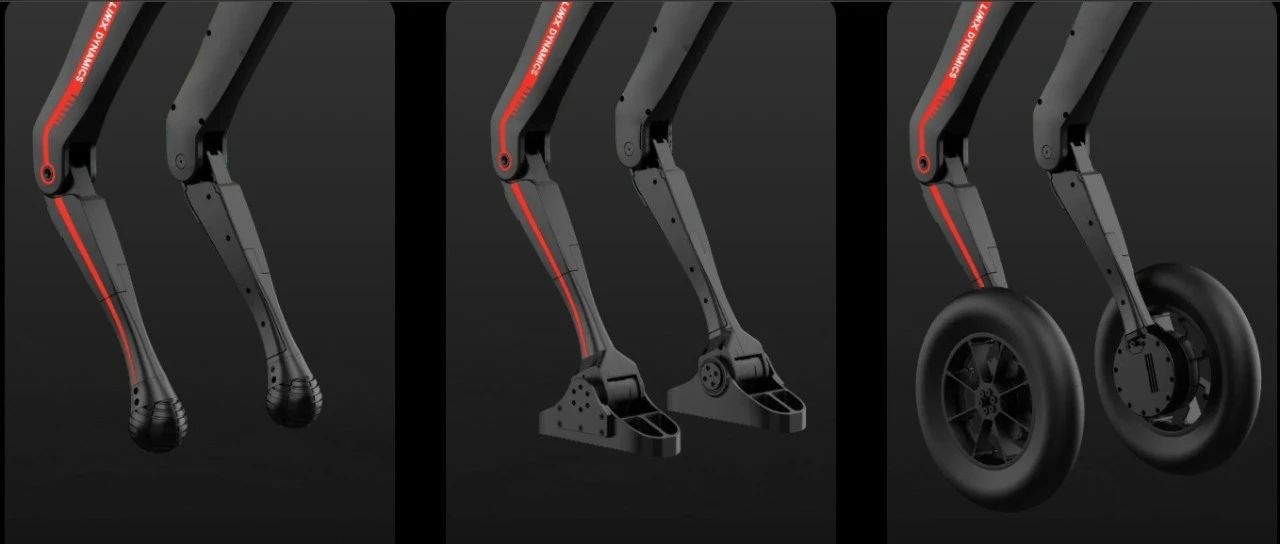
Core Viewpoint - TRON1 is a cutting-edge research platform designed for educational and scientific purposes, featuring a modular design that supports multiple locomotion forms and algorithms, maximizing research flexibility [1]. Group 1: Product Features - TRON1 supports humanoid gait development and is suitable for reinforcement learning research, with the EDU version allowing for external camera integration for navigation and perception tasks [6][4]. - The platform supports C++ and Python for development, making it accessible for users without C++ knowledge [6]. - It features a "sim2real" capability with minimal discrepancies, enhancing validation efficiency and lowering research barriers [9]. - TRON1 can be equipped with robotic arms for various mobile operation tasks, supporting both single-arm and dual-leg control modes [11]. - The platform integrates LiDAR and depth cameras for 3D mapping, localization, navigation, and dynamic obstacle avoidance [13]. Group 2: Technical Specifications - The TRON1 platform includes advanced hardware specifications such as NVIDIA Ampere architecture GPU with 1024 CUDA cores and 32 Tensor cores, providing AI computing power of 157 TOPS (sparse) and 78 TOPS (dense) [16][19]. - It operates on an 8-core Arm Cortex-A78AE CPU with a maximum frequency of 2.0GHz and has 16GB of LPDDR5 memory [16]. - The platform supports a maximum load capacity of approximately 10kg and can achieve speeds of up to 5m/s with its wheeled legs [26]. Group 3: User Support and Development - The company provides comprehensive user manuals and development guides, ensuring ease of use and support for new users [30][37]. - TRON1 SDK is well-documented, facilitating secondary development and allowing users to troubleshoot and expand their research capabilities [34][40]. - The platform offers one year of after-sales service post-acceptance, with paid maintenance and parts support available thereafter [40].
论具身智能的持久战
具身智能之心· 2025-07-17 14:22
Core Viewpoint - The article discusses the current state and future potential of the embodied intelligence industry, highlighting the challenges and opportunities in automating factories and the cautious approach taken by companies in this sector [1][4][12]. Group 1: Industry Transformation - The automotive industry's technological transformation is described as consisting of three phases: electrification, intelligence, and factory automation, with the latter still in the early conceptual exploration stage [1]. - Factory automation is seen as a desirable goal for large industrial enterprises, as it could significantly reduce labor costs and management complexities [1]. Group 2: Current Challenges - Embodied intelligence technology is currently in a nascent stage, with many startups struggling to produce even usable demos [2]. - There are significant hardware challenges, such as the high cost and short lifespan of dexterous hands, which can exceed ten thousand yuan but may fail within weeks [6]. - Software and algorithmic issues also persist, including difficulties in data collection for training models and the lack of generalization across different scenarios [9][10]. Group 3: Cautious Investment - Despite a surge in financing news for embodied intelligence companies, many are adopting a conservative approach, avoiding large-scale hiring and focusing on cost control [4][12]. - The industry is filled with pitfalls, leading to a cautious attitude among founders who are aware of the long and uncertain path to technological breakthroughs [12][13]. Group 4: Core Competitive Factors - The ability to secure financing is identified as the most critical competitive factor for embodied intelligence companies, as it supports talent acquisition, data collection, and computational power [16][20]. - Historical lessons from the autonomous driving sector indicate that algorithmic capabilities alone do not constitute a sustainable competitive advantage, as they can be quickly replicated by competitors [17][18]. Group 5: Strategic Outlook - The article suggests that companies should adopt a long-term strategy, preparing for a protracted battle in the face of numerous challenges in the embodied intelligence sector [22].