HKEX(00388)

Search documents
【锋行链盟】港交所SPAC上市核心要点
Sou Hu Cai Jing· 2025-09-27 16:19
Core Viewpoint - The Hong Kong Stock Exchange (HKEX) has officially implemented the SPAC (Special Purpose Acquisition Company) listing regime starting January 1, 2022, aiming to balance innovation with investor protection through a stringent regulatory framework [2]. Group 1: Sponsor Qualifications and Responsibilities - At least one sponsor must hold a license from the Hong Kong Securities and Futures Commission for either Type 6 (advising on corporate finance) or Type 9 (asset management), or be a qualified "senior person" with substantial capital market experience and a good compliance record [6]. - Sponsors are required to disclose their background, professional experience, and past performance to ensure they have the capability to drive acquisitions [6]. - Sponsors must subscribe to at least 10% of the SPAC shares with their own funds, aligning their interests with those of investors [6]. Group 2: SPAC Listing Conditions - The market capitalization of the SPAC at the time of listing must be at least HKD 1 billion, which is higher than some markets like the U.S. that do not have a clear minimum [6]. - The issue price must not be lower than HKD 10 per share to prevent dilution of investor rights [6]. - Public shareholding must be at least 25%, with a minimum of 30 public shareholders to avoid excessive concentration of ownership [6]. Group 3: Fundraising and Fund Custody - Funds raised through the IPO (after deducting issuance costs) must be fully deposited into an independent trust account and can only be used for specific purposes such as acquiring target companies, paying acquisition-related fees, or repurchasing shares if shareholders exercise their redemption rights [4]. - The trust account will be managed by an independent trustee to ensure funds are used exclusively for their intended purposes, reducing the risk of misappropriation [4]. Group 4: Acquisition Transaction (De-SPAC) Requirements - The target company must meet the main board listing requirements of HKEX, ensuring it has sustainable operational capabilities [4]. - An independent financial advisor must be hired to value the target company, and the valuation methods and key assumptions must be disclosed [7]. - The acquisition transaction must be approved by a special resolution of at least 75% of SPAC shareholders, with related sponsors required to abstain from voting [7]. Group 5: Shareholder Rights Protection - Shareholders who disagree with the acquisition can request to redeem their shares at a price not lower than the issue price, ensuring they are not forced into an acquisition they do not support [8]. - There are limits on dilution, with sponsor shares and warrants subject to a maximum dilution cap post-acquisition to protect public shareholders' interests [8]. Group 6: Time Limits and Failure Handling - SPACs must complete their acquisition within 24 months of listing, with a one-time extension of up to 6 months allowed, totaling a maximum of 30 months [8]. - If the acquisition is not completed within the time frame, the SPAC must initiate liquidation and return the principal to investors, along with interest [8]. Group 7: Information Disclosure and Regulation - SPACs are required to regularly disclose the use of funds, acquisition progress, and potential risks [10]. - HKEX will conduct comprehensive oversight of SPACs throughout their lifecycle, focusing on sponsor qualifications, fund safety, and fairness of acquisitions to prevent shell companies and market manipulation [10].

“打风不停市”满一年 留宿配套没跟上?
Nan Fang Du Shi Bao· 2025-09-27 03:04
香港特区政府财政司司长陈茂波说,"打风不停市"自去年9月23日实施至今刚满一周年,在恶劣天气下 维持巿场交易的安排经过多次实践,实行以来运作大致畅顺,市场也累积了一定经验。他在社交媒体表 示,港交所在台风下会继续维持正常交易,并且已经请金融机构尽早调配人力及营运资源,启动恶劣天 气下的交易运作安排,以维持市场平稳运作。港交所也继续密切监察情况,在有需要时发出公告,让市 场参与者及时获得最新消息。 开放50个临时庇护中心 比以往多 中环金钟核心区,集中了多家投行及高端酒店。 超强台风"桦加沙"来袭,9月24日,香港资本市场首次在"十号风球"下维持交易,创造了香港金融的新 历史。这个时间点恰好也是香港实施"打风不停市"政策的一周年。在过去12个月,香港资本市场迎接一 个又一个台风,仍然维持稳定交易,在风暴期间衔接全球市场,使香港的竞争力进一步增强。 券商总行资讯科技部等回公司上班 超强台风"桦加沙"靠近香港期间,香港特区政府财经事务及库务局管理的协调中心,确保在各种极端情 况下,香港金融市场的各个环节都能畅顺运作。 特区政府的财经部门,与各金融监管机构和持份者保持紧密联系,密切监察市场情况,并就天气情况对 金融市 ...
智通ADR统计|9月27日




智通财经网· 2025-09-27 00:06
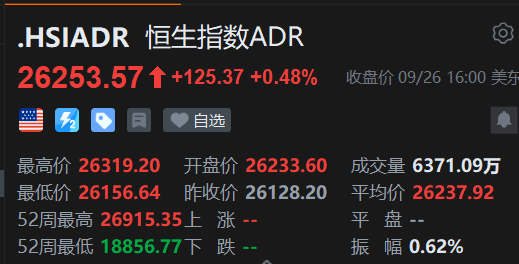
Market Overview - The Hang Seng Index (HSI) closed at 26,253.57, up by 125.37 points or 0.48% as of September 26, 16:00 [1] - The index reached a high of 26,319.20 and a low of 26,156.64 during the trading session, with a trading volume of 63.71 million [1] Major Blue-Chip Stocks Performance - HSBC Holdings closed at HKD 108.633, an increase of 1.081% from the previous close [2] - Tencent Holdings closed at HKD 648.733, up by 0.73% compared to the last trading session [2] ADR Performance Summary - Tencent Holdings (ADR: TCEHY) increased by HKD 4.733, or 0.73% [3] - Alibaba Group (ADR: BABA) rose by HKD 0.672, or 0.40% [3] - HSBC Holdings (ADR: HSBC) saw an increase of HKD 1.933, or 1.81% [3] - Xiaomi Group (ADR: XIACY) gained HKD 0.584, or 1.07% [3] - AIA Group (ADR: AAGIY) increased by HKD 0.222, or 0.31% [3] - Meituan (ADR: MPNGY) rose by HKD 0.534, or 0.53% [3] - Ctrip Group (ADR: TCOM) increased by HKD 8.120, or 1.39% [3] - JD.com (ADR: ID) rose by HKD 1.696, or 1.28% [3]
花旗集团在香港交易所的持股比例于9月22日从5.02%降至4.99%
Mei Ri Jing Ji Xin Wen· 2025-09-26 09:16
每经AI快讯,9月26日,香港交易所信息显示,花旗集团在香港交易所的持股比例于9月22日从5.02%降 至4.99%。 ...

香港交易所:没收未领取的2019 度第一次中期股息
Zhi Tong Cai Jing· 2025-09-26 08:42
香港交易所(00388)发布公告,香港交易所于20258月8日宣布,根据香港交易所《组织章程细则》,于 20199月26日派付而于2025年9月26日仍为未领取的2019年度第一次中期股息每股3.72港元将予没收及复 归香港交易所。因此,仍未被领取的2019年度第一次中期股息合共1868.65万港元已于今天被没收并复 归香港交易所。 ...
香港交易所(00388):没收未领取的2019年度第一次中期股息
智通财经网· 2025-09-26 08:41
智通财经APP讯,香港交易所(00388)发布公告,香港交易所于2025年8月8日宣布,根据香港交易所《组 织章程细则》,于2019年9月26日派付而于2025年9月26日仍为未领取的2019年度第一次中期股息每股 3.72港元将予没收及复归香港交易所。因此,仍未被领取的2019年度第一次中期股息合共1868.65万港元 已于今天被没收并复归香港交易所。 ...
香港交易所(00388.HK):没收未领取的2019年度第一次中期股息
Ge Long Hui· 2025-09-26 08:39
格隆汇9月26日丨香港交易所(00388.HK)于2025年8月8日宣布,根据香港交易所《组织章程细则》,于 2019年9月26日派付而于2025年9月26日仍为未领取的2019年度第一次中期股息每股3.72港元将予没收及 复归香港交易所。因此,仍未被领取的2019年度第一次中期股息合共18,686,498.56港元已于今天被没收 并复归香港交易所。 ...
香港交易所(00388) - 没收未领取的2019年度第一次中期股息
2025-09-26 08:30
根據《香港聯合交易所有限公司證券上市規則》第三十八章,證券及期貨事務監察委員會監管香港交 易及結算所有限公司有關其股份在香港聯合交易所有限公司上市的事宜。證券及期貨事務監察委員會 對本公告的內容概不負責,對其準確性或完整性亦不發表任何聲明,並明確表示,概不對因本公告全 部或任何部分內容而產生或因倚賴該等內容而引致的任何損失承擔任何責任。 沒收未領取的 2019 年度第一次中期股息 香港交易及結算所有限公司(「香港交易所」)於 2025 年 8 月 8 日宣布,根據香港交易所 《組織章程細則》,於 2019 年 9 月 26 日派付而於 2025 年 9 月 26 日仍為未領取的 2019 年度 第一次中期股息每股 3.72 港元將予沒收及復歸香港交易所。因此,仍未被領取的 2019 年度 第一次中期股息合共 18,686,498.56 港元已於今天被沒收並復歸香港交易所。 承董事會命 香港交易及結算所有限公司 集團公司秘書 曾志燿 香港,2025 年 9 月 26 日 於本公告日期,香港交易所董事會包括 12 名獨立非執行董事,分別是唐家成先生(主席)、 聶雅倫先生、白禮仁先生、陳健波先生、謝清海先生、張明明 ...
【锋行链盟】港交所IPO过程中可能面对的关注点
Sou Hu Cai Jing· 2025-09-26 01:20
Core Points - The core focus of the HKEX IPO process revolves around compliance, transparency, sustainability, and market acceptance [5] Financial Metrics and Profitability - HKEX has specific financial requirements for IPO applicants, including cumulative profits of at least 50 million HKD over the last three years, with at least 20 million HKD in the most recent year [3] - Different tests apply for various sectors, with a focus on the authenticity and sustainability of profits [3] Information Disclosure and Transparency - The principle of "disclosure-based" is emphasized, requiring issuers to provide full, accurate, and timely information to avoid misleading investors [2] Corporate Governance and Independence - Issuers must have a sound corporate governance structure to protect minority shareholders from potential harm by controlling shareholders or management [2] Business Model and Sustainability - The sustainability of business models, especially for new economy companies, is a key focus, including aspects like patent numbers and user engagement metrics [2] Industry Regulation and Compliance - Issuers must comply with both domestic and international regulatory requirements, particularly if their business involves specific sectors like finance or healthcare [4] Related Party Transactions and Interest Transfer - HKEX imposes strict regulations on related party transactions to prevent harm to minority shareholders [4] Use of Proceeds - Issuers are required to disclose the specific and reasonable use of raised funds [4] Shareholder Structure and Equity Arrangement - The structure of shareholders must avoid instability in control or conflicts of interest [4] Financial Statements and Auditing - Ensuring the authenticity of financial data is crucial, with a focus on the qualifications of auditing firms [4] Special Arrangements for New Economy - HKEX has introduced special rules to attract new economy companies, which also brings additional scrutiny [4] Cross-Border Regulation and Data Security - Companies with mainland operations must navigate regulatory coordination between regions [4] Responsibilities of Intermediaries - Intermediaries like sponsors, lawyers, and accountants must fulfill their due diligence responsibilities [5][6] Market Acceptance and Valuation - The market shows a preference for sectors like technology, consumption, healthcare, and renewable energy, while traditional industries may face lower valuations [6] Ongoing Obligations Post-IPO - Issuers must continue to comply with HKEX's ongoing listing obligations after the IPO [5]
智通ADR统计|9月26日
智通财经网· 2025-09-25 22:26
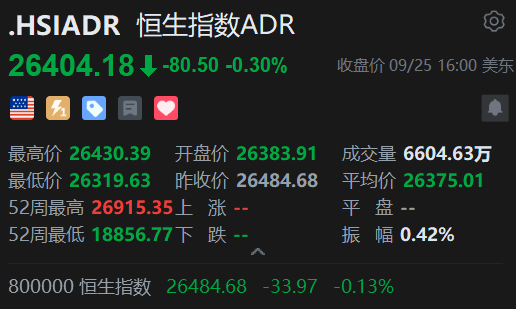
Market Overview - The Hang Seng Index closed at 26,404.18, down by 80.50 points or 0.30% on September 25 [1] - The index reached a high of 26,430.39 and a low of 26,319.63 during the trading session, with a trading volume of 66.046 million shares [1] Major Stocks Performance - HSBC Holdings closed at HKD 107.287, up by 0.17% compared to the previous close [2] - Tencent Holdings closed at HKD 648.343, down by 0.25% compared to the previous close [2] - Alibaba Group (W) saw a decline of 1.15%, closing at HKD 172.000 [3] - China Construction Bank dropped by 2.28%, closing at HKD 7.300 [3] - Xiaomi Group (W) increased by 4.48%, closing at HKD 59.450 [3] ADR Performance - Tencent's ADR price was USD 648.343, reflecting a decrease of 0.25% compared to its Hong Kong stock price [3] - Alibaba's ADR price was USD 170.695, down by 0.76% compared to its Hong Kong stock price [3] - HSBC's ADR price was USD 107.287, showing an increase of 0.17% compared to its Hong Kong stock price [3]