
HKEX(00388)

Search documents
德勤预计港股市场今年将有逾80只新股上市,募集2500亿至2800亿港元,港交所将稳居全球IPO融资额榜首
Mei Ri Jing Ji Xin Wen· 2025-09-25 08:45
Group 1 - Deloitte announced that the number of IPOs in Hong Kong is expected to exceed 80 by 2025, with the fundraising forecast raised from approximately HKD 200 billion to between HKD 250 billion and HKD 280 billion [1] - As of September 23, 2023, the total IPO fundraising in Hong Kong for the first three quarters reached approximately HKD 180 billion, with highlights including the return of Chinese concept stocks and the expansion of ETF products [1][2] - The technology sector is anticipated to remain a focal point for the market, with expectations for continued valuation improvements [1][2] Group 2 - In the first three quarters of 2025, Hong Kong's IPO market saw a significant increase, with 66 new listings compared to 45 in the same period last year, marking a 47% growth [2] - The total fundraising amount reached HKD 1,823 billion, a 228% increase from HKD 556 billion in the previous year, with six large IPOs contributing approximately 60% of the total [2][5] - The Hong Kong Stock Exchange (HKEX) remains the global leader in IPO fundraising, with a significant gap of over HKD 60 billion compared to the second-ranked New York Stock Exchange [4][5] Group 3 - The top ten global IPOs in terms of fundraising saw a slight decline of 3% year-on-year, with four of them listed on the HKEX, including Ningde Times at the top with HKD 41 billion [3] - The number of listing applications received by HKEX increased significantly, with 283 applications in the first eight months of 2025, up 123% from 127 applications in the same period last year [4] - The average price-to-earnings ratio for the Hong Kong main board reached 15 times, returning to levels seen in Q4 2021, indicating a recovery in the market [5]

港交所行政总裁陈翊庭:丰富产品货架 承接全球资金多元化配置需求
Zhong Guo Zheng Quan Bao· 2025-09-25 00:43
Core Insights - The Hong Kong Stock Exchange (HKEX) is witnessing a significant shift in foreign investment sentiment towards Chinese assets, moving from a stance of avoidance to one of necessity, driven by China's policy stability and technological advancements [1][3] Group 1: Investment Trends - HKEX's CEO highlighted that global diversification needs and the attractiveness of Chinese assets are leading foreign capital to transition from "cannot invest" to "cannot miss investing" in China [1][3] - In the first half of the year, HKEX reported a new stock financing amount of HKD 1,094 billion, reclaiming the top position among global exchanges, with a daily average trading volume of HKD 2,402 billion, a year-on-year increase of 118% [2] - Foreign capital is significantly returning to the Hong Kong market, with foreign subscriptions accounting for 70-80% of certain IPOs, indicating a robust demand from long-term investors from regions such as Europe, the Middle East, and Southeast Asia [2][3] Group 2: Market Dynamics - The shift in foreign investment logic is attributed to geopolitical tensions and a reassessment of asset allocation strategies, leading to a search for new investment opportunities in Hong Kong's leading and high-potential companies [2][3] - The average daily trading volume of Hong Kong stocks is projected to rise from approximately HKD 1,000 billion in 2023 to HKD 1,300 billion in 2024, further increasing to HKD 2,402 billion in the first half of 2025, with foreign trading volume accounting for about 70% [3] Group 3: Institutional Innovation - HKEX is committed to optimizing its institutional framework to meet diverse financing needs, with recent innovations such as the introduction of Chapter 18A and 18C rules allowing biotech and specialized technology companies to list without prior revenue [4][5] - The successful implementation of these rules has led to increased market recognition and a growing number of applications from companies seeking to list under these provisions [5] Group 4: Market Connectivity - The rise in IPO activity is complemented by a positive interaction with the A-share market, with "A+H" listings creating a beneficial cycle between the two markets [6] - HKEX aims to enhance its product offerings in fixed income, foreign exchange, and commodities to better compete globally, addressing current gaps in its market [6][7] - Future plans include expanding the range of products available through the Stock Connect program, including ETFs and bonds, to facilitate greater access for international investors [6][7]
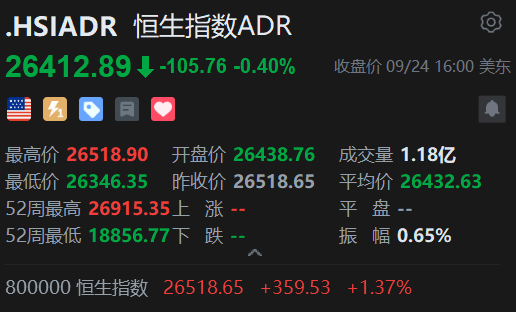
智通ADR统计|9月25日




智通财经网· 2025-09-24 22:24
Market Overview - The Hang Seng Index (HSI) closed at 26,412.89, down by 105.76 points or 0.40% on September 24 [1] - The index reached a high of 26,518.90 and a low of 26,346.35 during the trading session [1] Major Blue-Chip Stocks Performance - HSBC Holdings closed at HKD 108.728, up by 1.14% compared to the Hong Kong close [2] - Tencent Holdings closed at HKD 643.360, down by 0.79% compared to the Hong Kong close [2] Stock Price Movements - Tencent Holdings (00700) latest price is HKD 648.500, with an increase of HKD 13.000 or 2.05% [3] - Alibaba Group (09988) latest price is HKD 174.000, with an increase of HKD 14.600 or 9.16% [3] - HSBC Holdings (00005) latest price is HKD 107.500, down by HKD 1.100 or 1.01% [3] - China Construction Bank (00939) latest price is HKD 7.470, down by HKD 0.030 or 0.40% [3] - Xiaomi Group (01810) latest price is HKD 56.900, up by HKD 1.450 or 2.61% [3] - AIA Group (01299) latest price is HKD 70.400, down by HKD 0.500 or 0.71% [3] - Meituan (03690) latest price is HKD 102.200, up by HKD 1.200 or 1.19% [3] - Hong Kong Exchanges and Clearing (00388) latest price is HKD 438.200, up by HKD 0.800 or 0.18% [3] - Industrial and Commercial Bank of China (01398) latest price is HKD 5.810, up by HKD 0.030 or 0.52% [3] - JD.com (09618) latest price is HKD 133.000, up by HKD 4.700 or 3.66% [3]

港交所行政总裁陈翊庭: 丰富产品货架 承接全球资金多元化配置需求
Zhong Guo Zheng Quan Bao· 2025-09-24 20:26
Core Viewpoint - The Hong Kong Stock Exchange (HKEX) is witnessing a significant shift in foreign investment sentiment towards Chinese assets, moving from a stance of avoidance to one of necessity, driven by China's policy stability and technological advancements [1][3]. Group 1: Investment Trends - Foreign capital is increasingly viewing Chinese assets as essential, with a notable change in investment logic from "Anything But China" to "Buy China" [3]. - In the first half of the year, HKEX reported a new stock financing amount of HKD 1,094 billion, reclaiming the top position among global exchanges [2]. - The average daily trading volume in the securities market reached HKD 2,402 billion, a year-on-year increase of 118% [2]. Group 2: Supply and Demand Dynamics - The supply side is robust, with over 200 companies currently processing IPO applications, nearly half of which are technology firms [2]. - A significant highlight on the demand side is the substantial return of foreign capital, with foreign investors participating in 70-80% of certain IPOs [2][3]. - The shift in global asset allocation strategies, influenced by geopolitical tensions and trade protectionism, is prompting investors to diversify away from USD assets towards Hong Kong stocks [2][3]. Group 3: Institutional Innovation - HKEX is committed to optimizing its institutional framework to meet diverse financing needs, exemplified by the introduction of the 18A and 18C listing rules, which allow biotech and specialized technology companies to go public [5]. - The 18C rule has already seen three companies listed and over ten applications submitted, indicating growing market acceptance [5]. Group 4: Market Connectivity - The "A+H" listing model has created a positive feedback loop, with average trading volume for "A+H" companies in A-shares increasing by approximately 15% this year [6]. - HKEX aims to enhance its product offerings in fixed income, foreign exchange, and commodities to better compete with global markets [6]. - Future plans include expanding the range of products available through the Stock Connect, including ETFs and bonds, to facilitate greater market integration [6][7].
丰富产品货架 承接全球资金多元化配置需求
Zhong Guo Zheng Quan Bao· 2025-09-24 20:18
Core Viewpoint - The Hong Kong Stock Exchange (HKEX) is witnessing a significant shift in foreign investment sentiment towards Chinese assets, driven by the increasing attractiveness of these assets and the demand for diversified global capital allocation [1][2][3] Group 1: Investment Trends - Foreign capital is transitioning from a passive to an active approach in investing in Chinese assets, with a notable increase in foreign participation in IPOs, exemplified by a large domestic company's IPO where foreign subscription reached 70-80% [2][3] - The global asset allocation logic is changing, with investors moving away from USD assets due to geopolitical tensions and trade protectionism, leading them to consider Hong Kong stocks as a viable alternative [2][3] - The investment logic for foreign capital is shifting from "Anything But China" to "Buy China," indicating a growing confidence in Chinese assets [2][3] Group 2: Market Performance - HKEX reported impressive performance in the first half of the year, with new stock financing reaching HKD 109.4 billion, reclaiming the top position among global exchanges, and an average daily trading volume of HKD 240.2 billion, up 118% year-on-year [1][2] - The average daily trading volume for Hong Kong stocks is projected to rise from approximately HKD 1 billion in 2023 to HKD 1.3 billion in 2024, and further to HKD 2.4 billion in the first half of 2025, with foreign capital accounting for about 70% of the trading volume [3][4] Group 3: Institutional Innovation - HKEX is committed to optimizing its institutional framework to meet the diverse needs of enterprises and investors, with recent innovations such as the introduction of Chapter 18A and 18C allowing biotech and specialized technology companies to list without prior revenue [4][5] - The introduction of these new listing rules reflects HKEX's proactive approach to align with long-term investor demands and support early-stage financing for innovative companies [5][6] Group 4: Market Connectivity - The IPO boom in Hong Kong is positively correlated with the A-share market, with "A+H" listings creating a virtuous cycle between the two markets [5][6] - HKEX aims to enhance its product offerings in fixed income, foreign exchange, and commodities to better compete globally, as current offerings are limited compared to US markets [6] - Future plans include expanding the range of products available through the Stock Connect program, such as ETFs and bonds, to facilitate greater access for foreign investors [6]
德勤:前三季度香港新股融资额同比上升228%,港交所保持全球首位
IPO早知道· 2025-09-24 05:37
Core Viewpoint - The article discusses the performance and outlook of the IPO market in Hong Kong and mainland China, highlighting significant growth in new listings and financing amounts in 2023, with expectations for continued strong momentum in the fourth quarter and beyond [2][3][4]. Group 1: Hong Kong IPO Market - In the first three quarters of 2023, Hong Kong saw 66 new IPOs raising HKD 1,823 million, a 47% increase in the number of new listings and a 228% increase in financing compared to the same period last year [3]. - The market is expected to maintain strong momentum in Q4 2023, with over 230 listing applications currently being processed and more than 5 large-scale IPOs anticipated, projecting a total of over 80 new listings raising between HKD 2,500 million to HKD 2,800 million for the year [3]. - The new listings will primarily consist of A+H shares, with notable contributions from healthcare, technology, and consumer sectors [3]. Group 2: Mainland China IPO Market - By September 30, 2025, it is projected that 78 new IPOs will raise RMB 771 billion, representing a 13% increase in the number of new listings and a 61% increase in financing compared to the previous year [4]. - The ChiNext board is leading in the number of new listings, while the Shanghai main board has the highest total financing amount among various boards, with 25 new IPOs expected to raise RMB 454 billion [4]. - The article emphasizes the steady progress of new IPO issuances in the A-share market, aligning with regulatory policies and showcasing the strength of the mainland IPO market [4]. Group 3: U.S. Market for Chinese Companies - In the first three quarters of 2025, 57 Chinese companies are expected to go public in the U.S., raising USD 1.05 billion, which is a 54% increase in the number of new listings and a 26% increase in financing compared to the same period last year [4]. - The anticipated increase in regulatory hurdles for Chinese companies seeking to list on NASDAQ may lead some to consider Hong Kong as an alternative for their IPO plans [5].

港交所技術面現分歧!熊證兩日賺27%的啟示
Ge Long Hui· 2025-09-24 03:59
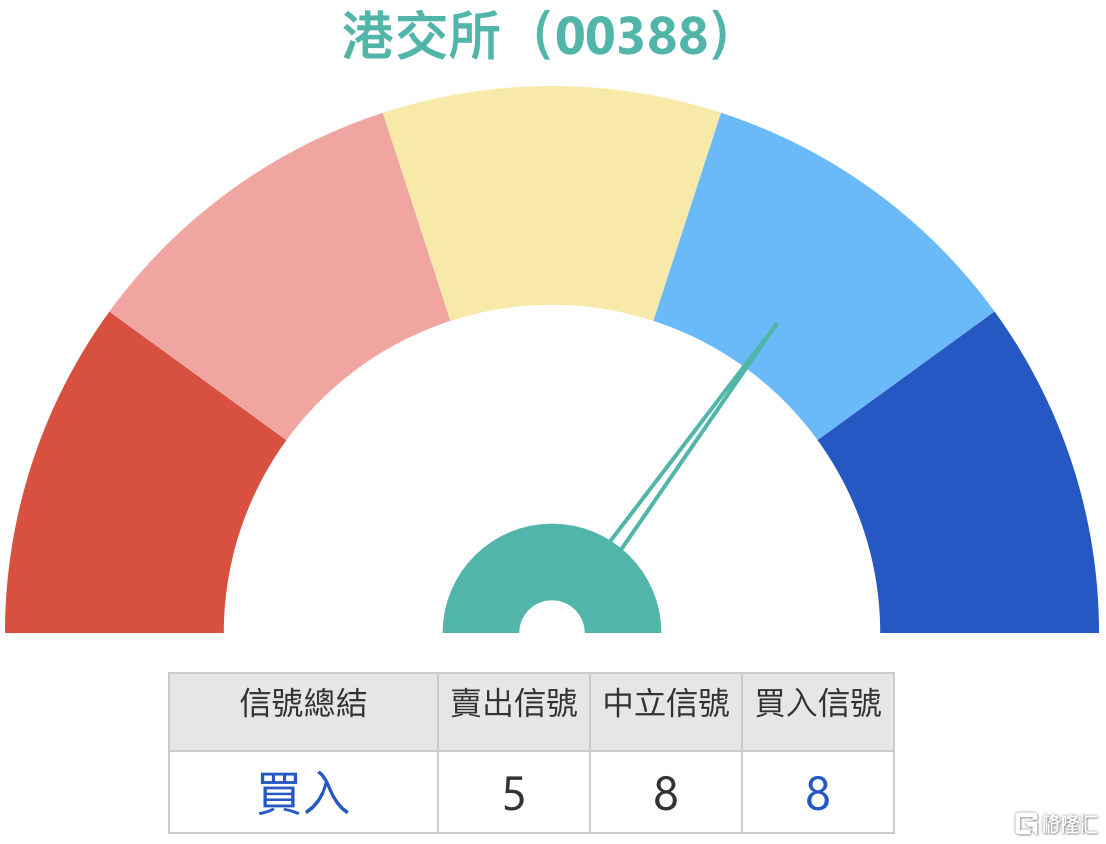
Market Overview - The Hong Kong stock market, represented by Hong Kong Exchanges and Clearing Limited (00388), is currently experiencing a tug-of-war between bullish and bearish sentiments, with technical indicators sending mixed signals [1] - As of 13:15, the stock price is at HKD 435.8, down 1.49%, oscillating near the 10-day moving average of HKD 446.36 and the 30-day moving average of HKD 444.37, while remaining above the 60-day moving average of HKD 435.69 [1] - The Relative Strength Index (RSI) is at 46, indicating a potential oversold condition, while the MACD and Ichimoku indicators suggest a bearish trend, indicating an imminent decision on short-term direction [1] Technical Analysis - Key support levels are identified between HKD 418 and HKD 428, while resistance levels are at HKD 450 and a stronger resistance at HKD 466 [1] - Despite a modest 5.5% fluctuation over five days, the overall strength of technical indicators reaches an 8-level buy signal, suggesting a potential breakout momentum [1] - The narrowing Bollinger Bands indicate that the market is in a state of consolidation, poised for a breakout [1] Derivative Market Performance - Recent performance in the warrants market shows significant gains, with the recommended Morgan Stanley bear certificate (60987) rising 27% within two days despite a 2.07% drop in the underlying stock [3] - The Bank of China put option (19860) also recorded an 11% increase during the same period, highlighting the potential for significant returns from bearish products during market volatility [3] Investment Strategies - For bullish positions, UBS call options (16698) offer a high leverage of 17.6 times, while Societe Generale call options (16900) provide even higher leverage at 18 times, both with an exercise price set at HKD 484.08 [6] - Bearish strategies can focus on Bank of China put options (19860) and UBS put options (19854), both maintaining low implied volatility and offering leverage above 7 times [8] - Morgan Stanley bear certificate (66719) has a redemption price of HKD 473, noted for its low premium and high actual leverage, while UBS bear certificate (60541) strikes a good balance between leverage and premium [8]
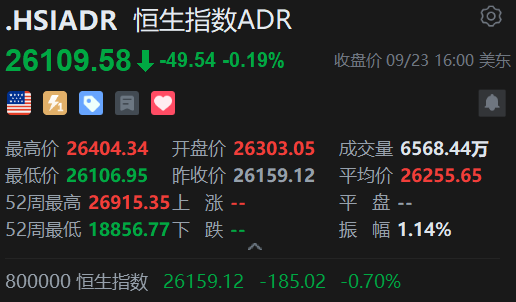
智通ADR统计|9月24日
智通财经网· 2025-09-23 22:27
Market Overview - The Hang Seng Index (HSI) closed at 26,109.58, down by 49.54 points or 0.19% on September 23 [1] - The index reached a high of 26,404.34 and a low of 26,106.95 during the trading session, with a trading volume of 65.684 million shares [1] - The 52-week high for the index is 26,915.35, while the 52-week low is 18,856.77, indicating a volatility of 1.14% [1] Major Blue-Chip Stocks Performance - HSBC Holdings closed at 109.177 HKD, up by 0.53% compared to the previous close [2] - Tencent Holdings closed at 633.990 HKD, down by 0.24% compared to the previous close [2] - Alibaba Group (ADR) closed at 158.517 HKD, down by 0.55% compared to the previous close [3] - Other notable performances include: - AIA Group down by 1.53% to 70.900 HKD [3] - Meituan down by 2.79% to 101.000 HKD [3] - JD.com down by 4.40% to 128.300 HKD [3] Summary of Key Stock Movements - Tencent Holdings: Latest price 635.500 HKD, down by 0.86% [3] - Alibaba Group: Latest price 159.400 HKD, up by 0.13% [3] - HSBC Holdings: Latest price 108.600 HKD, up by 1.31% [3] - Xiaomi Group: Latest price 55.450 HKD, down by 1.16% [3] - BYD Company: Latest price 106.300 HKD, down by 3.10% [3] - Baidu Group: Latest price 128.400 HKD, down by 5.38% [3]
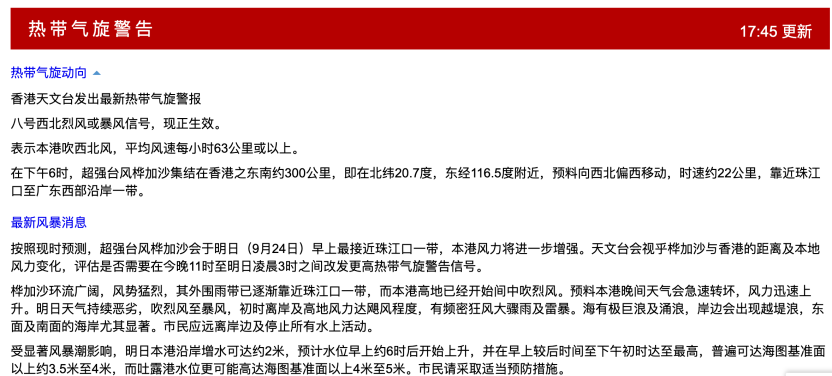
台风逼近!香港挂出“八号风球” 港交所:正常交易!
Zheng Quan Shi Bao· 2025-09-23 15:01
Core Viewpoint - The Hong Kong Stock Exchange (HKEX) will maintain normal trading operations despite the impending arrival of Typhoon Haikui, following the implementation of a "no trading halt during bad weather" policy a year ago [3][4]. Group 1: HKEX Operations - HKEX has received regulatory approval to implement trading during severe weather conditions since September 23, 2023, allowing the market to operate under adverse weather circumstances [3]. - The Financial Secretary of Hong Kong, Paul Chan, stated that the government is prepared for the typhoon and has activated a coordination center to ensure smooth financial market operations [3]. - HKEX has advised financial institutions to allocate resources and personnel in advance to ensure stable market operations during the typhoon [4]. Group 2: Weather Trading Arrangements - Under the bad weather trading arrangements, the securities and derivatives markets in Hong Kong will continue to operate during signal warnings of Typhoon No. 8 or above, black rainstorm warnings, or extreme situation warnings [4]. - HKEX has called on market participants to prepare for trading under adverse weather conditions and to refer to established operational arrangements [4]. Group 3: Recommendations for Market Participants - Securities brokers are advised to ensure that banking services and electronic transfer limits are sufficient for daily operations during bad weather trading days [5]. - Investors should familiarize themselves with the electronic trading platforms and transfer channels provided by their banks or brokers [6]. - Employees of securities firms or banks should be prepared for remote access to company systems and discuss work arrangements with employers in anticipation of potential weather changes [7].
德勤:港交所料登顶今年全球新股融资榜
Zhong Guo Xin Wen Wang· 2025-09-23 14:10
Group 1 - Deloitte's report predicts that Hong Kong will surpass the New York Stock Exchange and NASDAQ to become the top global IPO financing market in 2023 [1] - In the first three quarters of 2023, Hong Kong is expected to have 66 IPOs raising HKD 182.3 billion, a 228% increase from HKD 55.6 billion in the same period last year [1] - The NYSE and NASDAQ are projected to rank second and third globally, with IPO financing amounts of HKD 125.6 billion and HKD 114.6 billion, respectively [1] Group 2 - The influx of overseas capital into Hong Kong has significantly boosted market activity and valuations, driven by policies encouraging mainland leading companies to list in Hong Kong [1] - The report anticipates that with the Federal Reserve's interest rate cuts, more funds will flow into the Hong Kong stock market, with over five potential large IPOs expected [1] - For the mainland capital market, it is estimated that by September 30, 2023, there will be 78 IPOs in the A-share market raising RMB 77.1 billion, reflecting a year-on-year increase of 13% in the number of IPOs and 61% in total financing [1][2] Group 3 - The A-share market has shown steady growth in the first three quarters of 2023, supported by the implementation of new regulatory policies [2] - The focus on technology and innovation by the government is expected to keep sectors like technology and renewable energy as hotspots for new IPOs in the A-share market [2]