CHINA TELECOM(00728)

Search documents
中国电信跌2.06%,成交额8.51亿元,主力资金净流出1.60亿元
Xin Lang Zheng Quan· 2025-12-22 06:15
Core Viewpoint - China Telecom's stock price has experienced a decline of 4.41% this year, with a recent drop of 2.06% on December 22, 2023, indicating potential challenges in market performance [1][2]. Financial Performance - For the period from January to September 2025, China Telecom reported a revenue of 394.27 billion yuan, reflecting a year-on-year growth of 0.59%, while the net profit attributable to shareholders was 30.77 billion yuan, up by 5.03% year-on-year [2]. - The company has distributed a total of 95.19 billion yuan in dividends since its A-share listing, with 68.65 billion yuan distributed over the past three years [3]. Stock Market Activity - As of December 22, 2023, China Telecom's stock was trading at 6.64 yuan per share, with a market capitalization of 607.61 billion yuan. The trading volume was 8.51 billion yuan, with a turnover rate of 0.16% [1]. - The net outflow of main funds was 160 million yuan, with significant selling pressure observed, as large orders accounted for 33.02% of total sales [1]. Business Overview - China Telecom, established on September 10, 2002, and listed on August 20, 2021, primarily engages in telecommunications and related services, including fixed-line and mobile services, internet access, and value-added services [2]. - The revenue composition of the company includes mobile communication services (39.56%), industrial digital services (27.78%), fixed-line and smart home services (23.80%), and other income sources [2]. Shareholder Information - As of September 30, 2025, the number of shareholders for China Telecom reached 273,700, an increase of 22.83% from the previous period [2].

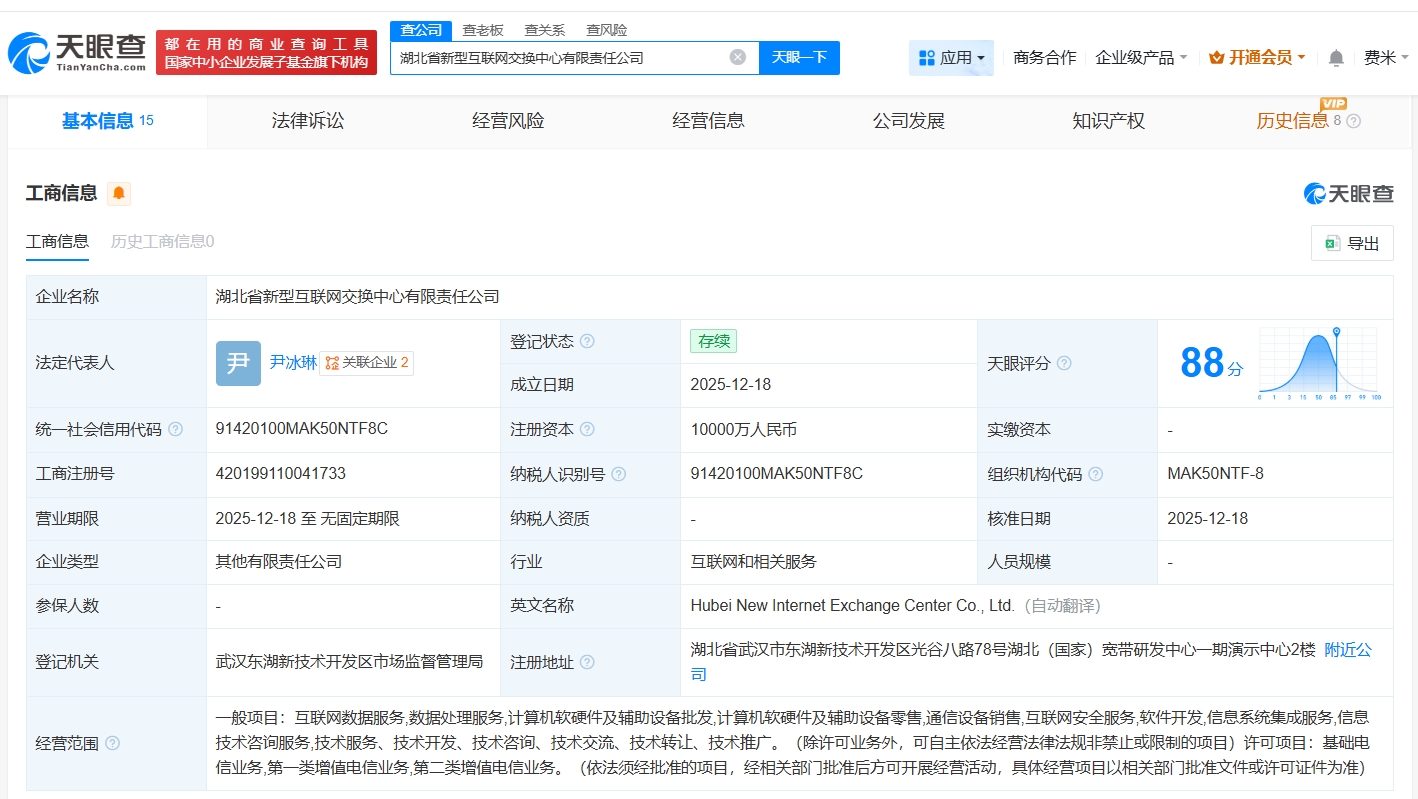
中国电信等在湖北成立新型互联网交换中心公司
2 1 Shi Ji Jing Ji Bao Dao· 2025-12-22 04:31
Core Viewpoint - The establishment of Hubei New Internet Exchange Center Co., Ltd. marks a significant development in the internet data service sector in Hubei Province, with a registered capital of 100 million RMB and a focus on various internet-related services [1]. Group 1: Company Overview - Hubei New Internet Exchange Center Co., Ltd. was founded on December 18, 2025, with a registered capital of 100 million RMB [2]. - The legal representative of the company is Yin Binglin, and it is registered under the Wuhan East Lake New Technology Development Zone Market Supervision Administration [2]. - The company operates in the internet and related services industry, with a business scope that includes internet data services, data processing services, and wholesale and retail of computer hardware and software [2]. Group 2: Shareholding Structure - The company is jointly held by four major shareholders: Tianyi Capital Holdings Co., Ltd. (63.75%), Hubei Big Data Group Co., Ltd. (18.75%), FiberHome Technologies Group Co., Ltd. (12.5%), and Hubei Broadcasting and Television Information Network Co., Ltd. (5%) [2]. - Tianyi Capital Holdings Co., Ltd. is a state-owned holding company, indicating strong governmental support for the new venture [2].


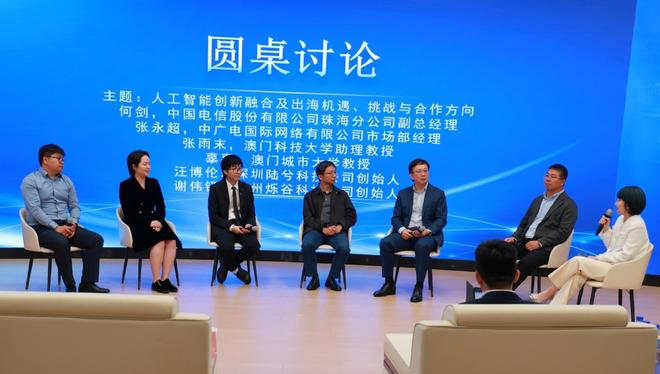
首场大湾区AI出海交流会在珠海举行,专家共议生态协同建设
Nan Fang Du Shi Bao· 2025-12-22 04:25
Core Viewpoint - The AI industry is entering a new phase of "ecological collaboration" for overseas expansion, emphasizing the importance of safety and local integration for Chinese AI to establish a global presence [1][4]. Group 1: Opportunities and Challenges in AI Overseas Expansion - Different global markets exhibit distinct demands for AI technologies and products, with Chinese AI companies finding core opportunities in energy utilization and computing power supply, particularly in Belt and Road Initiative countries and emerging markets [3]. - The emergence of large models as a new growth point differentiates from traditional AI products, focusing on underlying empowerment and integrating into global industrial chains as a "technical infrastructure" [3]. - The choice of overseas expansion paths should align with the development stage of the enterprise, with startups focusing on "product export" for market validation, while mature companies should adopt a "technology + brand" dual strategy [4]. Group 2: Importance of Ecological Collaboration - Ecological collaboration is identified as a core competitive advantage for AI overseas expansion, with the roles of government, universities, industry associations, and research institutions being crucial in building this ecosystem [5]. - Successful examples of full industry chain collaboration in AI projects highlight the value of integrating local resources and addressing energy challenges in overseas deployments [5]. - Recommendations for government policies include tax incentives and standardization efforts, while industry associations can facilitate connections through international exhibitions [6]. Group 3: Future Directions for AI Industry - The AI industry is transitioning from "individual advancement" to "ecological collaboration," with expectations for collective support from government, academia, and industry associations to enhance the AI overseas ecosystem [6]. - The city of Zhuhai aims to leverage its role as a connector in the Greater Bay Area, fostering resource integration and promoting local AI brands on a global scale [6].
248只港股获南向资金大比例持有
Zheng Quan Shi Bao Wang· 2025-12-22 01:33
Core Insights - The overall shareholding ratio of southbound funds in Hong Kong Stock Connect stocks is 19.35%, with 248 stocks having a shareholding ratio exceeding 20% [1] - Southbound funds hold a total of 4,922.61 million shares, accounting for 19.35% of the total share capital of the stocks, with a market value of 61,260.73 billion HKD, representing 14.61% of the total market value [1] Group 1: Shareholding Distribution - 248 stocks have a shareholding ratio of over 20%, 128 stocks between 10% and 20%, 96 stocks between 5% and 10%, 80 stocks between 1% and 5%, and 27 stocks below 1% [1] - The stock with the highest southbound fund shareholding is China Telecom, holding 10,007.11 million shares, which is 72.10% of the issued shares [2] - Other notable stocks include Green Power Environmental (70.23%) and China Resources Power (68.80%) [2] Group 2: Industry Concentration - Southbound funds with a shareholding ratio exceeding 20% are primarily concentrated in the healthcare, industrial, and financial sectors, with 56, 36, and 34 stocks respectively [2] - The majority of stocks with high southbound fund holdings are AH concept stocks, with 129 out of 248 stocks (52.02%) having a shareholding ratio over 20% [1] Group 3: Notable Stocks and Performance - Key stocks with high southbound fund holdings include: - China Telecom: 10,007.11 million shares, 72.10% [2] - Green Power Environmental: 28,403.90 million shares, 70.23% [2] - China Shenhua: 224,310.90 million shares, 66.41% [2] - Other significant stocks include: - Fosun Pharma: 31,757.00 million shares, 57.53% [3] - Longi Green Energy: 14,007.74 million shares, 56.00% [3]
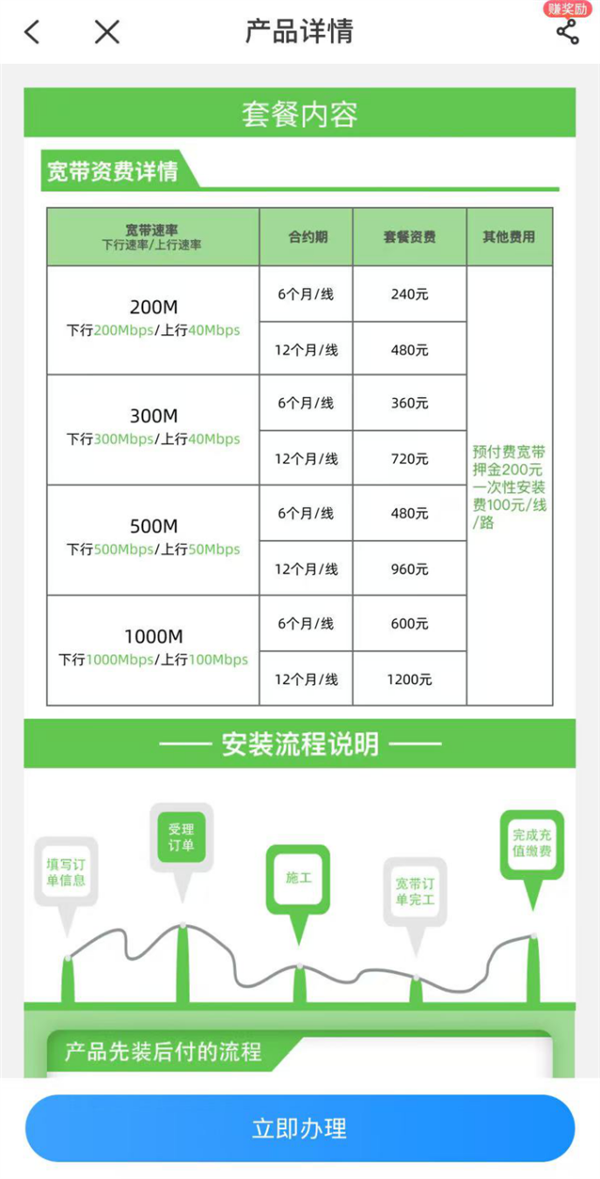
电信千兆宽带实测不足百兆 天下苦网速久矣....
Xin Lang Ke Ji· 2025-12-22 01:01
Core Viewpoint - The article discusses the dissatisfaction of users, including a notable figure, with the actual internet speeds provided by telecom companies, particularly Shanghai Telecom's claimed "gigabit" broadband service, which often delivers significantly lower speeds than advertised [1][2][8]. Group 1: User Complaints - Users have reported that despite subscribing to "gigabit" broadband, their actual speeds are often below 100 Mbps, leading to frustration and calls for better service [1][2]. - A consumer expressed that many users feel similarly, indicating a widespread issue with the actual performance of high-speed broadband services [1]. - Complaints highlight that even with high-tier plans, users experience speeds that do not meet expectations, with some reporting speeds as low as 300 Mbps on a 2000 Mbps plan [1]. Group 2: Industry Insights - Experts note that the discrepancy between advertised and actual speeds is common, attributing it to the difference between theoretical maximum speeds and real-world performance [2][5]. - Factors affecting broadband speeds include network congestion, the quality of the user's equipment, and the routing of data through various networks, which can limit speed [5][6]. - The concept of "gigabit broadband" is seen as potentially misleading, as it may not clearly communicate the conditions under which such speeds can be achieved [8]. Group 3: Regulatory and Legal Considerations - Legal experts suggest that if telecom providers fail to deliver the promised speeds, they may be violating consumer protection laws and contractual obligations [8][9]. - The article mentions that if users consistently receive speeds significantly lower than what they paid for, it could be considered a breach of contract, allowing for potential claims for damages [8][9]. - There are concerns that if telecom companies intentionally limit speeds while advertising "gigabit" services, they may be engaging in misleading marketing practices [8][9].
智通港股通持股解析|12月22日





智通财经网· 2025-12-22 00:37
智通财经APP获悉,根据2025年12月19日披露数据,中国电信(00728)、绿色动力环保(01330)、大 眾公用(01635)位居港股通持股比例前3位,分别为72.10%、70.23%、68.80%。此外,小米集团-W (01810)、中国平安(02318)、美团-W(03690)在最近有统计数据的5个交易日内,持股额增幅最 大,分别为+30.14亿元、+17.26亿元、+17.09亿元;中国移动(00941)、中国石油股份(00857)、华虹 半导体(01347)在最近有统计数据的5个交易日内,持股额减幅最大,分别为-14.34亿元、-10.05亿 元、-7.97亿元。 具体数据如下(交易所数据根据T+2日结算): | 公司名称 | 持股数量 | 最新持股比例 | | --- | --- | --- | | 中国电信(00728) | 100.07亿股 | 72.10% | | 绿色动力环保(01330) | 2.84亿股 | 70.23% | | 大眾公用(01635) | 3.67亿股 | 68.80% | | 凯盛新能(01108) | 1.70亿股 | 67.92% | | 天津创业环保股份( ...
人民日报点名运营商“套路”:新老用户有别,合约捆绑成常态
3 6 Ke· 2025-12-21 23:55
Core Viewpoint - The article highlights the hidden traps in mobile service plans offered by telecom operators, emphasizing the disparity in treatment between new and existing customers, and the complexity of contract terms that often lead to consumer dissatisfaction [3][20][22] Group 1: Issues with Mobile Plans - Consumers are increasingly cautious about mobile plans due to hidden costs and complex terms, leading to a tedious selection process [1][3] - The article criticizes telecom operators for practices such as "easy upgrades but difficult downgrades," "differential treatment for new and old users," and "contract bundling" [3][20] - Operators often promote attractive features like extensive free calling minutes or large data allowances, but these benefits are typically limited to the first year, with subsequent costs potentially increasing significantly [4][6] Group 2: Consumer Experience - Existing customers are often treated as stable revenue sources, while new users are targeted with enticing offers, creating a perception that older customers can bear higher costs [6][13] - Many consumers report difficulties when attempting to downgrade their plans, facing obstacles such as unavailability of options online or being redirected to customer service without resolution [9][12] - The emergence of "fee reduction" services on e-commerce platforms indicates widespread frustration among consumers, who seek assistance in navigating the complexities of telecom offerings [12] Group 3: Industry Dynamics - The mobile communication market in China has shifted from a growth phase to a saturation phase, with net user growth stagnating, prompting operators to focus on increasing average monthly revenue per user [13][20] - Despite ongoing government policies promoting lower prices and better services, operators continue to rely on complex pricing strategies to maintain revenue, which may not be sustainable in the long term [20][22] - The article suggests that as consumer awareness of billing practices increases, there may be a trend towards switching operators, especially with new policies facilitating easier number portability [20][22]



千兆宽带缩水,上网需要不打折扣的体验感
Nan Fang Du Shi Bao· 2025-12-21 16:41
Core Viewpoint - The recent complaints by a well-known blogger regarding internet speed highlight systemic issues within the telecommunications industry, particularly with Shanghai Telecom's service quality and customer support [2][3]. Group 1: Customer Complaints and Industry Response - The blogger, Luo Yonghao, expressed frustration over receiving internet speeds significantly lower than the promised gigabit service, often dropping to below 100 Mbps [2]. - Shanghai Telecom's response to the complaints suggested that the issue may lie with the user's equipment or home environment rather than the service provided, which reflects a common practice among telecom operators [2][4]. Group 2: Industry Practices and Consumer Experience - The comparison between internet service and real estate highlights how advertised speeds can be misleading, similar to how developers may include non-livable areas in property measurements [3]. - The industry's reliance on theoretical speeds and technical jargon often leaves consumers dissatisfied, as they experience slow connections despite paying for high-speed services [3][4]. - There is a call for telecom companies to provide clearer information about actual usable speeds and to take a more proactive approach in addressing customer issues, rather than deflecting responsibility [4].
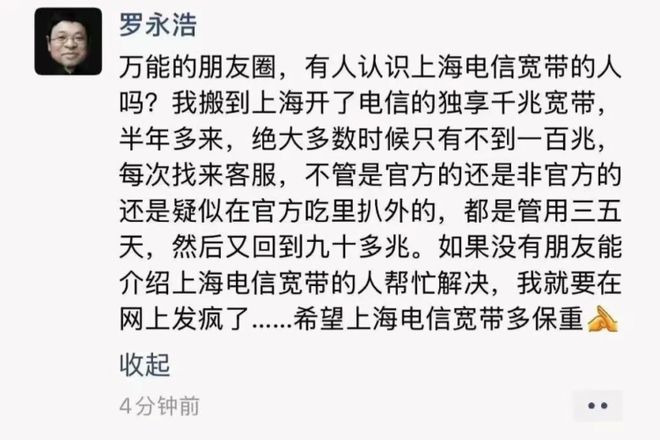
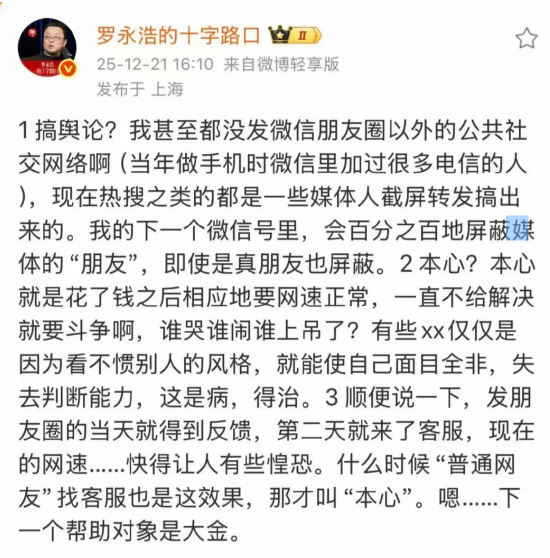
痛批电信“失去本心”?罗永浩回应:本心是花了钱网速就要正常
Xin Lang Cai Jing· 2025-12-21 11:30
新浪科技讯 12月21日晚间消息,近日,罗永浩因痛批上海电信宽带缩水引发广泛关注。有网友因此质 疑罗永浩道:"批天批地,已经失去本心了,流量使人膨胀,动不动就一哭二闹三上吊网上搞舆论,适 可而止,早晚反噬。" 今日,罗永浩就此回应称:"本心就是花了钱之后相应地要网速正常,一直不给解决就要斗争啊,谁哭 谁闹谁上吊了?"罗永浩直言,"有些xx仅仅是因为看不惯别人的风格,就能使自己面目全非,失去判断 能力,这是病,得治"。 罗永浩表示,自己发朋友圈的当天就得到(上海电信)反馈,第二天就来了客服,现在的网速…快得让 人有些惶恐。什么时候"普通网友"找客服也是这效果,那才叫"本心"。 新浪科技讯 12月21日晚间消息,近日,罗永浩因痛批上海电信宽带缩水引发广泛关注。有网友因此质 疑罗永浩道:"批天批地,已经失去本心了,流量使人膨胀,动不动就一哭二闹三上吊网上搞舆论,适 可而止,早晚反噬。" 今日,罗永浩就此回应称:"本心就是花了钱之后相应地要网速正常,一直不给解决就要斗争啊,谁哭 谁闹谁上吊了?"罗永浩直言,"有些xx仅仅是因为看不惯别人的风格,就能使自己面目全非,失去判断 能力,这是病,得治"。 罗永浩表示,自己发朋 ...
上海电信回应“罗永浩吐槽网速”
新浪财经· 2025-12-20 07:50
Core Viewpoint - The article discusses the issues faced by users of Shanghai Telecom's gigabit broadband service, highlighting complaints about inconsistent internet speeds and the company's response to these concerns [2][4]. Group 1: Company Commitment - Shanghai Telecom positions itself as a core communication service provider in Shanghai, committed to the mission of building a strong network nation and actively promoting gigabit coverage and leading in ten-gigabit services [4]. - The company aims to provide users with high-speed, stable, intelligent, and secure network services throughout the city [4]. Group 2: User Experience Challenges - Users may encounter issues with Wi-Fi speeds in different rooms, which can be attributed to various factors such as home layout, indoor area, wall shielding, signal interference, device placement, standards of self-purchased Wi-Fi routers, and computer terminals [4]. - Shanghai Telecom encourages users facing these issues to contact their customer service for free and professional network testing and repair services [2][4].