CHINA UNICOM(00762)

Search documents
镇江联通为槐荫村量身打造智慧平台,5G + 宽带让乡村振兴 “加速跑”
Yang Zi Wan Bao Wang· 2025-11-12 07:02
Core Viewpoint - The article highlights the efforts of Zhenjiang Unicom in promoting rural revitalization through digital transformation and community engagement, focusing on the partnership with Huaiyin Village to enhance local development and infrastructure [1][2][4]. Group 1: Partnership and Community Engagement - Zhenjiang Unicom has established a partnership with the Huaiyin Village Party Committee to implement the "Digital Village" framework, enhancing community governance and service capabilities [2]. - Joint activities such as party member training and thematic events are organized to strengthen the village's party organization and leadership role in development [2]. Group 2: Digital Infrastructure Development - A customized "Digital Village" service platform has been developed to integrate various resources, covering six key areas including party building, management, governance, industry, and finance [3]. - The platform allows villagers to access information and services via a WeChat mini-program, facilitating real-time updates on village affairs and agricultural policies [3]. Group 3: Network Expansion and Service Improvement - Zhenjiang Unicom is accelerating the deployment of 5G and broadband networks in Huaiyin Village, addressing communication challenges faced by residents [4]. - The initiative includes on-site visits to educate villagers about 5G technology and provide free network testing services, enhancing their digital experience [4]. - The ongoing network development is positioned as a catalyst for rural revitalization, aiming to improve the quality of life and access to information for villagers [4].

北京联通:持续提升企业客户服务水平 为首都营商环境注入“数字加速度”
Xin Hua She· 2025-11-12 06:53
原标题:联通好服务 用心为客户——北京联通持续提升企业客户服务水平 为首都营商环境注入"数字加 速度" 营商环境是区域经济发展的"软实力",更是企业扎根成长的"硬支撑"。北京联通作为首都地区主要 通信运营商之一,始终坚持"以首善之为,彰显首善之位",以"网络向新、技术向新、服务向新"为牵 引,坚决扛起优化通信营商环境的责任担当,聚焦企业客户核心诉求,以高品质服务和高品质网络为核 心抓手,系统推动服务升级与效能提升,致力于让企业享受更省心、更顺心、更放心的通信体验,深刻 践行"联通好服务用心为客户"高品质服务理念。 政企双线智能开通,让网络接入"立等可取" 高效稳定的网络服务是企业发展的信息基石,在优化营商环境的赛道上,北京联通以世行网络服务 评测指标为指引,推出政企双线智能开通服务,通过技术迭代与流程重构,为优化首都营商环境铺设了 一条坚实稳固的"信息高速路"。 专线业务开通时长是衡量网络环境的一把"时间标尺",网络环境的优良与否是营商环境中人文与社 会环境的重要组成部分。一条专线从客户提交申请到成功接入,所需时长越短,往往意味着营商环境越 优。北京联通通过拆解资源核查、建设部署、网络调度施工和测试验证等全流 ...
智网科技重启IPO:女董事长赵越退场,75后张然懋上位
Sou Hu Cai Jing· 2025-11-12 02:45
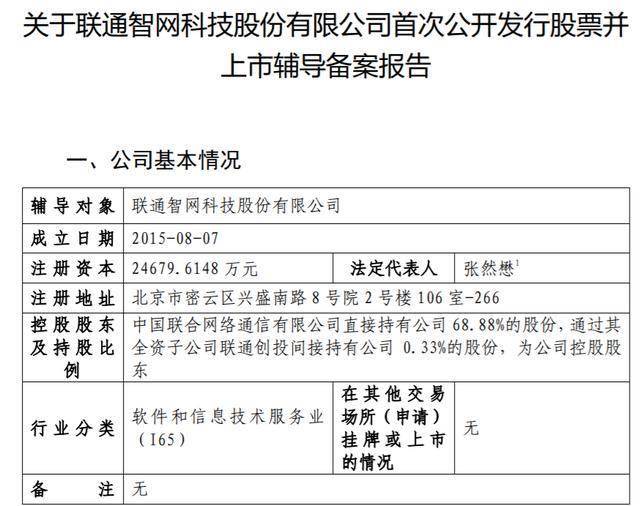
Core Viewpoint - Unicom Smart Network Technology Co., Ltd. (referred to as "Smart Network Technology") has initiated the IPO counseling process with the Beijing Securities Regulatory Bureau, aiming for a listing on the Growth Enterprise Market, with China International Capital Corporation as the counseling institution [1][2]. Company Overview - Smart Network Technology, established on August 7, 2015, has a registered capital of 246.8 million yuan and is a subsidiary focused on automotive digital operation services under China Unicom [2][4]. - The company specializes in providing vehicle information services and solutions for intelligent transportation systems, emphasizing open connectivity, big data aggregation, and real-time response [2]. Shareholding Structure - China Unicom directly holds 68.88% of Smart Network Technology's shares, while its wholly-owned subsidiary, Unicom Venture Capital, holds an additional 0.33%, totaling a 69.21% controlling stake [4]. Leadership Changes - Recent leadership changes include the departure of former chairman Zhao Yue, with Zhang Ranmao now serving as the party secretary, chairman, and general manager of the company [4]. - Zhang Ranmao has over 20 years of experience in the telecommunications industry and is also the head of China Unicom's Smart Transportation Corps [4].

2025数据要素赋能新型工业化大赛落幕,浙江联通8项目获奖
Zhong Guo Jing Ying Bao· 2025-11-11 06:19
Core Insights - The "2025 Data Element Empowering New Industrialization" competition concluded in Wuzhen, Zhejiang, focusing on the theme "Data-Driven Innovation, Intelligent Manufacturing Leading the Future" [1] - A total of 86 top teams reached the finals, emphasizing the deep application of data elements in industrial sectors [1] - The competition aimed to guide collaboration between industry and academia to tackle common challenges in new industrialization and promote intelligent upgrades in industries [1] Group 1: Competition Highlights - Zhejiang Unicom participated actively, with 8 projects winning awards across three tracks: industrial intelligence, industrial data circulation and utilization, and high-quality industrial data set construction and application [1] - The awarded projects showcased diverse practices of data elements in industrial scenarios, reflecting Zhejiang's varied explorations and achievements in promoting digital transformation in manufacturing [1] - Several winning projects were developed in collaboration with key industrial enterprises in the province [1] Group 2: Future Directions - Zhejiang Unicom plans to further promote the integration of new technologies such as 5G-A and industrial internet with data elements [1] - The company aims to replicate and promote solutions across multiple industries and scenarios, enhancing data circulation infrastructure and regulatory frameworks in collaboration with industry partners [1] - This initiative is expected to assist in advancing new industrialization to a higher level [1]
赋能产业智能化升级 “ 2025数据要素赋能新型工业化”大赛落幕
Zhong Guo Jing Ying Bao· 2025-11-11 05:52
Core Insights - The "2025 Data Element Empowering New Industrialization" competition was held in Wuzhen, Zhejiang, focusing on the theme "Data-Driven Innovation, Intelligent Manufacturing Leading the Future" [1] - A total of 86 top teams entered the finals, emphasizing the deep application of data elements in industrial sectors [1] - The competition aimed to guide collaboration between industry and academia to tackle common challenges in new industrialization development, promoting intelligent upgrades in industries [1] Company Highlights - Zhejiang Unicom actively participated in the digital transformation of Zhejiang, winning awards for 8 projects across three tracks: industrial intelligence, industrial data circulation and utilization, and high-quality industrial data set construction and application [1] - The awarded projects showcased diverse practices of data elements in industrial scenarios, reflecting Zhejiang's multifaceted exploration and achievements in promoting the digital transformation of manufacturing [1] - Several winning projects were developed in collaboration with key industrial enterprises in the province [1] Future Directions - Zhejiang Unicom plans to further promote the integration of new technologies such as 5G-A and industrial internet with data elements, aiming to replicate and promote solutions across multiple industries and scenarios [1] - The company intends to work with industry chain partners to enhance the infrastructure and regulatory framework for data circulation, supporting the advancement of new industrialization to a higher level [1]
联通智网科技启动上市辅导

Cai Jing Wang· 2025-11-11 02:57
Group 1 - The core point of the article is that Unicom Smart Network Technology Co., Ltd. has initiated the listing guidance process, with China International Capital Corporation serving as the advisory institution [1] - China United Network Communications Co., Ltd. directly holds 68.88% of the shares in Unicom Smart Network Technology Co., Ltd. [1] - Additionally, China United Network Communications Co., Ltd. holds an indirect stake of 0.33% through its wholly-owned subsidiary, Unicom Venture Capital [1]
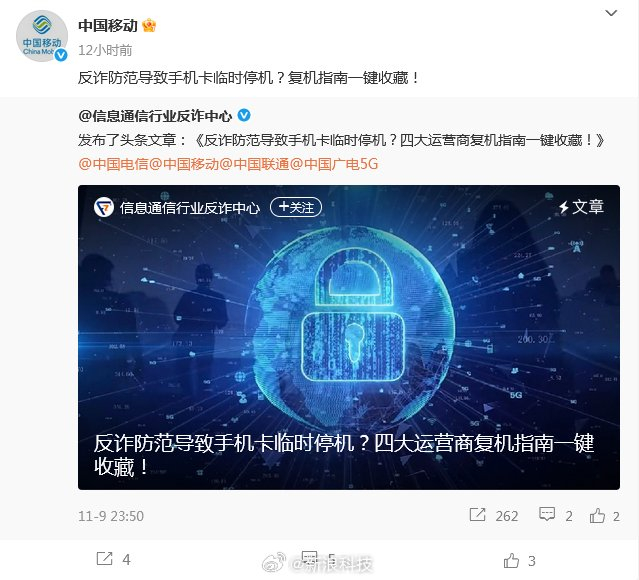
四大运营商发布反诈停机复机指南,线上线下均可办理
Xin Lang Ke Ji· 2025-11-11 02:22
Core Viewpoint - The article discusses the temporary suspension of mobile phone cards due to anti-fraud measures and provides recovery guidelines from the four major telecom operators in China. Group 1: China Telecom - Online channels: Users can process recovery through public accounts, mini-programs, and online service halls (specific methods can be found in the verification notification SMS) [1][17] - Offline channels: Users can bring their ID and phone card to any China Telecom service hall nationwide (specific locations can be queried via local 10000 service) [1][17] Group 2: China Mobile - Online channels: Users can click the link in the notification SMS or call the 10086 customer service hotline for self-service recovery (specific methods can be found in the verification notification SMS) [2][18] - Offline channels: Users can bring their ID and phone card to any China Mobile service hall nationwide (specific locations can be queried via local 10086 service) [2][18] Group 3: China Unicom - Online channels: Users can apply for recovery by searching for the "self-service recovery" interface on the China Unicom app homepage or through public accounts and mini-programs (specific methods can be found in the verification notification SMS) [3][19] - Offline channels: Users can bring their ID and phone card to any China Unicom service hall nationwide to complete real-person authentication [4][19] Group 4: China Broadcasting Network - Online channels: Users can download the China Broadcasting Network app via the link in the notification SMS and complete recovery after passing the identity verification. The app usage does not incur data charges [5][20] - Offline channels: Users can visit any China Broadcasting Network service hall, providing their ID and the phone card for real-person authentication to complete recovery [5][20]

从“地面”到“云端”,三大运营商硬核技术护航十五运会
2 1 Shi Ji Jing Ji Bao Dao· 2025-11-08 13:04
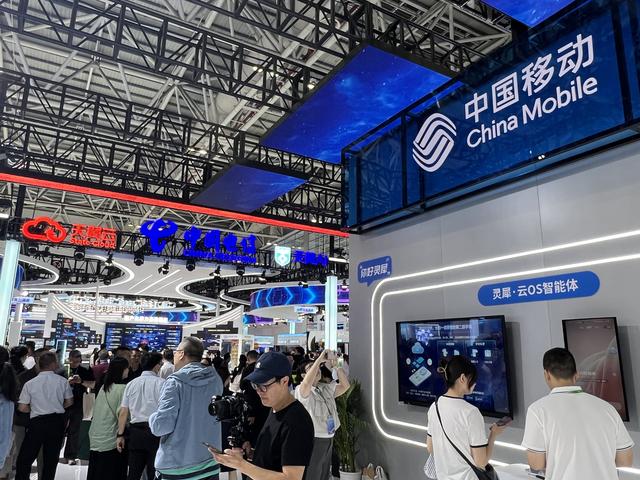
Core Viewpoint - The 15th National Games serves as a platform for showcasing athletic talent and advanced communication technology, with major telecom operators providing a comprehensive digital support system for the event [1] Group 1: Ultra HD Broadcasting - The three major telecom operators have utilized ultra HD broadcasting technology to break geographical barriers, enabling millions of viewers to experience the event in real-time [2] - China Unicom is the sole official partner for cloud broadcasting, employing a "Unicom Cloud + 5G backpack + 5G network slicing" solution to enhance broadcasting capabilities [2][3] - The broadcasting network covers 69 venues and supports 8K technology transmission, marking the largest scale of broadcasting network established for the National Games [3] Group 2: AI Integration - AI technology has been deeply integrated into event management, spectator services, and athlete training, enhancing the overall experience of the National Games [7] - China Unicom's cloud broadcasting platform uses AI algorithms to automatically edit highlight moments from the events, significantly reducing production time [7] - China Telecom has introduced an AI mascot that can interact with visitors, providing information and recommendations, thus enhancing the spectator experience [8] Group 3: Network Infrastructure - China Mobile has optimized 5G networks across 126 venues, adding 634 new 5G base stations to support high concurrent access during the event [4] - The deployment of a 5G-A network at Shenzhen Bao'an International Airport offers speeds 5-10 times faster than standard 5G, ensuring smooth live streaming for spectators [6] - A quantum encryption platform has been implemented in the power emergency command system, enhancing security against quantum computing attacks [6] Group 4: Long-term Benefits - The technological advancements demonstrated during the National Games are expected to benefit urban governance and long-term development beyond the event itself [9] - The MOC platform technology can be reused for city emergency command and various sporting events, promoting digital collaboration in the Guangdong-Hong Kong-Macao Greater Bay Area [9]

把“信号栏”变成“广告栏”,运营商的创新还是骚扰?
Guan Cha Zhe Wang· 2025-11-08 08:07
Core Viewpoint - The article discusses the recent trend of mobile operators in China replacing the operator name in the signal bar with promotional messages, which has raised concerns among users about privacy and the integrity of mobile services [1][5][13]. Group 1: Advertising in Signal Bars - Mobile operators have begun to modify the signal bar to display promotional messages related to local events, which users cannot turn off manually [1][5]. - This change is attributed to operators altering the global mobile communication standards, allowing them to push advertisements through the NITZ protocol instead of displaying the operator name from the SIM card [6][10]. - The new practice has been linked to the operators' need to find additional revenue streams amid declining average revenue per user (ARPU) in a saturated market [17][18]. Group 2: Regulatory and Compliance Issues - The modification of the signal bar for advertising purposes violates the 3GPP standards, which prioritize displaying the SIM card information over NITZ messages [10][13]. - Legal experts have indicated that this practice may infringe upon telecommunications regulations, as it constitutes forced advertising without user consent [13][19]. - There is a call for regulatory bodies to enhance compliance checks on operators to prevent such practices from becoming widespread [19][20]. Group 3: User Experience and Industry Response - Users have expressed dissatisfaction with the intrusive nature of these advertisements, which detract from the intended functionality of the signal bar [19]. - The article suggests that operators should focus on improving service quality and user experience rather than resorting to aggressive advertising tactics [18][20]. - There is a potential for operators to utilize the signal bar for practical notifications, such as data usage alerts, rather than commercial promotions [19].


央企战略新基金创立 三大运营商出资90亿元
Zhong Guo Jing Ying Bao· 2025-11-07 20:31
Core Insights - China Unicom announced an investment of 1.5 billion RMB in the Central Enterprise Strategic Emerging Industry Development Fund, acquiring a 2.94% stake [2][4] - The fund, initiated by the State-owned Assets Supervision and Administration Commission (SASAC), has a total size of 51 billion RMB and aims to support strategic emerging industries such as AI, new energy, and quantum technology [2][5] - The fund's investment period is set for 5 years, with a total management and exit period of 8 years, extendable to 15 years [2][5] Investment Strategy - The establishment of the fund aligns with China's economic development goals and the "14th Five-Year Plan," focusing on enhancing self-reliance in key technologies [3][5] - The fund aims to strengthen the industrial chain and promote the development of state-owned enterprises in strategic new industries [5][6] Participation of Major Telecom Operators - The three major telecom operators, including China Unicom, China Telecom, and China Mobile, are significant contributors to the fund, collectively holding nearly 21% of the fund's shares [7][9] - China Mobile's investment of 6 billion RMB gives it an 11.76% stake, making it the third-largest shareholder after China Guoxin and Beijing Financial Street Capital [7][9] Long-term Capital Support - The fund is designed to provide long-term capital support, differentiating itself from traditional short-cycle private equity and venture capital operations [5][6] - The involvement of state-owned enterprises in the fund is expected to enhance the speed of capacity and technology iteration in the industry [6][10] Focus on Emerging Technologies - The fund will prioritize investments in quantum technology, AI, and high-end equipment, aligning with the telecom operators' current investment strategies [10][11] - The integration of digital technology and green energy is also a focus area, supporting the operators' dual carbon goals [11][12] Transformation of Telecom Operators - The participation in the fund signifies a shift for telecom operators from traditional service providers to new information service providers, emphasizing the importance of capital in this transformation [12] - The fund is expected to accelerate the operators' layout in the "new quality productivity" sector, enhancing their capital evolution [12]