CHINA UNICOM(00762)

Search documents
2026年成eSIM「爆发元年」:iPhone Air降价,联通强推,手机厂商集体入局
3 6 Ke· 2026-01-30 03:26
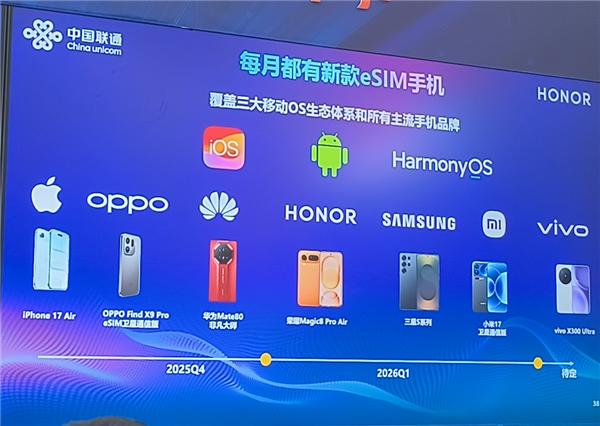
Core Insights - Apple unexpectedly announced a price drop for the iPhone Air, with the 256GB version reduced from 7999 yuan to 5499 yuan after discounts, leading to a rapid sell-out and delayed shipping dates [1] - The iPhone Air's sales were below expectations, with only around 200,000 activations, significantly lower than other models in the iPhone 17 series, primarily due to consumer resistance to eSIM technology [1] Group 1: eSIM Market Dynamics - China Unicom announced plans to launch at least one new eSIM-supported device each month in 2026, indicating a significant push for eSIM adoption [3][4] - The eSIM technology is expected to see a surge in user numbers in 2026, driven by the simultaneous readiness of key industry players, including manufacturers and carriers [6][10] - The first batch of eSIM-supported devices confirmed for release includes models from major brands like Samsung, Xiaomi, and Vivo, highlighting a collective industry shift towards eSIM [4][6] Group 2: Industry Challenges and Opportunities - The transition to eSIM is not merely a technical upgrade but involves significant changes in device design and user experience, which has made manufacturers cautious in the past [7] - The current competitive landscape among carriers is shifting, as traditional user acquisition strategies become less effective due to market saturation, making eSIM a potential new battleground for growth [10][13] - eSIM technology allows for more flexible device designs and reduces the risk of SIM card theft, which could enhance user convenience and attract tech-savvy consumers [12][13] Group 3: Future Outlook - The year 2026 is positioned as a turning point for the mobile communication market, with eSIM transitioning from a niche feature to a standard requirement in new devices [15] - The successful implementation of eSIM services will depend on how well carriers and manufacturers can streamline the user experience and support services [15]


2025年末5G基站达483.8万个
Zheng Quan Ri Bao Zhi Sheng· 2026-01-29 17:10
Core Insights - The Ministry of Industry and Information Technology released the "2025 Communication Industry Statistical Bulletin," indicating stable growth in China's communication industry, with ongoing optimization of industrial structure and a significant increase in user scale, particularly in 5G and gigabit infrastructure deployment [1] User Growth - By the end of 2025, the number of 5G mobile phone users is projected to reach 1.204 billion, accounting for 65.9% of total mobile phone users, an increase of 9.2 percentage points from the end of 2024 [1] - Fixed broadband access users are expected to total 691 million, with a net increase of 20.99 million in 2025. Among these, users with access speeds of 1000 Mbps or higher will reach 238 million, representing 34.5% of total users, up 3.6 percentage points from 2024 [1] Network Infrastructure Development - The number of 5G base stations is anticipated to reach 4.838 million by the end of 2025, with a net increase of 588,000 from 2024, making up 37.6% of total mobile base stations, an increase of 4 percentage points [2] - The total length of newly built optical cable lines in 2025 is projected to be 2.113 million kilometers, bringing the national total to 74.99 million kilometers. The number of 10G PON ports capable of gigabit network services is expected to reach 31.62 million, with a net increase of 3.419 million [2] Computing Power Integration - The three major telecom operators are transitioning their computing power layout from "broad coverage" to "deep integration," with the number of service data center racks reaching 938,000 by the end of 2025, an increase of 108,000 from 2024 [2] - The integration of computing and networking is expected to enhance the precision of computing power distribution across various industries and scenarios, leading to a unified national computing power network [3] Industry Digitalization - The ongoing integration of computing and networking is driving deeper digitalization across industries, characterized by active mobile data traffic consumption and extensive industry application integration [3] - The industrial internet has achieved coverage across 41 industrial categories, becoming a key driver for digital transformation and intelligent upgrades across various sectors [3] Technological Advancements - The integration of computing and networking is breaking down barriers between cloud computing and communication networks, embedding computing capabilities into the network layer for more efficient and customized services [4] - Continuous optimization of network infrastructure is expected to embed computing-network integration into new application scenarios and service models, providing users with diverse and innovative value [4]



众望所归! “山西联通”官方微信荣获“2025年度通信运营商领域具有影响力的官方新媒体账号”奖项
Xin Lang Cai Jing· 2026-01-29 13:37
运营商财经网讯 1月29日,运营商财经网举办了2026中国财经TMT"领秀榜"盛典,得到了包括运营商集团公司、省公 司、专业公司、研究院、地市公司在内的广泛关注和积极参与。 (责任编辑:张运迪) 盛典期间,运营商财经网公布了年度评选的获奖名单,涵盖了运营商、通信、互联网、金融、汽车、房 地产、手机数码、家电、家居、酒业、食品快消等领域的优秀企业及优秀产品。 其中,"山西联通"官方微信,斩获"2025年度通信运营商领域具有影响力的官方新媒体账号"奖项。 ...

大摩:下调中资电讯股评级至“中性” 过去多年上升周期的驱动因素已结束
智通财经网· 2026-01-29 06:17
大摩指,内地通缩格局是传统电信业ARPU增长的主要阻力,对公司利润、现金流的强调,可能抑制新 业务收入的增长,这一情况在2025年已经得到验证,料2026年也呈现类似趋势。尽管2025年第一季度出 现了DeepSeek,但由于收入规模有限以及政府端采用速度较慢,该行认为中资电信商收入的上行空间 有限。该行预测行业服务收入在2026年将增长1.7%(略高于2025年的0.9%),总净利润增长3%,主要由 效率提升推动。该行认为国企/政府的AI采用可能成为三大电信商(中国移动(00941)、中国电信(00728)和 中国联通(00762))的潜在上行催化剂。 该行指中资电讯股获重估的驱动因素有限:(1)中国收益率不太可能进一步下行; (2)增长显著放缓至低个 位数的利润增长,派息比率提升的空间也缩窄。该行预期中资电讯H股在2026年的目标股息率为6-7%, 并继续偏好排序:中国电信>联通>中国移动。 根据该行经济团队的预测,内地2026年将持续面临通缩,十年期国债收益率触底,人民币汇率走强。美 国在2026年上半年将进一步降息,该行将大中华电信营运商评级下调至"中性"。 该行指,中资电讯商多年的上升周期驱动因素— ...
贵安电算协同产业 迈入规范化集约化发展新阶段
Xin Lang Cai Jing· 2026-01-28 19:57
据悉,贵安新区电算协同产业联盟于2025年12月13日在贵安新区举办的第二届CCF中国数据大会上成立 揭牌。本次会议进一步明确了联盟使命:聚焦技术标准、科技研发、产业发展三大方向,破解电力与算 力割裂、资源分散、标准缺失等行业痛点,通过"政府搭台、企业唱戏"机制,打造可复制、可推广的电 算协同技术体系、标准规范和商业模式,为全国行业发展贡献"贵州方案"。 交流环节,来自贵州电网公司、华为、联通等12家单位的代表,围绕多主体联动机制、新型供配电方 案、AI技术应用等前沿议题分享见解、凝聚共识。"我们立足贵州国家算力枢纽节点优势,依托贵安智 算基地核心设施,紧扣'东数西算'战略攻关算网电一体化调度等核心技术,同时与贵州电网携手开展算 力-电力映射模型、共享备电及全直流供电示范等研究。"中国联通贵州省分公司企业客户部工业行业总 监张志民说。 联盟明确算力电力协同规划、电力与算力协同调度等13项任务方向,为电算协同发展搭建起"四梁八 柱"。贵安供电局总经理宋永超在谈及联盟规划时说:"联盟将秉承'聚能汇数、协同创新、共促发展、 安全合规'宗旨,聚焦'电-算-碳'协同目标,推进做精协同规划、建强协同调度体系、筑牢安全防线 ...

三大指数均涨超2% 光通讯和石油股成市场领头羊
Xin Lang Cai Jing· 2026-01-28 09:01
Market Performance - The Hong Kong stock market continued its upward trend with all three major indices closing higher: Hang Seng Index up 2.58% at 27,826.91 points, Hang Seng Tech Index up 2.53% at 5,900.16 points, and the National Enterprises Index up 2.89% at 9,512.24 points [2] - Leading sectors included optical communications, oil, gold, telecommunications, and real estate, while tea and aviation stocks faced downward pressure [3] Optical Communications - Demand for AI infrastructure has spurred the optical communications industry, with Changfei Optical Fiber Cable (06869.HK) leading the sector, closing up 15.43% at 75.20 HKD [4][5] - Corning, a major player in the fiber optics market, saw a single-day increase of over 15%, reaching a historical high, following a long-term agreement with Meta for the procurement of $6 billion worth of fiber optic cables by 2030 [4] Energy Sector - Geopolitical risks have heightened energy security expectations, with China National Offshore Oil Corporation (00883.HK) and China Petroleum & Chemical Corporation (00857.HK) both reaching historical highs, closing up 4.85% and 4.99% respectively [5][6] - The U.S. military's recent military exercises in the Middle East have raised concerns about energy supply stability, contributing to the rise in oil stocks [6] Gold Market - The weakening U.S. dollar has stimulated international gold prices, with Chifeng Jilong Gold Mining (06693.HK) rising 10.65% [7] - The dollar index experienced its largest single-day drop since April 2023, pushing gold prices above $5,200 per ounce [7] Telecommunications - The telecommunications sector is entering a new phase of "deep integration," with China Telecom (00728.HK) rising 6.27% [9] - The Ministry of Industry and Information Technology reported that the three major operators have added 108,000 data center racks, indicating a shift in focus from "broad coverage" to "deep integration" [9] Real Estate - Regulatory optimizations have boosted confidence in the real estate sector, with China Jinmao (00817.HK) rising 11.92% [11] - Feedback from multiple real estate companies indicates that the regulatory body has lifted the monthly reporting requirements for most firms, enhancing market expectations for liquidity and operational environment improvements [11] Individual Stock Movements - Wuneng Zhixing (00800.HK) rose 2.11% as it prepares to launch autonomous buses in Abu Dhabi [17][18] - Kuaishou-W (01024.HK) increased by 4.44%, with its AI product, Keling, surpassing 12 million monthly active users and achieving a 350% growth in paid users [19]

通信行业月报:光模块上游关键物料供应持续紧张,AWS规模部署空芯光纤-20260128
Zhongyuan Securities· 2026-01-28 08:29
Investment Rating - The report maintains an "Outperform" investment rating for the communication industry [2][9]. Core Insights - The communication industry index outperformed the Shanghai Composite Index in December 2025, rising by 12.82% compared to +2.06% for the Shanghai Composite Index and +2.28% for the CSI 300 Index [8][14]. - Key material supply for optical modules remains tight, with major players like Longfei and Hengtong winning bids for China Unicom's hollow-core fiber cable procurement [8][9]. - The retail sales of communication equipment in China increased by 20.9% year-on-year in December 2025, driven by the demand for smartphones [8][41]. - The global smartphone shipment is projected to grow by 2% year-on-year in 2025, reaching 1.25 billion units, with AI smartphones expected to penetrate 34% of the market [8][29]. - The export value of optical modules from China decreased by 15.6% year-on-year in 2025, while Thailand's communication equipment exports surged by 152.1% [8][9]. Summary by Sections Market Review - The communication industry index rose by 12.82% in December 2025, outperforming major indices [14]. - Sub-sectors such as cables and network equipment saw significant gains, with increases of 22.05% and 19.44% respectively [15][19]. Industry Tracking - The capital expenditure of major cloud providers in North America reached $112.43 billion in Q3 2025, a 76.9% increase year-on-year [25][28]. - AI applications are driving cloud business growth, with major companies like Amazon, Microsoft, Google, and Meta significantly increasing their capital expenditures [25][29]. - The Chinese ICT market is expected to grow to approximately $889.43 billion by 2029, with a CAGR of 7.0% [39][40]. Domestic Telecom Industry - Telecom business revenue in China reached 1.6096 trillion yuan from January to November 2025, a year-on-year increase of 0.9% [48]. - The number of 5G mobile phone users reached 1.193 billion by November 2025, accounting for 65.3% of total mobile phone users [49]. - The number of fixed broadband users with gigabit access reached 239 million, representing 34.3% of total users [52].





大行评级|大摩:下调中资电讯股H股评级至“与大市同步”,上升周期驱动因素已结束
Ge Long Hui· 2026-01-28 08:15
摩根士丹利发表研报指,中资电讯商多年的上升周期驱动因素——包括监管放松、竞争减弱、云业务份 额提升及股东回报的基本面素已经过去。宏观环境与通缩持续压力影响移动业务,而人工智能尚不足以 推动业务收入增长。该行将中资电讯股H股评级下调至"与大市同步",偏好固网多于移动,并偏好H股 多于A股,因为人民币走强以及A股溢价可能收窄。该行预期中资电讯H股在2026年的目标股息率为6- 7%,并继续偏好排序:中国电信>联通>中国移动。 ...
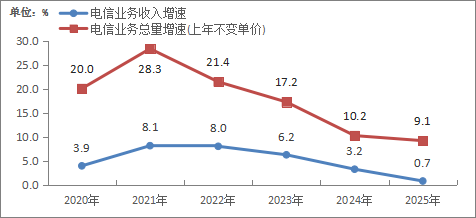
2025年我国通信业实现平稳增长,电信业务收入同比增长0.7%
Bei Jing Ri Bao Ke Hu Duan· 2026-01-28 07:02
来源:央视新闻客户端 作者: 朱江 孙蓟潍 工业和信息化部今天(1月28日)发布的《2025年通信业统计公报》显示,我国通信业产业结构持续优 化,5G、千兆等新型信息基础设施建设加快部署。 经初步核算,2025年电信业务收入累计完成1.75万亿元,比上年增长0.7%。云计算、大数据、数据中心 等新兴业务收入达到4508亿元,比上年增长4.7%。截至2025年底,5G移动电话用户超过12亿户,占移 动电话用户总数的65.9%。中国电信、中国移动和中国联通三家基础电信企业的固定宽带用户总数达 6.91亿户。其中,1000Mbps及以上接入速率的用户占总用户数的34.5%,固定互联网宽带接入服务持续 在农村地区加快普及,截至2025年底,全国农村宽带用户总数达2.04亿户。 ...

工信部:2025年我国电信业务收入累计完成1.75万亿元 比上年增长0.7%
智通财经网· 2026-01-28 06:36
Industry Overview - In 2025, China's telecommunications business revenue reached 1.75 trillion yuan, a year-on-year increase of 0.7%. The total telecommunications business volume, calculated at last year's prices, grew by 9.1% year-on-year [4][5][7]. Fixed Internet Broadband Access - Fixed internet broadband access revenue in 2025 was 289.6 billion yuan, up 5.9% from the previous year, increasing its share of total telecommunications revenue from 15.9% to 16.5%, contributing 0.9 percentage points to overall revenue growth [5][6]. Mobile Data Traffic - Mobile data traffic revenue in 2025 was 609.7 billion yuan, a decline of 3.1% compared to the previous year, with its share of total telecommunications revenue decreasing from 36.2% to 34.8% [7]. Emerging Business Growth - Revenue from emerging businesses, including cloud computing, big data, mobile IoT, and data centers, reached 450.8 billion yuan in 2025, growing by 4.7% year-on-year. This segment's share of total telecommunications revenue increased from 25% to 25.7%, contributing 1.2 percentage points to overall revenue growth. Specific growth rates included cloud computing at 2.9%, big data at 7.8%, and mobile IoT at 4.9% [8][9]. Voice Business Revenue - Revenue from fixed and mobile voice services was 16.09 billion yuan and 109.2 billion yuan, respectively, with fixed voice revenue increasing by 2.3% and mobile voice revenue decreasing by 1.7%. Together, these services accounted for 7.2% of total telecommunications revenue, a decrease of 0.1 percentage points from the previous year [12]. User Development - By the end of 2025, the total number of telephone users in China reached 1.987 billion, with a net increase of 30.91 million users. Mobile phone users totaled 1.827 billion, with a net increase of 37.25 million users, achieving a penetration rate of 130 per 100 people, an increase of 2.9 per 100 people from the previous year. The number of 5G mobile phone users reached 1.204 billion, accounting for 65.9% of mobile phone users, an increase of 9.2 percentage points [13][18]. Fixed Broadband Access Users - By the end of 2025, the total number of fixed internet broadband access users reached 691 million, with a net increase of 20.99 million users. Users with access speeds of 100 Mbps and above totaled 659 million, with a net increase of 22.99 million users, representing 95.3% of total users [18][20]. Mobile IoT User Growth - By the end of 2025, the number of mobile IoT terminal users reached 2.888 billion, with a net increase of 232 million users, surpassing the number of mobile phone users [21]. Internet TV User Growth - By the end of 2025, the total number of internet TV (IPTV, OTT) users reached 408 million, with a net increase of 590,000 users [22]. Mobile Internet Traffic Growth - In 2025, mobile internet access traffic reached 3.958 trillion GB, a year-on-year increase of 17.3%. The average monthly data usage per mobile internet user was 20.74 GB, up 14.1% from the previous year [23][26]. Network Infrastructure Development - In 2025, the total length of optical cable lines reached 74.99 million kilometers, with 2.113 million kilometers of new lines built. The number of fixed internet broadband access ports reached 1.251 billion, with a net increase of 48.77 million ports [30][31]. 5G Network Expansion - By the end of 2025, the total number of mobile phone base stations reached 12.87 million, with 4.838 million being 5G base stations, accounting for 37.6% of all mobile phone base stations, an increase of 4 percentage points from the previous year [31]. Regional Development - In 2025, the telecommunications business revenue shares for the eastern, central, western, and northeastern regions were 50.9%, 19.7%, 24.3%, and 5.1%, respectively. The telecommunications revenue shares for the Beijing-Tianjin-Hebei and Yangtze River Delta regions were 9.1% and 23.2% [35].