CHINA UNICOM(00762)

Search documents
风雪中的通信守护者
Xin Lang Cai Jing· 2026-01-21 10:20
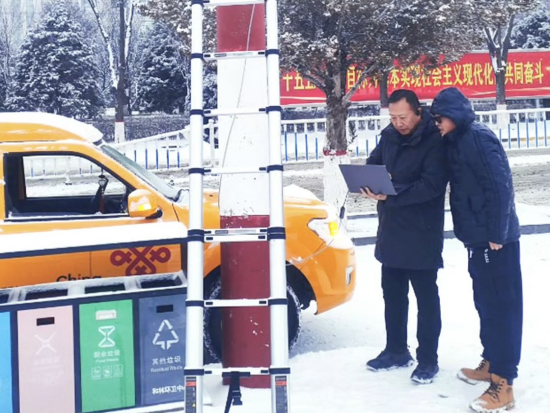
(来源:内蒙古晨网) 转自:内蒙古晨网 在鄂尔多斯达拉特旗,某单位互联网线路受天气影响突发中断。得知这一消息,达拉特旗分公司迅速组 建抢修小组奔赴现场。 彼时,夜间气温低至零下二十几度,寒风呼啸,天寒地冻,为尽快恢复通信,抢修队员们不畏严寒,在 光线昏暗的恶劣环境下连夜奋战,手脚冻僵也仍不停歇。经过连续数小时的作业,两处48芯光缆终于在 当晚21时许全部熔接完毕,所有受阻业务恢复正常。 这条冬日里的"安心线",输送的不仅是信号,更是寒冷中的温暖与期盼,它一端连着客户的生产运营命 脉,一端系着周边居民的"云端"生活。线通了,用户的心就稳了。 近日,内蒙古遭遇新一轮强冷空气,多地气温断崖式下跌,为通信网络稳定运行带来严峻挑战。天虽 寒、路虽远,但联通人毅然迎风战雪、坚守一线,默默守护广大用户用网体验。 周密部署保畅通 为保障城市通信"生命线"稳定运行,呼和浩特联通凭借一系列科学务实的举措做好寒潮天气通信保障。 呼和浩特联通以"防"为先,针对低温易导致线路覆冰、设备故障等问题,各维护队伍对全市范围内的通 信设施及重点区域开展"拉网式"特巡,确保通信网络万无一失。以"抢"为要,建立24小时应急响应机 制,备足应急物资 ...


中美竞逐万亿美元新赛道,五层解构下的投资蓝图
Tebon Securities· 2026-01-21 04:07
Investment Rating - The report maintains an "Outperform" rating for the commercial aerospace industry [1] Core Insights - The aerospace sector is transitioning from being viewed as a "cost center" driven by national will to a "growth engine" driven by commercial demand, with significant investments and strategic planning from both the US and China [6][9] - The global aerospace economy is projected to reach $613 billion in 2024, with commercial aerospace contributing 78%, and is expected to exceed $1 trillion by 2032 [6][9] - The value chain of commercial aerospace is divided into five core levels: "space, ground, terminal, rocket, and application," each presenting unique market opportunities and technical challenges from 2026 to 2030 [10][29] Summary by Sections 1. Space: Satellite Manufacturing - The satellite manufacturing market in China is expected to grow from approximately 7.1 billion yuan in 2025 to about 39.4 billion yuan by 2030, reflecting a shift from sporadic research models to continuous, batch engineering deliveries [16][18] 2. Ground: Ground Systems - The ground systems market is projected to increase from around 1.2 billion yuan in 2025 to approximately 39.1 billion yuan by 2030, evolving from a supporting role to a core infrastructure essential for stable satellite constellation operations [21][22] 3. Terminal: Key Variable for Commercial Aerospace - The terminal market is anticipated to grow from 500 million yuan in 2025 to about 141.9 billion yuan by 2030, driven by multiple vertical industries and potential consumer scenarios [23][24] 4. Rocket: Core Constraint - The cost of rocket launches is a critical constraint, with reusable technology expected to reduce costs by 80%-90% compared to traditional expendable rockets. The market for rocket launch services is projected to grow from approximately 10.7 billion yuan in 2025 to about 34.3 billion yuan by 2030 [25][26] 5. Application: Final Value Realization - The application market is expected to expand from 200 million yuan in 2025 to 525 billion yuan by 2030, with the revenue share from applications projected to rise from single digits to over 67% by around 2030 [27][28] 6. Investment Opportunities - Investment opportunities in commercial aerospace can be categorized into three main tracks: 1. Launch and manufacturing segments, which are expected to benefit directly from increased orders and visibility 2. Core components and systems, characterized by high technical barriers and critical for long-term competitiveness 3. Downstream applications and operational services, which, while currently limited in scale, hold the greatest long-term potential for value realization [29][30]


三大运营商定调2026:继续战略收缩 聚焦AI转型
Zhong Guo Jing Ying Bao· 2026-01-20 13:24
Core Insights - The three major telecom operators in China are shifting their strategies towards "strategic contraction and focused transformation," moving away from a "large and comprehensive" approach to concentrate resources on core business areas such as computing power, AI applications, and enterprise markets [1][4] Financial Performance - In 2024, the total revenue of the three operators approached 2 trillion yuan, with a year-on-year growth rate slowing to approximately 3%, a significant decline compared to previous years. The combined net profit was about 192 billion yuan, reflecting a year-on-year increase of approximately 6.1%. The combined EBITDA was around 574 billion yuan, showing a slight decline of about 0.7%, indicating a fatigue in profitability [2] Strategic Focus - China Telecom is upgrading its strategy from "cloud transformation" to "intelligent and beneficial cloud transformation," emphasizing AI empowerment and security in enterprise construction. In 2024, the revenue from digitalization in its industry is expected to increase, with a 22% year-on-year growth in capital expenditure for computing power [3] - China Unicom is focusing on four core areas: connectivity, computing power, services, and security, moving away from a comprehensive coverage model. Its investment in computing power is expected to rise by 19% in 2024, with plans to build a multi-layered computing supply system [3] - China Mobile aims to strengthen its three main businesses: communication services, computing services, and intelligent services, with a focus on technology leadership and scale synergy. The planned investment in computing power for 2025 is 37.3 billion yuan, maintaining the same level as 2024 but increasing its share in capital expenditure to 25% [4] Embracing AI - All three operators are sending a clear signal of "fully embracing AI." China Unicom is focusing on the synergy between AI and its core areas, while China Telecom is integrating AI throughout its operations. China Mobile is also prioritizing intelligent services and plans to develop 15 million AI terminals by 2026 [5][6] Capital Expenditure Trends - The capital expenditure of the three operators is showing a trend of "overall contraction with localized increases," with a total planned capital expenditure for 2025 reduced by 9.1% to 289.8 billion yuan. The focus is shifting towards "intelligent computing centers" and "massive card clusters" [7]


菏泽联通:圆满完成郓城县医院搬迁通信保障任务
Qi Lu Wan Bao· 2026-01-19 11:13
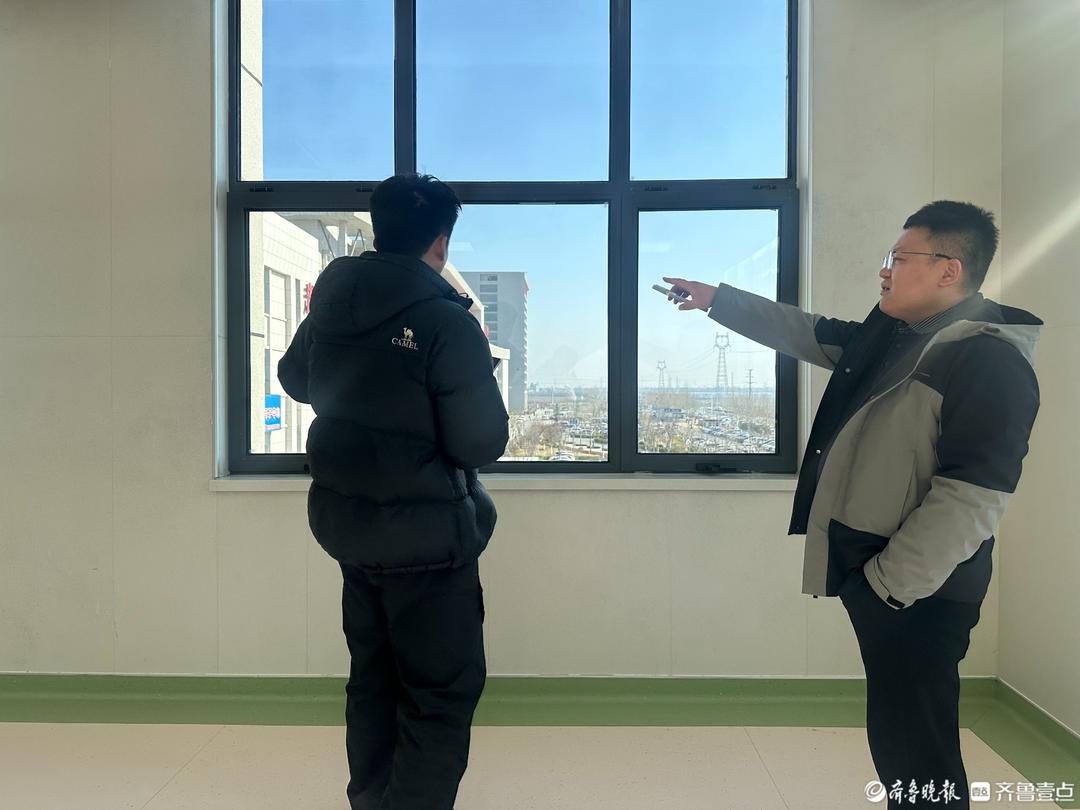
Core Insights - The new hospital district in Yuncheng County, Heze, has officially opened, marking a significant upgrade in local medical services [1] - China Unicom Yuncheng Branch played a crucial role in ensuring communication support for the new hospital, implementing a comprehensive network solution [1][5] Group 1: Communication Infrastructure - The new hospital's communication network was designed to support essential medical systems and digital healthcare applications, including remote consultations and smart nursing [1] - A three-part communication solution was customized, consisting of a "fiber backbone network + 5G private network + cloud platform" [1][2] Group 2: Project Execution - The project faced challenges such as tight deadlines and complex construction environments, with over 80 personnel and 30 types of equipment deployed [2] - More than 120 optical fiber links were laid to ensure gigabit network coverage across all areas of the new hospital [2] Group 3: System Migration - A "step-by-step migration and seamless transition" strategy was implemented for the hospital's core information systems, ensuring zero errors during the switch [4] - A 10-person emergency support team was established to monitor network performance and respond to communication needs on the opening day [4] Group 4: Impact on Healthcare Services - The stable communication network has significantly improved patient experience, reducing average waiting times for registration by 40% and increasing imaging report efficiency by 50% [4] - The successful implementation of remote consultations and smart guidance services has enhanced the overall quality of medical care [4] Group 5: Future Directions - China Unicom aims to continue integrating technology into healthcare, optimizing communication solutions for smart hospitals and supporting regional medical collaboration [5] - The company positions itself as a key player in the digital infrastructure and smart healthcare sectors, contributing to a more efficient and intelligent medical service system [5]
寒雪映初心 服务不“打烊”—菏泽联通以央企担当筑牢民生防线
Qi Lu Wan Bao· 2026-01-19 11:13
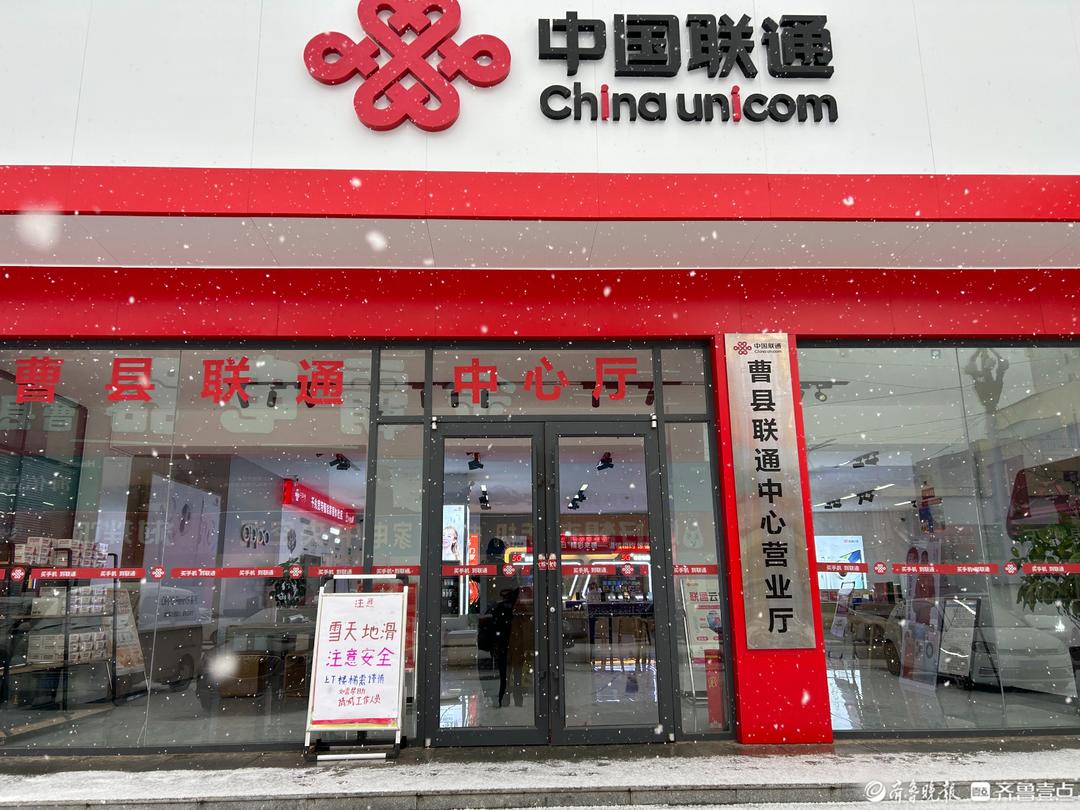
Core Viewpoint - The article highlights the commitment and dedication of the Heze Unicom employees in ensuring uninterrupted communication services and customer safety during the first snowfall of the winter, showcasing their corporate responsibility and service ethos [1][6]. Group 1: Employee Actions - On January 19, employees at the Cao County Unicom center arrived early to clear snow from the entrance and surrounding roads, demonstrating their commitment to customer safety and service continuity [3]. - A team of network maintenance personnel quickly responded to a broadband outage affecting nearly 200 households due to a broken fiber optic cable, overcoming challenging conditions to restore service [4]. - Li Guosun, a small CEO from Dongming, braved the snow to fulfill customer appointments, emphasizing the importance of keeping promises and providing quality service [6]. Group 2: Corporate Responsibility - Heze Unicom's actions during the snowstorm reflect the company's mission to ensure reliable communication services and support for the community, embodying the spirit of "People's Postal and Telecommunications for the People" [6]. - The company’s employees are portrayed as guardians of communication lines and dedicated service providers, reinforcing the central role of state-owned enterprises in community support during adverse conditions [6].
国资委公开80多家央企负责人薪酬
Sou Hu Cai Jing· 2026-01-17 13:14
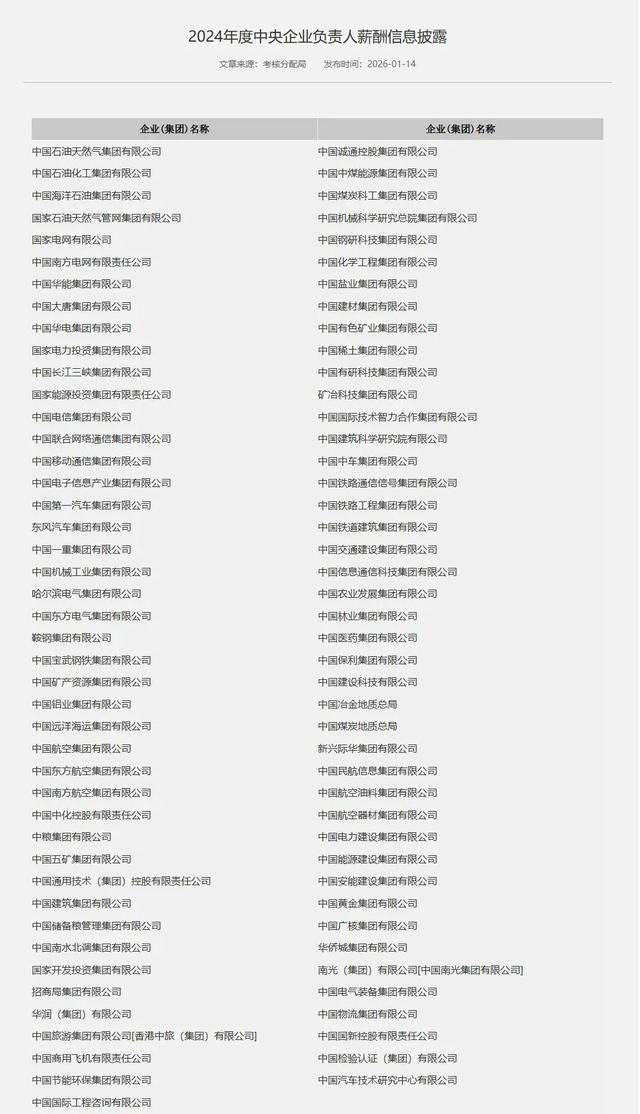
Core Viewpoint - The State-owned Assets Supervision and Administration Commission (SASAC) disclosed the salary information of over 80 central enterprise leaders for the year 2024, indicating a stable salary range without extreme high salaries, showcasing significant industry differentiation [1][5]. Group 1: Salary Disclosure - The disclosure of salary information is part of SASAC's ongoing efforts to enhance transparency in key areas and respond to public concerns [2]. - The overall salary of central enterprise leaders in 2024 remains within a stable range, characterized by "top leaders leading, median concentration, and low compliance," with no extreme high salary phenomena observed [5]. Group 2: Salary Rankings - The top tier of salaries is dominated by leaders from telecommunications and energy central enterprises, with China Mobile's former chairman Yang Jie leading with a pre-tax salary of 1.2582 million yuan, followed by China Telecom and China Unicom chairmen with salaries of 1.2160 million yuan and 1.2101 million yuan respectively [6]. - In the energy sector, PetroChina's chairman Dai Houliang and general manager Hou Qijun both have an annual salary of 978,500 yuan, ranking first among energy central enterprises [7]. - Other notable salaries include China Huaneng Group's chairman Wen Shugang at 961,700 yuan and State Power Investment Corporation's chairman Yu Bing at 953,700 yuan, both of whom are also in the top tier [8]. Group 3: Salary Distribution - The second tier includes core central enterprises in electricity, construction, and automotive industries, with notable figures such as State Grid's chairman Zhang Zhigang earning 735,000 yuan and China National Nuclear Corporation's chairman Yang Changli earning 930,000 yuan [15]. - The third tier consists of central enterprises with strong public welfare attributes, such as China Forestry Group's chairman Shan Zhongli and Overseas Chinese Town Group's chairman Zhang Zhenggao, both earning 438,500 yuan, which is below the average level for central enterprises [16]. Group 4: Salary Variability - Within the same industry, the salary differences among central enterprise executives are manageable, with the highest annual salary for energy central enterprise chairmen (PetroChina at 978,500 yuan) and the lowest (National Pipeline Network at 872,900 yuan) showing a difference of about 100,000 yuan [20].



央企帮扶转向常态化 为乡村振兴注入长效动能
Zhong Guo Jing Ying Bao· 2026-01-16 18:42
Core Viewpoint - Central enterprises are transitioning from temporary support to a systematic and sustainable assistance model for rural revitalization during the "14th Five-Year Plan" period, focusing on education and industrial empowerment [1][3][5]. Education Assistance - China General Nuclear Power Group (CGN) has invested 100 million yuan to build the Bailu School, transforming it into a modern educational facility with advanced teaching spaces and resources [1][2]. - The school now has 30 elementary classes and 7 middle school classes, along with specialized "Bailu Classes" supported by CGN for curriculum development and student incentives [2]. - CGN has organized 23 research activities to broaden students' horizons, fostering aspirations among students, such as a sixth-grade student who aims to become a teacher after participating in a summer camp [2][3]. Industrial Empowerment - COFCO Group is innovating its cooperation model with farmers, engaging in large-scale planting over 3 million acres through order agriculture and cooperative planting to enhance agricultural productivity and farmers' income [4]. - The company aims to create a modern agricultural service model that integrates various agricultural sectors, providing comprehensive solutions from production to sales [4][5]. - Digital technology is being leveraged to enhance agricultural practices, as seen in the smart cultivation of Lingzhi mushrooms in Jilin Province, which has significantly improved yield rates [6]. Transition to Normalized Support - The State-owned Assets Supervision and Administration Commission (SASAC) emphasizes the need for central enterprises to shift from transitional support to a normalized assistance phase, focusing on sustainable development and effective integration with rural revitalization plans [5][6]. - The goal of normalized support is to achieve comprehensive rural revitalization, moving beyond mere poverty alleviation to fostering thriving industries, ecological sustainability, and improved living standards [6].


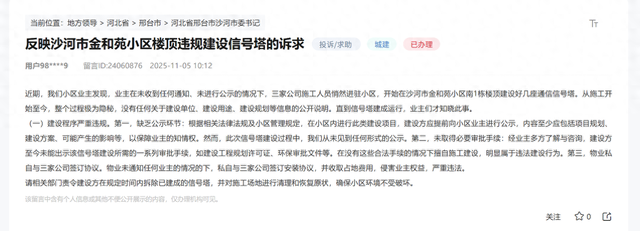
居民投诉信号塔“隐秘”进驻小区,邢台沙河:已通知移动联通拆除
Xin Lang Cai Jing· 2026-01-16 12:12
Core Viewpoint - The construction of communication signal towers in a residential area of Shihezi City, Hebei Province, has raised significant complaints from residents regarding the lack of transparency and proper approval processes [1][2]. Group 1: Complaints and Issues - Residents reported that the construction of multiple communication signal towers occurred without any prior notification or public announcement, violating their right to be informed [1][2]. - The complaints highlighted the absence of necessary approval documents for the construction, such as construction planning permits and environmental approval, indicating potential illegal construction activities [2]. - The property management allegedly signed installation agreements with three companies without informing the residents and collected fees, infringing on the homeowners' rights [2]. Group 2: Official Response - On December 25, 2025, the Shihezi City Municipal Office confirmed that the tower construction company had notified mobile operators to dismantle the communication equipment and would conduct further site surveys [3][4].

从“解决一件事”到“优化一类服务”,长沙联通以专业与诚意收获客户锦旗
Chang Sha Wan Bao· 2026-01-15 09:11
Core Viewpoint - The successful resolution of a customer complaint by Changsha Unicom highlights the company's commitment to high-quality service and proactive risk management [1][2] Group 1: Customer Complaint Handling - Changsha Unicom received a complaint from a customer regarding issues with a value-added service after switching to a new plan, which led to continued charges without access to benefits [1] - The company assigned an experienced specialist to address the complaint, who identified potential systemic issues affecting the entire province [1] - The resolution involved not only addressing the individual complaint but also implementing a comprehensive review and process improvement to prevent future occurrences [1] Group 2: Service Improvement and Strategy - The incident reflects Changsha Unicom's approach to viewing customer complaints as opportunities for service enhancement and management improvement [2] - The company aims to transition from a reactive complaint handling approach to a proactive risk prevention strategy [2] - Future initiatives will focus on enhancing predictive service capabilities and systematic error correction mechanisms, along with strengthening cross-departmental collaboration and data governance [2]
未满24岁都算低龄用户?联通办卡新规惹争议
Xin Lang Ke Ji· 2026-01-14 15:31
Group 1 - Ningxia Unicom has implemented a policy requiring users under 24 years old to present a stamped application form to obtain a mobile plan, citing concerns over potential fraud involving young users [1][2][3] - The initial definition of "under 24 years old" as "low-age users" has been updated to "ages 16-23," and the requirement for a stamped application form now only applies to users applying for a second phone number [2][3] - The customer service representative indicated that the majority of users in this age group are students who may lack social experience and legal awareness, making them vulnerable to scams [3] Group 2 - Experts have criticized the policy, arguing that labeling users under 24 as "low-age users" and imposing additional requirements constitutes age discrimination and lacks sufficient justification [4] - The expert noted that international practices typically only classify minors (under 18) as needing special protection, suggesting that the current approach is inconsistent with industry norms [4] - While the intention to prevent fraud is acknowledged, the expert argues that the measures taken may not be proportionate or necessary, as existing regulations already address most risk scenarios [4]