
PETROCHINA(00857)

Search documents
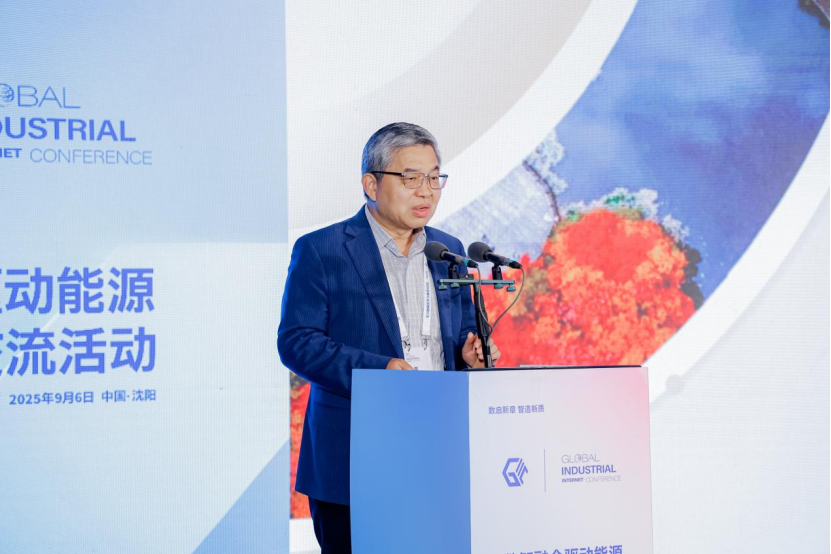
中国石油和化学工业联合会党委常委、外资委主席兼秘书长庞广廉:能源转型是石化行业降低碳排放的必由之路
Zhong Guo Jin Rong Xin Xi Wang· 2025-09-06 15:03
Core Viewpoint - The petrochemical industry must undergo an energy transition to reduce carbon emissions, with a focus on high-quality development and the integration of digital intelligence [1][3]. Group 1: Industry Position and Market Share - China is the largest chemical market globally, with a chemical output value of €2.4 trillion in 2022, accounting for 44% of the global market share, surpassing the combined total of the EU, the US, Japan, and South Korea [3]. - The carbon intensity of green energy usage in China is approximately 80 grams, compared to the global average of 60 grams, indicating a higher carbon emission structure [3]. Group 2: Energy Transition Strategy - The energy transition is essential for the petrochemical industry, moving from coal and oil to biomass, solar, wind, hydrogen, and nuclear energy as primary energy sources [3][4]. - By 2050, coal's share in primary energy must drop to over 10%, and below 5% by 2060, presenting significant challenges [3]. Group 3: Recommendations for High-Quality Development - The focus of the "14th Five-Year Plan" for high-quality development in the petrochemical sector includes new chemical materials as a direction, optimizing major productivity layouts as support, and establishing a robust institutional mechanism as a guarantee [3][4]. - Four key areas for institutional support are proposed: 1. Strengthening financial planning and support for R&D and production of key new chemical materials [4]. 2. Improving project investment guidance to ensure reliable technology and avoid overcapacity in popular new material fields [4]. 3. Promoting market construction for product applications, encouraging first-time applications, and creating a fair competitive environment [4][5]. 4. Enhancing collaboration and cooperation to foster both domestic and international supply chain advantages [5]. Group 4: Event Overview - The event focused on the digital and intelligent transformation of energy systems, aiming to provide systematic solutions for building a modern energy system [5].

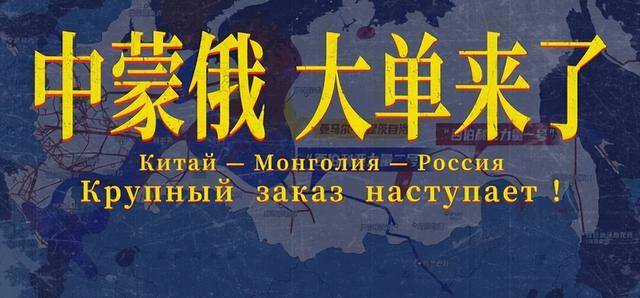
中俄蒙超级大单谈妥!北溪没了欧盟订单泡汤,俄罗斯选择向东看
Sou Hu Cai Jing· 2025-09-05 13:57
Core Insights - The main focus of the news is the strategic energy cooperation between Russia, China, and Mongolia, particularly the signing of the "Power of Siberia-2" gas pipeline agreement, which aims to transport natural gas from Russia to China, reflecting Russia's shift in energy export strategy following the disruption of the Nord Stream pipeline [1][2][12]. Group 1: Project Overview - The "Power of Siberia-2" pipeline will transport up to 50 billion cubic meters of natural gas annually from Russia to China over a 30-year period [2][10]. - The agreement also includes increasing the annual gas transport capacity of the existing "Power of Siberia" pipeline from 38 billion cubic meters to 44 billion cubic meters, and the "Far East" pipeline from 10 billion cubic meters to 12 billion cubic meters [4]. Group 2: Geopolitical Context - The destruction of the Nord Stream pipeline has significantly reduced Russia's natural gas exports to Europe, dropping from 40% to approximately 19% of the European market, prompting Russia to pivot its energy strategy towards Asia [5][8]. - The "Power of Siberia-2" project is seen as a critical step in Russia's "Look East" strategy, aiming to reduce dependence on European markets and mitigate the impact of Western sanctions [12]. Group 3: Economic Implications - By 2035, Russia plans to increase its natural gas export share to China from 0% to 25%, fundamentally altering its energy export landscape [12]. - China, as the world's largest energy importer, is expected to benefit from stable gas supplies through land pipelines, reducing reliance on maritime routes that are subject to geopolitical risks [13][16]. Group 4: Benefits for Mongolia - Mongolia stands to gain significant transit revenue and enhanced economic cooperation through the pipeline project, which is expected to boost its infrastructure and related industries [15]. - The agreement allows Mongolia to purchase Russian gas at discounted prices, positively impacting its energy supply and economic development [15]. Group 5: Challenges and Future Outlook - The project has faced lengthy negotiations since 2006, with past disagreements over gas pricing and transit fees causing delays [15]. - The successful signing of this agreement marks a significant advancement in energy cooperation and reflects the changing geopolitical landscape in the region [15].
贝莱德:在中国石油股份的持股比例升至6.07%

Ge Long Hui· 2025-09-05 09:25
Group 1 - BlackRock's stake in China Petroleum & Chemical Corporation increased from 5.83% to 6.07% as of September 2 [1]
贝莱德在中国石油股份的持股比例于9月2日从5.83%升至6.07%
Mei Ri Jing Ji Xin Wen· 2025-09-05 09:21
Group 1 - BlackRock's stake in China Petroleum & Chemical Corporation increased from 5.83% to 6.07% as of September 2 [1]
中国石油成立塔里木油田新能源公司,注册资本11.18亿
Sou Hu Cai Jing· 2025-09-05 04:39
Group 1 - Tarim Oilfield (Ruoqiang) New Energy Co., Ltd. has been established with a registered capital of 1.118 billion RMB [1] - The company is wholly owned by China National Petroleum Corporation (CNPC) through indirect holdings [1] - The business scope includes solar power generation technology services, emerging energy technology research and development, and utilization technology for waste heat, pressure, and gas [1] Group 2 - The company is registered in the Bayingolin Mongol Autonomous Prefecture, Xinjiang Uygur Autonomous Region [2] - The business license allows for power generation, transmission, and distribution services, subject to approval from relevant authorities [2] - The company is classified under the national standard industry of new energy technology promotion services [2]
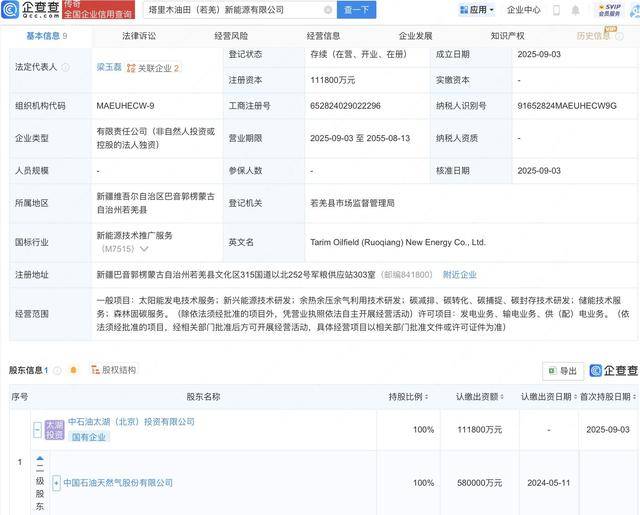
中国石油成立塔里木油田新能源公司,注册资本11.18亿元
Xin Lang Cai Jing· 2025-09-05 04:20
Group 1 - Tarim Oilfield (Ruoqiang) New Energy Co., Ltd. has been established with a registered capital of 1.118 billion yuan [1] - The company's business scope includes solar power generation technology services, emerging energy technology research and development, and the utilization of residual heat, pressure, and gas technology [1] - The company is indirectly wholly owned by China National Petroleum Corporation [1]
中国石油与香港大学签署战略合作协议
Xin Lang Cai Jing· 2025-09-05 02:59
Group 1 - The core point of the article is the strategic cooperation agreement signed between China National Petroleum Corporation (CNPC) and the University of Hong Kong, focusing on talent cultivation and technological collaboration [1] Group 2 - The meeting was held on September 4, where CNPC Chairman Dai Houliang met with the President of the University of Hong Kong, Zhang Xiang, to discuss various topics [1] - The strategic cooperation agreement aims to enhance collaboration in areas such as education and technology between the two entities [1]
中国石油集团董事长戴厚良会见香港大学校长张翔
Xin Lang Cai Jing· 2025-09-05 02:59
Core Viewpoint - China National Petroleum Corporation (CNPC) is enhancing its collaboration with Hong Kong University through a strategic partnership focused on talent development and technological cooperation [1] Group 1 - CNPC Chairman Dai Houliang met with Hong Kong University President Zhang Xiang to discuss various topics including talent cultivation and technology collaboration [1] - A strategic cooperation agreement was signed between CNPC and Hong Kong University, marking a significant step in their partnership [1]
大摩:8月外资投入中国股市资金速度环比放缓 本季度迄今3个股获加仓最多
智通财经网· 2025-09-05 02:46
Core Insights - Foreign investors continued to invest in the Chinese stock market in August, but the pace slowed compared to July, with a net inflow of $900 million, down from $2.7 billion in July [1] - The inflow was primarily driven by passive management funds, which saw a total inflow of 1.4 billion yuan, lower than the 3.9 billion yuan in July [1] - Active foreign funds experienced an outflow of 500 million yuan, marking the largest outflow since mid-2023 [1] Fund Flows - As of August 31, total foreign passive fund inflows into the Chinese stock market reached 13 billion yuan, surpassing the total of 7 billion yuan for the entire previous year [1] - Year-to-date, foreign active funds have seen a total outflow of 11 billion yuan, a slowdown compared to the 24 billion yuan outflow last year [1] - Cumulative inflows into long positions (bullish funds) have risen to 1 billion yuan, reversing last year's outflow of 17 billion yuan [1] Stock Performance - The most increased positions in the current quarter include Ningde Times (03750), Pop Mart (09992), and Zijin Mining (02899) [1] - The most reduced positions include PetroChina (00857) and China Construction Bank (00939) [1] Investor Behavior - There is an observed increase in participation from high-net-worth investors in Chinese A-shares, along with early signs of funds shifting from money market funds to equity funds [1] - After a large sell-off in April, foreign passive funds turned into net buyers of A-shares in August [1]



渤海钻探一钻公司 钻井队年累进尺首上2万米
Zhong Guo Hua Gong Bao· 2025-09-05 02:46
Core Insights - The company achieved a significant milestone by successfully drilling the Shanxi Anping 10 well to a depth of 2,278 meters, marking the first time a 40-type drilling team surpassed 20,000 meters in annual cumulative drilling [1] - The success is attributed to systematic production organization, refined technical management, and highly coordinated team operations, emphasizing the philosophy that "time equals footage, efficiency equals benefits" [1][2] - The team has maintained a 100% success rate in well quality and cementing quality, as well as a 100% success rate in electrical measurement on the first attempt [1] Production Optimization - The team holds daily "geological engineering integration" meetings to enhance communication with relevant parties, anticipate potential risks, and develop detailed construction plans [2] - Emphasis is placed on benchmark management, with scientific planning for each well's operational schedule and careful personnel allocation to ensure smooth transitions between construction phases [2] - Team leaders are on-site 24/7 to address any factors that may hinder drilling progress, while technical experts oversee critical positions to ensure strict technical control [2] Technical Advancements - The team has intensified technical research efforts, analyzing neighboring well data and summarizing construction experiences to identify bottlenecks and challenges for each well [3] - Customized technical measures and risk prevention strategies are developed for different well sections and geological conditions, implementing a dynamic management approach that allows for real-time adjustments [3] - Team collaboration is emphasized, with technicians actively involved in equipment maintenance and mud management to prevent downhole accidents and optimize drilling performance [3]