
CNOOC(00883)

Search documents
股票市场概览:资讯日报:美联储维持利率不变,符合市场普遍预期-20260129
Guoxin Securities Hongkong· 2026-01-29 11:58
Market Overview - The Federal Reserve maintained the federal funds rate target range at 3.5%-3.75%, aligning with market expectations[9] - The Hang Seng Index closed at 27,827, down 2.58% for the day but up 8.57% year-to-date[3] - The S&P 500 index closed at 6,978, with a slight decrease of 0.01% for the day and a year-to-date increase of 1.94%[3] Stock Performance - Gold prices surged, with spot gold exceeding $5,280 per ounce, marking a monthly increase of over 22%[9] - Semiconductor stocks saw significant gains, with the Philadelphia Semiconductor Index rising by 2.34%[9] - Major tech stocks showed mixed results, with Intel up 11.04% and Microsoft down 6% post-earnings report[9] Sector Highlights - Oil stocks continued to rise, with Shanghai Petrochemical gaining over 5% due to geopolitical tensions driving oil prices up by 3%[9] - New consumer concept stocks performed well, with a snack retail chain soaring 69% on its debut[9] - Airline stocks faced pressure, with China Southern Airlines down 6.83% due to rising operational costs[9] Economic Indicators - The U.S. dollar index fell to 95.51, the lowest since February 2022, contributing to the rise in gold prices[9] - The Japanese yen strengthened, impacting export-related stocks negatively, with Toyota down 3.24%[13] - The Bank of Japan raised its policy rate to 0.75%, the highest in 30 years, indicating a cautious approach to future rate hikes[13]



智通港股52周新高、新低统计|1月29日




智通财经网· 2026-01-29 08:43
Summary of Key Points Core Viewpoint - As of January 29, a total of 185 stocks reached their 52-week highs, indicating a strong market performance with notable gains in specific companies such as AV Planning Promotion, WT Group, and Spring Energy Holdings, which led the high achievers with significant percentage increases [1]. Group 1: Top Performers - AV Planning Promotion (08419) achieved a closing price of 0.092 with a peak of 0.190, marking a 91.92% increase [1]. - WT Group (08422) closed at 0.187, reaching a high of 0.230, reflecting a 79.69% increase [1]. - Spring Energy Holdings (08430) had a closing price of 0.160 and a peak of 0.295, resulting in a 46.77% increase [1]. Group 2: Other Notable Stocks - Tongyuan International (03830) reached a 25% increase with a closing price of 0.100 and a peak of 0.110 [1]. - Zhangli International (01693) saw a 24.15% increase, closing at 4.800 with a peak of 5.090 [1]. - Weili Life Technology (01703) achieved a 20% increase, closing at 0.110 with a peak of 0.150 [1]. Group 3: Additional Highs - Huashang Energy (00206) closed at 0.620, maintaining a peak of 0.620, with a 19.23% increase [1]. - MINIMAX-WP (00100) reached a peak of 590.000, closing at 500.000, reflecting an 18% increase [1]. - Shengxing Holdings (01472) closed at 0.106 with a peak of 0.116, marking a 16% increase [1]. Group 4: 52-Week Lows - Aigo Group (00328) reached a low of 0.600, reflecting a -29.91% decrease [5]. - Bojun Education (01758) saw a low of 0.070, indicating a -19.54% decrease [5]. - Hanyuan Holdings (00439) recorded a low of 0.960, resulting in a -7.69% decrease [5].
中信海直(000099):国内通用航空运输领导者,增量探索低空经济运营服务
Bank of China Securities· 2026-01-29 08:38
Investment Rating - The report assigns an "Accumulate" rating to the company, with a market price of RMB 21.27 and a sector rating of outperforming the market [2][4]. Core Insights - The company is positioned as a leader in domestic general aviation transportation, expected to benefit from the recovery in global oil and gas exploration investments and domestic low-altitude economic policies. The improvement in operational efficiency and fleet structure is anticipated to enhance profitability [4][19]. - The company's traditional strength in offshore oil helicopter services is expected to maintain steady growth, providing a solid foundation for performance. Additionally, the exploration of low-altitude economic-related businesses may open new growth opportunities for the company's future [4][19]. Financial Projections - Revenue projections for 2025-2027 are RMB 2.351 billion, RMB 2.554 billion, and RMB 2.736 billion, representing year-on-year growth rates of 8.7%, 8.6%, and 7.2% respectively. Net profit attributable to shareholders is expected to be RMB 352 million, RMB 382 million, and RMB 413 million, with growth rates of 16.1%, 8.6%, and 8.1% respectively. The estimated EPS for 2025-2027 is RMB 0.45, RMB 0.49, and RMB 0.53, corresponding to P/E ratios of 45.1, 41.5, and 38.4 times [6][8]. Business Overview - The company operates Asia's largest civil helicopter fleet, with a total of 84 advanced helicopters and a strong operational capability. Its main business areas include offshore oil, emergency rescue, land aviation, aviation maintenance, and low-altitude economy [19][25]. - The offshore oil helicopter service remains the core revenue source, contributing approximately 67.1% of total sales, with the largest client being China National Offshore Oil Corporation (CNOOC) [29][36]. Market Position - The company has a dominant position in the offshore oil service market, with a market share exceeding 60%. The strategic cooperation with CNOOC has been reinforced, ensuring a stable revenue stream and operational efficiency [29][39]. - The low-altitude economy is seen as a new growth area, with the company actively participating in industry standard-setting and exploring partnerships for eVTOL (electric vertical takeoff and landing) aircraft operations [26][32]. Financial Performance - The company has shown steady revenue growth, with total revenue increasing from RMB 15.67 billion in 2019 to RMB 21.63 billion in 2024, reflecting a year-on-year growth of 9.83% [43][44]. - The net profit for 2024 reached RMB 3.03 billion, a 26.81% increase compared to the previous year, marking the best performance since the company went public [43][44].

中国海油股价创新高
Mei Ri Jing Ji Xin Wen· 2026-01-29 01:47
(文章来源:每日经济新闻) 每经AI快讯,中国海油涨2.92%,报36.61元/股,股价再创新高,总市值突破1.74万亿元,成交额达 4377.45万元。 ...
驻中国海油纪检监察组:发现不法供应商与相关领导干部长期深度绑定
Zhong Yang Ji Wei Guo Jia Jian Wei Wang Zhan· 2026-01-29 01:00
近日,驻中国海油纪检监察组组长钟庆明与8位党组成员一对一、面对面开展约谈。这已经是该组连续 第5年全覆盖约谈党组成员,也是全面派驻改革后的首次约谈。5年来,约谈工作在坚持中不断深入深 化,成为贯通落实"两个责任"的有力抓手和加强党组班子建设的重要载体。 驻中国海油纪检监察组始终把学习贯彻习近平总书记重要指示批示精神和党中央重大决策部署作为约谈 的首要方面,推动党组成员结合分管领域,深入思考贯彻落实的具体思路和方法举措。 在查办某严重违纪违法案件过程中,驻中国海油纪检监察组发现不法供应商与相关领导干部长期深度绑 定。结合约谈,督促分管的党组成员做实查办案件"后半篇文章",对涉案供应商与案发单位业务往来情 况全面起底,针对性开展整改整治。 抓住了"关键少数",就抓住了责任落实的"牛鼻子"。驻中国海油纪检监察组把整改落实情况纳入日常监 督,并在下一年度约谈时,听取党组成员关于上年度通报问题整改情况。 "每次谈话结束后,我们都专门召开会议,专题研究约谈通报的问题。"有的党组成员表示,同时指导推 动其联系单位每季度也定期研究党风廉政建设和反腐败工作。 "上次通报项目廉洁风险情况后,我们迅速采取了措施。"有的党组成员说道 ...
中国海洋石油(00883.HK):1月28日南向资金增持451.86万股
Sou Hu Cai Jing· 2026-01-28 19:21
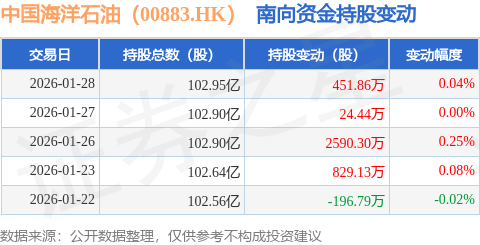
证券之星消息,1月28日南向资金增持451.86万股中国海洋石油(00883.HK)。近5个交易日中,获南向资金增持的有4天,累计净增持3698.94万 股。近20个交易日中,获南向资金增持的有13天,累计净增持9483.49万股。截至目前,南向资金持有中国海洋石油(00883.HK)102.95亿股,占 公司已发行普通股的21.65%。 以上内容为证券之星据公开信息整理,由AI算法生成(网信算备310104345710301240019号),不构成投资建议。 相关ETF 红利低波50ETF (产品代码:159547) ★ 跟踪:中证红利低波动指数 近五日涨跌: -0.75% | 交易日 | 持股总数(股) | 持股变动(股) | 变动幅度 | | --- | --- | --- | --- | | 2026-01-28 | 102.95亿 | 451.86万 | 0.04% | | 2026-01-27 | 102.90亿 | 24.44万 | 0.00% | | 2026-01-26 | 102.90亿 | 2590.30万 | 0.25% | | 2026-01-23 | 102.64亿 | 829.1 ...

智通港股通活跃成交|1月28日


智通财经网· 2026-01-28 11:01
| 公司名称 | 成交金额 | 净买入额 | | --- | --- | --- | | 阿里巴巴-W(09988) | 30.81 亿元 | -1.01 亿元 | | 中芯国际(00981) | 19.73 亿元 | -3957.24 万元 | | 腾讯控股(00700) | 18.66 亿元 | +1.67 亿元 | | 中国海洋石油(00883) | 18.60 亿元 | -2.47 亿元 | | 长飞光纤光缆(06869) | 13.52 亿元 | +2.98 亿元 | | 紫金矿业(02899) | 13.17 亿元 | +10.13 亿元 | | 泡泡玛特(09992) | 10.25 亿元 | +2.45 亿元 | | 小米集团-W(01810) | 8.56 亿元 | -5105.41 万元 | | 华虹半导体(01347) | 7.52 亿元 | +4528.36 万元 | | 金山云(03896) | 6.63 亿元 | +1.65 亿元 | | 公司名称 | 成交金额 | 净买入额 | | --- | --- | --- | | 阿里巴巴-W(09988) | 50.18 亿元 | -8 ...
三大指数均涨超2% 光通讯和石油股成市场领头羊
Xin Lang Cai Jing· 2026-01-28 09:01
Market Performance - The Hong Kong stock market continued its upward trend with all three major indices closing higher: Hang Seng Index up 2.58% at 27,826.91 points, Hang Seng Tech Index up 2.53% at 5,900.16 points, and the National Enterprises Index up 2.89% at 9,512.24 points [2] - Leading sectors included optical communications, oil, gold, telecommunications, and real estate, while tea and aviation stocks faced downward pressure [3] Optical Communications - Demand for AI infrastructure has spurred the optical communications industry, with Changfei Optical Fiber Cable (06869.HK) leading the sector, closing up 15.43% at 75.20 HKD [4][5] - Corning, a major player in the fiber optics market, saw a single-day increase of over 15%, reaching a historical high, following a long-term agreement with Meta for the procurement of $6 billion worth of fiber optic cables by 2030 [4] Energy Sector - Geopolitical risks have heightened energy security expectations, with China National Offshore Oil Corporation (00883.HK) and China Petroleum & Chemical Corporation (00857.HK) both reaching historical highs, closing up 4.85% and 4.99% respectively [5][6] - The U.S. military's recent military exercises in the Middle East have raised concerns about energy supply stability, contributing to the rise in oil stocks [6] Gold Market - The weakening U.S. dollar has stimulated international gold prices, with Chifeng Jilong Gold Mining (06693.HK) rising 10.65% [7] - The dollar index experienced its largest single-day drop since April 2023, pushing gold prices above $5,200 per ounce [7] Telecommunications - The telecommunications sector is entering a new phase of "deep integration," with China Telecom (00728.HK) rising 6.27% [9] - The Ministry of Industry and Information Technology reported that the three major operators have added 108,000 data center racks, indicating a shift in focus from "broad coverage" to "deep integration" [9] Real Estate - Regulatory optimizations have boosted confidence in the real estate sector, with China Jinmao (00817.HK) rising 11.92% [11] - Feedback from multiple real estate companies indicates that the regulatory body has lifted the monthly reporting requirements for most firms, enhancing market expectations for liquidity and operational environment improvements [11] Individual Stock Movements - Wuneng Zhixing (00800.HK) rose 2.11% as it prepares to launch autonomous buses in Abu Dhabi [17][18] - Kuaishou-W (01024.HK) increased by 4.44%, with its AI product, Keling, surpassing 12 million monthly active users and achieving a 350% growth in paid users [19]



资源股全线爆发!金银铜铝油全面开花!可能远超预期!商品的超级周期真的来了吗?
雪球· 2026-01-28 08:50
↑点击上面图片 加雪球核心交流群 ↑ A股三大指数今日涨跌不一,截止收盘,沪指涨0.27%,收报4151.24点;深证成指涨0.09%,收报14342.89点;创业板指跌0.57%,收报3323.56点。 沪深京三市成交额达到29926亿,较昨日放量709亿。 行业板块涨少跌多,贵金属、珠宝首饰、采掘行业、有色金属、小金属、煤炭行业涨幅居前,光伏设备、医疗器械、医疗服务、生物制品、航天航 空板块跌幅居前。 个股方面,上涨股票数量超过1700只,逾80只股票涨停。贵金属与有色金属板块掀涨停潮,中金黄金、四川黄金、湖南黄金、西部黄金、湖南白 银、白银有色、北方铜业、铜陵有色、中国铝业等多只股票涨停。 01 贵金属继续狂飙! 今天现货黄金日内暴涨100美元,现货黄金站上5280美元/盎司,日内涨1.91%。纽约期金站上5310美元/盎司,日内涨3.71%。本月以来累计涨超970 美元,累计涨幅超22%。 A股贵金属板块中中金黄金、四川黄金、湖南黄金、西部黄金、湖南白银、白银有色涨停!白银LOF涨停,本月累计涨幅112%,溢价率49.49%。 | 晓程科技 | 70.60 +20.01% | | 233.89 | | ...



在查办某严重违纪违法案件过程中,驻中国海油纪检监察组发现不法供应商与相关领导干部长期深度绑定
Xin Jing Bao· 2026-01-28 07:46
Core Viewpoint - The article discusses the ongoing efforts of the disciplinary inspection and supervision group at China National Offshore Oil Corporation (CNOOC) to enhance governance and accountability within the organization through regular one-on-one discussions with party members, emphasizing the importance of anti-corruption measures and compliance with central directives [1][2][3][4] Group 1 - The CNOOC disciplinary inspection group has conducted one-on-one interviews with party members for five consecutive years, marking the first such engagement since the comprehensive reform of the inspection system [1] - The focus of these discussions includes the implementation of Xi Jinping's directives and major decisions from the central government, encouraging party members to reflect on specific strategies for execution in their respective areas [1][2] - In 2023, CNOOC was included in the first round of inspections by the central government, prompting the inspection group to combine interview efforts with oversight of the central inspection rectification process [1][2] Group 2 - The 2025 interviews will focus on the implementation of the 14th Five-Year Plan and other significant political tasks, aiming to clarify responsibilities and promote high-quality development within the enterprise [2] - Prior to each interview, the inspection group prepares by identifying key issues in party governance related to each member's responsibilities, creating a checklist to guide discussions [2] - The group has identified issues such as high subcontracting ratios that pose risks to corporate development and potential corruption, urging reforms in the operational models of professional service companies [2] Group 3 - The inspection group emphasizes the importance of addressing the root causes of issues discussed during interviews, ensuring that both parties share insights and solutions [2][3] - Following each interview, the group holds meetings to analyze the issues raised, with members reporting on corrective actions taken in response to previous discussions [3] - The regularity of these interviews has fostered a culture of accountability and proactive engagement among party members, with many expressing a desire for continued dialogue [3] Group 4 - The CNOOC disciplinary inspection group is committed to implementing comprehensive reform requirements, enhancing the effectiveness of supervision over leadership and promoting responsible governance [4] - The group aims to create a culture of strict compliance and positive ethical standards within the organization [4]