
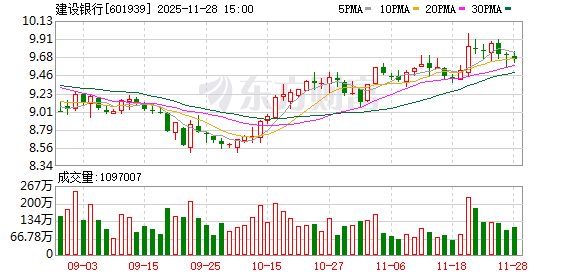
CCB(00939)

Search documents
工行、农行、中行、建行、交行、邮储 停售!
Zhong Guo Ji Jin Bao· 2025-11-29 03:28
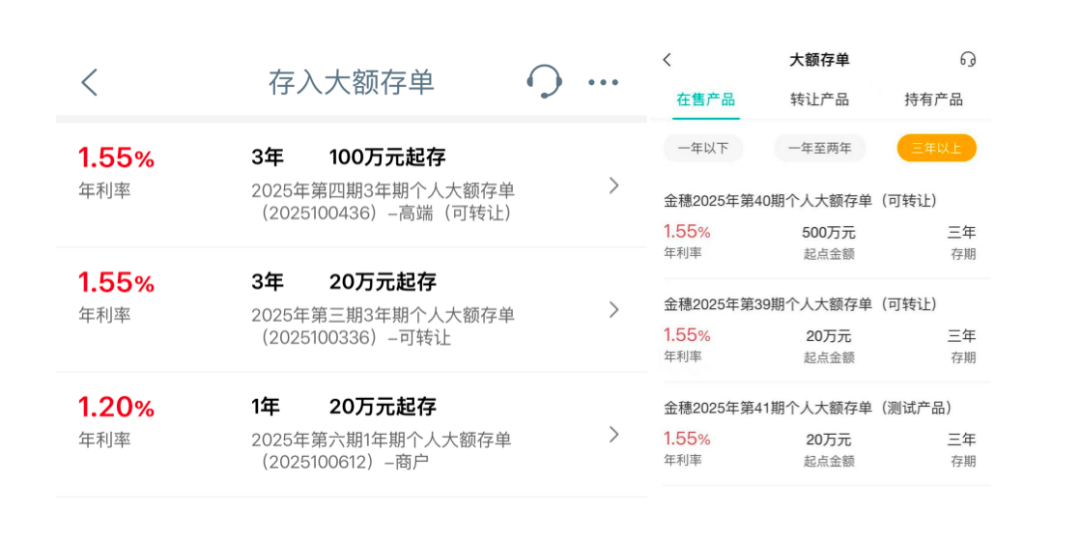
Core Viewpoint - The six major state-owned banks have collectively discontinued the 5-year large denomination certificates of deposit (CDs), reflecting a broader trend of adjustments in long-term deposit products among banks to reduce liability costs and stabilize net interest margins [1][3][8]. Group 1: Market Reactions and Adjustments - The discontinuation of 5-year large denomination CDs by major banks has drawn significant attention, as many smaller banks have also been adjusting their long-term deposit products [3][8]. - Some state-owned banks had already stopped offering 5-year CDs prior to this collective action, indicating a shift in the market [5][8]. - The adjustments in deposit products are primarily aimed at lowering high-cost liabilities and optimizing the banks' liability structures [9][10]. Group 2: Interest Rate Trends - Recent data shows that the net interest margin for commercial banks remains under pressure, with state-owned banks having the lowest net interest margin at 1.31% compared to 3.83% for private banks [8][10]. - The trend of lowering deposit rates is expected to continue, with banks likely to maintain a limited number of 5-year products at reduced rates [10][11]. - The adjustments reflect a significant transformation in the financial system under a low-interest-rate environment, with banks responding to declining asset yields by shortening deposit terms [9][10]. Group 3: Investor Guidance - Investors are advised to shift from a single deposit mindset to a diversified investment strategy, considering options like money market funds, cash management products, and government bonds to balance risk and return [11]. - The expectation of continued declines in deposit rates suggests that investors should lower their return expectations and adjust their investment strategies accordingly [11].




建设银行捐赠1000万港元 全力支持香港大埔火灾救援
Zhong Guo Xin Wen Wang· 2025-11-29 03:01
Group 1 - China Construction Bank donated 10 million HKD to support disaster relief efforts for affected residents in Tai Po, Hong Kong [1] - The bank established a cross-border donation channel to facilitate contributions from mainland institutions or individuals, waiving remittance fees [1] - A 24-hour customer service hotline was set up to assist clients with urgent banking needs [1] Group 2 - Following the fire incident on November 26, which resulted in significant casualties, the bank mobilized resources to assist affected clients [2] - Insurance service hotlines were arranged to provide support for impacted customers [3] - Over 200 employees joined volunteer efforts, providing essential supplies and organizing blood donations [3] Group 3 - The bank's international division collected emergency supplies and delivered them to various relief stations [4] - Volunteers assisted in distributing supplies and providing emotional support to disaster victims [4] - The bank expressed condolences to the victims and their families, and acknowledged the efforts of firefighters and rescue personnel [5]

智通ADR统计 | 11月29日
智通财经网· 2025-11-28 23:32
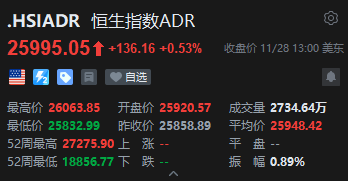
Market Overview - US stock indices closed higher on Friday, with the Hang Seng Index ADR rising to 25,995.05 points, an increase of 136.16 points or 0.53% compared to the Hong Kong close [1]. Major Blue-Chip Stocks - HSBC Holdings closed at HKD 110.552, up 1.15% from the Hong Kong close [2]. - Tencent Holdings closed at HKD 615.201, an increase of 0.61% from the Hong Kong close [2]. Stock Performance Summary - Tencent Holdings (HKD 615.201) saw an increase of HKD 3.701 or 0.61% compared to its Hong Kong stock price [3]. - Alibaba Group (HKD 152.837) increased by HKD 1.337 or 0.88% [3]. - HSBC Holdings (HKD 110.552) rose by HKD 1.252 or 1.15% [3]. - Other notable movements include BYD Company (HKD 97.551) up by HKD 0.051 or 0.05% and Ctrip Group (HKD 544.354) up by HKD 9.354 or 1.75% [3].




捐款、贷款展期、开设绿色通道多家银行全力支持香港大埔救灾及灾后重建
Mei Ri Jing Ji Xin Wen· 2025-11-28 14:42
Core Viewpoint - Following the fire incident at Hong Kong's Tai Po Wang Fuk Court, multiple banks have swiftly mobilized to support disaster relief and post-disaster reconstruction through donations, emergency financial services, loan extensions, and fee waivers [1][2][3]. Group 1: Donations and Financial Support - Shanghai Bank initiated an emergency donation mechanism, contributing 10 million HKD to the Hong Kong White Magnolia Charity Foundation to support rescue operations, medical treatment, and post-disaster recovery [1]. - Major banks including ICBC Asia, Bank of China Hong Kong, and others have also announced donations to aid emergency relief and reconstruction efforts [1][2]. Group 2: Emergency Services - ICBC Asia has set up dedicated service windows for affected customers, offering cardless cash withdrawals and expedited card replacements [2]. - SPD Bank established a green channel for emergency services, prioritizing the transfer of disaster relief funds and ensuring uninterrupted financial services [3]. - Several banks have increased staffing and extended operating hours at branches in the affected area to assist customers [3]. Group 3: Loan Management - Banks such as Bank of Communications (Hong Kong) and Bank of China Hong Kong are considering individual cases of affected customers for loan management, including loan extensions and fee waivers [4]. - ICBC Asia is also implementing a comprehensive plan for loan extensions, interest reductions, and fee waivers for early withdrawals from fixed deposits to meet the financial needs of disaster-affected individuals [4]. Group 4: Insurance Claims - Several banks have announced the establishment of emergency claims channels for affected customers, simplifying the claims process and providing prompt responses to inquiries [5]. - Agricultural Bank of China Insurance has initiated customer risk assessments and launched a service green channel to ensure the rights of disaster-affected individuals are protected [5].



工行、农行、中行、建行、交行等,齐出手
中国基金报· 2025-11-28 14:35
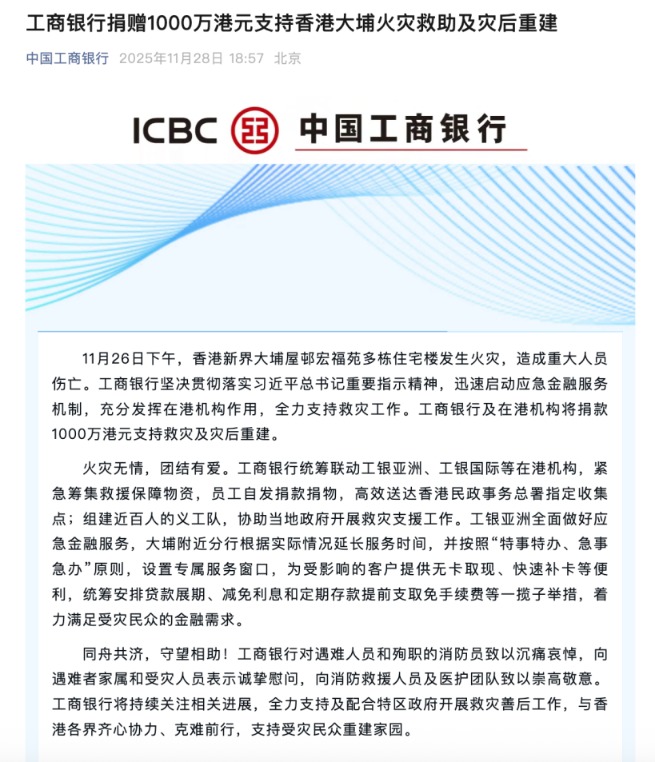
Core Viewpoint - Multiple banks in Hong Kong are actively supporting rescue and reconstruction efforts following a significant fire incident in Tai Po, New Territories, which resulted in major casualties [1] Group 1: Donations and Support Actions - Industrial and Commercial Bank of China (ICBC) donated 10 million HKD and organized a volunteer team to assist local government in rescue efforts [3] - Agricultural Bank of China (ABC) also donated 10 million HKD, focusing on supporting fire rescue and post-disaster recovery [6] - Bank of China (BOC) announced a donation of 20 million HKD and established a special account for public donations [11] - China Construction Bank (CCB) pledged 10 million HKD for emergency relief and recovery efforts, while also facilitating cross-border donations [15] - Bank of Communications (BoCom) plans to donate 10 million HKD and set up emergency service stations in affected areas [18] - Shanghai Bank and Minsheng Bank collectively donated over 50 million HKD, with Shanghai Bank contributing 10 million HKD and Minsheng Bank 5 million HKD [24] Group 2: Financial Services and Customer Support - ICBC is providing emergency financial services, including extended service hours and special service windows for affected customers [3] - ABC is coordinating with public welfare organizations for targeted donations and has initiated a volunteer team for disaster support [6] - BOC is expediting the reissuance of bank cards for affected customers and waiving related fees [12] - CCB is offering flexible identity verification and free reissuance of bank cards for customers unable to provide identification [15] - BoCom has set up priority service channels and is providing emergency cash support for affected customers [19]

工行、农行、中行、建行、交行等,齐出手
Zhong Guo Ji Jin Bao· 2025-11-28 14:26
Core Viewpoint - Multiple banks are taking urgent actions to support the rescue and reconstruction efforts following a significant fire incident in Hong Kong's Tai Po district, which resulted in major casualties and damage [1]. Group 1: Bank Contributions - Industrial and Commercial Bank of China (ICBC) has pledged HKD 10 million for disaster relief and reconstruction efforts, coordinating with its Hong Kong branches to provide emergency financial services and support [3]. - Agricultural Bank of China (ABC) is also donating HKD 10 million to assist in fire rescue and post-disaster recovery, while organizing volunteer teams to support affected families [6][7]. - Bank of China (BOC) has committed HKD 20 million, establishing a special donation account for public contributions and offering various financial support measures for affected customers [11][12]. - China Construction Bank (CCB) announced a donation of HKD 10 million and is providing flexible identity verification and fee waivers for affected customers [15][16]. - Bank of Communications plans to donate HKD 10 million and has set up emergency service stations to assist affected residents [19][20]. - Other banks, including Shanghai Bank and Minsheng Bank, collectively donated over HKD 50 million, with HSBC and Hang Seng Bank contributing HKD 30 million [25][26].
多家银行捐款 驰援香港大埔灾后工作
Zhong Guo Jing Ying Bao· 2025-11-28 14:26
Core Points - A significant fire occurred in Hong Kong's Tai Po district, resulting in major casualties and prompting extensive rescue efforts by the Hong Kong Fire Services [1] - Various banks have pledged financial support for the fire relief efforts, with donations totaling 100 million HKD from multiple institutions [1] Group 1: Donations and Support - China Construction Bank donated 10 million HKD to support the fire rescue efforts in Tai Po [1] - Agricultural Bank of China, along with its Hong Kong branches, pledged 10 million HKD specifically for fire rescue and post-disaster reconstruction [1] - Shanghai Pudong Development Bank also contributed 10 million HKD to aid in the fire rescue operations [1] - Shanghai Bank initiated an emergency donation mechanism, donating 10 million HKD to the Hong Kong Baiyulan Charity Foundation [1] - Minsheng Bank's Hong Kong branch announced a donation of 5 million HKD to the "Tai Po Hongfuyuan Assistance Fund" for emergency aid and reconstruction efforts [1] - DBS Bank (Hong Kong) donated 10 million HKD to the Hong Kong Red Cross [1] - HSBC and Hang Seng Bank announced an initial donation of 30 million HKD to support the affected residents and families from the Hongfuyuan fire [1]


银行批量上调代销基金风险等级 投资者如何应对?
Guo Ji Jin Rong Bao· 2025-11-28 12:52
Core Viewpoint - Banks are increasingly adjusting the risk levels of mutual fund products they distribute, with several banks, including China Construction Bank and Minsheng Bank, making multiple adjustments this year to align with market conditions and regulatory requirements [1][3][4]. Group 1: Bank Adjustments - China Construction Bank has announced a batch increase in the risk levels of 87 mutual fund products, marking the fourth adjustment this year [1][3]. - Minsheng Bank has also made four similar adjustments since October, with the latest announcement on November 18 regarding eight lower-risk fund products being raised to medium risk [1][3]. - Postal Savings Bank has adjusted the risk levels of 86 mutual fund products in two recent announcements [1][4]. Group 2: Reasons for Adjustments - The adjustments are attributed to a combination of mutual fund product characteristics, market conditions, and regulatory guidance, which aim to reduce the risk mismatch between investors and products [1][4]. - Changes in investment strategies and asset allocations of certain funds have increased their net value volatility, prompting institutions to reassess the risk-return alignment [4]. - Regulatory frameworks, such as the Asset Management New Regulations, are reinforcing the core requirement of "risk matching," compelling institutions to establish dynamic risk rating mechanisms [4][5]. Group 3: Future Implications - The adjustments may become a regular practice as banks are required to dynamically assess product risks to fulfill their suitability obligations and protect investor interests [5]. - Short-term impacts may lead conservative investors to redeem their investments due to increased risk levels, while long-term benefits include enhanced risk transparency and reduced risk mismatch [5][6]. - This shift is expected to drive the wealth management industry towards a service-oriented model, encouraging fund companies to improve their research and investment capabilities [5][6].

延长服务时间、提供延迟还款宽限期!银行业驰援香港大埔火灾救助
Bei Jing Shang Bao· 2025-11-28 12:05
Group 1 - The major fire incident at Hong Kong's Tai Po Wang Fuk Court has led to significant casualties and has drawn attention from various sectors of society [1] - The banking industry has quickly activated emergency mechanisms, providing donations, material support, and financial service green channels to establish a "financial lifeline" for disaster relief [1] - Agricultural Bank of China, along with its local institutions, will donate HKD 10 million to support fire rescue and post-disaster reconstruction efforts [1] - Industrial and Commercial Bank of China (ICBC) and its local institutions will also contribute HKD 10 million for disaster relief and reconstruction [1] - China Construction Bank is donating HKD 10 million for emergency rescue, transitional housing, and post-disaster recovery, while also opening a green channel for cross-border donations [1] - Minsheng Bank's Hong Kong branch will donate HKD 5 million to the "Tai Po Wang Fuk Court Relief Fund" established by the Hong Kong government for emergency assistance [1] - Bank of China Hong Kong will contribute HKD 20 million and establish a dedicated account for public donations [1] Group 2 - China Construction Bank (CCB) Asia has initiated three emergency measures for affected residents, including flexible identity verification for withdrawals and waiving early withdrawal fees for fixed deposits [2] - CCB Asia has also launched a fundraising campaign, raising HKD 2 million for emergency relief and community rebuilding efforts [2] - ICBC Asia's Tai Po branch has extended service hours and set up dedicated service windows for affected customers, offering various conveniences such as cardless cash withdrawals and expedited card replacements [2] - Bank of Communications (Hong Kong) has established emergency service stations and extended branch hours, providing fee-free withdrawals and flexible loan arrangements for affected customers [2]


建设银行(00939) - 董事会会议决议公告(2025年11月28日)
2025-11-28 11:47
香港交易及結算所有限公司及香港聯合交易所有限公司對本公告之內容概不負責,對其準確性 或完整性亦不發表任何聲明,並明確表示,概不對因本公告全部或任何部分內容而產生或因依 賴該等內容而引致之任何損失承擔任何責任。 00939 董事會會議決議公告 (2025年11月28日) 中國建設銀行股份有限公司(「本行」)董事會會議(「本次會議」)以書面議案方式召 開。本行於2025年11月28日發出本次會議通知,並於當日收到全體董事的書面表 決意見。本次會議的召開符合《中華人民共和國公司法》《中國建設銀行股份有限公 司章程》等規定。 2025年11月28日 於本公告日期,本行的執行董事為張金良先生、張毅先生和紀志宏先生,本行的 非執行董事為辛曉岱女士、劉芳女士、李璐女士、李莉女士和竇洪權先生,本行 的獨立非執行董事為威廉•科恩先生、梁錦松先生、詹誠信勛爵、林志軍先生和 張為國先生。 本次會議審議通過《關於向香港大埔宏福苑火災公益捐贈的議案》。 表決情況:同意13票,反對0票,棄權0票。 本次會議同意捐贈1,000萬港元,用於受災民眾緊急救援、過渡安置及災後恢復工 作。 特此公告。 中國建設銀行股份有限公司 董事會 ...