
CCB(00939)

Search documents
有银行积存金起点涨至1500元,为历史最高
2 1 Shi Ji Jing Ji Bao Dao· 2025-11-12 14:28
Core Viewpoint - The international gold price has returned to $4,100 per ounce, prompting banks to raise the minimum investment threshold for gold accumulation, with some banks adjusting the starting point to a historical high of 1,500 yuan [1][5]. Group 1: Bank Adjustments - Citic Bank has raised the minimum investment amount for its gold accumulation plan from 1,000 yuan to 1,500 yuan, effective from November 15 [5]. - Construction Bank has revised its gold accumulation plan, increasing the minimum investment amount from 1,000 yuan to 1,200 yuan, marking the second increase this year [5]. - Several banks, including Agricultural Bank, have adopted a "floating mechanism" for gold accumulation, allowing the minimum investment to adjust according to real-time gold prices [6]. Group 2: Market Dynamics - The gold price has experienced significant volatility, with a rise of over 60% this year, peaking above $4,300 per ounce before a sharp decline [8]. - Analysts predict that while short-term fluctuations may occur due to factors like interest rate expectations and a stronger dollar, the medium-term outlook remains optimistic, with potential for gold prices to reach $4,500 to $5,000 per ounce [8][9]. - The World Gold Council maintains a positive outlook for the gold market, citing factors such as a weakening dollar and inflation risks that could support gold investment demand [8]. Group 3: Institutional Perspectives - Various financial institutions have differing forecasts for gold prices by the end of 2025, ranging from $4,200 to $4,600 per ounce, with long-term views suggesting gold retains its value as a safe-haven asset [9]. - Bank of America highlights that non-traditional policies in the U.S. will continue to favor gold, driven by factors like rising fiscal deficits and inflation [9]. - Citigroup anticipates a potential decline in gold prices to $3,650 per ounce by 2026, arguing that improving economic conditions may reduce gold's appeal as a safe-haven asset [9].




有银行积存金起点涨至1500元,为历史最高
21世纪经济报道· 2025-11-12 13:40
Core Viewpoint - The article discusses the recent adjustments in the minimum investment thresholds for gold accumulation plans by various banks in response to fluctuating international gold prices, which have seen significant volatility this year, particularly after surpassing $4000 per ounce [1][4][8]. Summary by Sections Investment Threshold Adjustments - Several banks, including Citic Bank and China Construction Bank, have raised their minimum investment amounts for gold accumulation plans, with Citic Bank increasing it from 1000 RMB to 1500 RMB, marking the highest threshold in history [4]. - China Construction Bank has also revised its minimum investment amount from 1000 RMB to 1200 RMB, indicating a trend of increasing thresholds across the banking sector [4][5]. Floating Investment Mechanism - To avoid frequent adjustments, some banks, such as Bank of Communications and Agricultural Bank of China, have implemented a "floating" investment mechanism where the minimum investment amount is tied to real-time gold prices [5]. - This approach allows investors to adjust their investment amounts based on market conditions, providing greater flexibility amid price volatility [5]. Market Volatility and Risk Awareness - The article highlights the significant fluctuations in gold prices, with a peak of over $4300 per ounce followed by a drop below $4100, emphasizing the need for investors to be aware of the associated risks [8][9]. - Regulatory bodies and banks are increasing their risk awareness efforts, advising investors to recognize the uncertainties in the gold market [6]. Future Price Predictions - Analysts have differing views on future gold prices, with some predicting a potential rise to $5000 per ounce due to factors like inflation and fiscal policies, while others foresee a decline to around $3650 per ounce as economic conditions improve [9][10]. - The overall sentiment remains optimistic regarding gold's long-term value as a safe-haven asset, despite short-term volatility [9][10].

取款过万元就要被盘问用途?反诈举措不能异化为侵害个人隐私和阻碍资金自由流动的借口
Mei Ri Jing Ji Xin Wen· 2025-11-12 13:27
每经编辑|金冥羽 魏官红 一用户希望在银行柜台取款4万元,因为额度超过1万元被柜员要求报备用途,还被追问"具体买什么",甚至查询其过往流水。用户拒绝透露更多私人信 息,银行方面竟然选择报警,半个小时后,又称无法联系到警方,转变态度表示可以取款。当被质疑相关要求的合法性时,柜员坦言为当地反诈中心要 求。 这是央视报道的周筱赟律师反映近日在建设银行山东东营支行的真实经历。这件事情如同一面多棱镜,折射出当前一些地方反诈行动中耐人寻味的深层矛 盾,包括依据"土政策"的严格审查、个人隐私的被迫让渡以及银行报警后的程序空转等。 据周律师讲述,事发之后,银行工作人员向其发来信息表示歉意。周律师表示,他准备起诉相关银行,以推动改变借反诈折腾普通老百姓和银行柜员的现 状。 反诈行动的初衷毋庸置疑。在信息高度不对称的金融交易中,诈骗分子隐匿身份与意图,消费者处于绝对的信息劣势。因此,金融机构与警方协同,通过 必要的尽职调查(如大额交易问询)来打破这种不对称,本是维护金融公正、保护弱势方的必要之举。 从微观视角看,反诈带来"安全收益",即阻止诈骗行为所避免的损失,但反诈加码也意味着提高"交易成本",从而带来成本与收益的失衡。在周律 ...

戴志锋:3Q25货币政策执行报告点评
Xin Lang Cai Jing· 2025-11-12 11:59
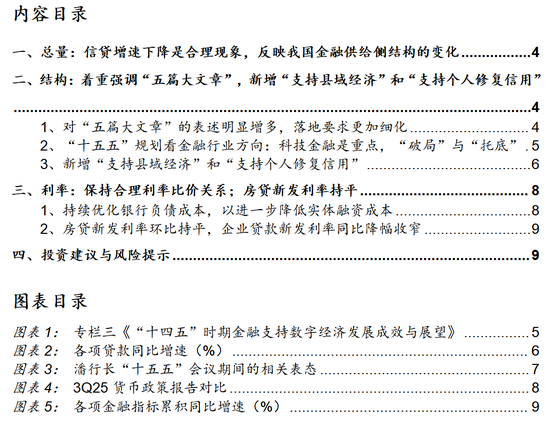
Summary of Key Points Overall Credit Growth - The decline in credit growth is a reasonable phenomenon, reflecting changes in China's financial supply-side structure. The focus should be on social financing scale and money supply as more comprehensive indicators compared to bank loans [1][8]. - Factors contributing to the decline include local special bonds replacing financing platform loans, the reform of small and medium-sized banks, and the trend of long-term economic structural evolution [9][12]. - Since last year, local governments have issued 4 trillion yuan in special refinancing bonds, with approximately 60-70% used to repay bank loans [10]. - In 2024, financial institutions are expected to write off about 1.3 trillion yuan in loans, with over 1 trillion yuan already written off in the first nine months of this year [11]. - The decline in real estate loans and the low credit dependence of light asset industries make it difficult to fill the gap left by real estate [12]. Structural Emphasis - The monetary policy report emphasizes the "Five Major Articles," with increased focus on supporting county economies and personal credit repair [2][18]. - The "14th Five-Year Plan" highlights technology finance as a key area, with policies aimed at breaking through economic growth ceilings and stabilizing macroeconomic environments [16]. - New measures include improving financial support mechanisms for county economic development and implementing policies for personal credit repair, which will not display certain default information in credit systems for individuals who have repaid loans [18][19]. Interest Rates - Maintaining a reasonable interest rate relationship is crucial, with new mortgage rates remaining stable [3][21]. - Continuous optimization of bank liability costs is necessary to lower financing costs for the real economy. The report notes that loan rates are decreasing faster than deposit rates, which compresses banks' net interest margins [21]. - As of September 2025, new loan rates for general loans, personal housing loans, and corporate loans are 3.67%, 3.06%, and 3.14%, respectively, with year-on-year declines of 48 basis points, 25 basis points, and 37 basis points [22]. Investment Recommendations - The banking sector is transitioning from a "pro-cyclical" to a "weak cyclical" phase, with a focus on the stability and sustainability of the sector [4]. - Two main investment lines are suggested: regional banks with strong certainty and high dividend stability, particularly in areas like Jiangsu, Shanghai, and Fujian [4].




门槛有点高!有银行积存金起点“三连涨”,最高达到1500元
2 1 Shi Ji Jing Ji Bao Dao· 2025-11-12 11:37
Core Viewpoint - The international gold price has returned to $4,100 per ounce, prompting banks to raise the minimum investment threshold for gold accumulation, with some banks adjusting the starting point to a historical high of 1,500 yuan [1][3] Summary by Sections Investment Threshold Adjustments - On November 11, Citic Bank raised the minimum investment amount for its gold accumulation plan from 1,000 yuan to 1,500 yuan, effective from November 15 [3] - China Construction Bank revised its gold accumulation plan, increasing the minimum investment amount from 1,000 yuan to 1,200 yuan, marking the second increase this year [3] - Other banks, such as Agricultural Bank and Bank of Communications, have also implemented a "floating mechanism" for gold accumulation thresholds, allowing the starting point to adjust with market gold prices [4][5] Market Volatility and Risk Management - The gold price has experienced significant fluctuations, with a rise of over 60% this year, followed by a sharp decline [7] - Regulatory bodies and banks are enhancing risk warnings due to the volatile gold market, urging investors to be aware of potential risks [6] - Analysts suggest that the floating mechanism for investment thresholds allows for better alignment with market changes and provides investors with more flexibility [5] Future Price Predictions - Various institutions predict that gold prices could range from $4,200 to $4,600 per ounce by the end of 2025, with some forecasts suggesting prices could reach as high as $5,000 per ounce [8] - The outlook for gold remains optimistic due to factors such as a weakening dollar and inflation risks, although short-term volatility is expected [7][8]

行业点评报告:抵债房产加速处置下,银行涉房风险再观察
KAIYUAN SECURITIES· 2025-11-12 10:13
Investment Rating - The industry investment rating is "Positive" (maintained) [1] Core Insights - Banks are accelerating the disposal of debt properties due to multiple considerations including capital, profitability, and market risks. This includes selling properties obtained from non-performing loans on platforms like JD and Alibaba, which helps avoid legal disputes [3][4] - The current economic environment pressures banks to dispose of these assets quickly to reduce capital consumption, supplement profits, and mitigate risks associated with fluctuating real estate prices [3][4] - The scale and impairment provisions of debt assets among listed banks show significant differentiation, with some banks having higher levels of non-performing assets and varying impairment ratios [4][5] Summary by Sections Section on Debt Property Disposal - Banks are expediting the sale of debt properties to alleviate capital pressure, as regulations require disposal within two years to avoid punitive risk weights [3] - The new capital management guidelines propose extending the disposal period to five years and reducing risk weights for non-self-use properties beyond the disposal period [3][8] Section on Asset Characteristics - The characteristics of debt assets among listed banks vary significantly, with some banks like ICBC and Minsheng Bank having higher levels of debt assets and differing asset structures [4][9] - The impairment provision ratios for debt assets also differ, with some banks fully provisioning while others have lower ratios, indicating potential under-provisioning issues [4][5] Section on Risk Parameters - The risk exposure and default parameters for housing collateral loans indicate that the majority of banks have low default probabilities, particularly in first and second-tier cities [5][15] - The analysis shows that higher collateral values correlate with lower default probabilities, suggesting that banks with significant exposure in major cities may face manageable risks [5][15]

建设银行(601939) - 建设银行关于2025年第二次临时股东会会议增加临时提案的公告
2025-11-12 10:00
证券代码:601939 证券简称:建设银行 公告编号:2025-065 中国建设银行股份有限公司 关于2025年第二次临时股东会会议 增加临时提案的公告 本行董事会及全体董事保证本公告内容不存在任何虚假记载、误导性陈述或 者重大遗漏,并对其内容的真实性、准确性和完整性承担法律责任。 一、股东会会议有关情况 (一) 股东会会议类型和届次 2025年第二次临时股东会会议 (二) 股东会会议召开日期:2025 年 11 月 27 日 (三) 股权登记日 | 股份类别 | 股票代码 | 股票简称 | 股权登记日 | | --- | --- | --- | --- | | A股 | 601939 | 建设银行 | 2025/11/21 | 二、增加临时提案的情况说明 (一) 提案人:中国长城资产管理股份有限公司 (二) 提案程序说明 本行已于2025年11月8日刊载 2025年第二次临时股东会会议的召开通知。 实质持有本行有表决权股份总数约3.0065%股份的股东中国长城资产管理股份 有限公司于2025 年 11 月 10 日向本行提交《关于选举史剑先生担任中国建设银 日期时间:2025 年 11 月 27 日 14: ...
部分金饰价突破1310元/克 有银行提高定投门槛至1500元
2 1 Shi Ji Jing Ji Bao Dao· 2025-11-12 09:41
Group 1 - The domestic gold jewelry prices have significantly increased, with most brands surpassing 1300 RMB per gram, and some top brands exceeding 1310 RMB per gram, reaching new highs [2] - As of November 12, 2023, the international gold market continues to rise, with London gold priced at 4116.931 USD per ounce, reflecting a year-to-date increase of 56.89%, while COMEX gold is at 4119.6 USD per ounce, also up 56.09% for the year [2] - The domestic gold price in Shanghai is reported at 945.76 RMB per gram, with a year-to-date increase of 51.13%, indicating a clear upward trend in both domestic and international gold prices [2] Group 2 - Several banks have raised the minimum investment thresholds for gold accumulation products, with Citic Bank increasing its minimum from 1000 RMB to 1500 RMB effective November 15, 2025 [3] - China Construction Bank announced a revision to its gold accumulation business, raising the minimum investment amount from 1000 RMB to 1200 RMB, effective November 15, 2023 [3] - Other banks, including Ningbo Bank, Industrial and Commercial Bank of China, and Bank of China, have also adjusted their minimum investment amounts for gold accumulation products in recent weeks, reflecting a broader trend in the banking sector [4]


建设银行(00939) - 2025年11月27日举行之2025年第二次临时股东会会议之补充代理人委...
2025-11-12 09:39
2025年11月27日舉行之2025年第二次臨時股東會會議之補充代理人委任表格 00939 為本人╱吾等之代理人,代表本人╱吾等出席於2025年11月27日14:50於北京市西城區金融大 街25號舉行之2025年第二次臨時股東會會議(「會議」),以考慮並酌情通過日期為2025年11月 12日的2025年第二次臨時股東會會議補充通告(「補充通告」)所載決議案,並於該會議上代表 本人╱吾等以本人╱吾等之名義就以下決議案投票表決 (附註4) 。 普通決議案 贊成 (附註4) 反對 (附註4) 棄權 (附註4) 3. 選舉史劍先生擔任本行非執行董事 日期:2025年 月 日 簽名 (附註5) 附註: : 1. 請用正楷填上全名及地址。 2. 請填上與本補充代理人委任表格有關並登記於 閣下名下之股份數目。如未有填上股數,則本補充代理人委 任表格將被視為 閣下名下所有中國建設銀行股份有限公司股份之委任表格。 3. 倘擬委派會議主席以外之人士為代理人,請刪去「會議主席」字樣,並在空欄內填上 閣下所擬委派代理人之 姓名及地址。股東可委派代理人出席會議,並於表決時代為投票。本補充代理人委任表格之每項更正,均須 由簽署人簡簽示可 ...
建设银行(00939) - 2025年第二次临时股东会会议补充通告
2025-11-12 09:33
香港交易及結算所有限公司及香港聯合交易所有限公司對本通告之內容概不負責,對其準確性 或完整性亦不發表任何聲明,並明確表示,概不對因本通告全部或任何部分內容而產生或因依 賴該等內容而引致之任何損失承擔任何責任。 00939 2025年第二次臨時股東會會議補充通告 茲提述中國建設銀行股份有限公司(「本行」)日期為2025年11月7日的2025年第二次 臨時股東會會議通告和通函(「第一份通函」),其中載列了本行2025年第二次臨時 股東會會議舉行的時間和地點及於會上提請股東審議的決議案。 3. 選舉史劍先生擔任本行非執行董事 上述議案的詳情載於本行日期為2025年11月12日的2025年第二次臨時股東會會議 補充通函(「補充通函」)。 中國建設銀行股份有限公司 董事會 2025年11月12日 - 1 - 於本通告日期,本行的執行董事為張金良先生、張毅先生和紀志宏先生,本行的 非執行董事為辛曉岱女士、劉芳女士、李璐女士、李莉女士和竇洪權先生,本行 的獨立非執行董事為威廉•科恩先生、梁錦松先生、詹誠信勛爵、林志軍先生和張 為國先生。 附註: 依照相關法律法規和公司章程的規定,選舉史劍先生擔任本行非執行董事的議案將作為本 ...