CCB(00939)

Search documents
建行莱芜莱矿支行:智能时代的金融守护
Qi Lu Wan Bao· 2025-09-29 00:36
Core Points - The article highlights a recent incident at the CCB Laiwu Laikuan Branch where staff effectively resolved a sudden "deduction crisis" for an elderly customer, showcasing the bank's commitment to providing warm and professional financial services tailored for seniors [1][2] - The incident involved an elderly man, Mr. Zhang, who was distressed over unauthorized monthly deductions from his bank account, which were later identified as subscription fees for a video platform [1][2] - The bank staff not only resolved the issue by identifying the source of the deductions but also educated Mr. Zhang on how to manage his account better, including disabling automatic renewals and setting up transaction alerts [2] Summary by Sections Incident Description - A sudden call for help from an elderly customer disrupted the calm atmosphere at the bank, leading to immediate assistance from the branch manager [1] - The customer was anxious about monthly deductions from his account, which he had not noticed for several months [1] Resolution Process - The bank manager calmly reassured the customer and assisted him in checking his transaction history, revealing the source of the deductions [1][2] - The customer realized that the deductions were for a video membership activated by his grandson, which he had unknowingly agreed to [2] Service Quality and Future Commitment - The successful resolution of the issue highlighted the bank's dedication to providing thoughtful and professional services for elderly clients [2] - The bank plans to continue enhancing its services to create a more secure financial environment for senior customers [2]
建行临沂西城支行:暖心服务聋哑客户 无声传递金融温度
Qi Lu Wan Bao· 2025-09-29 00:36
Core Points - The article highlights a heartwarming service experience at the CCB Linyi Xicheng Branch, where staff provided exceptional assistance to a hearing-impaired customer in renewing a social security card and using mobile banking services, embodying the "finance for the people" service philosophy [1][2] - The bank's staff adapted their communication methods to ensure effective interaction with the customer, utilizing written text, visual aids, and gestures to bridge communication gaps [1][2] - The service experience reflects the bank's commitment to inclusivity and accessibility in financial services, aiming to ensure that all customers, regardless of physical conditions, can enjoy quality financial services [2] Service Process - The staff recognized the communication barrier and quickly adjusted their approach, abandoning traditional verbal communication for written and visual methods [1] - During the information verification phase, staff meticulously wrote down key information and confirmed understanding through gestures, ensuring the customer comprehended each step of the process [1] - After completing the card renewal, staff proactively assisted the customer in downloading and logging into the mobile banking app, providing hands-on guidance for common functions like balance inquiries and fund transfers [1] Commitment to Inclusivity - The service experience is portrayed as a microcosm of the bank's daily operations, emphasizing its role as a social service provider and its responsibility to promote barrier-free services [2] - The bank plans to continue enhancing its service measures to ensure that every customer can access quality financial services conveniently and feel the warmth of financial support [2]
银行治理改革迎新进展:五大国有银行监事会正式退出,邮储银行监事长到龄辞任
Xin Lang Cai Jing· 2025-09-29 00:33
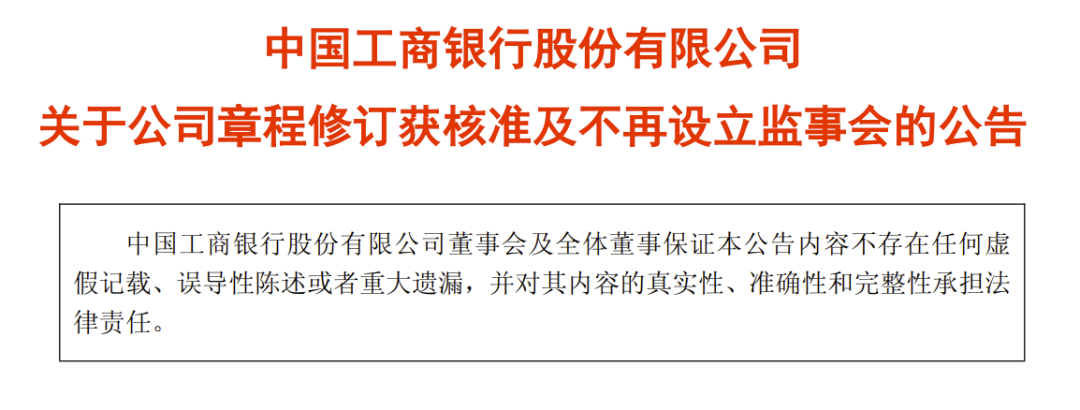
9月25日,工商银行、农业银行、中国银行、建设银行、交通银行集体发布公告,宣布公司 章程修订获监管核准,自核准之日起不再设立监事会,由董事会审计委员会依法承接监事会 职权。 交通银行同样发布相关公告,自2025年9月25日起不再设立监事会,由董事会审计委员会行 使监事会相关职权。现任监事王学庆、苏治、林至红、丰冰、颇颖不再担任监事及监事会相 关职务。 邮储银行也于近日发布公告表示,监事长、股东代表监事陈跃军到龄辞任。该行2025年第二 次临时股东大会会议资料显示,拟不再设立监事会及下设专门委员会,自公司章程获国家金 融监督管理总局核准之日起生效。 据不完全统计,目前已有20逾家银行披露公司治理架构改革计划,有银行已宣布监事团队人 员调整。业内人士认为,银行裁撤监事会有助于提升银行治理效率、精简公司治理结构、权 责更加清晰,同时也要防范监督独立性风险。 五家国有银行集体官宣取消监事会 邮储银行监事长日前已辞任 9月25日,国有五大行集体发布公告,宣布公司章程修订获核准以及不再设立监事会,由董 事会审计委员会依法承接监事会职权。 工商银行公告称,近日收到《国家金融监督管理总局关于工商银行修改公司章程的批复》。 自 ...



驻建行纪检监察组深化细化评查工作严守案件质量生命线
Zhong Yang Ji Wei Guo Jia Jian Wei Wang Zhan· 2025-09-29 00:09
Core Viewpoint - The Central Commission for Discipline Inspection and National Supervisory Commission's inspection team is conducting on-site evaluations of disciplinary cases at the China Construction Bank's Xinjiang branch to enhance the quality of case handling and promote high-quality development in discipline inspection and supervision [1][2]. Group 1: Evaluation Mechanism - The inspection team has revised the "Case Quality Evaluation Standards and Scoring Details," focusing on five aspects: evidence, qualitative handling, procedural compliance, management norms, and execution, with 17 evaluation items and 76 scoring criteria [1][2]. - A comprehensive evaluation system has been established, incorporating online evaluations, on-site evaluations, and special evaluations to strengthen the foundation of case quality assessments [1]. Group 2: Evaluation Frequency and Findings - The frequency of evaluations for completed cases has increased from semi-annual to quarterly, allowing for regular monitoring and timely feedback [2]. - From July to August, the inspection team completed a second round of evaluations, identifying issues in qualitative handling and promoting corrective actions [2]. Group 3: Training and Guidance - The inspection team regularly summarizes evaluation results, addressing typical issues such as insufficient evidence and procedural non-compliance, and requires units to implement corrective measures [3]. - Annual training sessions are held for discipline inspection personnel, enhancing their professional capabilities and addressing common quality issues through targeted guidance materials [4]. Group 4: Future Directions - The inspection team aims to further deepen case quality evaluations and innovate evaluation methods to enhance the standardization and legal compliance of discipline inspection work across the organization [4].
招商中证A50交易型开放式指数证券投资基金发起式联接基金基金份额发售公告
Shang Hai Zheng Quan Bao· 2025-09-28 17:34
Group 1 - The fund being launched is the "招商中证A50交易型开放式指数证券投资基金发起式联接基金" [25] - The fund is categorized as a contract-type open-end ETF linked fund [2] - The fund will be publicly offered from October 13, 2025, to October 31, 2025, with the possibility of adjustments based on subscription conditions [4][33] Group 2 - The fund is managed by 招商基金管理有限公司 and the custodian is 中国建设银行股份有限公司 [2][3] - The minimum subscription amount for the A class fund shares through direct sales is 500,000 RMB, while for non-direct sales, it is 1 RMB [3][42] - The fund has two classes of shares: A class, which charges subscription fees, and C class, which does not [27][36] Group 3 - The total amount of fund shares to be raised is no less than 1 million shares, with a total fundraising amount of at least 10 million RMB [31] - The fund's initial share price is set at 1 RMB [30][36] - Investors can subscribe multiple times during the fundraising period, but each subscription will be treated separately for fee calculations [42][43] Group 4 - The fund's sales institutions include both direct and non-direct sales channels [6][34] - Investors must ensure that the funds used for subscription are legally sourced and not borrowed [3][42] - The fund's effective subscription funds will earn interest during the fundraising period, which will be converted into fund shares for the holders [10][61]

建行德州齐河支行开展金融教育宣传活动
Qi Lu Wan Bao· 2025-09-28 16:25
Core Points - The article emphasizes the importance of financial education and awareness in enhancing the financial literacy of various community groups, particularly students and the elderly [1][2] - The activities organized by the bank aim to protect financial rights and contribute to a better quality of life through targeted financial knowledge dissemination [1] Group 1: Activities and Initiatives - The bank collaborated with local universities to conduct themed presentations focusing on common scams faced by students, such as "campus loans" and "customer service impersonation" [1] - Interactive methods like scenario simulations and Q&A sessions were employed to educate students on personal information protection, rational consumption, and legal rights [1] - Outreach efforts were also made in local markets to educate elderly clients and new residents about the dangers of illegal fundraising and pension fraud [1] Group 2: Impact and Future Plans - The activities effectively enhanced the understanding of financial knowledge among different groups, especially students with relatively low financial literacy [2] - The bank plans to continue exploring new methods and avenues for financial knowledge dissemination to contribute to a safe and stable financial environment in the community [2]
金融圈大消息!刚宣布,林朝晖履新
中国基金报· 2025-09-28 11:06
Core Viewpoint - Lin Chaohui, a member of the Party Committee and Vice President of China Life Insurance (Group), has been appointed as the Party Secretary of Guangfa Bank and is proposed to be the bank's president [2][5]. Group 1: Leadership Changes - On September 28, Guangfa Bank held a cadre meeting where Lin Chaohui's appointment was announced [2][5]. - Wang Kai has resigned from his positions at Guangfa Bank due to organizational adjustments within the group, confirming no disagreements with the board [6]. - The bank's management team has undergone significant changes this year, including the resignation of former Chairman Bai Tao in March and the election of Cai Xiliang as the new chairman in April [10]. Group 2: Lin Chaohui's Background - Lin Chaohui, born in 1974, holds a master's degree in law and is a senior economist, currently serving as Vice President of China Life Insurance (Group) [8]. - He has extensive experience in the financial sector, having previously held positions such as Party Secretary and President of the Beijing Branch of China Construction Bank [8]. Group 3: Bank Performance - As of the end of 2024, Guangfa Bank's total assets reached 3.64 trillion yuan, reflecting a growth of 3.86% from the beginning of the year [11]. - The bank reported an operating income of 69.237 billion yuan and a net profit of 15.284 billion yuan for the previous year [11].



建行广东省分行:落地消费贷贴息 点亮民生“小确幸”
Nan Fang Du Shi Bao· 2025-09-28 10:58
Core Viewpoint - The introduction of consumer loan interest subsidies by China Construction Bank (CCB) is significantly benefiting consumers, enhancing their purchasing power and stimulating the local economy in Guangdong province [1][2][8]. Group 1: Consumer Loan Interest Subsidy Program - CCB's Guangdong branch reported that from September 1 to 24, 2023, it added 5,833 new customers for personal consumer loans with a total subsidy amount of 103 million yuan [1]. - The subsidy program, effective from September 1, 2023, offers a 1% annual interest subsidy on eligible consumer loans, with a maximum subsidy cap of 3,000 yuan per customer [2][4]. - The program covers various consumer categories, including home appliances, automobiles, healthcare, and education, with specific limits based on loan amounts [4][5]. Group 2: Product Offerings and Consumer Engagement - CCB has developed a range of consumer loan products, including "Jianyi Loan," "Fangyi Loan," and "Yangyi Loan," each with a maximum loan amount of 1 million yuan and a minimum interest rate of 3.0% [7]. - The bank has established a dedicated team to facilitate the implementation of the subsidy program, ensuring effective communication and service delivery to customers [3]. - The user-friendly mobile banking platform allows customers to easily access subsidy information and apply for loans, enhancing customer experience [6]. Group 3: Economic Impact and Future Outlook - CCB's consumer loan initiatives align with national strategies to boost consumption, with the bank's personal consumer loan scale exceeding 50 billion yuan and over 42 billion yuan disbursed this year [8][9]. - The bank aims to continue innovating its consumer finance products and support the upgrading of consumer spending, contributing to the economic vitality of the Guangdong-Hong Kong-Macao Greater Bay Area [9].
建行广东省分行:落地消费贷贴息,点亮民生“小确幸”
Nan Fang Du Shi Bao· 2025-09-28 10:53
Core Insights - The article highlights the significant impact of the personal consumption loan interest subsidy program initiated by China Construction Bank (CCB) in Guangdong Province, which has successfully attracted a large number of customers and boosted consumer spending [2][4][11] Group 1: Consumer Loan Subsidy Program - CCB Guangdong Province has seen a total of 5,833 new customers benefiting from the interest subsidy program, with a total loan amount of 103 million yuan issued from September 1 to 24 [2] - The subsidy program, effective from September 1, 2023, offers a 1% annual interest subsidy for personal consumption loans, with a maximum subsidy limit of 3,000 yuan per customer [4][7] - The program covers various consumption categories, including home appliances, automotive purchases, healthcare, and education, enhancing consumer access to financing [7][11] Group 2: Innovative Financial Products - CCB has introduced innovative products like "Yangyidai," which targets employees with pension contributions, allowing them to access loans for various elder care and travel needs [4][11] - The bank's product matrix includes "Jianyidai," "Fangyidai," and "Yangyidai," each with a maximum loan amount of 1 million yuan and a term of up to 7 years, with interest rates starting at 3.0% [11][10] - The "Kuaidai" product offers internet-based credit loans with a maximum limit of 300,000 yuan and a term of up to 3 years, with interest rates starting at 3.3% [10] Group 3: Implementation and Customer Experience - CCB has established a dedicated team to implement the subsidy program, ensuring effective communication and training across branches [5] - The bank has created a user-friendly mobile banking interface for customers to easily access subsidy information and apply for loans [8] - The subsidy is automatically applied to loan interest, simplifying the process for consumers and enhancing their experience [8][9] Group 4: Economic Impact and Future Outlook - CCB's efforts align with national strategies to boost consumer spending, with the bank's personal consumption loan scale exceeding 50 billion yuan and over 42 billion yuan disbursed this year [11][12] - The bank plans to continue advancing its consumer finance initiatives, focusing on product innovation and supporting consumption upgrades in the Guangdong-Hong Kong-Macao Greater Bay Area [12]

工行、农行、中行、建行、交行、邮储银行同日公告
Jing Ji Wang· 2025-09-28 09:19
Core Viewpoint - Major banks in China have decided to abolish their supervisory boards, transferring their functions to the audit committee of the board of directors, which is seen as a move to optimize corporate governance and reduce costs [7][8][9] Group 1: Decision and Implementation - The five major banks have announced that they will no longer establish supervisory boards, a decision approved at the 2024 annual general meeting held on June 27, 2025, and recently sanctioned by the National Financial Regulatory Administration [7] - Postal Savings Bank has also proposed to abolish its supervisory board and related committees, with the audit committee of the board taking over these responsibilities, pending shareholder approval [8] Group 2: Rationale and Expert Opinions - Industry experts suggest that the functions of supervisory boards overlap with those of the audit committee, particularly the independent directors, making the abolition a strategic choice to enhance governance flexibility and efficiency [8] - The decision to eliminate supervisory boards is viewed as a way to maintain effective corporate governance while lowering governance costs, according to a leading expert from the Shanghai Financial and Development Laboratory [8] Group 3: Regulatory Framework - The revised Company Law allows companies to establish audit committees within the board of directors to perform the functions of supervisory boards, a change that has been recognized by the National Financial Regulatory Administration [9] - Besides the six major banks, several other national joint-stock banks and local commercial banks have also announced the abolition of their supervisory boards [9]