
CHINA MOBILE(00941)

Search documents
频次高结构优 上市公司分红总额屡创新高
Zheng Quan Ri Bao· 2026-01-07 17:31
Core Insights - In 2025, A-share listed companies' total cash dividends reached 2.61 trillion yuan, marking an 8.75% year-on-year increase, continuing a trend of annual growth [1][2] - The increase in cash dividends reflects improvements in corporate governance, performance, and policy guidance, indicating a profound transformation in the A-share market ecosystem [2][3] Policy and Regulatory Environment - The new "National Nine Articles" emphasizes strengthening the regulation of cash dividends and encourages measures to increase dividend yields [2] - The China Securities Regulatory Commission released a draft regulation supporting companies in formulating reasonable and stable dividend policies [2] Financial Performance - In the first three quarters of 2025, A-share companies achieved a total operating revenue of 53.46 trillion yuan, a 1.36% increase, and a net profit of 4.70 trillion yuan, up 5.50% [3] - By the end of Q3 2025, listed companies had a total cash reserve of 18.36 trillion yuan, indicating strong dividend-paying capacity [3] Dividend Frequency and Structure - The frequency of dividends has increased, with multiple distributions per year becoming the norm; over 900 companies disclosed three-year dividend plans, enhancing transparency and predictability [4][3] - In 2025, 16 companies executed four cash dividends, 88 companies executed three, and 902 companies executed two [5] Sectoral Analysis - Traditional industries like finance and oil & gas continue to dominate high dividend payouts, while technology companies are also increasing their dividend distributions [6] - In 2025, 945 companies on the ChiNext board distributed 137.45 billion yuan in cash dividends, an 8.41% increase year-on-year [6] Market Dynamics - The rise in dividend amounts is seen as a shift in the capital market's focus from financing expansion to shareholder returns, establishing predictable cash returns as a new benchmark for asset pricing [3][7] - The number of ETFs linked to dividend indices has grown, with 42 new products launched in 2025, and the total scale of these ETFs reached 1520.18 billion yuan by the end of 2025, a 70.11% increase from the previous year [7]



港股通净买入91.78亿港元
Zheng Quan Shi Bao Wang· 2026-01-07 14:49
Group 1 - The Hang Seng Index fell by 0.94% on January 7, closing at 26,458.95 points, while southbound funds through the Stock Connect recorded a net buy of HKD 9.178 billion [1] - The total trading volume for the Stock Connect on January 7 was HKD 134.393 billion, with a net buy of HKD 9.178 billion [1] - In the Shanghai Stock Connect, the trading volume was HKD 80.489 billion with a net buy of HKD 3.490 billion, while in the Shenzhen Stock Connect, the trading volume was HKD 53.905 billion with a net buy of HKD 5.688 billion [1] Group 2 - In the top ten active stocks in the Shanghai Stock Connect, Alibaba-W had the highest trading volume at HKD 8.352 billion, followed by SMIC and Tencent Holdings with trading volumes of HKD 4.491 billion and HKD 3.434 billion respectively [1] - The stock with the highest net buy was the Tracker Fund of Hong Kong, with a net buy of HKD 1.465 billion, despite its closing price dropping by 0.82% [1] - The stock with the highest net sell was China Mobile, with a net sell of HKD 1.126 billion, and its closing price fell by 0.97% [1] Group 3 - In the Shenzhen Stock Connect, Alibaba-W had the highest trading volume at HKD 6.705 billion, followed by Tencent Holdings and SMIC with trading volumes of HKD 2.831 billion and HKD 1.991 billion respectively [2] - The stock with the highest net buy in the Shenzhen Stock Connect was Tencent Holdings, with a net buy of HKD 1.069 billion, while Alibaba-W had the highest net sell of HKD 0.850 billion [2] - The closing price of Alibaba-W fell by 3.25%, while Tencent Holdings dropped by 1.26% [2]
南向资金今日净买入91.78亿港元,腾讯控股净买入19.55亿港元
Zheng Quan Shi Bao Wang· 2026-01-07 14:42
Core Viewpoint - The Hang Seng Index fell by 0.94% on January 7, with southbound capital transactions totaling HKD 134.39 billion, indicating a net inflow of HKD 9.18 billion [2] Group 1: Southbound Capital Transactions - Total southbound capital transactions amounted to HKD 134.39 billion, with buy transactions at HKD 71.79 billion and sell transactions at HKD 62.61 billion, resulting in a net buy of HKD 9.18 billion [2] - The Shenzhen Stock Connect saw total transactions of HKD 53.91 billion, with net buying of HKD 5.69 billion, while the Shanghai Stock Connect had total transactions of HKD 80.49 billion, with net buying of HKD 3.49 billion [2] Group 2: Active Stocks - Alibaba-W had the highest transaction amount among southbound stocks at HKD 15.06 billion, followed by SMIC and Tencent Holdings with HKD 6.48 billion and HKD 6.27 billion respectively [2][4] - Tencent Holdings recorded a net buy of HKD 1.96 billion, while Xiaomi Group-W had a net buy of HKD 1.63 billion, and the Yingfu Fund saw a net buy of HKD 1.47 billion [2][3] - China Mobile experienced the highest net sell at HKD 1.13 billion, with its stock price declining by 0.97% [2][4] Group 3: Continuous Net Buying - Four stocks received continuous net buying from southbound capital for more than three days, with Xiaomi Group-W leading at five days, followed by Alibaba-W at four days, and China Life at three days [3] - The total net buying amounts during this period were HKD 3.61 billion for Xiaomi Group-W, HKD 2.12 billion for Alibaba-W, and HKD 1.25 billion for China Life [3]



移动联通重押雷鸟创新背后:智能眼镜发出“独立宣言”,欲告别“手机附属品”标签
Hua Xia Shi Bao· 2026-01-07 14:17
Core Viewpoint - The investment by Chinese telecom operators in Thunderbird Innovation marks a strategic move to position themselves in the next generation of personal communication terminals, particularly in the AR smart glasses market, which is expected to reach a significant milestone akin to the "iPhone moment" in the coming years [2][3][4]. Group 1: Investment and Financing - Thunderbird Innovation has completed a new financing round exceeding 1 billion yuan, led by China Mobile's Chain Long Fund and CITIC Jinshi, with participation from China Unicom's Lianchuang Innovation Fund [3]. - Since its establishment in 2021, Thunderbird Innovation has attracted significant capital, with its previous financing round occurring just two months prior, setting a record for the largest single financing amount in the domestic AI+AR glasses sector for 2025 [3]. - The strategic investment from China Mobile and China Unicom signifies the formal entry of AR terminals into the strategic vision of national communication infrastructure [3]. Group 2: Market Position and Growth - According to Counterpoint Research, Thunderbird Innovation held a 24% global market share in AR glasses by Q3 2025, achieving the highest shipment volume globally for two consecutive quarters [4]. - The company has established a strong presence in international retail channels, with its products available in over 25 countries and regions, and a cumulative user base exceeding 500,000, with overseas sales increasing by 3.8 times year-on-year [4]. Group 3: Strategic Collaboration - The partnership with telecom operators will facilitate comprehensive collaboration in market channel development, business model innovation, and core technology ecosystems, leveraging the operators' extensive offline service networks and user bases [5]. - The introduction of the first AR smart glasses with eSIM technology, "Thunderbird X3 Pro Project eSIM," exemplifies the collaborative efforts between Thunderbird Innovation and telecom operators, enabling independent communication capabilities [5][6]. Group 4: Future Outlook - The integration of eSIM technology is expected to transform AR smart glasses into a complete personal computing center, capable of independent communication, computation, display, and interaction [6]. - The operators' involvement is anticipated to catalyze the growth of AR glasses sales in China, potentially reaching millions in volume by 2026-2027, thus accelerating their adoption as mainstream consumer devices [7].


智通港股通活跃成交|1月7日





智通财经网· 2026-01-07 11:04
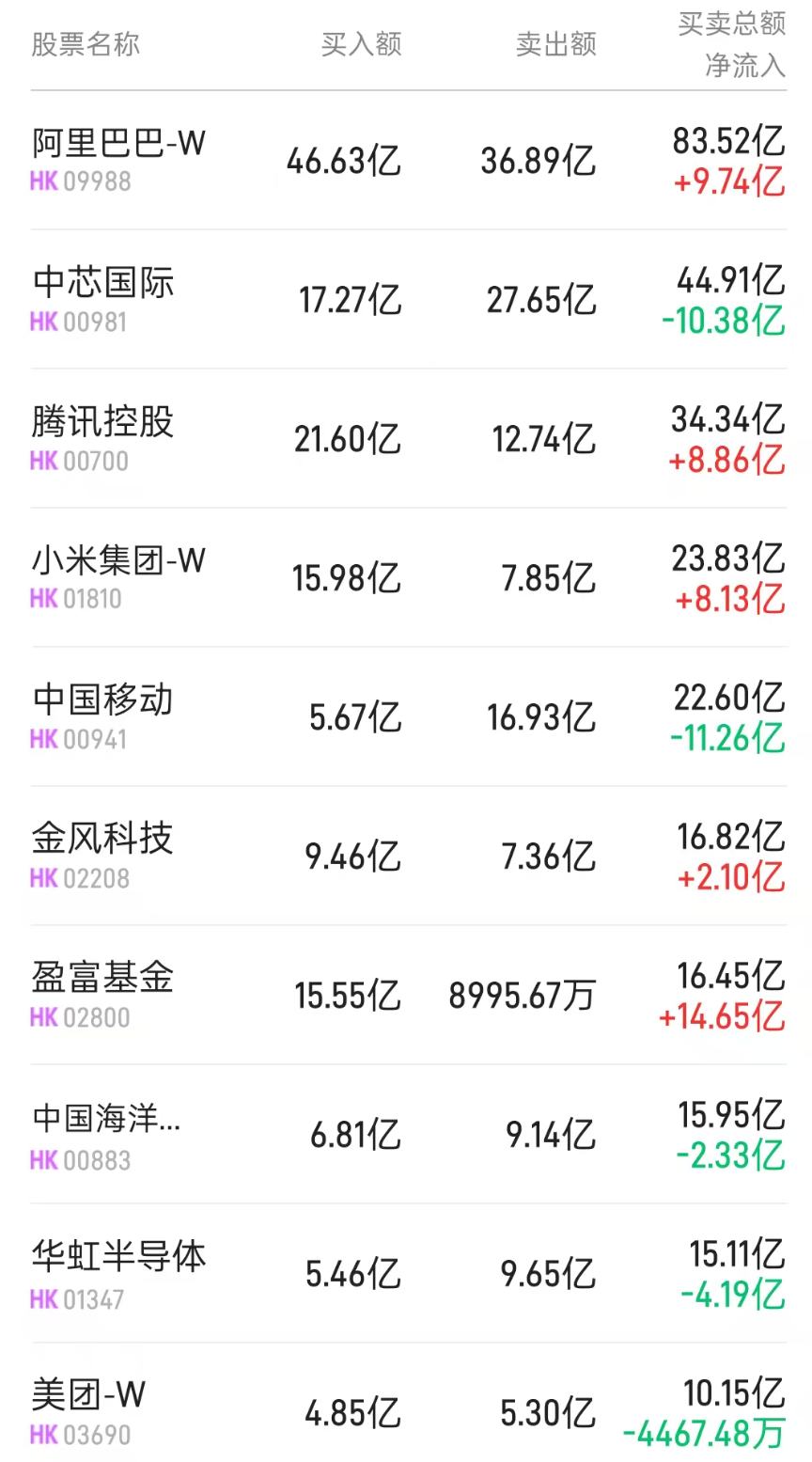
Core Insights - On January 7, 2026, Alibaba-W (09988), SMIC (00981), and Tencent Holdings (00700) were the top three stocks by trading volume in the Southbound Stock Connect, with trading amounts of 83.52 billion, 44.91 billion, and 34.34 billion respectively [1] - In the Southbound Stock Connect for the Shenzhen-Hong Kong Stock Connect, Alibaba-W (09988), Tencent Holdings (00700), and SMIC (00981) also ranked as the top three, with trading amounts of 67.05 billion, 28.31 billion, and 19.91 billion respectively [1] Southbound Stock Connect (Shanghai-Hong Kong) - The top active stocks included: - Alibaba-W (09988): Trading amount of 83.52 billion, net buying of +9.74 billion - SMIC (00981): Trading amount of 44.91 billion, net selling of -10.38 billion - Tencent Holdings (00700): Trading amount of 34.34 billion, net buying of +8.86 billion - Xiaomi Group-W (01810): Trading amount of 23.83 billion, net buying of +8.13 billion - China Mobile (00941): Trading amount of 22.60 billion, net selling of -11.26 billion [2] Southbound Stock Connect (Shenzhen-Hong Kong) - The top active stocks included: - Alibaba-W (09988): Trading amount of 67.05 billion, net selling of -8.50 billion - Tencent Holdings (00700): Trading amount of 28.31 billion, net buying of +10.69 billion - SMIC (00981): Trading amount of 19.91 billion, net selling of -3.20 million - Xiaomi Group-W (01810): Trading amount of 16.55 billion, net buying of +8.19 billion - Meituan-W (03690): Trading amount of 13.07 billion, net buying of +4.48 billion [2]
年终奖真相:为什么总感觉像在补发工资?
Xin Lang Cai Jing· 2026-01-07 10:07
Core Viewpoint - The year-end bonus system in state-owned enterprises (SOEs) creates a perception of "back pay" due to the fixed salary cap established at the beginning of the year, which is linked to the company's economic performance and profit targets [2][4][20]. Salary Cap Management - The total salary budget is predetermined annually, encompassing all forms of employee compensation, including salaries, bonuses, and allowances [2][18]. - The salary budget is linked to the company's economic performance; if profits decline, the salary budget must also decrease [4][20]. - This budgetary constraint leads to conservative monthly payouts, with significant adjustments made at year-end based on confirmed performance metrics [5][20]. Performance Pressure in 2025 - The major telecom operators are facing significant performance pressures, with emerging business revenue growth slowing down from 22.2% in 2023 to 9.9% in 2024, and further stagnation expected in 2025 [6][22]. - EBITDA for China Mobile and China Unicom has shown rare negative growth, while China Telecom's growth rate has also declined, indicating reduced profitability [6][22]. - Management salaries have been cut, with China Mobile's key management compensation decreasing from 10.1 million yuan in 2022 to 9.29 million yuan in 2024, a reduction of approximately 8% [6][22]. Year-End Bonus Disparities - There is a significant disparity in year-end bonuses among employees, with reported bonuses ranging from 6,000 yuan to 150,000 yuan depending on position and location [7][23]. - For example, a graduate from Hunan Mobile received a total of 100,000 yuan, while a master's degree holder from Anhui received around 30,000 yuan [7][23]. - The differences reflect the complex internal distribution logic within the operators [9][25]. Hierarchical Influence on Compensation - The fixed salary cap means that higher-ranking employees receive a larger share of the total compensation pool, leading to substantial differences in bonuses based on job level [10][26]. - For instance, an employee in a lower position may receive only a fraction of what a higher-ranking colleague earns for similar contributions [10][26]. Departmental Impact on Bonuses - Not all departments within the telecom operators are equally valued; R&D departments are prioritized, with significant increases in R&D budgets for AI and cloud computing [12][28]. - Conversely, traditional communication roles are under pressure, with bonuses likely to decrease as these services decline [12][28]. Year-End Bonus as a Management Tool - Year-end bonuses serve as a management tool rather than just a reward, with a portion of the total salary budget allocated to performance-based bonuses linked to company performance metrics [29][34]. - This system allows for differentiated bonuses to incentivize and manage employee performance effectively [29][34]. Future Trends in Year-End Bonuses - The trend of bonus disparities is expected to continue, with traditional communication roles facing further reductions while positions in AI and computing may see increases [15][31]. - The success of the operators' transformation into digital service providers will directly influence the potential for year-end bonuses to become genuine incentives rather than mere compensatory payments [33].


北水动向|北水成交净买入91.78亿 北水加仓科网股及港股ETF 抢筹腾讯(00700)超19亿港元
智通财经网· 2026-01-07 10:04
Group 1 - The Hong Kong stock market saw a net inflow of 9.178 billion HKD from northbound trading on January 7, with the Shanghai-Hong Kong Stock Connect contributing 3.49 billion HKD and the Shenzhen-Hong Kong Stock Connect contributing 5.688 billion HKD [1] - The most bought stocks included Tencent (00700), Xiaomi Group-W (01810), and the Tracker Fund of Hong Kong (02800), while the most sold stocks were China Mobile (00941), SMIC (00981), and CNOOC (00883) [1][2] - Alibaba-W (09988) recorded a net inflow of 9.74 billion HKD, while SMIC (00981) experienced a net outflow of 10.38 billion HKD [2] Group 2 - Tencent (00700) received a net inflow of 8.86 billion HKD, while Xiaomi Group-W (01810) saw a net inflow of 8.13 billion HKD [2] - The report from Citigroup highlighted three key themes for the mainland internet industry by 2026: growth in recurring revenue from cloud infrastructure, competition among major internet companies for AI chatbot user traffic, and deployment of proprietary AI agents by vertical companies [4] - Xiaomi Group-W (01810) was notably bought with a net inflow of 16.32 billion HKD, as the CEO announced plans for the new generation of the Xiaomi SU7 to be launched in April [5] Group 3 - The Tracker Fund of Hong Kong (02800) and Hang Seng China Enterprises (02828) received net inflows of 14.65 billion HKD and 9.12 billion HKD, respectively [5] - Goldman Sachs maintained an "overweight" rating on Chinese A-shares and H-shares, citing attractive risk-reward ratios amid low investor positioning [5] - Goldwind Technology (02208) received a net inflow of 2.1 billion HKD, with potential positive catalysts linked to its stake in Blue Arrow Aerospace [6] Group 4 - China Life (02628) saw a net inflow of 4.16 billion HKD, while China Mobile (00941) and SMIC (00981) faced net outflows of 11.26 billion HKD and 10.7 billion HKD, respectively [7]
南向资金今日净买入近92亿港元 腾讯控股获净买入居前
Xin Lang Cai Jing· 2026-01-07 09:51
Group 1 - The core point of the article is that southbound funds recorded a net purchase of approximately 91.78 billion Hong Kong dollars on January 7, with Tencent Holdings and Xiaomi Group being the top beneficiaries [1] - Tencent Holdings received a net purchase of about 19.55 billion Hong Kong dollars, indicating strong investor interest [1] - Xiaomi Group-W also saw significant net buying, amounting to approximately 16.33 billion Hong Kong dollars [1] Group 2 - China Mobile experienced a net sell-off of 11.26 billion Hong Kong dollars, suggesting a negative sentiment towards the stock [1]
中国移动(600941) - 中国移动:月报表
2026-01-07 09:30
股份發行人及根據《上市規則》第十九B章上市的香港預託證券發行人的證券變動月報表 | 截至月份: | 2025年12月31日 | 狀態: 新提交 | | --- | --- | --- | | 致:香港交易及結算所有限公司 | | | | 公司名稱: | 中國移動有限公司 | | | 呈交日期: | 2026年1月7日 | | | I. 法定/註冊股本變動 不適用 | | | FF301 第 1 頁 共 10 頁 v 1.1.1 FF301 II. 已發行股份及/或庫存股份變動 | 1. 股份分類 | 普通股 | | 股份類別 | 不適用 | | 於香港聯交所上市 (註1) | 是 | | | --- | --- | --- | --- | --- | --- | --- | --- | --- | | 證券代號 (如上市) | 00941 | | 說明 | | 於香港聯交所上市的股份(「香港股份」) | | | | | 多櫃檯證券代號 | 80941 | RMB | 說明 | 香港股份 | | | | | | | | | 已發行股份(不包括庫存股份)數目 | | 庫存股份數目 | | 已發行股份總數 | | ...
中国移动(00941) - 截至二零二五年十二月三十一日止股份发行人的证券变动月报表
2026-01-07 08:45
股份發行人及根據《上市規則》第十九B章上市的香港預託證券發行人的證券變動月報表 | 截至月份: | 2025年12月31日 | 狀態: 新提交 | | --- | --- | --- | | 致:香港交易及結算所有限公司 | | | | 公司名稱: | 中國移動有限公司 | | | 呈交日期: | 2026年1月7日 | | | I. 法定/註冊股本變動 不適用 | | | FF301 | 1. 股份分類 | 普通股 | | 股份類別 | 不適用 | | 於香港聯交所上市 (註1) | 是 | | | --- | --- | --- | --- | --- | --- | --- | --- | --- | | 證券代號 (如上市) | 00941 | | 說明 | | 於香港聯交所上市的股份(「香港股份」) | | | | | 多櫃檯證券代號 | 80941 | RMB | 說明 | 香港股份 | | | | | | | | | 已發行股份(不包括庫存股份)數目 | | 庫存股份數目 | | 已發行股份總數 | | | 上月底結存 | | | | 20,737,818,688 | | 0 | | 20,73 ...