Workflow
SMIC(00981)
icon
Search documents
芯片ETF基金(159599)开盘涨0.14%,重仓股中芯国际涨0.02%,寒武纪跌0.17%
Xin Lang Cai Jing· 2025-11-10 06:05
Core Viewpoint - The Chip ETF Fund (159599) opened with a slight increase of 0.14%, indicating a stable market performance for the fund and its holdings [1] Group 1: Fund Performance - The Chip ETF Fund (159599) opened at 2.079 yuan [1] - Since its establishment on April 19, 2024, the fund has achieved a return of 107.62% [1] - The fund's performance over the past month has seen a decline of 6.84% [1] Group 2: Major Holdings - Key stocks in the Chip ETF Fund include: - SMIC (中芯国际) opened up by 0.02% [1] - Cambricon (寒武纪) decreased by 0.17% [1] - Haiguang Information (海光信息) fell by 0.29% [1] - Northern Huachuang (北方华创) remained unchanged [1] - Lattice Semiconductor (澜起科技) increased by 1.48% [1] - Zhaoyi Innovation (兆易创新) rose by 3.41% [1] - Zhongwei Company (中微公司) gained 1.28% [1] - OmniVision (豪威集团) increased by 0.10% [1] - Chipone (芯原股份) remained unchanged [1] - Changdian Technology (长电科技) rose by 0.59% [1] Group 3: Management Information - The fund is managed by Dongcai Fund Management Co., Ltd. [1] - The fund manager is Wu Yi [1] - The performance benchmark for the fund is the CSI Chip Industry Index return [1]
中芯国际11月7日获融资买入5.90亿元,融资余额139.38亿元
Xin Lang Cai Jing· 2025-11-10 04:30
Core Insights - SMIC's stock price decreased by 2.19% on November 7, with a trading volume of 4.694 billion yuan, indicating market volatility [1] - The financing data shows a net financing outflow of 209 million yuan on the same day, with a total financing and securities balance of 13.968 billion yuan [1] - The company reported a significant increase in revenue and net profit for the first half of 2025, with revenue reaching 32.348 billion yuan, a year-on-year growth of 23.14%, and net profit of 2.301 billion yuan, up 39.76% [2] Financing and Margin Trading - On November 7, SMIC had a financing buy-in of 590 million yuan, with a total financing balance of 13.938 billion yuan, accounting for 5.71% of its market capitalization [1] - The financing balance is above the 80th percentile of the past year, indicating a high level of investor engagement [1] - The short selling data shows a repayment of 19,800 shares and a short selling amount of 48,370 yuan, with a short selling balance of 3.0045 million yuan, also above the 80th percentile of the past year [1] Shareholder Structure - As of June 30, 2025, SMIC had 252,300 shareholders, a decrease of 2.20% from the previous period, while the average number of circulating shares per person increased by 2.26% to 8,223 shares [2] - Major institutional shareholders include various ETFs, with notable increases in holdings, indicating growing institutional interest [2] - The top five shareholders include 华夏上证科创板50成份ETF and 易方达上证科创板50ETF, reflecting a trend of increasing institutional investment in SMIC [2]
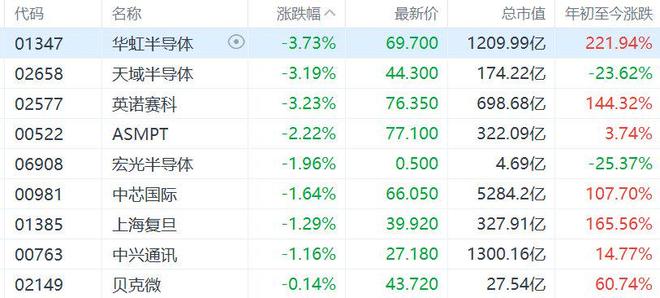
港股半导体概念股走弱,中芯国际、华虹半导体领跌恒生科技一众成分股
Mei Ri Jing Ji Xin Wen· 2025-11-10 03:23
Group 1 - The Hang Seng Technology Index experienced fluctuations, with semiconductor stocks weakening and tech stocks showing mixed performance [1] - The largest A-share ETF in the same sector, the Hang Seng Technology Index ETF (513180), followed the index's movements, with leading stocks including Tongcheng Travel, BYD, Kingsoft, Tencent, and Kingdee, while SMIC, Hua Hong Semiconductor, Xpeng Motors, and Horizon Robotics lagged [1] - According to Zhongtai Securities, the current investment focus in A-shares may shift towards strategic upstream industries and the expansion of technology applications under the "anti-involution" theme, with short-term attention on consumption-boosting policies leading to structural rebounds [1] Group 2 - As of November 7, the latest valuation (PETTM) of the Hang Seng Technology Index ETF (513180) was 22.69 times, which is in the historical low valuation range, being below 72% of the time since the index was launched [2] - The Hong Kong tech sector is expected to benefit from the current trends represented by AI, with potential foreign capital inflow exceeding expectations due to the backdrop of Federal Reserve interest rate cuts, alongside continuous increases in southbound capital [2] - Investors without a Hong Kong Stock Connect account may consider the Hang Seng Technology Index ETF (513180) for exposure to core Chinese AI assets [2]
消费电子概念股走低,相关ETF跌超2%
Sou Hu Cai Jing· 2025-11-10 02:25
Core Viewpoint - The consumer electronics sector is experiencing a decline, with significant drops in key stocks and ETFs tracking the sector, despite a long-term growth outlook driven by AI innovations [1][2]. Group 1: Stock Performance - Major consumer electronics stocks such as Cambrian-U, Industrial Fulian, and Luxshare Precision have fallen over 5%, while SMIC and Huagong Technology have decreased by more than 2% [1]. - ETFs tracking the CSI Consumer Electronics Theme Index have also seen declines, with the Consumer Electronics ETF down by over 2% [1]. Group 2: ETF Details - The following ETFs have reported declines: - Consumer Electronics ETF (561310): 1.178, down 2.56% - Consumer Electronics ETF Fortune (561100): 1.304, down 2.40% - Consumer Electronics ETF (561600): 1.216, down 2.33% - Consumer Electronics 50 ETF (159779): 1.154, down 2.20% - Consumer Electronics ETF E Fund (562950): 1.245, down 2.12% [2]. Group 3: Market Outlook - Analysts suggest that the long-term growth logic of the consumer electronics sector remains solid, with clear trends in AI innovation. Leading companies in the domestic supply chain, characterized by strong R&D capabilities and a solid fundamental base, are expected to benefit significantly from the AI terminal innovation wave [2].
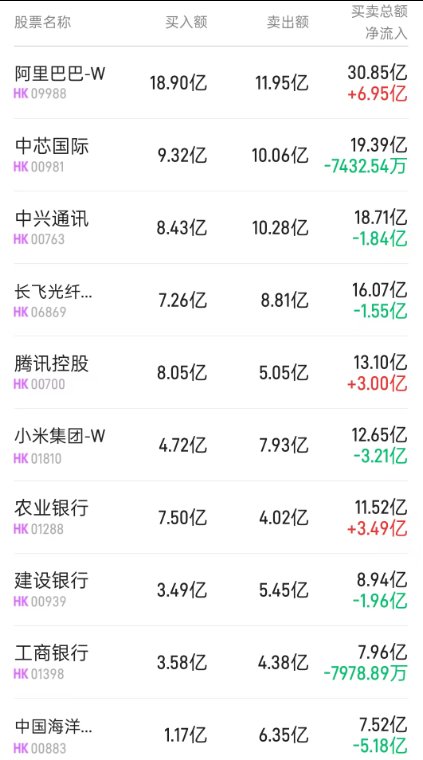
智通港股通持股解析|11月10日
智通财经网· 2025-11-10 00:31
Core Insights - The top three companies by Hong Kong Stock Connect holding ratios are China Telecom (71.56%), Gree Power (69.48%), and COSCO Shipping Energy (68.98%) [1] - The companies with the largest increase in holdings over the last five trading days include CNOOC (+27.13 billion), Xiaomi Group (+25.79 billion), and Southern Hengtai Technology (+22.70 billion) [1] - The companies with the largest decrease in holdings over the last five trading days include SMIC (-22.26 billion), Hua Hong Semiconductor (-10.25 billion), and Alibaba Group (-9.05 billion) [2] Hong Kong Stock Connect Holding Ratios - China Telecom (00728): 99.31 billion shares, 71.56% holding ratio [1] - Gree Power (01330): 2.81 billion shares, 69.48% holding ratio [1] - COSCO Shipping Energy (01138): 8.94 billion shares, 68.98% holding ratio [1] - Other notable companies include China Shenhua (67.68%) and Southern Hengtai Technology (61.58%) [1] Recent Increases in Holdings - CNOOC (00883): +27.13 billion, +12.81 million shares [1] - Xiaomi Group (01810): +25.79 billion, +6.11 million shares [1] - Southern Hengtai Technology (03033): +22.70 billion, +39.66 million shares [1] - Other companies with significant increases include China Mobile (+12.47 billion) and Industrial and Commercial Bank (+11.24 billion) [1] Recent Decreases in Holdings - SMIC (00981): -22.26 billion, -2.95 million shares [2] - Hua Hong Semiconductor (01347): -10.25 billion, -1.29 million shares [2] - Alibaba Group (09988): -9.05 billion, -0.57 million shares [2] - Other companies with notable decreases include Sunny Optical (-5.81 billion) and Jiangxi Copper (-5.34 billion) [2]
智通港股沽空统计|11月10日
智通财经网· 2025-11-10 00:24
Core Insights - The article highlights the top short-selling stocks in the market, with Anta Sports, JD Group, and Tencent Holdings leading in short-selling ratios at 100.00%, 100.00%, and 95.83% respectively [1][2] - Alibaba, Xiaomi, and Pop Mart have the highest short-selling amounts, with figures of 1.746 billion, 1.525 billion, and 1.523 billion respectively [1][2] - The deviation values, which indicate the difference between current short-selling ratios and the average over the past 30 days, show Alibaba, Tencent, and JD Group at 50.20%, 42.97%, and 42.21% respectively [1][2] Short-Selling Ratio Rankings - Anta Sports-R (82020) and JD Group-SWR (89618) both have a short-selling ratio of 100.00%, while Tencent Holdings-R (80700) follows closely at 95.83% [2] - The short-selling amounts for the top three stocks are: Anta Sports-R at 59,000, JD Group-SWR at 636,800, and Tencent Holdings-R at 1,332,200 [2] Short-Selling Amount Rankings - Alibaba-SW (09988) leads with a short-selling amount of 1.746 billion, followed by Xiaomi Group-W (01810) at 1.525 billion and Pop Mart (09992) at 1.523 billion [2] - Other notable mentions include Tencent Holdings (00700) with 1.369 billion and Kuaishou-W (01024) with 710 million [2] Deviation Value Rankings - Alibaba-SWR (89988) has the highest deviation value at 50.20%, indicating a significant difference from its historical average short-selling ratio [2] - Tencent Holdings-R (80700) and JD Group-SWR (89618) also show high deviation values of 42.97% and 42.21% respectively [2]
智通港股通资金流向统计(T+2)|11月10日
智通财经网· 2025-11-09 23:32
Core Insights - Southbound funds saw significant inflows into Southern Hang Seng Technology, Alibaba-W, and Xiaomi Group-W, with net inflows of 1.286 billion, 0.885 billion, and 0.650 billion respectively [1][2] - Conversely, Huahong Semiconductor, SMIC, and Bilibili-W experienced the largest net outflows, with amounts of -0.642 billion, -0.505 billion, and -0.188 billion respectively [1][2] Net Inflow Summary - The top three stocks by net inflow were: - Southern Hang Seng Technology (03033) with a net inflow of 1.286 billion and a closing price of 5.670 (-0.61%) [2] - Alibaba-W (09988) with a net inflow of 0.885 billion and a closing price of 158.500 (-0.31%) [2] - Xiaomi Group-W (01810) with a net inflow of 0.650 billion and a closing price of 43.320 (-0.23%) [2] Net Outflow Summary - The top three stocks by net outflow were: - Huahong Semiconductor (01347) with a net outflow of -0.642 billion and a closing price of 73.450 (-3.10%) [2] - SMIC (00981) with a net outflow of -0.505 billion and a closing price of 71.700 (-0.21%) [2] - Bilibili-W (09626) with a net outflow of -0.188 billion and a closing price of 220.200 (-4.09%) [2] Net Inflow Ratio Summary - The top three stocks by net inflow ratio were: - Qingdao Bank (03866) with a net inflow ratio of 83.58% and a closing price of 4.240 (-1.17%) [1][2] - China Communication Construction (03969) with a net inflow ratio of 56.27% and a closing price of 3.490 (+1.16%) [2] - Datang New Energy (01798) with a net inflow ratio of 55.14% and a closing price of 2.470 (+0.82%) [2] Net Outflow Ratio Summary - The top three stocks by net outflow ratio were: - Yimaitong (02192) with a net outflow ratio of -51.15% and a closing price of 10.210 (+0.39%) [3] - China Oriental Education (00667) with a net outflow ratio of -48.49% and a closing price of 6.310 (-2.77%) [3] - Gushengtang (02273) with a net outflow ratio of -46.32% and a closing price of 28.180 (-1.33%) [3]
美国脖子没那么好卡,稀土还是中国的王牌,这张牌最好用
Sou Hu Cai Jing· 2025-11-09 21:22
Core Viewpoint - China's export control on rare earths has become a significant tool in the ongoing US-China rivalry, marking a shift from passive to active defense strategies [1] Group 1: Export Control and Economic Warfare - The recent export control measures on rare earths are seen as a direct response to aggressive US policies, including the "50% ownership penetration" rule and exorbitant fees for Chinese ships entering US ports [1] - The "long-arm jurisdiction" policy not only restricts the export of raw materials but also applies to processed rare earth products that utilize Chinese technology, effectively controlling global supply chains [1] Group 2: Dependency on Chinese Supply Chains - The US estimates that it will take at least seven to eight years to completely eliminate dependence on Chinese rare earths, requiring hundreds of billions in federal investment annually [4] - Key industries such as lithium batteries, semiconductors, and pharmaceuticals are heavily reliant on Chinese materials, with over 70% of basic pharmaceutical raw materials sourced from China [7][8] Group 3: Challenges in Alternative Supply Chains - The US attempts to build alternative supply chains for rare earths face significant challenges, particularly in refining capabilities, where China holds a monopoly on advanced processing techniques [1][4] - The semiconductor industry is also at risk, with China capturing 31% of the market share in mature processes, and US manufacturers relying on Chinese firms for critical components [5] Group 4: Broader Implications of the US-China Rivalry - The geopolitical landscape is shifting, with the potential for resource management strategies extending beyond rare earths to include nickel, cobalt, and lithium [10] - The competition is not just about technology but also about systemic resilience, with China demonstrating a strong ability to adapt and innovate under pressure [15]
下周重磅日程:腾讯京东中芯国际财报,中国10月经济数据
Hua Er Jie Jian Wen· 2025-11-09 13:39
Group 1: Economic Indicators - China's industrial output for October is expected to show a year-on-year increase of 6.5%, while retail sales are projected to grow by 3% [4][6] - Real estate development investment in China is anticipated to decline by 13.9% for the first ten months of the year [4][6] - The overall economic activity in China is showing signs of stabilization due to government policies aimed at growth [6][7] Group 2: U.S. Economic Data - The U.S. Consumer Price Index (CPI) for October is expected to show a year-on-year increase of 3.1%, compared to a previous expectation of 3% [4][8] - The U.S. Producer Price Index (PPI) data is also anticipated to be released, with market expectations indicating a potential for a 0.2% month-on-month increase [8][9] Group 3: Corporate Earnings Reports - Major companies such as Tencent, JD.com, and Bilibili are set to release their earnings reports next week, with Tencent expected to see a revenue increase of approximately 14% year-on-year [4][14] - CoreWeave, Circle, and Cisco are among other companies expected to report earnings, with CoreWeave anticipated to continue its explosive growth [14] Group 4: Key Events - The G7 Foreign Ministers' meeting is scheduled for November 11-12 in Canada [12] - The eighth China International Import Expo concluded on November 10, showcasing international trade opportunities [13] - AMD's annual Analyst Day is set for November 11, where significant announcements regarding future growth and technology are expected [10]
加仓港股,基金经理,真金白银“投票”
Zheng Quan Shi Bao· 2025-11-09 00:07
Core Viewpoint - The market has shown alternating activity between A-shares and Hong Kong stocks this year, with notable performance in the Hong Kong new consumption, technology, and innovative pharmaceutical sectors in the first half, while A-shares' ChiNext and STAR Market technology sectors gained strength in the second half, leading to a phase of volatility in Hong Kong stocks [1] Group 1: Fund Manager Activity - Several prominent fund managers have increased their positions in Hong Kong stocks, with notable increases in allocations to AI applications and innovative pharmaceuticals, particularly in companies like Alibaba and SMIC [1][2] - The Silver Harvest Fortune Select Fund, managed by Jiao Wei, raised its Hong Kong stock allocation from 11.38% to 39.66%, an increase of approximately 28 percentage points, with Alibaba and Tencent as top holdings [2] - The CITIC Prudential New Blue Chip Fund, managed by Wu Hao and Jinshan, increased its Hong Kong stock allocation from 4.87% to 26.66%, a rise of about 22 percentage points, with seven of its top ten holdings being Hong Kong stocks [2] Group 2: Sector Performance - The technology sector remains the most heavily weighted in Hong Kong stock funds at 37%, followed by the consumer sector at 25.16% and the pharmaceutical sector at 15.52% [4] - The pharmaceutical sector saw the largest increase in holdings, up 3.09 percentage points, while the technology sector experienced a decrease of 1.95 percentage points due to limited opportunities in Hong Kong tech stocks related to computing power [4] - The top ten stocks held by Hong Kong stock funds include Alibaba, Tencent, Xiaomi, Meituan, Kuaishou, SMIC, NetEase, BYD, JD.com, and Innovent Biologics, with Alibaba moving to the top position [4] Group 3: Market Trends and Valuation - The recent pullback in the Hong Kong market is attributed to short-term investor sentiment changes rather than significant capital outflows, with a structural rotation in industry cycles between A-shares and Hong Kong stocks [6] - There is a growing trend of "Hong Kong stock premium," where certain companies are trading at a premium in Hong Kong compared to A-shares, reversing the previous norm of A-shares being more expensive [7] - International investors are increasingly focusing on quality investments in high-end manufacturing, new energy, innovative pharmaceuticals, and robotics, indicating a shift in investment strategy towards companies that are competitive on a global scale [6][7]