CNCB(00998)

Search documents
薪火相传卅七载 金融报国“圳”当时——中信银行深圳分行奋力书写“五篇大文章”精彩答卷
Zhong Guo Ji Jin Bao· 2025-10-13 07:11
Core Viewpoint - CITIC Bank Shenzhen Branch has been committed to serving the economic and social development of Shenzhen for 37 years, focusing on various financial services including technology finance, green finance, inclusive finance, pension finance, and digital finance to meet national and public needs [1]. Technology Finance - The bank supports semiconductor companies in Shenzhen, providing credit loans during the R&D phase and flexible financing options post-IPO to enhance production capacity and market expansion [2]. - CITIC Bank aims to create a technology finance ecosystem by collaborating with government, private equity, and research institutions to support startups and their diverse financing needs [3]. - The bank offers comprehensive financial services throughout the lifecycle of technology companies, having supported over 200 specialized enterprises in becoming national "little giants" and assisting 18 companies in listing on the A-share market [4]. Green Finance - The bank actively promotes green finance to support the dual carbon strategy, enhancing its green financial service capabilities and risk management [5][7]. - A specific case involved providing a 60 million yuan green loan to a new materials company to alleviate short-term liquidity issues caused by increased procurement costs for environmentally friendly materials [6]. - As of September 2025, the bank's green loan balance reached 26.9 billion yuan, a 54% increase from the beginning of the year, reflecting strong growth in green financing [7]. Inclusive Finance - CITIC Bank has enhanced its inclusive finance services, with over 12 billion yuan in loans to small and micro enterprises, marking a 50% year-on-year increase [8]. - The bank has implemented a coordinated financing mechanism to streamline loan processes for small businesses, ensuring rapid response and efficient service delivery [9]. - The bank's supply chain financing products have significantly contributed to the growth of inclusive loans, with a balance exceeding 4 billion yuan as of September 2025 [10]. Pension Finance - The bank is developing a comprehensive pension finance service system to address the needs of the aging population in Shenzhen, having created pension planning solutions for nearly 20,000 citizens [11][12]. - It collaborates with various institutions to explore integrated pension service models, aiming to meet the high-quality pension needs of the elderly population in both Shenzhen and Hong Kong [13]. Digital Finance - CITIC Bank is advancing its digital transformation strategy, utilizing technologies like AI and blockchain to enhance service efficiency [14]. - The launch of the "Cross-Border Flash Loan" product has provided quick financing solutions for foreign trade enterprises, with over 130 million yuan disbursed since its introduction [15]. - The "Xiaotianyuan" platform offers a one-stop service for SMEs, integrating digital and financial services to support their digital transformation [16].

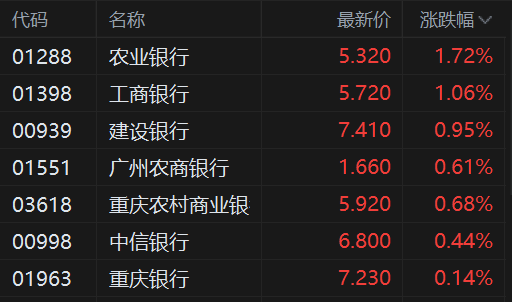
港股异动丨内银股部分拉升 农行、建行、工行均上涨
Ge Long Hui· 2025-10-13 03:04
从基本面展望,银行业绩波动较小,利润基本保持平稳正增长,25H1上市银行利润增速达0.8%,全年 来看,业绩有望保持稳中向好的趋势。从边际变化的角度来看,银行息差的同比降幅有望持续收窄,利 好业绩表现。(格隆汇) | 代码 | 名称 | 最新价 | 涨跌幅 √ | | --- | --- | --- | --- | | 01288 | 农业银行 | 5.320 | 1.72% | | 01398 | 工商银行 | 5.720 | 1.06% | | 00939 | 建设银行 | 7.410 | 0.95% | | 01551 | 广州农商银行 | 1.660 | 0.61% | | 03618 | 重庆农村商业银 | 5.920 | 0.68% | | 00998 | 中信银行 | 6.800 | 0.44% | | 01963 | 重庆银行 | 7.230 | 0.14% | 港股内银股部分逆势上涨,其中,农业银行涨近2%,工商银行、建设银行涨1%,中信银行、重庆银 行、广州农商银行跟涨。 消息上,国泰海通研报指出, 受资金风格切换影响,自7月10日以来,银行指数累计跌幅达到14%,明 显跑输沪深300(累 ...



薪火相传卅七载 金融报国“圳”当时
Nan Fang Du Shi Bao· 2025-10-12 23:14
Core Viewpoint - CITIC Bank Shenzhen Branch has been committed to serving the economic and social development of Shenzhen for 37 years, focusing on five key areas: technology finance, green finance, inclusive finance, pension finance, and digital finance [1] Group 1: Technology Finance - CITIC Bank Shenzhen Branch has increased support for technology innovation and specialized enterprises, helping over 200 local specialized enterprises become national "little giants" [2] - The bank has provided financial services throughout the lifecycle of technology companies, with nearly 1,300 technology enterprise loan accounts and a loan balance of approximately 28.6 billion yuan as of September 2025 [2] Group 2: Green Finance - The bank has strengthened its green finance system, contributing to Shenzhen's green low-carbon transformation, with a green loan balance of 26.9 billion yuan, an increase of 9.5 billion yuan (54%) from the beginning of the year [3] - CITIC Bank has actively participated in green bond issuance, underwriting 1.122 billion yuan in green credit bonds and investing 410 million yuan in green credit bonds in 2025 [3] Group 3: Inclusive Finance - The bank has enhanced its financing coordination for small and micro enterprises, with inclusive loan balances exceeding 12 billion yuan in 2025, a year-on-year increase of over 50% [4] - CITIC Bank has developed a product matrix for scenario-based credit loans, focusing on various industry clusters and supply chains [4] Group 4: Pension Finance - The bank has established a comprehensive "Happiness+" pension finance service system, providing pension planning for nearly 20,000 citizens [5] - It has also supported medical and rehabilitation institutions and conducted renovations for accessibility in all branches [5] Group 5: Digital Finance - CITIC Bank has integrated new technologies like AI, big data, and blockchain into its services, launching the "Xiao Tian Yuan" platform to enhance digital capabilities for small and medium enterprises [6] - The bank aims to create a positive cycle of "technology empowerment - efficiency improvement - value creation" through its digital finance strategy [6]
银行股的保险资金配置:有望持续提升
ZHONGTAI SECURITIES· 2025-10-12 12:46
Investment Rating - The report maintains an "Overweight" rating for the banking sector [1]. Core Insights - The scale of insurance capital investment is steadily increasing, with a significant rise in stock investment proportion, which has outpaced bond growth [3][4]. - Bank stocks have consistently held the largest share in insurance capital's heavy stock holdings, with a notable recovery in their proportion post-2023, reaching 41.9% of total stock purchases in 2025 [3][4]. - Current policies are promoting long-term capital market entry, with adjustments in insurance company assessment mechanisms to enhance equity investment ratios, a strategy validated by experiences in the US and Japan [3][4]. Summary by Sections Insurance Capital Investment: Steady Growth and Increased Stock Proportion - As of 1H25, the total insurance capital investment balance in China reached 36.2 trillion yuan, marking a year-on-year growth of 17.4%, with life insurance companies accounting for 90% of this balance [6][8]. - Stock investment growth has outpaced bond investment, with stock investment proportion rising to 8.8% in 1H25, reflecting a significant increase compared to previous years [10][12]. - The decline in long-term interest rates has been a crucial factor driving insurance companies to increase stock investments, as they seek to mitigate risks associated with interest rate spreads [24][26]. Increased Proportion of Bank Stocks in Insurance Capital Holdings - Bank stocks have maintained the highest proportion in the heavy stock holdings of insurance capital, accounting for 47.2% in 1H25, significantly higher than other sectors [29][30]. - The number of stock purchases (or "takeovers") in the banking sector surged in 2025, with bank stocks representing 41.9% of total purchases, a marked increase from previous years [29][30]. Policy Support for Increased Equity Investment by Insurance Capital - Recent policies have been implemented to facilitate the entry of long-term capital into the market, with a focus on enhancing the willingness of insurance companies to invest in equities [31][32]. - The experiences of the US and Japan demonstrate that increasing equity investment during periods of declining long-term interest rates is a viable strategy for maintaining the health of insurance companies [33][37]. Projected New Insurance Investment Funds - It is anticipated that new insurance investment funds will exceed 4 trillion yuan in both 2025 and 2026, with stock investment proportions expected to rise to 9.3% and 10.9%, respectively [41][42]. Investment Recommendations - In the current policy and macroeconomic environment, it is recommended to focus on bank stocks, particularly those with regional advantages and high dividend yields, as insurance capital is likely to increase its holdings in this sector [48].





多家银行上调基金风险评级
21世纪经济报道· 2025-10-11 06:28
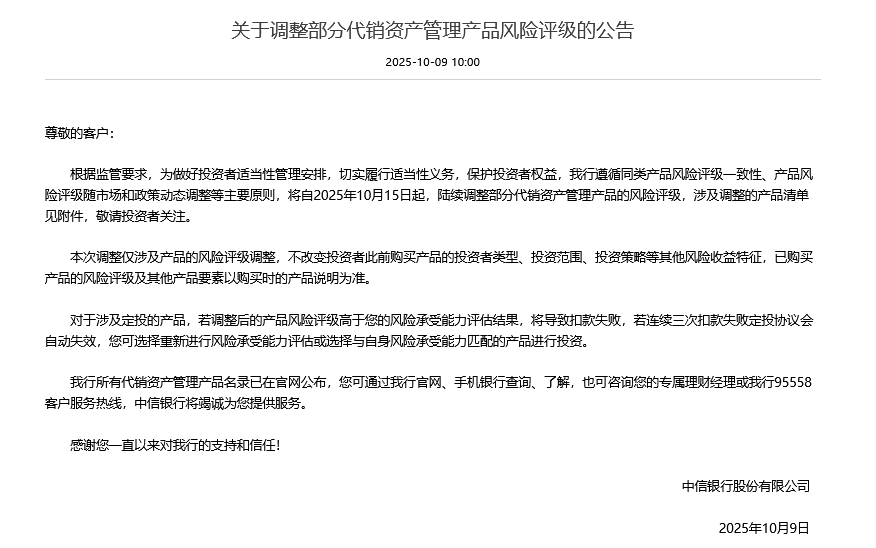
Core Viewpoint - The article discusses the recent adjustments made by several banks, including Citic Bank, to the risk ratings of their sold asset management products, reflecting the increased volatility in the stock market and the need for better investor suitability management [1][4]. Group 1: Risk Rating Adjustments - Citic Bank announced it will adjust the risk ratings of 17 asset management products starting from October 15, 2025, with 15 products seeing an increase in risk rating and 2 products, specifically a mixed FOF fund managed by E Fund, being downgraded from PR3 to PR2 [1][3]. - Other banks, including Agricultural Bank of China, China Construction Bank, and Minsheng Bank, have also adjusted their fund risk ratings this year, primarily increasing them due to the significant rise in stock market indices [1][4]. Group 2: Regulatory Compliance and Investor Protection - The adjustments are in line with regulatory requirements aimed at enhancing investor suitability management and protecting investor rights, as stated by Citic Bank [2][5]. - The adjustments do not change the investment characteristics of the products purchased prior to the rating changes, ensuring that existing investors are not adversely affected [3][5]. Group 3: Market Context and Implications - The article highlights that the banking sector is facing increased regulatory scrutiny regarding the sale of asset management products, with a focus on ensuring that the risk levels of these products align with the risk tolerance of investors [5][6]. - The Financial Regulatory Authority has emphasized the importance of the suitability principle, which mandates that banks must ensure that high-risk products are not recommended to investors who cannot bear such risks [5][6].

重庆金融监管局核准廖淮中信银行重庆分行行长助理任职资格
Jin Tou Wang· 2025-10-11 03:49
二、中信银行应要求上述核准任职资格人员严格遵守金融监管总局有关监管规定,自中信银行政许可决 定作出之日起3个月内到任,并按要求及时报告到任情况。未在上述规定期限内到任的,本批复文件失 效,由决定机关办理行政许可注销手续。 三、中信银行应督促上述核准任职资格人员持续学习和掌握经济金融相关法律法规,牢固树立风险合规 意识,熟悉任职岗位职责,忠实勤勉履职。 2025年10月9日,重庆金融监管局发布批复称,《中信银行关于廖淮任职资格核准的请示》(信银字 〔2025〕632号)收悉。经审核,现批复如下: 一、核准廖淮中信银行重庆分行行长助理的任职资格。 ...
多家银行上调基金风险评级
2 1 Shi Ji Jing Ji Bao Dao· 2025-10-11 03:25
Core Viewpoint - Several banks in China are adjusting the risk ratings of their sold asset management products in response to increased stock market volatility, with most ratings being raised to better reflect the actual risk levels of these funds [1][3]. Group 1: Bank Adjustments - CITIC Bank announced it will adjust the risk ratings of 17 asset management products starting from October 15, 2025, marking its fourth adjustment this year [1][2]. - Among the adjustments, 15 products will see their risk ratings increased, while 2 products will have their ratings decreased, specifically a mixed FOF fund managed by E Fund [1][2]. - Other banks, including Agricultural Bank of China, China Construction Bank, and Minsheng Bank, have also made similar upward adjustments to their fund ratings throughout the year [3][4]. Group 2: Regulatory Compliance - The adjustments are primarily driven by regulatory requirements aimed at ensuring appropriate investor management and protecting investor rights [2][4]. - The Financial Regulatory Authority has emphasized the need for banks to independently and prudently assess the risk ratings of the asset management products they sell [3][4]. - The adjustments are part of a broader effort to align product risk levels with investors' risk tolerance, thereby preventing mismatches in product recommendations [4]. Group 3: Market Context - The adjustments come amid a significant rise in stock market indices and increased volatility, prompting banks to optimize their risk ratings [1][3]. - The regulatory framework established in March 2023 mandates banks to enhance their responsibilities in managing the sale of asset management products, ensuring that investors receive accurate and complete risk information [4].
中信银行再度出手,罕见调降两款代销基金风险评级,有北交所主题基金被调至“高风险”
Xin Lang Cai Jing· 2025-10-10 06:33
Core Viewpoint - CITIC Bank announced on October 9 that it will adjust the risk ratings of 17 asset management products starting from October 15, 2025, marking the fourth adjustment of the year [1][3]. Group 1: Risk Rating Adjustments - This adjustment includes a rare downgrade of two FOF products managed by E Fund, changing their risk rating from PR3 to PR2, while the majority of other funds saw an increase in their risk ratings [4][8]. - Other banks, including Agricultural Bank of China, China Construction Bank, and Minsheng Bank, have also adjusted their fund product risk ratings this year, with most adjustments being upward [3][8]. Group 2: Industry Context - The adjustments are part of a broader trend where banks are optimizing the risk ratings of their public fund products to better reflect their risk profiles and comply with suitability principles [3][9]. - A researcher from a state-owned bank indicated that these adjustments help in meeting the regulatory requirements for investor suitability and protecting investor interests [3][9]. Group 3: Specific Product Changes - Among the products adjusted, two funds from Huatai-PineBridge were upgraded from PR4 to PR5, indicating a higher risk level, while a pension-themed product from ICBC was upgraded from PR3 to PR4 [5][7]. - The adjustments reflect the ongoing evaluation of fund products based on market conditions, with a focus on ensuring that investors are aware of the risks associated with their investments [9].
中信银行长沙分行联合中国信保湖南分公司精准破解企业融资难题
Chang Sha Wan Bao· 2025-10-09 10:24
Core Viewpoint - The successful implementation of online export credit insurance policy financing by CITIC Bank's Changsha branch demonstrates the effectiveness of cross-border financial service platforms in enhancing financing efficiency for small and micro foreign trade enterprises [1][2] Group 1: Business Overview - CITIC Bank's Changsha branch facilitated an online export credit insurance policy financing for a small micro foreign trade enterprise in Yongzhou, addressing the company's short-term funding pressure [1] - The enterprise, a clothing company, faced challenges due to increased export orders and cash flow cycles, prompting CITIC Bank to respond quickly to its financing needs [1] Group 2: Technological Integration - The financing process utilized the cross-border financial service platform's data verification capabilities, allowing for rapid approval and disbursement of funds within 10 minutes without collateral [1][2] - The platform enhances information sharing and verification among government, banks, enterprises, and insurance institutions, effectively addressing information asymmetry in financing [2] Group 3: Future Directions - CITIC Bank plans to deepen cooperation with China Export & Credit Insurance Corporation and continue to support small micro enterprises through innovative financial products like "Export Convenience Loan" [2] - The bank aims to leverage technology to optimize service processes and provide professional, quick, and flexible financial support to more small micro foreign trade enterprises, contributing to high-quality regional foreign trade development [2]
银行零售信贷“缩表”,调整期持续?
券商中国· 2025-10-08 08:10
Core Viewpoint - Recent adjustments by some joint-stock banks to reduce credit card overdraft rates to "0" aim to increase volume by lowering costs [1] Group 1: Credit Card Loan Trends - Credit card loan balances are a key indicator of retail banking customer activity, with recent adjustments reflecting banks' efforts to compete for existing customers during a retail "cold season" [2] - Many listed banks have seen a further expansion of negative growth in credit card loan balances this year, alongside a decline in other retail loan categories such as consumer loans and mortgages [2][4] - Major state-owned banks like Bank of China and Postal Savings Bank reported declines in credit card loan balances of 13.88% and 5.67% respectively, while some joint-stock banks also experienced negative growth [3] Group 2: Overall Retail Lending Environment - The retail lending sector is undergoing an "adjustment period," with 17 out of 42 listed banks reporting a contraction in personal loan balances as of mid-2023 [4] - The contraction in personal housing mortgage loans has been a significant factor, with a reported negative growth of 1.6% in personal housing loan balances at the end of 2023, marking the first decline since 1997 [5][6] Group 3: Retail Loan Risk Assessment - Retail loan risks are on the rise, with the non-performing loan (NPL) ratio for retail loans increasing to 1.23% as of mid-2023, compared to a decrease in corporate loan NPL ratios [9] - Specific segments such as mortgage loans, consumer loans, and credit cards have seen their NPL ratios rise, indicating a challenging environment for retail lending [9][10] - The overall retail loan risk trend remains upward, with banks acknowledging the need for improved risk management practices in response to these challenges [10]