AGRICULTURAL BANK OF CHINA(01288)

Search documents
金融服务守护春节烟火气
Jing Ji Ri Bao· 2026-02-24 22:07
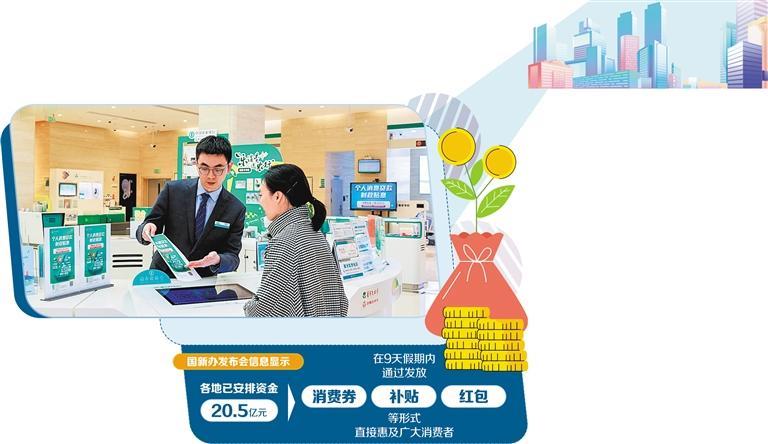
Group 1 - The article highlights the importance of financial services during the Spring Festival, emphasizing their role in enhancing consumer experience and ensuring a smooth cash flow [2][3][4] - Financial institutions, including Agricultural Bank of China and China Construction Bank, are actively implementing measures to meet the demand for new banknotes and provide tailored services for special groups, such as the elderly [3][4] - The "2026 'Happy Shopping Spring Festival' Special Activity Plan" encourages financial institutions to collaborate with key merchants to offer exclusive promotions, such as consumption red envelopes and discounts [4][5] Group 2 - The consumer market is experiencing a surge in activity during the Spring Festival, with banks like Citic Bank launching promotional activities to cater to increased demand for large purchases, such as home appliances and electronics [5][6] - Financial support is crucial for businesses during this peak season, with banks providing credit facilities to ensure adequate supply of essential goods, such as rice and cooking oil [7][8] - The article discusses how financial institutions are facilitating the upgrading of production processes for companies in the agricultural sector, ensuring they can meet high demand during the festival [8] Group 3 - The article addresses the rise in fraud cases during the Spring Festival, urging financial institutions to protect consumers while providing convenient services [9][10] - Banks are conducting educational campaigns to raise awareness about common scams and promote financial literacy among consumers, particularly targeting vulnerable groups [10][11] - The integration of traditional culture with financial education is highlighted as a strategy to enhance consumer awareness and safeguard their financial interests during the festive season [11]

银行经营周期如何定价各类资产?
GF SECURITIES· 2026-02-24 12:04
Investment Rating - The report assigns a "Buy" rating for the banking sector, indicating an expectation of stock performance exceeding the market by more than 10% over the next 12 months [58]. Core Insights - In 2025, the banking sector's asset growth is projected to be 8.01%, an increase from 6.52% in 2024, driven by factors such as fiscal stimulus, cross-border capital inflows, and the activation of maturing deposits [5][13]. - The report identifies two key cycles affecting asset pricing in banking: the bank expansion cycle and the interest margin cycle, suggesting a comprehensive analysis of these cycles [5][13]. - The debt cycle is characterized as a fundamental aspect of the bank expansion cycle, with a model proposed by Dalio outlining seven stages of a typical debt cycle, which can be influenced by external debt reliance [16][19]. - The report anticipates limited upward space for the debt cycle in 2026, with government leverage expected to increase by 5.89%, lower than the 7.6% projected for 2025 [35][36]. - The banking interest margin cycle is expected to stabilize in 2025, following two complete cycles since 2010, with a correlation observed between bank interest margins and the 30Y-10Y government bond spread [41][45]. Summary by Sections Bank Expansion Cycle - The asset growth rates for different types of banks in 2025 are projected as follows: state-owned banks at 11%, joint-stock banks at 4.74%, city commercial banks at 9.68%, and rural commercial banks at 5.17%, all exceeding the average growth rate [5][13]. - The report emphasizes the importance of understanding the relationship between bank assets and liabilities, highlighting that credit and debt expansion are cyclical and self-reinforcing [15][16]. Debt Cycle Analysis - The report outlines that the current debt cycle, which began in 2022, has lasted 16 quarters, surpassing previous cycles, and indicates a shift in leverage dynamics among enterprises, government, and households [35][36]. - The analysis includes a comparison of deflationary and inflationary debt cycles, noting that the U.S. faces greater inflationary pressures due to higher external debt reliance compared to China [21][19]. Interest Margin Cycle - The report notes that the banking interest margin has experienced significant fluctuations since 2010, with a stabilization phase expected to begin in 2025 [41][45]. - It highlights the impact of loan repricing cycles on interest margins, with a notable decline in loan rates observed in recent years [49][50].




多家银行春节瞄准青少年客群,“高息”存款产品密集上线
Xin Lang Cai Jing· 2026-02-24 11:11
Core Insights - The financial marketing activities targeting children and teenagers have significantly increased during the Spring Festival, with both state-owned and joint-stock banks actively launching related products [1][6] - Banks are offering higher interest rates on savings products to attract "lucky money" and "red envelope" funds, aiming to cultivate brand loyalty from an early age and capture family retail business [1][6] - The awareness of financial rights among young people is rising, leading to a demand for dedicated management of "lucky money," presenting banks with new opportunities to serve family asset management [1][7] Group 1: Product Offerings - Beijing Bank offers a three-year fixed deposit with an interest rate of 1.75%, while Yinzhou Bank's "Children's Deposit" product offers up to 1.88% for new customers [1][6] - Agricultural Bank of China has launched a secondary account activity allowing daily investment limits of up to 10,000 yuan, while Industrial and Commercial Bank of China has introduced a "Baby Card" for children's savings [7][8] - China Merchants Bank has created a "Golden Little Aui" section in its app, offering 51 financial products including savings, investments, and insurance specifically for managing "lucky money" [8] Group 2: Competitive Landscape - Banks face strong competition from internet platforms in attracting young customers, as many prefer using WeChat or Alipay for managing "lucky money" due to the convenience of these platforms [9][10] - The number of underage internet users in China has reached 196 million, prompting financial institutions to develop customized tools like "youth accounts" and "family cards" [9][10] - Banks are shifting their strategies from focusing solely on individual accounts to extending services to family financial asset management, including education and growth needs through various financial products [10]


节后流动性无虞,关注二季度通胀格局
GF SECURITIES· 2026-02-24 06:04
Core Insights - The report indicates that liquidity is expected to remain stable post-holiday, with a focus on the inflation landscape in the second quarter of 2026 [1]. Group 1: Market Performance - During the observation period from February 9 to February 20, 2026, the banking sector (CITIC first-level industry) experienced an overall decline of 1.3%, ranking 23rd among all industries and underperforming the Wind All A index, which rose by 1.1% [15]. - The performance of state-owned banks, joint-stock banks, city commercial banks, and rural commercial banks showed declines of -1.67%, -1.53%, -0.52%, and -0.81% respectively [15]. - The Hang Seng Composite Index increased by 0.4%, while H-shares of banks fell by 0.2%, underperforming the Hang Seng Composite Index but outperforming A-share banks [15]. Group 2: Individual Stock Performance - Among A-share banks, Huaxia Bank and Nanjing Bank saw increases of 2.28% and 1.43% respectively, while Chongqing Bank and Xi'an Bank faced declines of 4.40% and 3.61% [15]. - In the H-share market, Minsheng Bank led with a 4.80% increase, followed by Zhejiang Commercial Bank at 1.96% and Qingdao Bank at 0.91%. Conversely, Postal Savings Bank, Agricultural Bank, and Chongqing Bank saw declines of 2.68%, 1.64%, and 1.62% respectively [15]. Group 3: Bond Market Performance - The average price of bank convertible bonds rose by 0.48%, underperforming the Zhongzheng convertible bond index by 0.60 percentage points [16]. - The top-performing convertible bonds included Shangyin Convertible Bond (+1.26%), Zhongyin Convertible Bond (+0.51%), and Xingye Convertible Bond (+0.25%), while the worst performers included Ziyin Convertible Bond, which fell by 0.02% [16]. Group 4: Profit Forecasts - There were changes in the performance growth expectations for three banks in 2025, specifically Huaxia Bank, Changshu Bank, and Jiangyin Bank. However, the net profit and revenue growth expectations for A-share banks in 2025 remained unchanged compared to the previous period [16]. Group 5: Investment Recommendations - The report suggests that while banks are unlikely to yield relative returns, their valuations may receive liquidity support, leading to potential absolute returns. The overall banking sector is expected to trend upwards from the post-holiday period until the Two Sessions [17]. - The core issue for the second quarter is whether inflation will accelerate and if long-term interest rates will continue to rise. If inflation accelerates, high-dividend and bond-like asset valuations may be pressured, necessitating a downward adjustment of target returns for the banking sector [17]. - The report maintains that the banking sector may experience further differentiation in 2026, with larger banks and wealth management banks expected to outperform. Recommended core stocks include Ningbo Bank, China Merchants Bank, Qingdao Bank, and large state-owned banks [17].
中国农业银行广东省分行:金融活水润南粤,服务大局显担当
Nan Fang Nong Cun Bao· 2026-02-24 05:01
Core Viewpoint - The Agricultural Bank of China Guangdong Branch is committed to supporting the high-quality development of the Guangdong economy by providing extensive financial services and products tailored to local needs, focusing on key areas such as manufacturing, rural revitalization, and the Guangdong-Hong Kong-Macao Greater Bay Area [2][3][4]. Financial Support and Growth - By the end of 2025, the loan balance of the Agricultural Bank of China Guangdong Branch is expected to reach 2.6 trillion yuan, with an annual increase of over 200 billion yuan, ranking first in both the industry and the system [6]. - The bank has provided nearly 360 billion yuan in loans to strategic emerging industries, supporting sectors like new-generation electronic information and advanced equipment [19][20]. - The bank's inclusive loans have exceeded 376 billion yuan, benefiting over 360,000 market entities and stabilizing employment [23]. Innovation and Technology - The bank has introduced ten measures to support the construction of a modern industrial system, including innovative financial products like "Technology Innovation Loan" and "Patent Loan" [9][14]. - The bank has established review centers for new productivity in cities like Guangzhou and Dongguan, offering comprehensive services that combine financing and intelligence [13]. Rural and Regional Development - The bank's county loan balance is nearly 620 billion yuan, with an average annual growth rate of 16%, contributing to rural revitalization efforts [27][28]. - The bank has launched a series of financial products and initiatives to support the "Hundred Counties, Thousand Towns, and Ten Thousand Villages" project, enhancing financial service precision [30]. Marine Economy and Cross-Border Finance - The bank has invested over 21 billion yuan in credit to support the development of marine ranching and related industries [44]. - The bank has collaborated with the Guangdong Provincial Department of Commerce to release ten measures to stabilize foreign trade and investment, enhancing cross-border financial service capabilities [47][55]. Community and Social Services - The bank has issued over 30.5 million social security cards, ensuring a robust social safety net, and has served over 3 million individual pension clients [59][60]. - The bank's services are designed to be accessible and warm, aiming to enhance the quality of life for residents in the Guangdong region [61].

中国人民银行、金融监管总局 发布我国系统重要性银行名单
Jin Rong Shi Bao· 2026-02-24 01:28
Core Viewpoint - The People's Bank of China and the National Financial Regulatory Administration have conducted the 2025 assessment of systemically important banks, identifying 21 domestic banks categorized into five groups based on their systemic importance scores [1] Group 1: Assessment of Systemically Important Banks - A total of 21 domestic systemically important banks have been recognized, including 6 state-owned commercial banks, 10 joint-stock commercial banks, and 5 city commercial banks [1] - The banks are divided into five groups based on their systemic importance scores, with the first group consisting of 11 banks, the second group having 4 banks, the third group with 2 banks, the fourth group containing 4 banks, and the fifth group having no banks [1] Group 2: Breakdown of Bank Groups - The first group includes: China Minsheng Bank, China Everbright Bank, Ping An Bank, Huaxia Bank, Ningbo Bank, Jiangsu Bank, Beijing Bank, Nanjing Bank, Guangfa Bank, Zheshang Bank, and Shanghai Bank [1] - The second group consists of: Industrial Bank, China CITIC Bank, Shanghai Pudong Development Bank, and China Postal Savings Bank [1] - The third group includes: Bank of Communications and China Merchants Bank [1] - The fourth group comprises: Industrial and Commercial Bank of China, Bank of China, China Construction Bank, and Agricultural Bank of China [1] - The fifth group currently has no banks included [1] Group 3: Future Regulatory Actions - The People's Bank of China and the National Financial Regulatory Administration will implement additional regulatory measures for systemically important banks according to the "Regulations on Additional Supervision of Systemically Important Banks (Trial)" [1] - The aim is to enhance the synergy between macro-prudential management and micro-prudential supervision, ensuring the safe and sound operation of systemically important banks [1] - This initiative is intended to better support the high-quality development of the real economy [1]




银行股分红大比拼!谁才是真现金奶牛?
Sou Hu Cai Jing· 2026-02-22 08:54
Core Viewpoint - The article highlights the significant cash dividends offered by major Chinese banks, positioning them as reliable investment options compared to traditional financial products in a volatile market [2][10]. Dividend Overview - In 2024, the total dividends from China's six major state-owned banks are expected to exceed 420 billion yuan, accounting for 78% of the entire banking sector's dividends [6]. - Industrial and Commercial Bank of China (ICBC) leads with a total dividend payout of 109.8 billion yuan, followed by China Construction Bank (CCB) with nearly 100 billion yuan [6]. - Agricultural Bank of China (ABC) and Bank of China (BOC) each exceed 60 billion yuan in annual dividends, showcasing strong performance [6]. Dividend Policy and Stability - The China Securities Regulatory Commission encourages cash dividends, with state-owned banks maintaining a dividend payout ratio of over 30% [9]. - Some joint-stock banks, like China Merchants Bank, have even higher payout ratios exceeding 35% [9]. - The introduction of mid-year dividends alongside annual dividends effectively doubles the cash flow for investors [9]. Yield Comparison - The average dividend yield for major state-owned banks ranges from 4.2% to 5.8% in A-shares, with Hong Kong shares reaching around 7% [9]. - Agricultural Bank of China boasts an average dividend yield of 6.41% over the past five years, significantly outperforming the current one-year fixed deposit rate of approximately 1.5% [9]. Investment Characteristics - Bank stocks are characterized by consistent dividends, making them suitable for conservative investors and long-term holdings [10]. - The article emphasizes that bank stocks are not about capital gains but rather about stable cash flow and dividends, providing a sense of security for investors [10]. - The low volatility of bank stocks makes them ideal for retirement planning and managing family savings [10].
中国农业银行申请事务处理方法专利,提升交易状态确认的准确性
Sou Hu Cai Jing· 2026-02-18 08:30
Core Viewpoint - China Agricultural Bank has applied for a patent related to a transaction processing method, device, storage medium, and electronic equipment, aimed at enhancing the accuracy of transaction status confirmation and efficiency of account reconciliation [1] Group 1: Patent Application Details - The patent, titled "A Transaction Processing Method, Device, Storage Medium, and Electronic Equipment," was published under CN121544411A and filed on November 2025 [1] - The invention focuses on distributed transaction processing technology, utilizing unique transaction elements to execute pre-business transactions and generate local transaction records [1] - After successful pre-transactions, the method retrieves auxiliary reconciliation information and executes auxiliary reconciliation transactions to produce results, ultimately synchronizing transaction statuses across systems [1] Group 2: Company Overview - China Agricultural Bank, established in 1986 and headquartered in Beijing, primarily engages in monetary financial services [1] - The company has a registered capital of approximately 34.998 billion RMB [1] - According to data analysis, the bank has invested in 16 enterprises, participated in 5,000 bidding projects, and holds 1,309 trademark records along with 5,000 patent records [1]
国有大行主导手机银行市场,生态嵌入构筑护城河
Jing Ji Guan Cha Wang· 2026-02-18 05:47
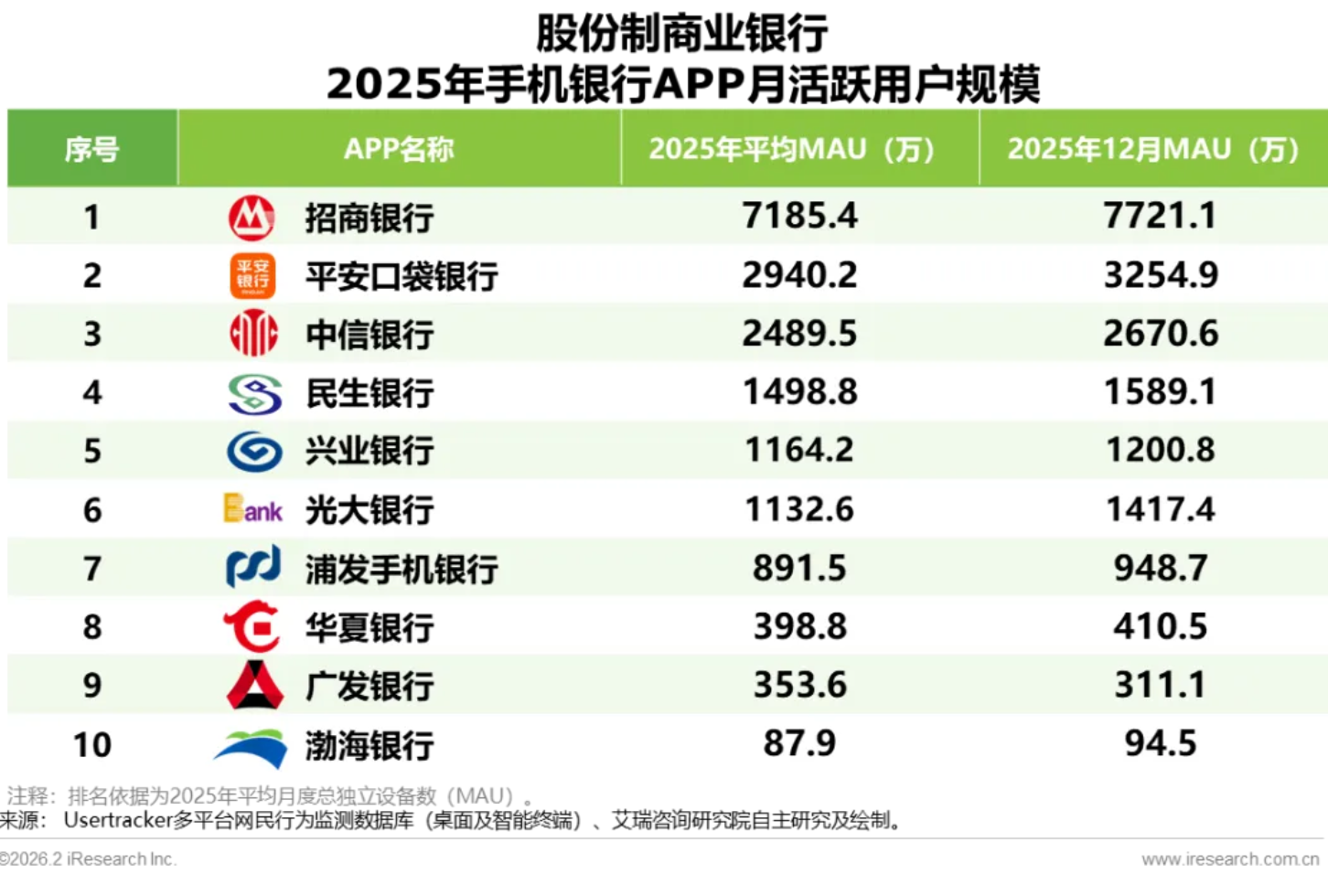
Core Insights - The Chinese mobile banking market is entering a stage of stock competition in 2025, with monthly active users (MAU) stabilizing between 648 million and 739 million [2] - State-owned commercial banks dominate the market due to their ecological embedding advantages, with Agricultural Bank of China leading at 249 million MAU, followed by Industrial and Commercial Bank of China (194 million) and China Construction Bank (109 million) [2] - Private banks are expected to collectively exit the top 50 MAU rankings in 2025 due to a lack of offline branch support and local living ecosystems [2] Group 1: Major Players - Agricultural Bank of China has the highest MAU at 249 million, followed by Industrial and Commercial Bank of China with 194 million and China Construction Bank with 109 million, forming the first tier of banks [2] - China Bank and Postal Savings Bank have MAUs exceeding 50 million, constituting the second tier [2] - China Merchants Bank leads the joint-stock banks with 71.85 million MAU, while Ping An Bank and CITIC Bank form the second tier, with other joint-stock banks generally below 20 million MAU [2] Group 2: Market Dynamics - The core advantage of state-owned banks lies in their "full-scenario integration" capabilities, embedding services deeply into high-frequency life scenarios such as government affairs, social security, healthcare, and education [2] - Agricultural Bank of China extends its services to rural areas through intelligent service matching and customer customization, while Industrial and Commercial Bank of China utilizes its "Gong Xiao Zhi" model for interactive service [2] - Regional banks like Jiangsu Bank, Beijing Bank, and Ningbo Bank show stable performance by focusing on local markets, with some rural commercial banks like Fujian Rural Credit exceeding 4.5 million MAU, indicating the sustainability of localized operations in the stock market [2]

流量红利枯竭 存量博弈下银行APP被迫断臂求生
Jing Ji Guan Cha Wang· 2026-02-18 05:44
Core Insights - The Chinese mobile banking market is transitioning from "scale expansion" to "value cultivation," indicating a saturation of user growth and the end of the traffic dividend period [2] - Different types of banks are exhibiting varied development trends in this new landscape [2] State-Owned Commercial Banks - The six major state-owned banks dominate the mobile banking market, with Agricultural Bank of China leading with over 250 million monthly active users (MAUs) [2] - The top three banks, including Industrial and Commercial Bank of China and China Construction Bank, have MAUs of nearly 200 million and over 100 million, respectively [2] - All six major banks reported positive month-on-month growth in MAUs, with ICBC leading at a 6.1% growth rate [2] Joint-Stock Commercial Banks - Joint-stock banks are seeking to carve out a niche in the saturated market, with China Merchants Bank leading among them with over 70 million MAUs [3] - Some banks like Everbright Bank and CITIC Bank showed significant month-on-month growth rates of 11.0% and 9.2%, respectively [3] - The performance of joint-stock banks is mixed, with some experiencing negative growth [3] Urban Commercial Banks - Urban commercial banks are growing rapidly, with 17 banks making it to the top 50 list, led by Ningbo Bank with 3.644 million MAUs and a growth rate of 43.9% [3] - The growth is attributed to localized strategies that enhance customer engagement [3] Rural Commercial Banks and Credit Cooperatives - Rural commercial banks and credit cooperatives also performed well, with 17 banks in the top 50, led by Fujian Rural Credit with 781.6 thousand average MAUs [4] - 12 out of these 17 banks reported positive month-on-month growth [4] Private Banks - Private banks are facing significant challenges, with only WeBank making it to the top 50 list in the first half of 2025, experiencing a 27.3% decline in MAUs [4] - The competitive landscape has shifted, making it difficult for online-only private banks to maintain their initial advantages [4] Conclusion - State-owned banks leverage "ecosystem" advantages to solidify their market position, while joint-stock banks focus on "professional" opportunities [5] - Urban commercial banks establish a strong local presence, whereas private banks struggle to survive in the competitive environment [5] - The future of banking will require a focus on creating irreplaceable value for users through technology and insights into user behavior [5]