
AGRICULTURAL BANK OF CHINA(01288)

Search documents
商业银行赋能“冷资源”变“热经济”
Zheng Quan Ri Bao· 2026-01-19 16:44
Core Insights - The winter ice and snow economy is becoming a significant driver for consumption upgrades, regional development, and industrial integration, supported by innovative financial services from banks [1] Group 1: Financial Support for the Ice and Snow Economy - Banks are embedding services throughout the entire ice and snow economy chain, providing differentiated financial support tailored to various segments such as infrastructure, equipment manufacturing, and tourism [2] - Construction Bank's Heilongjiang branch has provided billions in loans for major infrastructure projects to enhance tourism connectivity between key ice and snow attractions [2] - Agricultural Bank of China quickly issued a 2.73 million yuan loan to a local beverage company facing cash flow issues during peak tourism season, demonstrating the banks' responsiveness to small and micro enterprises [2][3] Group 2: Support for Small and Micro Enterprises - Small and micro enterprises are crucial to the ice and snow economy, with Construction Bank providing over 100 million yuan in credit support to more than 130 hotels and restaurants in Heilongjiang since 2025 [3] - Financial institutions are actively identifying and addressing the funding needs of local businesses, ensuring they can upgrade facilities and meet increased demand during the winter season [3] Group 3: Consumer Experience and Payment Solutions - Banks are enhancing consumer experiences by integrating financial services into consumption scenarios, such as the "Love Ice and Snow Carnival" campaign by Industrial and Commercial Bank of China, which offers discounts to stimulate spending [4] - Agricultural Bank and Construction Bank have established "Ice and Snow Stations" to provide free services like hot drinks and luggage storage, improving visitor satisfaction [5][6] - The introduction of comprehensive payment solutions, including support for international card payments, aims to accommodate diverse consumer payment preferences [5] Group 4: Future Projections and Strategic Directions - The "China Ice and Snow Tourism Development Report (2026)" predicts that ice and snow tourism will attract 360 million visitors and generate 450 billion yuan in revenue during the 2025-2026 winter season [6] - Financial institutions are encouraged to leverage technology and green finance to support high-tech equipment production and eco-tourism projects, enhancing the overall ice and snow industry [6]



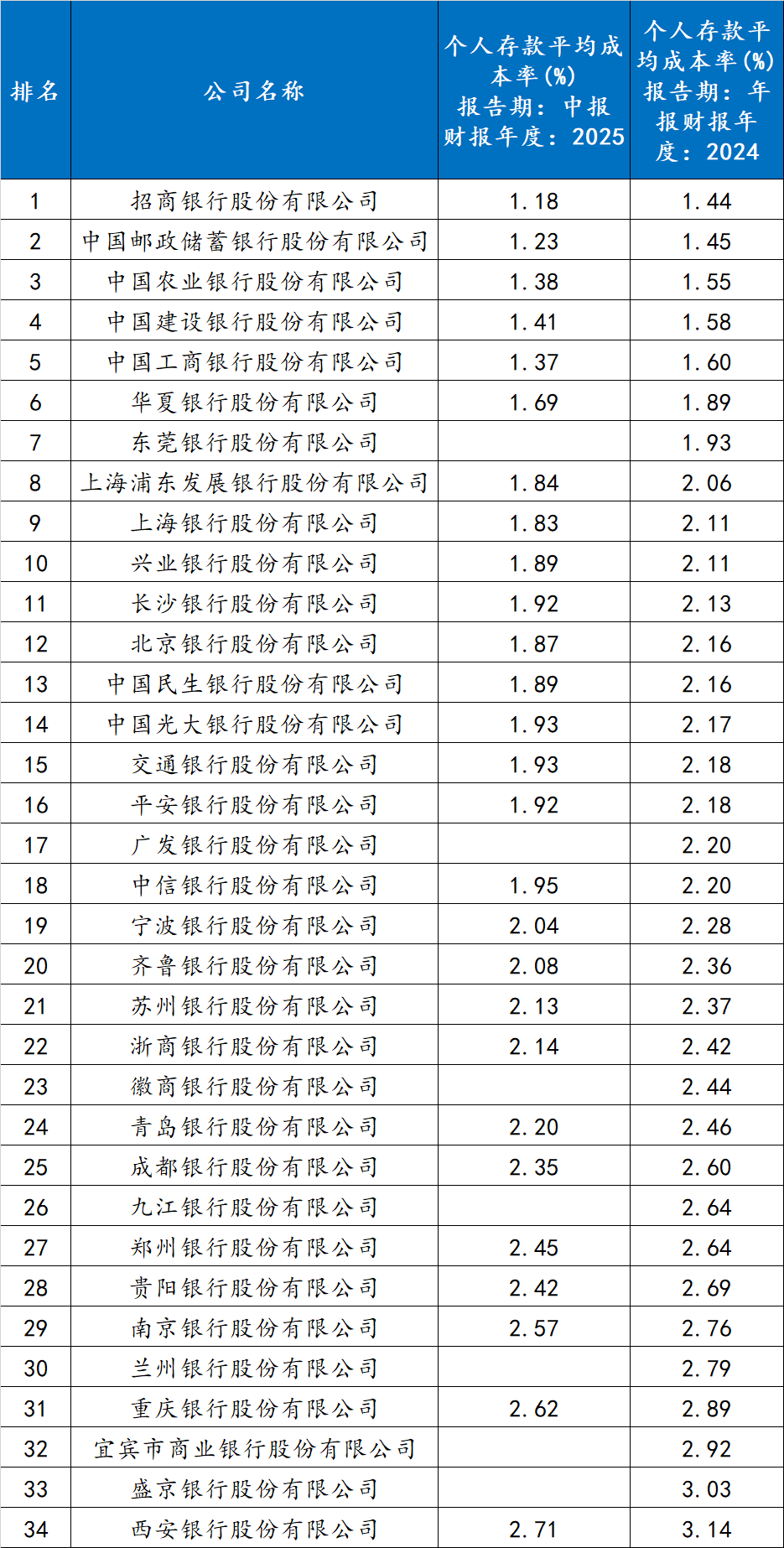
银行个人负债成本排名
Xin Lang Cai Jing· 2026-01-19 13:16
Core Insights - The average cost of personal deposits is a key indicator of banks' liability costs, with lower rates indicating stronger competitiveness in attracting deposits [1][7]. Group 1: Ranking of Banks by Deposit Cost - The banks with the lowest average cost of personal deposits are primarily state-owned large banks and some retail-focused joint-stock banks, with China Merchants Bank leading at 1.18% for the 2025 mid-year report [2][8]. - Following China Merchants Bank are China Postal Savings Bank at 1.23% and Agricultural Bank of China at 1.38%, benefiting from extensive branch networks and strong customer bases [2][8]. - The top six banks all have costs below 2%, indicating strong deposit cost control capabilities [2][8]. Group 2: Cost Trends and Observations - A notable trend is the general decline in average deposit costs across most banks when comparing 2024 annual reports to 2025 mid-year reports, with China Merchants Bank decreasing from 1.44% to 1.18% [6][12]. - This decline reflects a reduction in liability cost pressures for the banking industry, positively impacting net interest margins and profitability [6][12]. - However, lower deposit costs must align with asset yield and risk management capabilities, as a healthy bank seeks to balance these factors [12]. Group 3: Challenges for Joint-Stock and Regional Banks - Joint-stock banks and regional commercial banks generally face higher average deposit costs, often exceeding 2%, which can challenge their net interest margin management [5][11]. - National joint-stock banks like Industrial Bank and Minsheng Bank have costs ranging from 2.11% to 2.18%, while some regional banks experience even greater cost pressures [5][11].




吴通控股:全资子公司未中标中国农业银行手机短信长号码代理服务商项目 预计将会对公司未来经营业绩产生较大不利影响
Mei Ri Jing Ji Xin Wen· 2026-01-19 10:14
Core Viewpoint - Wu Tong Holdings (300292.SZ) announced that its wholly-owned subsidiary, Beijing Guodu Huilian Technology Co., Ltd., did not win the bid for the mobile SMS long number agency service project released by Agricultural Bank of China, which accounts for 32.98% of the company's total revenue, indicating a significant adverse impact on future operating performance [1] Group 1: Financial Impact - The project represents 32.98% of the company's total revenue, suggesting a substantial financial loss due to the unsuccessful bid [1] - The anticipated negative effect on future operating performance highlights the importance of this project to the company's overall financial health [1] Group 2: Strategic Response - The company plans to enhance the development of channel resources and cost management in its mobile information service business to improve operational efficiency [1] - In the electronic and communication intelligent manufacturing sector, the company aims to consolidate its advantages in the new energy vehicle industry, expand its customer base, and accelerate market development for new products such as energy storage connectors [1]

农发行与乌兹别克斯坦农业银行举行会谈 共商农业金融合作机遇
Xin Lang Cai Jing· 2026-01-19 09:41
来源:中国农业发展银行 1月16日,中国农业发展银行(以下简称农发行)董事长湛东升在总行会见乌兹别克斯坦农业银行(以 下简称乌农行)董事长埃尔金·卡霍罗夫一行。双方就区域农业金融、知识分享与能力建设、企业客户 对接等领域合作进行深入交流。 湛东升表示,中乌两国是好邻居好伙伴,农业是两国合作的重要领域,两行拥有广阔的合作空间。农发 行愿同乌农行一道,充分发掘"一带一路"沿线农业金融合作空间,交流分享在支持农业农村发展领域的 有益经验和成功实践,共同推动农产品贸易领域的客户资源对接,为促进两国农业高质量发展贡献力 量。 卡霍罗夫高度赞扬农发行在促进农业农村发展、助力农业现代化和推动金融科技创新等方面取得的成 就,表示希望以此次会谈为契机,加强信息共享和经验交流,充分发挥双方资源优势,推动双方农业金 融领域的务实合作。 农发行副行长张连钢,总行战略规划部、基础设施部、国际部、信息科技部负责人及相关人员,乌农行 相关人员参加会见。 责任编辑:王馨茹 来源:中国农业发展银行 1月16日,中国农业发展银行(以下简称农发行)董事长湛东升在总行会见乌兹别克斯坦农业银行(以 下简称乌农行)董事长埃尔金·卡霍罗夫一行。双方就区域 ...
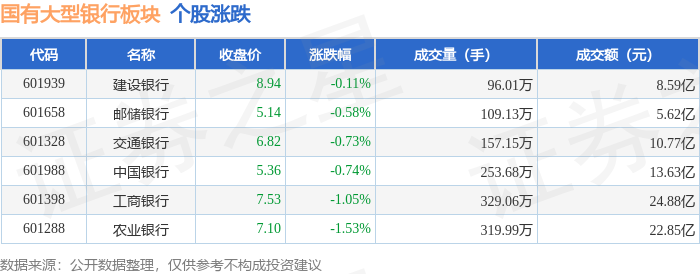
国有大型银行板块1月19日跌1.12%,农业银行领跌,主力资金净流出4.07亿元
Zheng Xing Xing Ye Ri Bao· 2026-01-19 08:58
Group 1 - The core viewpoint of the news is that the state-owned large bank sector experienced a decline of 1.12% on January 19, with Agricultural Bank leading the drop [1] - The Shanghai Composite Index closed at 4114.0, up 0.29%, while the Shenzhen Component Index closed at 14294.05, up 0.09% [1] - The trading performance of individual stocks in the state-owned large bank sector showed varied results, with Agricultural Bank down 1.53% and Industrial and Commercial Bank down 1.05% [1] Group 2 - The net outflow of main funds from the state-owned large bank sector was 407 million yuan, while retail investors saw a net inflow of 539 million yuan [1] - The detailed fund flow data indicates that the Agricultural Bank had a significant net outflow of 35.37 million yuan from main funds, but a net inflow of 73.72 million yuan from retail investors [2] - The overall trend shows that while main and speculative funds are withdrawing, retail investors are increasing their positions in certain banks [2]

银行资负跟踪20260119:降准降息还有空间
GF SECURITIES· 2026-01-19 04:26
Investment Rating - The industry investment rating is "Buy" [3] Core Viewpoints - The report indicates that there is still room for further cuts in reserve requirement ratios and interest rates, with a focus on structural monetary policy support for high-quality economic development [15][19] - The central bank has implemented a reduction of 0.25 percentage points in various structural monetary policy tool rates, signaling a supportive monetary policy stance [15][19] - The report emphasizes the importance of timing for future policy implementations, particularly in relation to government bond issuance peaks and the maturity schedule of high-interest bank deposits [15] Summary by Sections 1. Monetary Policy Adjustments - The report notes a reduction of 0.25 percentage points in structural monetary policy tool rates, with a focus on supporting key areas through increased re-lending [15] - Future attention is directed towards December economic data and January LPR [22] 2. Central Bank Dynamics and Market Rates - The central bank conducted a total of 9,515 billion yuan in 7-day reverse repos at an interest rate of 1.40%, with a net injection of 9,741 billion yuan [16] - The report highlights that the funding rates remained stable, with expectations of slight increases due to tax payments and government bond net repayments [16] 3. Bank Financing Tracking - The report indicates that the total outstanding amount of interbank certificates of deposit (CDs) is 19.09 trillion yuan, with an average issuance rate of 1.65% [20] - The report also notes that there were no commercial bank bond issuances during the period, with a total outstanding commercial bank bond size of 3.38 trillion yuan [20]


菏泽金融监管分局核准高兆国农业银行菏泽分行副行长任职资格
Jin Tou Wang· 2026-01-19 03:39
2026年1月9日,菏泽金融监管分局发布批复称,《中国农业银行股份有限公司山东省分行关于核准高兆 国中国农业银行菏泽分行副行长任职资格的请示》(农银鲁发〔2025〕102号)收悉。经审核,现批复 如下: 一、核准高兆国中国农业银行菏泽分行副行长任职资格。 二、中国农业银行应要求上述核准任职资格人员严格遵守金融监管总局有关监管规定,自中国农业银行 政许可决定作出之日起3个月内到任,并按要求及时报告到任情况。未在上述规定期限内到任的,本批 复文件失效,由决定机关办理行政许可注销手续。 三、中国农业银行应督促上述核准任职资格人员持续学习和掌握经济金融相关法律法规,牢固树立风险 合规意识,熟悉任职岗位职责,忠实勤勉履职。 ...
跨境流动性跟踪20260118:12月跨境净回流、净结汇规模均创历史新高
GF SECURITIES· 2026-01-19 02:46
Investment Rating - The industry investment rating is "Buy" [2] Core Views - December saw a record high in both cross-border net inflow and net settlement scale, with the bank's foreign-related payment surplus reaching 801.1 billion CNY, a year-on-year increase of 400.2 billion CNY [14][17] - The arbitrage trading return rate declined significantly, influenced by the depreciation of the US dollar against the offshore RMB, which fell by 1.32% to 6.98 [14][17] - The cross-border funds' net inflow in December was the highest on record, driven by a substantial increase in merchandise trade surplus [17][31] Summary by Sections Section 1: December Cross-Border Net Inflow and Settlement - The bank's foreign-related payment surplus in December was 801.1 billion CNY, with a year-on-year increase of 400.2 billion CNY, primarily due to a significant expansion in merchandise trade surplus [17] - The net settlement in December reached a historical high of 705.5 billion CNY, with a month-on-month increase of 589.1 billion CNY and a year-on-year increase of 780.6 billion CNY [31] Section 2: Arbitrage Trading Returns - The arbitrage trading return rate for 10Y US Treasury bonds in RMB terms fell by 1.43 percentage points to -1.77% due to the marginal appreciation of the RMB [14][17] - The 10Y China-US interest rate spread widened by 15 basis points, with the 10Y US Treasury yield rising by 16 basis points [14] Section 3: Cross-Border Funds and M2 Liquidity - Cross-border funds contributed significantly to M2 liquidity, with a total of 774.4 billion CNY added, reflecting an increase of 863.2 billion CNY month-on-month [55] - The cross-border funds' inflow had a pull rate of 0.10% on M2, indicating a continued upward trend [55]
银行投资观察20260118:贝塔弹性主导近期板块表现
GF SECURITIES· 2026-01-19 01:47
Core Insights - The banking sector has shown weak relative and absolute returns recently, primarily due to market funds shifting towards high-beta and small-cap stocks, leading to a diversion of funds from low-beta banking stocks [18] - The report suggests that the banking sector is likely to experience further internal differentiation in 2026, with larger banks and wealth management banks expected to outperform [18] - Core stock recommendations include Ningbo Bank, China Merchants Bank, Qingdao Bank, and large state-owned banks [18] Section Summaries 1. Current Observation: A-shares in Banking Decline, H-shares Outperform - During the observation period from January 12 to January 16, 2026, the banking sector (CITIC first-level industry) declined by 2.6%, ranking 25th among all industries and underperforming the Wind All A index [16] - The performance of state-owned banks, joint-stock banks, city commercial banks, and rural commercial banks varied, with declines of -2.16%, -3.33%, -1.92%, and -2.24% respectively [16] - H-shares of banks increased by 2.4%, underperforming the Hang Seng Composite Index, while A-share banks showed mixed results [16] 2. Investment Recommendations: Beta Elasticity Dominates Recent Sector Performance - The report indicates that the recent downturn in the banking sector has solidified valuations, with limited further downside expected [18] - The anticipated trends include a shift towards non-bank financial services, wealth management, and disintermediation, with large banks expected to gain an advantage [18] 3. Sector Performance: Banking Sector Decline, Weekly Turnover Rate Increases - The banking sector's weekly turnover rate increased to 1.61%, ranking last among 30 CITIC first-level industries [42] - As of January 16, 2026, the banking sector's latest price-to-earnings (P/E) ratio was 6.89x, and the price-to-book (P/B) ratio was 0.67x, indicating valuations at historical average levels [42] 4. Individual Stock Performance: A-share Banks Overall Decline, City Commercial Banks Relatively Stable - Among A-share banks, Ningbo Bank saw a rise of 4.09%, while Beijing Bank, Huaxia Bank, and Shanghai Pudong Development Bank experienced declines of 4.90%, 4.73%, and 4.33% respectively [16] - In H-shares, Industrial and Commercial Bank of China and China Construction Bank increased by 3.59% and 3.16%, while China Everbright Bank and Chongqing Bank saw declines of 6.14% and 3.10% [16] 5. Convertible Bond Performance: Average Price Increase - The average price of banking convertible bonds rose by 0.06%, underperforming the Zhongzheng convertible bond index by 1.02 percentage points [17] - The top-performing convertible bonds included Chongqing Bank's convertible bond (+0.58%) and Industrial Bank's convertible bond (+0.18%) [17] 6. Profit Forecast Tracking: 2025 Profit Growth Expectations Remain Stable - For the current period, three banks (China Merchants Bank, Minsheng Bank, and Hangzhou Bank) showed changes in the consensus profit growth expectations for 2025 [17] - The net profit growth and revenue growth expectations for A-share banks in 2025 adjusted slightly downwards by -0.08 percentage points and -0.03 percentage points respectively [17]
【四中全会精神在基层】金融“贷”动农民增收
Zhong Guo Jing Ji Wang· 2026-01-18 23:09
Group 1 - The core idea of the news is the innovative "credit village" model introduced by Agricultural Bank of China in Tianjin to address financing challenges for farmers, enabling timely access to funds for land contracting and agricultural inputs [1][2] - The "credit village" initiative involves collaboration with village committees to establish credit records and provide loans to eligible farmers, thereby reducing loan costs and improving production efficiency [1] - In 2025, a farmer in Baodi District received 3 million yuan in credit loans, allowing for an expansion of 2,000 acres in grain cultivation due to the good credit standing of his farm [1] Group 2 - Agricultural Bank of China has increased its agricultural credit support by simplifying processes and optimizing credit granting methods, ensuring stable financial backing for farmers [2] - A rice grower received a 500,000 yuan "Rural Revitalization e-loan" in 2025, which alleviated his financial concerns regarding the long repayment cycle associated with rice cultivation [2] - The bank's provision of 4.9 million yuan in credit to a trading company facilitated timely storage and processing of grain, ensuring stable market supply during peak sales periods [2] Group 3 - The entire agricultural production chain, from preparation to harvest and value addition, relies heavily on financial support, highlighting the importance of financial services in agriculture [3] - The 20th National Congress of the Communist Party of China emphasized the need for the development of various financial sectors, including technology finance and inclusive finance, which raises expectations for commercial banks to innovate in providing quality financial services [3] - Agricultural Bank of China aims to continue supporting grain production stability and farmers' income growth through financial initiatives [3]