
AGRICULTURAL BANK OF CHINA(01288)

Search documents
金融“贷”动农民增收
Jing Ji Ri Bao· 2026-01-18 22:03
Core Insights - The "Credit Village" initiative by Agricultural Bank of China in Tianjin addresses financing challenges for farmers, enabling timely access to funds for land contracting and agricultural inputs [1][2] - The program involves collaboration with local village committees to provide loans to eligible farmers, utilizing a flexible repayment plan based on crop cycles to reduce loan costs [1] - Financial support is crucial for the entire agricultural production chain, from preparation to harvest and sales, with a focus on enhancing the quality of agricultural products [3] Group 1 - The "Credit Village" model allows farmers like Shen Bingyang to secure loans quickly, exemplified by a 3-day approval for a 3 million yuan loan to expand grain cultivation by 2,000 acres [1] - Agricultural Bank of China has simplified loan processes and optimized credit granting to provide stable financial support for farmers, as seen with a 500,000 yuan loan to rice grower Qin Wei [2] - The bank's financial services are designed to enhance the efficiency of agricultural production and ensure stable market supply, particularly during peak sales seasons [2] Group 2 - The initiative aligns with national policies promoting the development of various financial sectors, including technology and inclusive finance, to support agricultural stability and farmer income [3] - Agricultural Bank of China aims to continuously provide financial resources to ensure food security and support farmers' income growth [3]

一箱难求!银行“古早”业务突然火了,保管箱为何“爆单”?
券商中国· 2026-01-16 23:38
所谓保管箱服务,其全称为保管箱租赁服务,是银行以出租保管箱形式,代租用人保管贵重物品、有价证券及文件等财物的一项服务业务。券商中国记者从已使用 多年银行保管箱服务的人士处了解到,通常会将重要合同等文件放在保管箱中,"以前也放过金条,在银行买的金条不开封直接就放进去了。" 记者走访多家银行网点发现,目前北京地区保管箱"一箱难求"的情况较为普遍。 "我们这儿现在已经有40多位客户在排队了,但去年只有1位退箱,所以目前也就不再接受新的排队。"工商银行某支行营业部工作人员对记者表示。 近期,银行保管箱"一箱难求"引发关注。券商中国记者近日走访或致电工商银行、农业银行、中国银行、招商银行、民生银行、兴业银行在北京地区的多家分支机 构,仅中国银行一家支行仍有空箱,其余网点均需排队等待或因排队人数过多而不再新增预约。 从排队等待人数来看, 少则三四人,多则三四十人 ;至于等待时长,多数网点工作人员表示无法给出准确时点,因为这一业务已存续很长时间,客户大多为存量 客户,只能等待每年自然退租、腾出空箱;而腾退本身又具有比较强的主观性,因此无法给出明确判断。 "一箱难求"情况普遍 "一般其他网点没有(空箱)了,才会再到我们这儿来 ...



绿色信贷增速超24%,县域金融覆盖超千镇!看广东金融如何协同赋能高质量发展
Nan Fang Nong Cun Bao· 2026-01-16 10:31
Core Viewpoint - Guangdong's green loans have maintained a rapid growth rate of 24.2% year-on-year by the end of 2025, significantly outpacing the growth of other types of loans, indicating a strong focus on green finance in the region [3][21][31]. Financial Growth and Support - By the end of 2025, the balance of green loans in Guangdong reached 533.9 billion yuan, with an annual increase of 81.9 billion yuan, showcasing the effectiveness of financial institutions in supporting green initiatives [27][31]. - The People's Bank of China Guangdong Branch has implemented structural monetary policy tools to guide financial resources towards green projects, resulting in a cumulative investment of 612 billion yuan, which has stimulated local banks to increase credit in related fields by 333.9 billion yuan [15][16]. Collaborative Financial Ecosystem - Financial institutions in Guangdong, including Agricultural Bank and Postal Savings Bank, have established a collaborative network to enhance support for green and rural revitalization projects, with a focus on integrating resources and providing comprehensive services [20][21][56]. - The establishment of "Green Guangdong Financial Service Centers" by Agricultural Bank aims to provide tailored financing and advisory services for urban and rural development projects [23][25]. Innovation in Financial Services - Financial institutions have introduced innovative financial products and services to address the unique challenges faced by green industries, such as customized credit assessments and financing solutions for environmentally friendly projects [38][40]. - The Postal Savings Bank has developed a credit assessment model to support green technology enterprises, addressing their financing difficulties [30]. Environmental and Social Governance - Financial institutions are increasingly focusing on environmental and social risk management, conducting extensive ESG assessments to ensure the quality of green assets [86][89]. - The shift towards "ecological value finance" reflects a broader commitment to not only support green industries but also to directly contribute to ecological restoration and protection efforts [82][83]. Rural and Community Development - Financial services have been extended to rural areas through a comprehensive network, with Agricultural Bank covering 1,127 towns and villages, facilitating access to financial resources for local communities [56][57]. - Innovative rural financial products, such as "Rural Housing Credit Loans," have been introduced to help farmers overcome collateral challenges, demonstrating a commitment to rural revitalization [68]. Future Outlook - The financial sector in Guangdong is expected to continue deepening its collaborative efforts, enhancing policy guidance, and innovating financial products to support green development and rural revitalization in the upcoming "15th Five-Year Plan" [102][104].


银行业“10万亿俱乐部”扩容至10家,陈国汪详解大中小银行划分标准
Jin Rong Jie· 2026-01-16 09:09
Group 1 - The core viewpoint of the articles highlights that both Pudong Development Bank and CITIC Bank have successfully surpassed the 10 trillion yuan asset threshold, expanding the "10 trillion asset club" in China's banking industry to 10 members, which includes six major state-owned banks and four national joint-stock banks [1] - The total asset scale of the 10 banks now accounts for 60% of the entire banking industry, indicating a growing concentration of resources among leading institutions [1] - Chen Guowang, director of the Financial Industry Research Institute, noted that the significant changes in asset scale among banks have created a clear disparity with the classification standards established in 2015, which need to be updated to better reflect the current industry landscape [2] Group 2 - The classification standards for banks, established in 2015, categorize institutions based on asset size, but the threshold for large banks is no longer applicable as multiple institutions have surpassed the 10 trillion yuan mark [2] - The current classification includes various types of banks, such as policy banks, state-owned commercial banks, joint-stock banks, urban commercial banks, rural small banks, and private banks, indicating a diverse banking landscape [2] - Chen Guowang suggests that the asset scale classification standards should be revised to adapt to the new developments in the banking industry [2]


国有大型银行板块1月16日跌1.08%,农业银行领跌,主力资金净流入1.46亿元
Zheng Xing Xing Ye Ri Bao· 2026-01-16 08:55
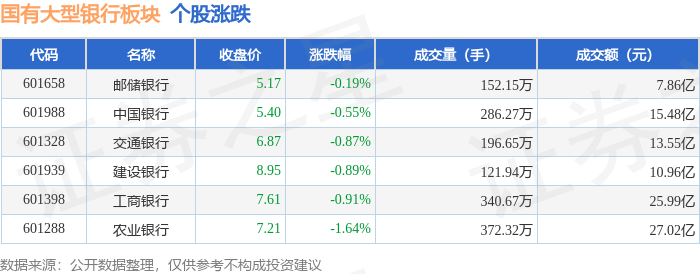
Market Performance - The state-owned large bank sector declined by 1.08% compared to the previous trading day, with Agricultural Bank leading the decline [1] - The Shanghai Composite Index closed at 4101.91, down 0.26%, while the Shenzhen Component Index closed at 14281.08, down 0.18% [1] Individual Bank Performance - Postal Savings Bank closed at 5.17, down 0.19% with a trading volume of 1.52 million shares and a transaction value of 7.86 billion [1] - Bank of China closed at 5.40, down 0.55% with a trading volume of 2.86 million shares and a transaction value of 15.48 billion [1] - Bank of Communications closed at 6.87, down 0.87% with a trading volume of 1.97 million shares and a transaction value of 13.55 billion [1] - China Construction Bank closed at 8.95, down 0.89% with a trading volume of 1.22 million shares and a transaction value of 10.96 billion [1] - Industrial and Commercial Bank closed at 7.61, down 0.91% with a trading volume of 3.41 million shares and a transaction value of 25.99 billion [1] - Agricultural Bank closed at 7.21, down 1.64% with a trading volume of 3.72 million shares and a transaction value of 27.02 billion [1] Fund Flow Analysis - The state-owned large bank sector saw a net inflow of 146 million from institutional investors, while retail investors contributed a net inflow of 123 million [1] - The sector experienced a net outflow of 269 million from speculative funds [1] Detailed Fund Flow for Individual Banks - Bank of Communications had a net inflow of 172 million from institutional investors, while speculative funds saw a net outflow of 67.34 million [2] - Industrial and Commercial Bank had a net inflow of 73.01 million from institutional investors, with a significant net outflow of 363 million from speculative funds [2] - Postal Savings Bank had a net inflow of 65.23 million from institutional investors, while speculative funds had a net inflow of 37.30 million [2] - Bank of China had a net inflow of 6.76 million from institutional investors, with speculative funds contributing a net inflow of 43.81 million [2] - China Construction Bank experienced a net outflow of 18.52 million from institutional investors, while speculative funds had a net inflow of 66.99 million [2] - Agricultural Bank had a net outflow of 153 million from institutional investors, with a small net inflow of 13.28 million from speculative funds [2]

农业银行晋城凤庆支行被罚31万元:发放不符合条件的贷款、代销保险业务管理不到位
Xin Lang Cai Jing· 2026-01-16 05:57
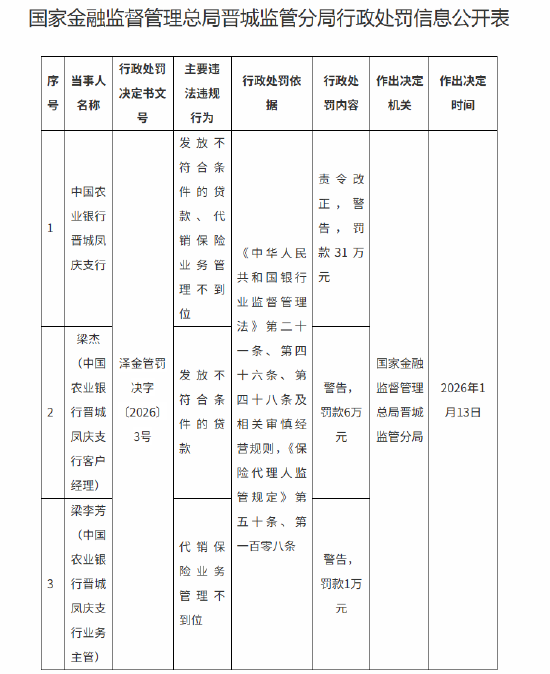
责任编辑:王馨茹 1月16日金融一线消息,据国家金融监督管理总局晋城监管分局行政处罚信息公开表显示,中国农业银 行晋城凤庆支行因发放不符合条件的贷款、代销保险业务管理不到位,被责令改正,警告,罚款31万 元。 同时,梁杰(中国农业银行晋城凤庆支行客户经理)因发放不符合条件的贷款被警告并罚款6万元;梁 李芳(中国农业银行晋城凤庆支行业务主管)因代销保险业务管理不到位被警告并罚款1万元。 1月16日金融一线消息,据国家金融监督管理总局晋城监管分局行政处罚信息公开表显示,中国农业银 行晋城凤庆支行因发放不符合条件的贷款、代销保险业务管理不到位,被责令改正,警告,罚款31万 元。 同时,梁杰(中国农业银行晋城凤庆支行客户经理)因发放不符合条件的贷款被警告并罚款6万元;梁 李芳(中国农业银行晋城凤庆支行业务主管)因代销保险业务管理不到位被警告并罚款1万元。 | 序 | 当事人 | 行政处罚 | 主要谱 | 行政处罚依 | 行政处 | 作出决定 | 作出决定 | | --- | --- | --- | --- | --- | --- | --- | --- | | | | 决定书文 | 法违规 | | | | | | 릉 ...
银行行业点评报告:企业信贷超季节性增长,信贷投放前置趋势或延续
KAIYUAN SECURITIES· 2026-01-16 05:44
Investment Rating - Investment rating: Positive (maintained) [2] Core Viewpoints - In December, corporate credit experienced a seasonal growth, with expectations that the credit issuance in Q1 2026 may reach the highest level in history [4] - The report highlights that while the year-end credit issuance slowed down, the impact of debt reduction policies has weakened, allowing for stable credit growth [4] - The report indicates that the demand for corporate loans has shown signs of recovery, with a year-on-year increase of 5.8 trillion yuan in December, although the overall demand still requires further observation [4] - The report notes that the new issuance rates for corporate and personal housing loans have stabilized at 3.10%, reflecting a shift in bank lending strategies [5][6] Summary by Sections Credit Market Analysis - December saw a new issuance of 910 billion yuan in RMB loans, a year-on-year decrease of 80 billion yuan, with a balance growth rate of 6.4% [4] - The corporate loan structure improved, with short-term and medium-to-long-term loans increasing by 3.9 trillion yuan and 2.9 trillion yuan respectively [4] - The report emphasizes that the overall credit demand from residents remains weak, with a year-on-year decrease of 441.6 billion yuan in December [4] Social Financing and Government Bonds - In December, social financing increased by 2.2 trillion yuan, a year-on-year decrease of 646.2 billion yuan, with a stock growth rate of 8.3% [5] - The slowdown in government bond issuance has been identified as a drag on social financing, with new government bonds issued at 683.3 billion yuan, one of the lowest levels of the year [5] Monetary Supply and Deposits - M2 growth in December was 8.5%, while M1 growth fell to 3.8% [6] - The report notes that the increase in fiscal deposits may indicate a weaker year-end fiscal spending compared to the previous year [6] Investment Recommendations - The report suggests that banks with strong wealth management businesses and active financial environments in key regions will benefit from the stable growth policies [7] - Recommended banks include CITIC Bank, with beneficiaries including Agricultural Bank of China, China Merchants Bank, and others [7]


一年之内,超300家村镇银行“消失”,啥情况?
Xin Lang Cai Jing· 2026-01-16 05:15
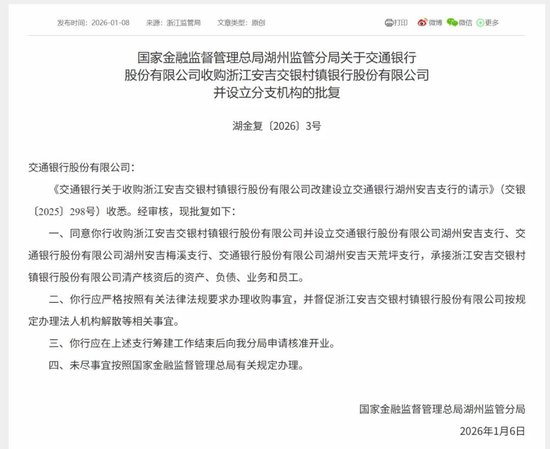
Core Viewpoint - The restructuring of village banks is accelerating, with state-owned banks actively converting village banks into branches, reflecting a trend of market exit and consolidation in the rural banking sector [1][10]. Group 1: Recent Developments - On January 6, 2026, the China Banking Regulatory Commission approved the acquisition of Zhejiang Anji Jiaoyin Village Bank by Bank of Communications, which will be converted into three branches [2][10]. - Since 2025, Bank of Communications has completed multiple "village-to-branch" conversions, including acquisitions in Qingdao and Sichuan [2][10]. - A total of 300 village banks have exited the market since 2025, with "village-to-branch" and "village-to-subsidiary" becoming the mainstream exit strategies [10][11]. Group 2: Participation of State-Owned Banks - State-owned banks, including Industrial and Commercial Bank of China and Agricultural Bank of China, have also engaged in "village-to-branch" conversions, with ICBC being the first to do so in June 2025 [3][11]. - By the end of 2025, state-owned banks had completed conversions for 10 village banks, indicating a significant trend in the industry [3][11]. Group 3: Strategic Implications - The "village-to-branch" strategy aims to integrate rural financial resources and enhance operational efficiency, driven by the need for state-owned banks to expand their reach in rural areas [4][13]. - Analysts suggest that merging village banks into branches can improve service capabilities and risk management, while also allowing for potential expansion in areas lacking existing branches [5][12]. Group 4: Regulatory Environment - The 2025 Central Document No. 1 emphasized the need for rural small and medium-sized banks to focus on agricultural support, leading to a significant increase in market exits among village banks [6][14]. - As of 2026, over 430 village banks have been listed for exit since 2010, with 310 exiting in 2025 alone, representing over 70% of the total exits [6][14]. Group 5: Future Outlook - The ongoing trend of "reduction and quality improvement" in small and medium-sized banks is expected to continue, with a focus on effective measures to prevent the emergence of high-risk institutions [16][17]. - The emphasis on optimizing the financial institution system and enhancing governance is crucial for the sustainable development of the rural banking sector [17].
中国农业银行拟在1月16日-18日实施生产系统维护
Jin Tou Wang· 2026-01-16 03:26
Core Viewpoint - China Agricultural Bank (601288) announced a scheduled maintenance of its production systems, which will temporarily affect various banking services from January 16 to January 18, 2026 [1][2][3] Service Interruptions - From January 16, 23:00 to January 17, 23:50, the corporate mobile banking standard version and various exclusive service versions will be suspended [1] - On January 16, 23:00 to January 17, 2:00 and January 17, 23:00 to January 18, 2:00, credit card services via WeChat mini-program will experience brief interruptions lasting less than 5 minutes each [1] - New customer self-registration, interbank transfer, and digital RMB wallet upgrades will be paused on January 17, 0:00 to January 18, 1:00, with each interruption lasting approximately 2 minutes [1] - Fund and commercial pension services will be interrupted on January 17, 1:30 to 2:00 and January 18, 2:00 to 2:30, with each pause lasting about 1 minute [1] Additional Service Interruptions - From January 17, 23:00 to January 18, 2:00, various electronic invoice services and corporate mobile banking functions will be suspended [2] - Personal mobile banking and online banking services will experience extended transaction response times on January 17, 23:00 to January 18, 2:00, with delays of less than 1 minute each [2] - Barcode payment services across multiple channels will be interrupted on January 18, 1:00 to 1:10 and 2:10 to 2:20, with each interruption lasting under 10 minutes [2] Final Service Interruptions - From January 18, 2:00 to 6:00, personal deposit service transactions will experience interruptions lasting about 10 minutes each [3] - Asset view query transactions and related personal liability transactions will also be paused during the same timeframe, with similar duration of interruptions [3] - The bank has expressed apologies for any inconvenience caused and encourages customers to plan their banking activities accordingly [3]
银行行业点评报告:政策支撑稳增长,关注Q1银行景气度修复行情
KAIYUAN SECURITIES· 2026-01-16 03:11
Investment Rating - The investment rating for the banking industry is "Positive" (maintained) [2] Core Viewpoints - The report emphasizes that policy support is crucial for stabilizing growth, with a focus on the recovery of banking sector sentiment in Q1 [4][7] - The People's Bank of China (PBOC) has indicated the feasibility of further interest rate cuts and reserve requirement ratio (RRR) reductions due to high current levels of RRR and a stable exchange rate environment [4] - Structural monetary policy tools have been introduced to lower the overall financing costs in society, with specific interest rate cuts for various loans [5] - The resumption of government bond trading operations by the PBOC is aimed at enhancing the monetary policy toolkit and ensuring smooth issuance of government bonds [6] Summary by Sections Monetary Policy and Economic Recovery - The PBOC's recent measures include a potential for 1-2 interest rate cuts within the year, with a possible reduction of 10 basis points each time, with the earliest cut expected in Q1 [4] - The report notes that the core Consumer Price Index (CPI) has shown positive growth, indicating effective policy collaboration [7] Banking Sector Performance - The banking sector is expected to benefit from improved economic conditions, with a significant increase in credit issuance anticipated in January, potentially the highest in history [7] - Banks with strong wealth management capabilities and those in active financial environments are likely to gain more from the supportive policy landscape [7] Recommendations - The report recommends focusing on banks such as CITIC Bank, Construction Bank, Agricultural Bank, and others, which are expected to benefit from the current economic recovery and policy support [7]
