
AIA(01299)

Search documents
友邦保险(01299) - 董事名单与其角色和职能
2026-02-04 08:31
友邦 保 險控 股 有限 公司 董 事會 成 員載 列如 下 : 獨 立 非 執 行 主席 及 獨 立 非 執 行 董事 杜嘉 祺 爵士 執行董事 李源 祥 先生 ( 集團 首席 執 行官 兼 總裁 ) 獨 立 非 執 行 董事 AIA Group Limited 友 邦 保 險 控 股 有 限 公 司 (於香港註冊成立的有限公司) 股份代號:1299(港幣櫃台)及 81299(人民幣櫃台) 董事名單與其角色和職能 1 提名委員會 杜嘉 祺 爵士 ( 主席 ) 蘇澤 光 先生 周松 崗 爵士 John Barrie HARRISON先生 楊榮 文 先生 劉遵 義 教授 Narongchai AKRASANEE博士 Cesar Velasquez PURISIMA先生 Mari Elka PANGESTU女 士 王宗 智 先生 Nor Shamsiah MOHD YUNUS女 士 薪酬委員會 楊榮 文 先生 ( 主席 ) 蘇澤 光 先生 杜嘉 祺 爵士 風險委員會 周松 崗 爵士 ( 主席 ) 劉遵 義 教授 Cesar Velasquez PURISIMA先生 Nor Shamsiah MOHD YUNUS女 ...
友邦保险(01299) - 委任独立非执行董事
2026-02-04 08:30
本公告僅供參考,並不構成任何人士收購、購買或認購證券的邀請或要約。本公告並非亦無意作 為在美國發售本公司證券供出售的要約。本公司證券並無亦不會根據 1933 年美國證券法(經修 訂)(「美國證券法」)登記,且不得未根據美國證券法登記或適用豁免登記規定而在美國發售或 出售。本公司證券並無亦無計劃在美國公開發售。 香港交易及結算所有限公司及香港聯合交易所有限公司對本公告的內容概不負責,對其準確性或 完整性亦不發表任何聲明,並明確表示,概不對因本公告全部或任何部分內容而產生或因倚賴該 等內容而引致的任何損失承擔任何責任。 AIA Group Limited 友 邦 保 險 控 股 有 限 公 司 (於香港註冊成立的有限公司) 股份代號:1299(港幣櫃台)及 81299(人民幣櫃台) 在加入平安集團之前,顧先生曾於1997年至1999年期間於麥肯錫公司(McKinsey & Company)任職業務分析師。 委任獨立非執行董事 友邦保險控股有限公司(「本公司」,連同其附屬公司,統稱「本集團」)董事會 (「董事會」)欣然宣佈Shulamite N K Khoo女士(「Khoo女士」)及顧敏先生 (「顧先生」)已獲委任 ...
金融高水平对外开放蹄疾步稳
Jin Rong Shi Bao· 2026-02-04 05:32
Core Viewpoint - The establishment of AIA Asset Management and Aegon Asset Management in Shanghai marks a significant step in the high-level opening of China's financial market, showcasing the commitment of international capital to China's financial reform and development [1][4]. Group 1: Company Establishment - AIA Asset Management and Aegon Asset Management held their opening ceremony on January 28, marking the debut of the first wholly foreign-owned insurance asset management companies in Shanghai [1]. - The approval for the establishment of these companies was granted by the Financial Regulatory Bureau in December 2025, following a rapid six-month preparation period [2][3]. - AIA Asset Management is fully owned by AIA Life Insurance with a registered capital of 100 million yuan, while Aegon Asset Management, backed by the 180-year-old Aegon Group, has a registered capital of 250 million yuan [3]. Group 2: Strategic Importance - The simultaneous launch of these institutions is seen as a landmark event for Shanghai's financial sector and reflects the dual engagement of China's financial industry with international capital [4]. - Both companies aim to leverage their global expertise to provide diversified and international asset management services to Chinese institutional investors [3][5]. Group 3: Market Insights - The past five years have seen an average annual growth rate of about 8% in the assets under management in China's trust, wealth management, and insurance asset management sectors, making it the second-largest asset and wealth management market globally [6]. - International insurance giants view China as a market with significant growth potential, leading to increased investment and participation from foreign institutions [6]. - The entry of foreign firms is expected to enhance the diversity of products and services available in the Chinese insurance market, benefiting consumers and pushing local firms to improve their professional capabilities [6].
大行评级丨海通国际:上调友邦保险目标价至108.5港元,看好今明两年增长前景
Ge Long Hui· 2026-02-03 02:26
Core Viewpoint - Haitong International's report indicates that AIA Group is expected to achieve a 14% growth in new business value by the end of Q4 2025, driven by improved agent productivity, diversified channels, and better performance in Hong Kong and mainland markets [1] Group 1 - The forecast for the new business value growth trajectory is projected to remain healthy and sustainable at 15% to 17% over the next two years [1] - The new business value predictions for AIA from 2025 to 2027 have been revised upward by 0% to 7% [1] - The target price for AIA has been increased from HKD 99.5 to HKD 108.5, while maintaining an "outperform" rating [1]
智通港股沽空统计|2月3日
智通财经网· 2026-02-03 00:23
Group 1 - Anta Sports (82020), Li Ning (82331), and JD Health (86618) have the highest short-selling ratios at 100.00% each [1][2] - BYD Company (01211), Meituan (03690), and Xiaomi Group (01810) lead in short-selling amounts, with 1.896 billion, 1.439 billion, and 0.965 billion respectively [1][2] - Li Ning (82331), Shangmei Group (02145), and Bank of China Hong Kong (82388) have the highest deviation values at 37.55%, 31.60%, and 30.16% respectively [1][2] Group 2 - The top short-selling ratio rankings include Anta Sports (82020) at 100.00%, Li Ning (82331) at 100.00%, and JD Health (86618) at 100.00% [2] - The top short-selling amounts are led by BYD Company (01211) at 1.896 billion, Meituan (03690) at 1.439 billion, and Xiaomi Group (01810) at 0.965 billion [2] - The top deviation values are led by Li Ning (82331) at 37.55%, Shangmei Group (02145) at 31.60%, and Bank of China Hong Kong (82388) at 30.16% [2]


智通ADR统计 | 2月3日
智通财经网· 2026-02-02 22:23
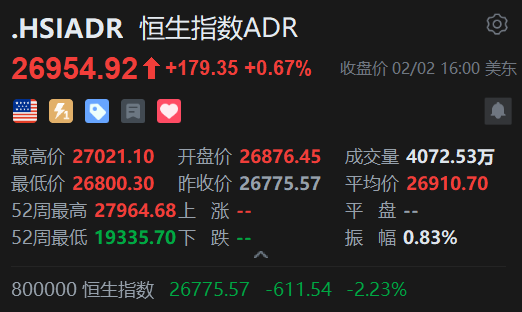
Market Overview - The Hang Seng Index (HSI) closed at 26,954.92, up by 179.35 points or 0.67% as of February 2, 16:00 Eastern Time [1] - The index reached a high of 27,021.10 and a low of 26,800.30 during the trading session, with a trading volume of 40.725 million shares [1] Major Blue-Chip Stocks Performance - HSBC Holdings closed at HKD 139.961, increasing by 3.91% compared to the Hong Kong close [2] - Tencent Holdings closed at HKD 595.694, down by 0.47% compared to the Hong Kong close [2] Stock Price Movements - Tencent Holdings: Latest price HKD 598.500, down by HKD 7.500 or 1.24% [3] - Alibaba Group: Latest price HKD 163.300, down by HKD 5.900 or 3.49% [3] - HSBC Holdings: Latest price HKD 134.700, down by HKD 1.900 or 1.39% [3] - AIA Group: Latest price HKD 89.050, down by HKD 1.300 or 1.44% [3] - Meituan: Latest price HKD 94.850, down by HKD 2.350 or 2.42% [3] - BYD Company: Latest price HKD 91.000, down by HKD 6.750 or 6.91% [3] - Kuaishou Technology: Latest price HKD 77.000, down by HKD 3.150 or 3.93% [3]






AIA (AAGIY) Upgraded to Buy: What Does It Mean for the Stock?
ZACKS· 2026-02-02 18:00
Core Viewpoint - AIA has been upgraded to a Zacks Rank 2 (Buy), indicating a positive outlook on its earnings estimates, which is a significant factor influencing stock prices [1][3]. Earnings Estimates and Stock Price Movement - The Zacks rating system is based on changes in earnings estimates, which are strongly correlated with near-term stock price movements [4]. - Institutional investors utilize earnings estimates to determine the fair value of stocks, leading to buying or selling actions that affect stock prices [4]. AIA's Earnings Outlook - The upgrade for AIA reflects an improvement in the company's underlying business, which is expected to drive the stock price higher as investors recognize this trend [5]. - For the fiscal year ending December 2026, AIA is projected to earn $3.18 per share, with a 1.9% increase in the Zacks Consensus Estimate over the past three months [8]. Zacks Rank System - The Zacks Rank system classifies stocks into five groups based on earnings estimates, with a strong historical performance, particularly for Zacks Rank 1 stocks, which have averaged a +25% annual return since 1988 [7]. - AIA's upgrade to Zacks Rank 2 places it in the top 20% of Zacks-covered stocks, indicating a strong potential for market-beating returns in the near term [10].


1月30日【港股Podcast】恆指、寧德時代、快手、紫金礦業、比亞迪股份、 友邦保險
Ge Long Hui· 2026-02-02 12:11
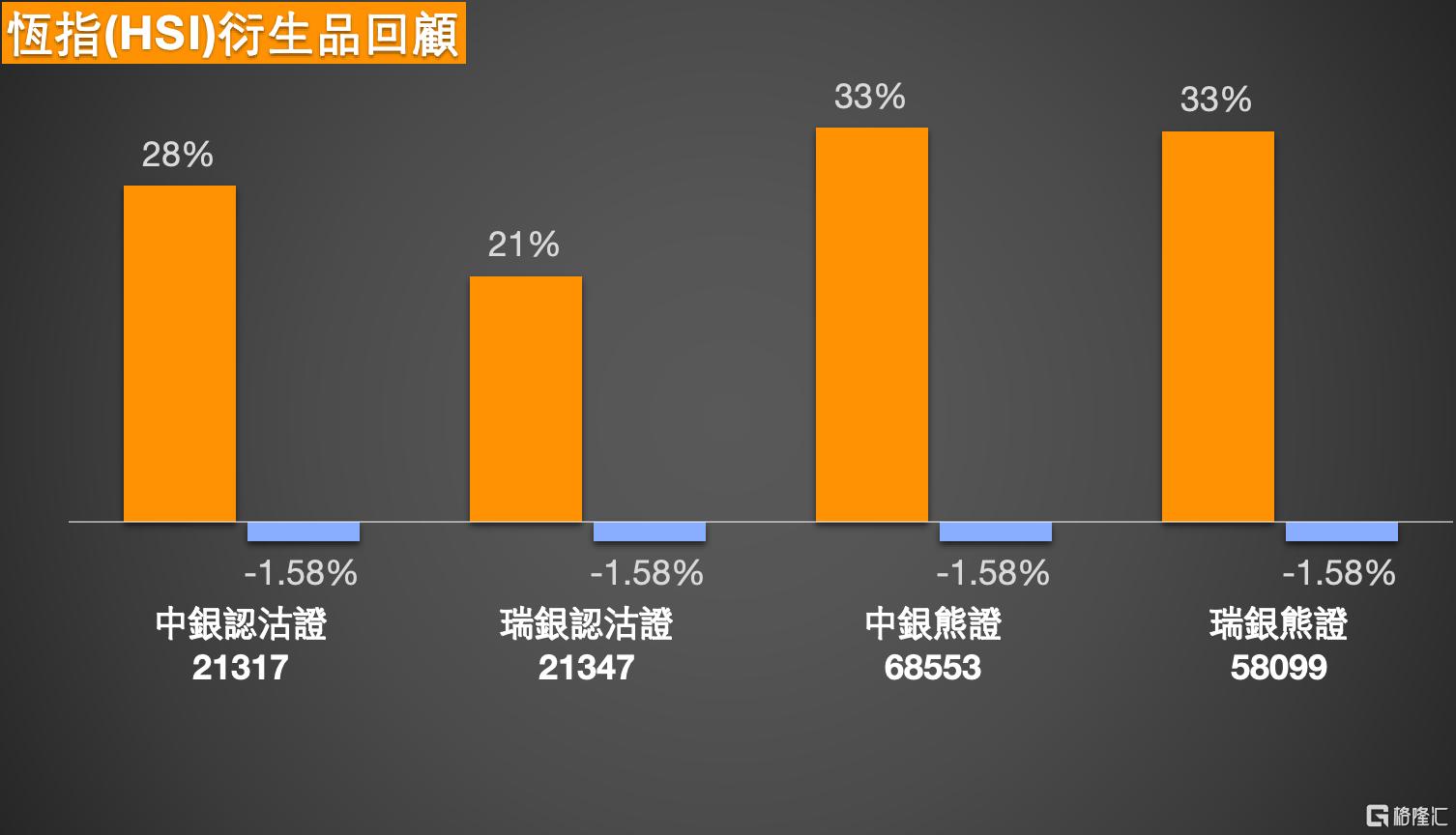
Group 1: Hang Seng Index (HSI) - The Hang Seng Index experienced a significant pullback after reaching a recent high of 28,000 points, closing around 27,300 points on January 30, with a decrease in trading volume compared to previous days but still at a relatively high level [2] - Investors are divided on the market outlook, with some viewing the pullback as a buying opportunity, while others are cautious about short-term volatility and are considering bear certificates [2] - Technical indicators show a bearish short-term signal with 9 sell signals and 6 buy signals, suggesting market sentiment is under pressure [2] Group 2: Contemporary Amperex Technology Co., Limited (CATL) - On January 30, CATL's stock price rose against the market trend, closing at 491 HKD, approaching the 500 HKD mark, with increased trading volume but still below the high levels seen in November [9] - Investors are focused on whether CATL can break through the 500 HKD level, with some looking at call options with a strike price of 629.38 HKD [9] - Technical indicators are neutral, with no clear direction for price movement, and resistance levels are set at 511 HKD and 520 HKD if the 500 HKD mark is surpassed [9] Group 3: Kuaishou Technology (Kuaishou) - Kuaishou's stock price adjusted to close at 80.15 HKD, maintaining the 80 HKD support level, with discussions on the potential to challenge the 90 HKD mark [15] - Technical indicators show a slight advantage for sell signals, indicating upward pressure, with resistance at 84.5 HKD and further at 86.8 HKD [15] - Investors interested in Kuaishou's bull certificates are advised to select products with a redemption price around 70 HKD or lower to mitigate risks [16] Group 4: Zijin Mining Group Co., Ltd. - Zijin Mining's stock price saw significant volatility, closing at 41.9 HKD, with a trading volume reaching a two-month high, indicating a technical pullback [22] - Investors remain optimistic about Zijin Mining, considering the recent drop as a short-term correction, with 38 HKD being a potential entry point [22] - Technical indicators show a slight predominance of sell signals, with key support at 38.5 HKD and further support at 36.3 HKD [22] Group 5: BYD Company Limited - BYD's stock price recorded a notable decline, closing at 97.75 HKD, having fallen below the middle line of the Bollinger Bands [28] - Technical indicators suggest a short-term support level at 94.6 HKD, with further support at 91.3 HKD, and resistance at 101.5 HKD [28] - Investors looking to position in BYD's bear certificates are recommended to choose products with a redemption price above 105 HKD to avoid risks associated with price rebounds [28] Group 6: AIA Group Limited - AIA's stock price fluctuated moderately, closing at 90.35 HKD, above the upper line of the Bollinger Bands, with increased trading volume [35] - Investors are optimistic about AIA's potential to challenge the 100 HKD mark, with technical indicators showing a slight predominance of sell signals [35] - Resistance levels are set at 92.6 HKD and 96.8 HKD, which need to be surpassed for a potential move towards the 100 HKD level [35]


瑞银:上调友邦保险目标价至106港元 重申“买入”评级
Zhi Tong Cai Jing· 2026-02-02 08:37
Group 1 - UBS estimates that AIA Group (01299) will see new business value (VNB) growth of 17% and 19% for 2025 based on fixed and actual exchange rates respectively, with a market consensus of 18% growth based on actual rates, indicating a year-on-year growth of 14% and 16% in Q4 [1] - The bank expects VNB growth in Hong Kong to slow down in Q4 compared to a 40% growth in Q3, but strong demand for the Global Flexi savings plan and sales continuation from September to October post-regulatory changes will maintain growth momentum [1] - In mainland China, AIA is expected to experience a moderate slowdown in VNB growth for the full year compared to a 5% increase in the first nine months, primarily because Q4 only accounts for 9% of the 2024 VNB [1] Group 2 - UBS has raised its 2025 earnings per share forecast by 11% to reflect strong market performance in the second half of the year, mainly due to the present value of future new business value increasing [2] - The intrinsic value forecast has been increased by 2% to reflect the upward trend in the stock market and the depreciation of the US dollar [2] - The valuation benchmark has been rolled forward to 2026 [2]
瑞银:上调友邦保险(01299)目标价至106港元 重申“买入”评级
智通财经网· 2026-02-02 08:33
Group 1 - UBS estimates that AIA Group's (01299) new business value (VNB) will grow by 17% and 19% in 2025 based on fixed and actual exchange rates, respectively, indicating a year-on-year growth of 14% and 16% in Q4 [1] - The target price for AIA has been raised from HKD 88 to HKD 106, maintaining a "Buy" rating [1] - In Hong Kong, VNB growth is expected to slow in Q4 compared to a 40% increase in Q3, but remains solid due to strong demand for the Global Flexi savings plan and sales momentum extending from September to October [1] Group 2 - In mainland China, VNB growth is anticipated to moderate compared to the first nine months, with a 5% increase, primarily because Q4 only accounts for 9% of the 2024 VNB [1] - In Thailand, a noticeable decline in Q4 is expected as demand was released earlier in the first nine months, with annualized new premiums decreasing by 2.9% from a growth of 8.5% in the first nine months [1] - In Singapore, strong VNB growth from Q3 is expected to continue into Q4, while in Malaysia, VNB growth is anticipated to accelerate in Q4 as the decline in the agency channel narrows [1] Group 3 - UBS has raised its 2025 earnings per share forecast by 11% to reflect strong market performance in the second half of the year, mainly due to the present value of future new business value [2] - The embedded value forecast has been increased by 2% to reflect the upward trend in the stock market and the depreciation of the US dollar [2] - The valuation benchmark has been rolled forward to 2026 [2]