
AIA(01299)

Search documents
The Capital Group Companies, Inc.增持友邦保险(01299)约48.49万股 每股作价约90.62港元
智通财经网· 2026-02-06 13:35
Group 1 - The Capital Group Companies, Inc. increased its stake in AIA Group Limited (01299) by acquiring 484,880 shares at a price of HKD 90.6171 per share, totaling approximately HKD 43.9384 million [1] - Following the acquisition, the total number of shares held by The Capital Group is approximately 526 million, representing a holding percentage of 5% [1]
友邦保险(01299.HK)获The Capital Group增持48.5万股
Ge Long Hui· 2026-02-06 12:55
Group 1 - The Capital Group Companies, Inc. increased its stake in AIA Group Limited (01299.HK) by purchasing 485,000 shares at an average price of HKD 90.6171 per share, totaling approximately HKD 43.94 million [1][2] - Following the purchase, The Capital Group's total shareholding in AIA Group reached 525,511,306 shares, representing 5.00% of the company's issued shares [1][2]


港股开盘受压 恒指低开1.97% 百度集团(09888)跌4.33%
Xin Lang Cai Jing· 2026-02-06 05:55
Market Overview - The Hong Kong stock market opened under pressure, with the Hang Seng Index down 1.97%, the National Enterprises Index down 1.88%, and the Hang Seng Tech Index down 2.42% [1][3] - Major stocks such as Baidu Group, Zijin Mining, AIA, and JD Health experienced declines of 4.33%, 4.14%, 4.02%, and 3.96% respectively [1][3] - Only a few blue-chip stocks, including Mengniu Dairy, Midea Group, and New Oriental, recorded slight gains [1][3] Company Specifics - China Overseas Development reported a 20.4% year-on-year increase in contract property sales amounting to approximately RMB 144.78 billion in January, while the sales area decreased by 12.9% to about 516,600 square meters [1][3] - The company anticipates that approximately RMB 111.46 billion in recognized property sales will convert into contract property sales in the coming months [1][3] - Meituan plans to acquire all issued shares of Dingdong, a leading fresh e-commerce company in mainland China, for an initial cost of USD 717 million, which is subject to adjustments [1][3] - NIO reported a positive earnings forecast, expecting adjusted operating profit (non-GAAP) between RMB 700 million (approximately USD 100 million) and RMB 1.2 billion (approximately USD 172 million) for Q4 2025, marking its first quarter of adjusted operating profit [2][4] - In contrast, NIO recorded an adjusted operating loss of RMB 5.5436 billion in Q4 2024 [2][4]

智通港股通持股解析|2月6日
智通财经网· 2026-02-06 00:31
Core Insights - The top three companies by stockholding ratio in the Hong Kong Stock Connect are China Telecom (71.39%), Gree Power Environmental (68.80%), and Haotian International Construction Investment (67.58%) [1] - Tencent Holdings, Xiaomi Group-W, and Pop Mart have seen the largest increases in stockholding amounts over the last five trading days, with increases of +36.02 billion, +22.89 billion, and +13.06 billion respectively [1] - Conversely, SMIC, Alibaba-W, and Zijin Mining International experienced the largest decreases in stockholding amounts, with reductions of -18.54 billion, -15.48 billion, and -11.14 billion respectively [2] Stockholding Ratios - The latest stockholding ratios for the top 20 companies in the Hong Kong Stock Connect are as follows: - China Telecom (00728): 99.09 million shares, 71.39% - Gree Power Environmental (01330): 2.78 million shares, 68.80% - Haotian International Construction Investment (01341): 75.00 million shares, 67.58% - Other notable companies include: - Kaisa New Energy (01108): 67.54% - Tianjin Chuangye Environmental Protection (01065): 66.84% [1] Recent Stock Increases - The top 10 companies with the largest stockholding increases in the last five trading days are: - Tencent Holdings (00700): +36.02 billion, +6.44 million shares - Xiaomi Group-W (01810): +22.89 billion, +6.55 million shares - Pop Mart (09992): +13.06 billion, +5.39 million shares - Other significant increases include: - Industrial and Commercial Bank of China (01398): +11.23 billion - China Merchants Bank (03968): +11.16 billion [1] Recent Stock Decreases - The top 10 companies with the largest stockholding decreases in the last five trading days are: - SMIC (00981): -18.54 billion, -2.75 million shares - Alibaba-W (09988): -15.48 billion, -0.97 million shares - Zijin Mining International (02259): -11.14 billion, -0.54 million shares - Other notable decreases include: - Zijin Mining (02899): -10.96 billion - Jiangxi Copper (00358): -6.97 billion [2]



友邦保险(01299) - 截至2026年1月31日止月份之股份发行人的证券变动月报表
2026-02-05 09:32
股份發行人及根據《上市規則》第十九B章上市的香港預託證券發行人的證券變動月報表 | 截至月份: | 2026年1月31日 | 狀態: 新提交 | | --- | --- | --- | | 致:香港交易及結算所有限公司 | | | | 公司名稱: | 友邦保險控股有限公司 | | | 呈交日期: | 2026年2月5日 | | | I. 法定/註冊股本變動 | 不適用 | | | 備註: | | | | 友邦保險控股有限公司(「本公司」)並無法定股本及/ 或其普通股並無股份面值。 | | | FF301 第 1 頁 共 11 頁 v 1.2.0 II. 已發行股份及/或庫存股份變動及足夠公眾持股量的確認 | 1. 股份分類 | 普通股 | | 股份類別 | 不適用 | | 於香港聯交所上市 (註1) | 是 | | | --- | --- | --- | --- | --- | --- | --- | --- | --- | | 證券代號 (如上市) | 01299 | | 說明 | | | | | | | 多櫃檯證券代號 | 81299 | RMB 說明 | | | | | | | | | | 已發行股份( ...
大摩闭门会-金融-房地产-化工行业更新
2026-02-05 02:21
Summary of Key Points from Conference Call Industry Overview Real Estate Market - The liquidity in the real estate market is constrained by sales rather than financing, with residents holding a pessimistic view on leveraging and housing prices. The cancellation of the "three red lines" has limited impact [1][3] - Recent increases in the real estate sector are primarily driven by market sentiment and capital rotation, with expectations of a pullback in February and March due to decreased transaction volumes during the Spring Festival and a generally poor outlook for 2025 [1][5] - Companies like Longfor, Greentown, and Jinmao may issue profit warnings due to expected underperformance [5] Recommendations - Companies to watch include China Resources Land and Xincheng Holdings, which are expected to benefit from commercial real estate operations and domestic demand stimulus policies. China Resources' performance in 2025 may not meet expectations, but growth in 2026 and 2027 is anticipated [1][6] Banking and Insurance Sector - The banking sector is starting the year rationally, with reasonable GDP growth across provinces supporting stable development. Strong sales in funds and insurance are beneficial for the market environment [1][7] - The insurance sector is expected to continue its growth trajectory, driven by strong sales, high profit margins, and good investment returns. Ping An Group aims for a mid-term ROE of over 15% through asset management loss reduction and improved life insurance profitability [1][8][10] Future Outlook for Insurance - The insurance industry is projected to maintain rapid growth in 2026, supported by expanded distribution networks and favorable regulatory policies [9] Chemical Industry - Recent stock performance in the chemical sector has exceeded expectations, with price increases driven by capital rotation rather than fundamental improvements. Current valuations are at high percentiles within a 10-year range, while product prices remain low [1][21] - Downgrades for companies like Xinghecheng and Wanhua are warranted due to valuations exceeding reasonable levels, with expectations of a market correction in the short term [1][22][23] Specific Company Insights - Xinghecheng faces significant pressure in 2026 due to intense competition in the methionine market and low vitamin prices, while Wanhua's MDI prices are weaker than expected [23] Additional Insights - Futu Holdings is accelerating the integration of Tianxing Bank, increasing its stake to 68%, and plans to launch more integrated banking and securities products in 2026 [1][14] - AIA (AIA Group) is expected to perform strongly in 2025, with a positive outlook for 2026, supported by a rebound in the Chinese market and ongoing share buyback plans [1][15] - Futu is also making strides in the cryptocurrency space, with applications for licenses in multiple regions, including Hong Kong, to enhance customer experience [1][16] This summary encapsulates the key points discussed in the conference call, highlighting the current state and future outlook of the real estate, banking, insurance, and chemical industries, along with specific company insights and recommendations.




智通ADR统计 | 2月5日





智通财经网· 2026-02-04 22:19
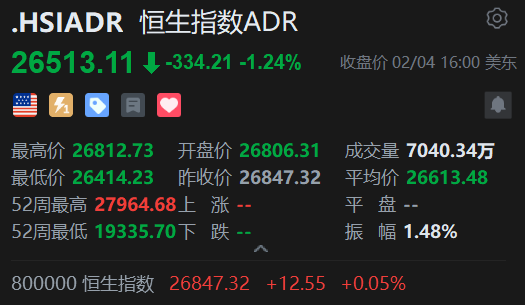
Market Overview - The Hang Seng Index (HSI) closed at 26,513.11, down by 334.21 points or 1.24% [1] - The index reached a high of 26,812.73 and a low of 26,414.23 during the trading session [1] - The trading volume was 70.4034 million shares, with an average price of 26,613.48 [1] Major Blue-Chip Stocks Performance - HSBC Holdings closed at HKD 139.704, up by 0.51% compared to the previous close [2][3] - Tencent Holdings closed at HKD 552.190, down by 1.04% compared to the previous close [2][3] - Alibaba Group (W) closed at HKD 159.500, down by 0.93% [3] - AIA Group closed at HKD 90.700, up by 1.40% [3] - Xiaomi Group (W) closed at HKD 33.960, down by 1.85% [3] - Meituan (W) closed at HKD 92.150, down by 1.13% [3] - China Ping An closed at HKD 72.050, up by 1.05% [3] ADR Performance - Tencent's ADR (TCEHY) was priced at USD 552.190, reflecting a decrease of 1.04% compared to its Hong Kong counterpart [3] - Alibaba's ADR (BABA) was priced at USD 155.411, down by 2.56% compared to its Hong Kong counterpart [3] - HSBC's ADR (HSBC) was priced at USD 139.704, up by 0.51% compared to its Hong Kong counterpart [3]
友邦保险:Shulamite N K Khoo及顾敏获委任为独立非执行董事
Zhi Tong Cai Jing· 2026-02-04 08:41
Group 1 - AIA Group Limited (01299) announced the appointment of Shulamite N K Khoo and Gu Min as independent non-executive directors, effective from February 5, 2026 [1]
友邦保险(01299.HK):Shulamite N K Khoo及顾敏获委任为独立非执行董事
Ge Long Hui· 2026-02-04 08:35
Group 1 - AIA Group (01299.HK) announced the appointment of Shulamite N K Khoo and Gu Min as independent non-executive directors, effective from February 5, 2026 [1]
友邦保险(01299):Shulamite N K Khoo及顾敏获委任为独立非执行董事
智通财经网· 2026-02-04 08:35
Group 1 - AIA Group Limited (01299) announced the appointment of Shulamite N K Khoo and Gu Min as independent non-executive directors, effective from February 5, 2026 [1]