PICC(01339)

Search documents
守护金融权益,点亮美好未来——人保寿险泰安中支走进社区开展金融知识宣传活动
Qi Lu Wan Bao· 2025-09-25 11:28
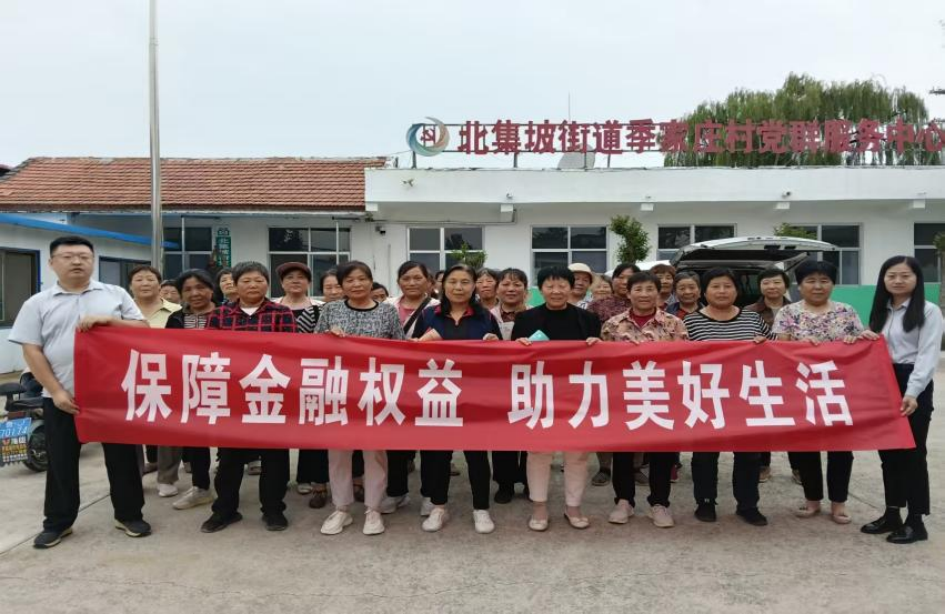
Core Viewpoint - The event organized by the company aims to enhance financial literacy and consumer rights protection, aligning financial services with the public's needs for a better life [1][3]. Group 1: Event Overview - The event took place on September 18 at the Beijipo Jizhaozhuang community, focusing on the theme "Protecting Financial Rights, Supporting a Better Life" [1]. - The initiative is part of the insurance industry's "Five Entrances" work requirements, promoting precise financial services and knowledge dissemination [1][3]. Group 2: Community Engagement - The event was held in a community党员活动室, creating an interactive platform for residents [3]. - Company staff distributed promotional materials covering eight key consumer rights, illegal fundraising risk warnings, and financial rights protection for the elderly [3]. - The focus was on preventing financial fraud, with staff providing examples of common scams and strategies for identification and response [3]. Group 3: Impact and Future Plans - The event successfully ignited community interest in financial knowledge and improved residents' financial literacy and risk prevention capabilities [3]. - The company plans to continue enhancing consumer rights protection by promoting financial education and innovating outreach activities [4]. - The commitment to a "service-first" philosophy aims to improve insurance protection capabilities and contribute to a stable financial environment [4].

人保寿险菏泽中支市县联动开展宣传 筑牢金融安全防线
Qi Lu Wan Bao· 2025-09-25 11:21
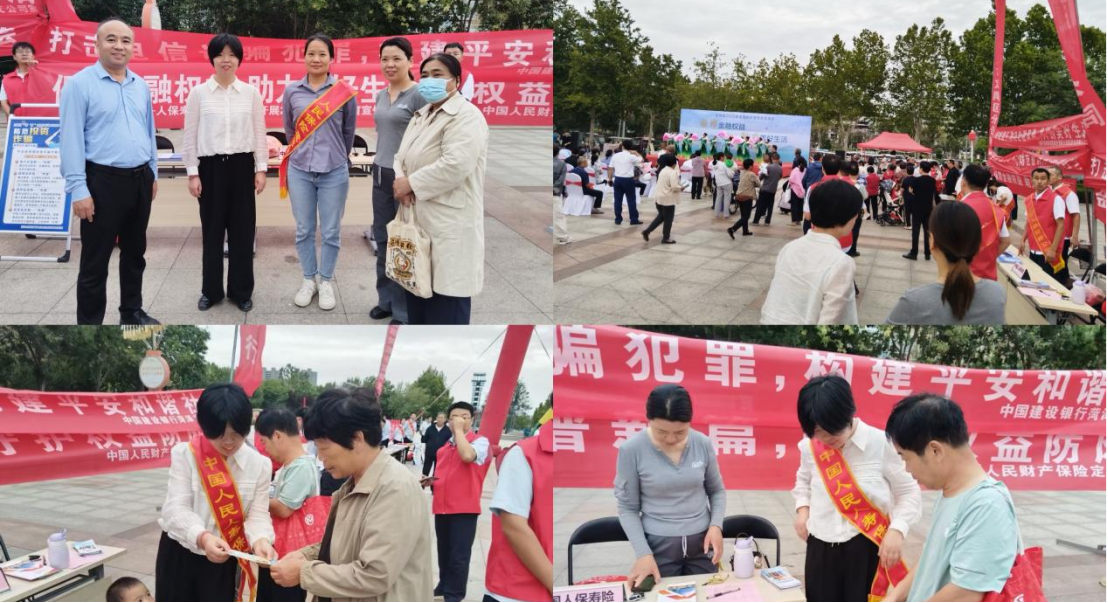
Group 1 - The core message of the initiative is to enhance public awareness of financial risks and improve financial literacy through a series of educational activities [1][3] - The campaign is titled "Protecting Financial Rights, Supporting a Better Life" and aims to deepen the warning against illegal fundraising risks [1] - The promotional team focuses on community engagement by conducting presentations in public areas, using simple language and case studies to explain financial fraud scenarios [3] Group 2 - The initiative emphasizes the importance of not trusting suspicious calls or messages, advising the public to report immediately and refrain from transferring money [3] - It aims to demystify financial safety concepts by addressing the traps behind high-interest temptations, making financial knowledge more accessible to the public [3] - The campaign showcases the responsibility of financial institutions, enhancing public trust and contributing positively to the healthy development of the financial industry [3]
人保寿险济宁中支深化“五进入”宣传 把金融安全与服务送上门
Qi Lu Wan Bao· 2025-09-25 11:20
Core Viewpoint - The company is actively promoting financial literacy and risk prevention through a series of targeted outreach activities, emphasizing a people-centered development approach [1][4]. Group 1: Outreach Activities - The company has launched the "Five Entering" initiative, which includes targeted financial education efforts in rural areas, communities, enterprises, and business districts [4]. - In rural areas, the company focuses on educating vulnerable groups such as the elderly and left-behind women and children through personalized, on-the-ground presentations [1][3]. - In community settings, the company has established knowledge dissemination platforms, utilizing interactive methods like quizzes to engage residents and enhance their understanding of personal finance and fraud prevention [3][4]. - The company is providing specialized services to enterprises, helping them understand financial tools and highlighting risks such as credit and settlement risks [3][4]. - In business districts, mobile teams are distributing customized materials to educate merchants and consumers about payment safety and fraud recognition [3]. Group 2: Impact and Future Plans - The "Five Entering" activities have successfully increased financial literacy and risk awareness among various demographic groups, contributing to a better understanding of financial products and services [4]. - The company plans to continue its efforts in financial knowledge dissemination, aiming for a sustainable and long-term impact on consumer rights protection and the overall financial ecosystem [4].

美国资本集团增持中国人保70.8万股 每股作价约6.42港元
Zhi Tong Cai Jing· 2025-09-25 11:17
香港联交所最新资料显示,9月23日,美国资本集团增持中国人保(601319)(01339)70.8万股,每股作 价6.4193港元,总金额约为454.49万港元。增持后最新持股数目为4.37亿股,最新持股比例为5.00%。 ...
美国资本集团增持中国人保(01339)70.8万股 每股作价约6.42港元
智通财经网· 2025-09-25 11:10
Group 1 - The core point of the article is that American Capital Group has increased its stake in China Life Insurance (01339) by purchasing 708,000 shares at a price of HKD 6.4193 per share, totaling approximately HKD 4.5449 million [1] - After the purchase, American Capital Group's total holdings in China Life Insurance amount to 437 million shares, representing a 5.00% ownership stake [1]
中国人民保险集团(01339.HK):9月23日南向资金减持847.5万股
Sou Hu Cai Jing· 2025-09-25 10:31
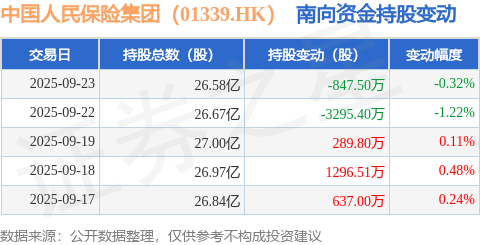
Group 1 - The core point of the news is that southbound funds have reduced their holdings in China People's Insurance Group (01339.HK) by 8.475 million shares on September 23, 2025, marking a decrease of 0.32% [1][2] - Over the past five trading days, there have been two days of net reductions in holdings, totaling 19.196 million shares [1][2] - In the last 20 trading days, there were 14 days of net increases in holdings, amounting to a total of 70.1964 million shares [1][2] Group 2 - As of now, southbound funds hold 2.658 billion shares of China People's Insurance Group, which represents 30.45% of the company's total issued ordinary shares [1][2] - The company primarily provides insurance products, including property insurance, health insurance, life insurance, reinsurance, Hong Kong insurance, and pension insurance [2] - The property insurance segment includes products for both corporate and individual clients, such as motor vehicle insurance, agricultural insurance, property insurance, and liability insurance [2]
港股通央企红利ETF天弘(159281)跌1.03%,成交额4068.29万元
Xin Lang Cai Jing· 2025-09-25 09:16
Core Viewpoint - The Tianhong CSI Hong Kong Stock Connect Central State-Owned Enterprises Dividend ETF (159281) experienced a decline of 1.03% in its closing price on September 25, with a trading volume of 40.68 million yuan [1]. Group 1: Fund Overview - The Tianhong CSI Hong Kong Stock Connect Central State-Owned Enterprises Dividend ETF was established on August 20, 2025, with an annual management fee of 0.50% and a custody fee of 0.10% [1]. - As of September 24, the fund's latest share count is 344 million shares, with a total size of 335 million yuan [1]. - The current fund manager is He Yuxuan, who has managed the fund since its inception, with a performance return of -2.80% during the management period [1]. Group 2: Fund Holdings - The top holdings of the Tianhong ETF include: - China COSCO Shipping (0.85% holding, 218,000 shares, market value of 2.9175 million yuan) - Orient Overseas International (0.40% holding, 10,500 shares, market value of 1.3717 million yuan) - China Foreign Transport (0.33% holding, 270,000 shares, market value of 1.1396 million yuan) - China National Petroleum (0.32% holding, 162,000 shares, market value of 1.0973 million yuan) - CITIC Bank (0.32% holding, 175,000 shares, market value of 1.1136 million yuan) - CNOOC (0.29% holding, 58,000 shares, market value of 1.0041 million yuan) - China Shenhua Energy (0.29% holding, 30,500 shares, market value of 982,600 yuan) - China People's Insurance Group (0.29% holding, 164,000 shares, market value of 1.0107 million yuan) - China Unicom (0.28% holding, 104,000 shares, market value of 952,800 yuan) - Agricultural Bank of China (0.27% holding, 189,000 shares, market value of 933,900 yuan) [2].


不止于保险!险企布局健康管理,已是“必选项”
Huan Qiu Wang· 2025-09-25 08:53
Core Insights - The recent approval by the National Financial Supervision Administration for PICC Health to invest 200 million RMB in establishing PICC Health Management Co., reflects a significant shift in the health insurance sector towards integrating health management services with traditional insurance offerings [1][3] - Insurance companies are increasingly adopting a "health insurance + health management" strategy, enhancing service offerings beyond mere policy sales to include comprehensive health-related services for consumers [3][4] Industry Trends - Major insurance firms, including China Life and Ping An, are actively establishing health management subsidiaries, indicating a growing trend in the industry to provide integrated health services alongside insurance products [3][4] - The health insurance market is expanding, driven by regulatory reforms such as DRG and DIP, which create opportunities for product innovation and a new multi-layered health insurance framework [5][6] Policy Environment - The upcoming "National Ten Articles" in 2024 aims to enhance health insurance service levels and promote the integration of commercial health insurance with health management [5] - The "Health Insurance Management Measures" implemented in December 2019 allows insurance companies to combine health insurance products with health management services, emphasizing preventive care and risk assessment [5][6] Strategic Implications - Insurance companies are focusing on proactive health management to reduce claims and improve profitability, while also enhancing customer loyalty through differentiated product offerings [6][7] - The integration of health management into insurance is becoming essential, with a shift towards personalized services and dynamic pricing models based on health data [6][7]



保险板块9月25日跌0.33%,中国人保领跌,主力资金净流出2.74亿元
Zheng Xing Xing Ye Ri Bao· 2025-09-25 08:37
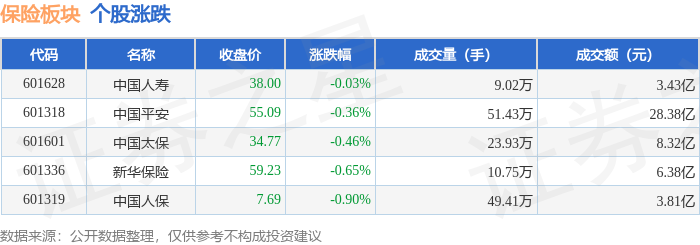
证券之星消息,9月25日保险板块较上一交易日下跌0.33%,中国人保领跌。当日上证指数报收于 3853.3,下跌0.01%。深证成指报收于13445.9,上涨0.67%。保险板块个股涨跌见下表: 从资金流向上来看,当日保险板块主力资金净流出2.74亿元,游资资金净流出4946.39万元,散户资金净 流入3.23亿元。保险板块个股资金流向见下表: | 代码 | 名称 | 主力净流入 (元) | 主力净占比 游资净流入 (元) | | 游资净占比 散户净流入 (元) | | 散户净占比 | | --- | --- | --- | --- | --- | --- | --- | --- | | 601628 中国人寿 | | 1462.03万 | 4.27% | -1235.89万 | -3.61% | -226.14万 | -0.66% | | 601319 中国人保 | | -4068.55万 | -10.68% | 528.42万 | 1.39% | 3540.14万 | 9.30% | | 601601 中国太保 | | -5835.77万 | -7.01% | -4177.25万 | -5.02% | 1 ...


2025上半年度10家上市寿险公司分析
Sou Hu Cai Jing· 2025-09-25 05:38
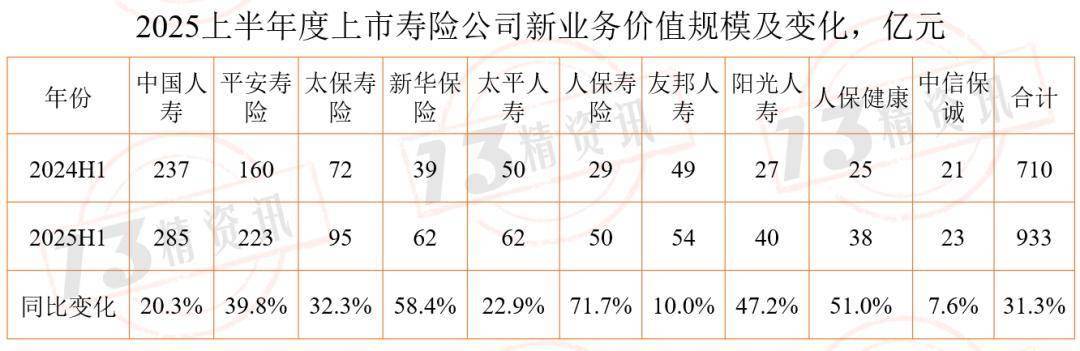
Core Insights - The new business value of listed life insurance companies in China saw a significant increase of 31.3% in the first half of 2025, with all but one company achieving double-digit growth [1][24][26]. New Business Value - In the first half of 2025, the new business value for listed life insurance companies totaled 933 billion yuan, with notable growth from major players such as China Life (285 billion yuan, +20.3%) and Ping An Life (223 billion yuan, +39.8%) [24][25]. - The overall new business value rate for the industry increased by 6.7 percentage points, reaching a weighted average of 27.8% [30][34]. New Single Premiums - The total new single premium income for listed life insurance companies in the first half of 2025 was 5,227 billion yuan, reflecting a year-on-year growth of 7.8% [38]. - However, the agent channel saw a decline of 13.8% in new single premiums, while the bancassurance channel experienced a robust growth of 61.1% [8][16][40]. Factors Influencing Growth - The increase in new business value and value rate is attributed to the adjustment of preset interest rates and the implementation of cost control policies under the "reporting and operation integration" framework [4][14][34]. - The shift from guaranteed products to floating yield products has increased sales difficulty, impacting the attractiveness of insurance products [6][47]. Agent Channel Performance - The number of agents decreased by 2.9% to 1.605 million, with average productivity dropping by 11.3% to 139,000 yuan per agent [51][55]. - Despite the decline in agent numbers, the overall industry is showing resilience through the growth in the bancassurance channel, which compensates for the downturn in the agent channel [64].