
PICC(01339)

Search documents
鹤壁金融监管分局同意撤销中国人保财险鹤壁市分公司浚县城区营销服务部
Jin Tou Wang· 2025-09-03 04:16
一、同意撤销中国人民财产保险股份有限公司鹤壁市分公司浚县城区营销服务部。 2025年8月27日,鹤壁金融监管分局发布批复称,《关于撤销中国人民财产保险股份有限公司鹤壁市分 公司浚县城区营销服务部的请示》(鹤人保财险发〔2025〕27号)收悉。经审核,现批复如下: 二、接此批复文件后,中国人民财产保险股份有限公司应立即停止该机构一切经营活动,于15个工作日 内向鹤壁金融监管分局缴回许可证,并按照有关法律法规要求办理相关手续。 ...

巴中监管分局同意人保寿险巴中中心支公司变更营业场所
Jin Tou Wang· 2025-09-03 04:16
二、中国人民人寿保险股份有限公司应按照有关规定及时办理变更及许可证换领事宜。 2025年8月26日,国家金融监督管理总局巴中监管分局发布批复称,《关于申请中国人民人寿保险股份 有限公司巴中中心支公司营业场所变更的请示》(人保寿险川〔2025〕59号)收悉。经审核,现批复如 下: 一、同意中国人民人寿保险股份有限公司巴中中心支公司将营业场所变更为:四川省巴中市巴州区回风 路83号写字楼7楼1号。 ...
“稳进兼备”成保险业半年报关键词
Huan Qiu Wang· 2025-09-03 01:40
Group 1: Insurance Premium Growth - The insurance industry in China reported a premium income of 3.7 trillion yuan in the first half of 2025, marking a year-on-year increase of 5.1% [2] - Major insurance companies such as China Life and China Pacific have shown continuous growth in premium income, with China Life achieving a record high of 525.09 billion yuan, up 7.3% year-on-year [2][3] - China Pacific's premium income from property insurance reached 323.3 billion yuan, reflecting a 3.6% increase, maintaining the industry's leading market share of 33.5% [3] Group 2: Enhanced Insurance Capacity - The insurance industry has strengthened its capital operation capabilities, with New China Life achieving an annualized total investment return rate of 5.9%, up 1.1 percentage points year-on-year [3] - The total assets of insurance companies and asset management companies reached 39.2 trillion yuan by the end of the second quarter of 2025, an increase of 3.3 trillion yuan since the beginning of the year [5] - The industry is actively integrating into national development strategies and enhancing service to the real economy, with Ping An Property & Casualty developing 1,741 products to provide risk protection for small and micro enterprises [5] Group 3: Technological Advancements - China Pacific is leveraging AI technology to optimize insurance business processes, with AI applications covering nearly half of customer service interactions and achieving a 99% accuracy rate in liability recognition [4] - The automation rate for health insurance claims has reached 16%, with a 47% reduction in average costs per case [4]



“低供体”模式合力护航低空经济“飞得稳”
Jin Rong Shi Bao· 2025-09-03 00:50
Core Insights - The low-altitude economy is rapidly integrating into various sectors, becoming a new driver for economic growth, but it also faces challenges such as technical risks and operational disputes [1][2] - The establishment of the first low-altitude economic mutual insurance body in Chongqing aims to address the insurance supply-demand mismatch in this emerging industry [1][5] Group 1: Low-Altitude Economy Overview - The low-altitude economy involves activities below 1,000 meters, including drone logistics, agricultural protection, and urban air traffic, with the drone industry accounting for approximately 85% of this market [2] - China's low-altitude economy market is projected to reach 1.5 trillion yuan by 2025 and 3.5 trillion yuan by 2035, supported by favorable government policies [2][3] Group 2: Insurance Demand and Development - The safety of low-altitude operations is critical, as risks such as signal interference and network attacks are more complex than ground activities [2] - Insurance companies are actively developing products tailored to the low-altitude economy, with over 30% of property insurance firms already engaged in related business [3][5] Group 3: Chongqing's Initiatives - Chongqing has launched a comprehensive action plan to promote the high-quality development of the low-altitude economy, with 147 related enterprises established and 40 key projects planned, amounting to an investment of 28.84 billion yuan [4][5] Group 4: Insurance Product Development - The mutual insurance body has developed the "Yudikongbao" insurance products, focusing on key risk areas such as drone liability and network security, providing coverage for 16 low-altitude economy enterprises [5] - The core goal of the mutual insurance body is to address the insurance supply-demand mismatch in the low-altitude economy [5] Group 5: Challenges in Insurance Sector - The insurance sector faces challenges in product pricing and standardization, as current pricing models are based on historical data, which is insufficient for the diverse applications of drones [6][7] - There is a lack of standardized risk definitions and industry norms, complicating the formulation of insurance terms and claims processes [6][7] Group 6: Talent Development - The low-altitude economy requires professionals with expertise in aviation technology, insurance actuarial models, and risk management, but there is a shortage of such talent [7] - Educational institutions are encouraged to develop courses related to low-altitude economy insurance to foster a skilled workforce [7]



上市险企半年报:总投资收益增9%,新华保险收益率领跑行业
Sou Hu Cai Jing· 2025-09-02 19:43
Core Insights - The five major listed insurance companies in the A-share market have released their semi-annual reports for 2025, highlighting significant investment dynamics and performance in the capital market [1] Investment Dynamics - The total stock investment of the five major insurance companies reached 1,846.43 billion yuan by the end of Q2, an increase of 411.86 billion yuan from the beginning of the year, reflecting a nearly 30% growth [1] - This increase indicates the insurance companies' confidence in the equity market and recognition of long-term investment value [1] Investment Performance - The five major insurance companies collectively achieved a total investment income of 367.38 billion yuan in the first half of the year, representing a year-on-year growth of nearly 9% [1] - China Life Insurance led with a total investment income of 127.51 billion yuan, accounting for over 30% of the total, attributed to its large investment asset scale [1] - New China Life Insurance reported an annualized total investment return rate of 5.9%, leading the industry and showcasing its efficient investment strategy [2] Return Rate Disparity - There is a notable disparity in the total investment return rates among the insurance companies, with New China Life and China Pacific Insurance achieving annualized rates of 5.9% and 5.1%, respectively, both showing significant year-on-year growth [2] - In contrast, China Life and China Taiping reported lower return rates of 3.29% and 2.3%, respectively [2] - China Ping An did not disclose its annualized return rate but achieved a non-annualized comprehensive investment return rate of 3.1%, up by 0.3 percentage points year-on-year [2] Asset Scale and Strategy - China Life and China Ping An are in the leading tier with investment assets of 7.13 trillion yuan and 6.20 trillion yuan, respectively [2] - China Taiping, China Pacific Insurance, and New China Life follow closely, with their asset scales gradually converging [2] - The differentiation in asset scale influences the investment strategies and performance of each insurance company [2] Market Adaptation - In response to low bond market interest rates and structural differentiation in the stock market, insurance funds have become a crucial stabilizing force in the capital market [2] - Insurance companies are adjusting their asset allocation strategies to adapt to market changes, such as New China Life expanding its equity layout through private equity funds and China Life increasing its allocation to high-dividend assets [2] Investment Strategy Implementation - China Ping An's co-CEO emphasized that the investment strategy is integral to the company's asset matching, focusing on duration, cost, cash flow, yield, and regulatory requirements to achieve a linkage between investment and liability [4] - This precise implementation of investment strategy allows China Ping An to maintain stable investment returns even in complex market conditions [4] - The trend of increasing stock asset allocation among insurance companies is expected to enhance investment returns and promote stable development in the capital market [4] Overall Performance - The five major listed insurance companies demonstrated robust investment styles and flexible market adaptability in their first-half investment performance [4] - As market conditions continue to evolve, these companies will further adjust and optimize their investment strategies to achieve more sustainable and efficient investment returns [4]



从首张保单到为全域提供风险保障 中国人保护航西藏高质量发展
Jin Rong Shi Bao· 2025-09-02 16:40
Core Viewpoint - China People's Insurance Company (CPIC) has significantly contributed to the development of the insurance industry in Tibet over the past 30 years, establishing a comprehensive risk protection system that supports various sectors including rural revitalization and disaster response [3][4]. Group 1: Historical Development - CPIC established its first branch in Tibet in 1987, marking the beginning of the insurance industry in the region with an initial investment of 3 million yuan and a small team [3]. - Over the years, CPIC has expanded to 89 branches and 686 service stations across Tibet, providing a wide range of insurance products to meet diverse needs [4]. Group 2: Social Responsibility and Community Engagement - Since 2011, CPIC has sent 8 village work teams annually, involving 186 members and investing nearly 100 million yuan in rural development [6]. - The company has introduced innovative insurance products such as the "poverty alleviation income insurance," benefiting 75,000 individuals at risk of falling back into poverty [6]. Group 3: Economic Contributions - CPIC has provided risk coverage of 1.88 trillion yuan for 284 key construction projects in Tibet, including major infrastructure developments [7]. - The company has also supported ecological projects, offering 14.5 billion yuan in risk coverage for ecological public forests in Nyingchi City [7]. Group 4: Disaster Response and Emergency Support - Following the 6.8 magnitude earthquake in Dingri County in January 2025, CPIC quickly mobilized resources, providing 230,000 yuan worth of emergency supplies and 190 million yuan in insurance coverage for disaster recovery efforts [9]. - The company has demonstrated a rapid response capability, completing insurance claims for the earthquake within 10 days, totaling 173 million yuan [8][9]. Group 5: Employment and Economic Development - CPIC has facilitated job placements for 252 Tibetan university graduates since 2020, creating 516 job opportunities in impoverished areas [9]. - The company's initiatives reflect a commitment to enhancing local livelihoods and supporting sustainable economic growth in Tibet [9].
4家上市险企中期分红近300亿元
Bei Jing Shang Bao· 2025-09-02 16:30
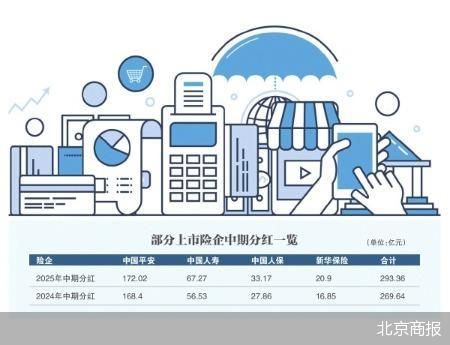
Core Viewpoint - The five major listed insurance companies in A-shares announced their mid-term profit distribution plans alongside their 2025 semi-annual reports, with a total dividend amount of approximately 29.336 billion yuan (including tax) [1][3]. Group 1: Profit Distribution - China Ping An plans to distribute a mid-term cash dividend of 0.95 yuan per share, totaling 17.202 billion yuan, with a year-on-year increase of 2.2% in the dividend per share [3][4]. - China Life, China Pacific Insurance, and New China Life plan to distribute mid-term cash dividends of 6.727 billion yuan, 3.317 billion yuan, and 2.09 billion yuan, respectively, contributing to the total dividend of approximately 29.336 billion yuan [3][4]. Group 2: Financial Performance - In the first half of the year, the five major listed insurance companies achieved a total net profit of 178.192 billion yuan, representing a year-on-year growth of 3.7% [3][5]. - The capital market recovery has led to a significant increase in investment income for many listed insurance companies [3]. Group 3: Dividend Policy and Market Impact - Stable dividends enhance market confidence and help shape a robust operational image, attracting long-term value investors [4]. - High dividends can better reward investors but may constrain the company's internal capital accumulation and potential investment capabilities [5]. Group 4: Accounting Standards and Future Outlook - The implementation of new financial instrument standards has increased the volatility of net profits, affecting the continuity and stability of dividend policies [6]. - Companies are considering long-term growth and regulatory guidelines when formulating their dividend policies, aiming for sustainable returns for shareholders [6][7].
中国人保9月2日大宗交易成交1071.68万元
Zheng Quan Shi Bao Wang· 2025-09-02 15:24
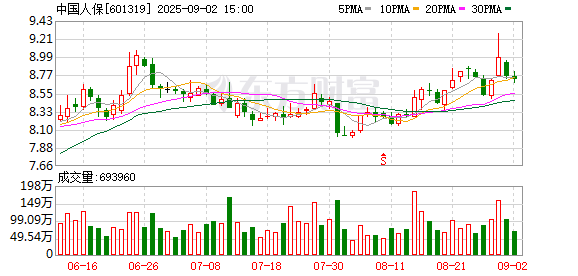
Group 1 - China Pacific Insurance (CPIC) executed a block trade on September 2, with a transaction volume of 1.36 million shares and a transaction value of 10.72 million yuan, at a price of 7.88 yuan, which represents a discount of 9.63% compared to the closing price of the day [2][3] - The closing price of CPIC on the same day was 8.72 yuan, reflecting a decrease of 0.34%, with a turnover rate of 0.20% and a total trading volume of 607 million yuan, indicating a net outflow of 2.18 million yuan in main funds [2][3] - Over the past five days, CPIC's stock has seen a cumulative decline of 0.23%, while the total net inflow of funds during this period was 9.72 million yuan [2][3] Group 2 - The latest margin financing balance for CPIC is 1.574 billion yuan, which has increased by 103 million yuan over the past five days, representing a growth rate of 7.02% [3] - In terms of institutional ratings, seven institutions have provided ratings for CPIC in the last five days, with Huachuang Securities setting the highest target price at 10.30 yuan in a report published on August 28 [3]
金融中报观|资本充足与回馈股东,上市险企中期分红背后的平衡术
Bei Jing Shang Bao· 2025-09-02 12:11
Core Viewpoint - The five major listed insurance companies in A-shares announced their mid-term profit distribution plan, with a total dividend amount of approximately 29.336 billion yuan (including tax) [1][3]. Group 1: Dividend Distribution - The five major listed insurance companies, excluding China Pacific Insurance, announced mid-term dividends, with China Ping An distributing 17.202 billion yuan, China Life 6.727 billion yuan, China Pacific Insurance 3.317 billion yuan, and New China Life 2.090 billion yuan [3][4]. - The total net profit of these five companies reached 178.192 billion yuan in the first half of the year, reflecting a year-on-year growth of 3.7% [3][5]. - The mid-term dividend distribution is seen as "stable and slightly positive," aligning with the companies' profitability while balancing shareholder returns and capital safety [3][4]. Group 2: Dividend Policy and Market Impact - The continuous dividend policy of these companies enhances market confidence and attracts long-term value investors, contributing to their market capitalization management [4]. - High dividends can improve shareholder returns but may restrict internal capital accumulation and potential investment capabilities [5]. - The implementation of new financial instrument standards has increased profit volatility, affecting the stability of dividend policies [5][6]. Group 3: Future Outlook - Despite increased profit volatility due to new financial standards, insurance companies are expected to maintain dividend policy continuity through smoothing mechanisms and adjusting dividend ratios [6]. - The industry is anticipated to focus more on shareholder returns, with a long-term goal of stable growth in per-share dividends [6].

金融中报观|资本充足与回馈股东 上市险企中期分红背后的平衡术
Bei Jing Shang Bao· 2025-09-02 12:07
Core Viewpoint - The five major listed insurance companies in A-shares announced a mid-term profit distribution plan, with a total dividend amount of approximately 29.336 billion yuan (including tax) [1][2]. Group 1: Mid-term Dividend Distribution - The five major listed insurance companies, excluding China Pacific Insurance, announced mid-term dividends, with China Ping An distributing 17.202 billion yuan, China Life 6.727 billion yuan, China Pacific Insurance 3.317 billion yuan, and Xinhua Insurance 2.090 billion yuan [2][3]. - The total net profit of these companies reached 178.192 billion yuan in the first half of the year, reflecting a year-on-year growth of 3.7% [2]. Group 2: Importance of Stable Dividends - Stable dividends enhance market confidence and attract long-term value investors, contributing to the companies' market position [3]. - The continuous dividend policy of these companies is seen as a strategy for effective market value management [3]. Group 3: Balancing Dividends and Business Development - High dividends can improve shareholder returns but may restrict internal capital accumulation and investment capacity [4]. - The implementation of new financial instrument standards has increased profit volatility, affecting the stability of dividend policies [4]. Group 4: Future Outlook - Despite increased profit volatility due to new financial standards, companies can maintain dividend policy continuity through smoothing mechanisms and adjusting dividend ratios [5]. - The industry is expected to focus more on shareholder returns, with a long-term goal of stable growth in per-share dividends [5].