
HUA HONG SEMI(01347)

Search documents
华虹公司(688347) - 港股公告:月度更新
2025-10-16 09:30
香港交易及結算所有限公司及香港聯合交易所有限公司對本公告的內容概不負責,對其準確性 或完整性亦不發表任何聲明,並明確表示,概不就因本公告全部或任何部分內容而產生或因依 賴該等內容而引致的任何損失承擔任何責任。 本公告僅供參考,並不構成收購、購買或認購本公司證券的邀請或要約。 HUA HONG SEMICONDUCTOR LIMITED 華虹半導體有限公司 (於香港註冊成立之有限公司) (股份代號:01347) 月度更新 內容有關 (1) 主要及關連交易-收購協議 (2) 建議非公開發行人民幣股份以募集配套資金 及 (3) 申請清洗豁免 茲提述(i)本公司日期為二零二五年八月三十一日之公告,內容有關(其中包括)(a) 建議收購事項、(b)建議非公開發行人民幣股份及(c)清洗豁免(「交易公告」);及 (ii)本公司日期為二零二五年九月十九日之公告(「延期公告」),內容有關(其中包 括)延遲寄發通函(連同交易公告,統稱「該等公告」)。除另有界定者外,本公告 所用詞彙與該等公告所界定者具有相同涵義。 本公司謹此通知股東及本公司潛在投資者,於本公告日期,本公司正與其他各方 就建議收購事項的條款(包括但不限於補充協議及標 ...
华虹半导体(01347) - 月度更新内容有关(1) 主要及关连交易-收购协议(2) 建议非公开发行...
2025-10-16 08:30
本公告僅供參考,並不構成收購、購買或認購本公司證券的邀請或要約。 HUA HONG SEMICONDUCTOR LIMITED 香港交易及結算所有限公司及香港聯合交易所有限公司對本公告的內容概不負責,對其準確性 或完整性亦不發表任何聲明,並明確表示,概不就因本公告全部或任何部分內容而產生或因依 賴該等內容而引致的任何損失承擔任何責任。 華虹半導體有限公司 (於香港註冊成立之有限公司) (股份代號:01347) 月度更新 內容有關 (1) 主要及關連交易-收購協議 (2) 建議非公開發行人民幣股份以募集配套資金 及 (3) 申請清洗豁免 茲提述(i)本公司日期為二零二五年八月三十一日之公告,內容有關(其中包括)(a) 建議收購事項、(b)建議非公開發行人民幣股份及(c)清洗豁免(「交易公告」);及 (ii)本公司日期為二零二五年九月十九日之公告(「延期公告」),內容有關(其中包 括)延遲寄發通函(連同交易公告,統稱「該等公告」)。除另有界定者外,本公告 所用詞彙與該等公告所界定者具有相同涵義。 本公司謹此通知股東及本公司潛在投資者,於本公告日期,本公司正與其他各方 就建議收購事項的條款(包括但不限於補充協議及標 ...
产能利用率优于预期,晶圆代工厂酝酿涨价
Xuan Gu Bao· 2025-10-15 23:42
Group 1 - The core viewpoint is that the capacity utilization rate of foundries is expected to remain stable due to low inventory levels among chip design companies, the peak sales season for smartphones, and strong ongoing demand for AI [1] - Some foundries are considering price increases for tight process platforms such as BCD and Power due to better-than-expected performance in Q4 compared to Q3 [1] - The importance of domestic foundries is highlighted by the surge in demand for advanced foundry services driven by domestic computing infrastructure and the "China for China" strategy [1] Group 2 - According to SEMI, the CAGR for Chinese wafer fabs from 2024 to 2028 is projected to be 8.1%, surpassing the global average of 5.3% [2] - The CAGR for mature nodes (55nm and above) in China is expected to be 3.7%, while mainstream nodes (22nm-40nm) will see a CAGR of 26.5%, and advanced nodes (14nm and below) will have a CAGR of 5.7% [2] - By 2024, China's mainstream node capacity is expected to account for 25% of the global total, increasing to 42% by 2028 [2] Group 3 - Major domestic foundries include SMIC, Hua Hong Semiconductor, Jinghong Integrated Circuit, Yandong Microelectronics, and ChipLink Integrated [3]



智通港股通资金流向统计(T+2)|10月16日
智通财经网· 2025-10-15 23:33
Core Insights - The article highlights the net inflow and outflow of funds in the Hong Kong stock market, with specific focus on the top gainers and losers in terms of capital movement [1][2][3] Net Inflow Summary - The top three stocks with the highest net inflow are: - Yingfu Fund (02800) with a net inflow of 5.873 billion, representing a 16.92% increase in capital [2] - Hang Seng China Enterprises (02828) with a net inflow of 1.738 billion, showing an 8.61% increase [2] - Huahong Semiconductor (01347) with a net inflow of 1.340 billion, reflecting a 13.36% increase [2] Net Outflow Summary - The top three stocks with the highest net outflow are: - Tencent Holdings (00700) with a net outflow of -2.444 billion, indicating a -10.13% decrease [2] - Alibaba-W (09988) with a net outflow of -1.680 billion, showing a -3.71% decrease [2] - Innovent Biologics (01801) with a net outflow of -734 million, reflecting a -30.27% decrease [2] Net Inflow Ratio Summary - The stocks with the highest net inflow ratio are: - Wisdom Hong Kong 100 (02825) with a net inflow ratio of 100.00% [3] - GX Hang Seng Technology (02837) with a net inflow ratio of 89.15% [3] - Xinhua Wencuan (00811) with a net inflow ratio of 59.93% [3] Net Outflow Ratio Summary - The stocks with the highest net outflow ratio are: - Midea Real Estate (03990) with a net outflow ratio of -51.51% [3] - Kangji Medical (09997) with a net outflow ratio of -49.51% [3] - Baifu Global (00327) with a net outflow ratio of -47.37% [3]
北水成交净卖出54.43亿 内资再度加仓科网股 抛售盈富基金超85亿港元
Zhi Tong Cai Jing· 2025-10-15 21:24
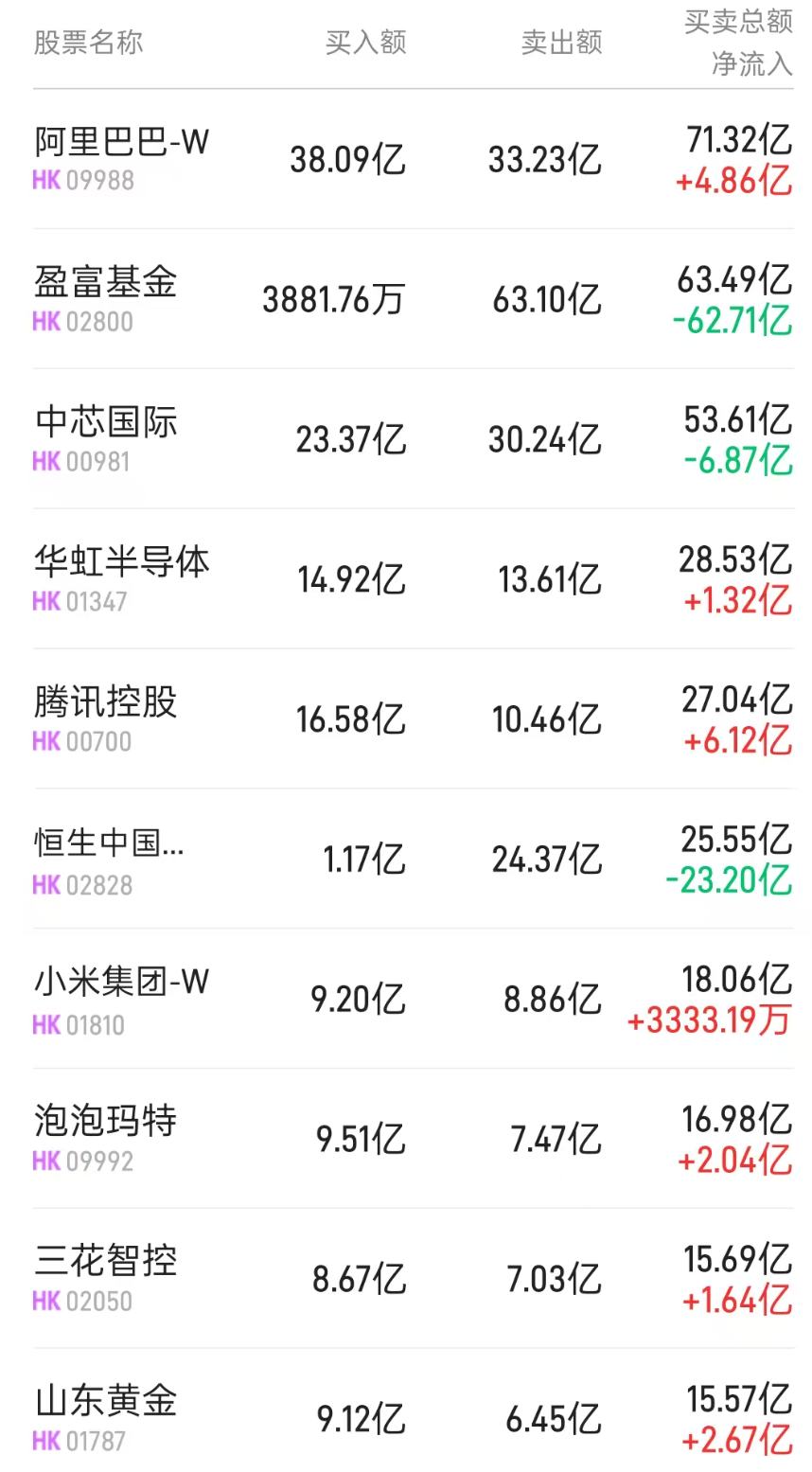
Core Insights - The Hong Kong stock market experienced significant net selling from northbound capital, totaling HKD 54.43 billion, with the Shanghai-Hong Kong Stock Connect seeing a net sell of HKD 63.1 billion and the Shenzhen-Hong Kong Stock Connect a net buy of HKD 8.66 billion [2] Group 1: Stock Performance - Alibaba-W (09988) was the most actively bought stock, with a net inflow of HKD 38.09 billion, while it had a total buy amount of HKD 71.32 billion and sell amount of HKD 33.23 billion [3] - Semiconductor stocks showed divergence, with Hua Hong Semiconductor (01347) receiving a net buy of HKD 4.45 billion, while SMIC (00981) faced a net sell of HKD 6.42 billion [6] - Xiaomi Group-W (01810) saw a net buy of HKD 2.96 billion, supported by promotional activities and new product launches [7] Group 2: Company Announcements - Shandong Gold (01787) announced an expected net profit for the first three quarters between HKD 3.8 billion and HKD 4.1 billion, representing a year-on-year increase of 83.9% to 98.5% [8] - Tencent (00700) is expected to report stable performance in its upcoming Q3 earnings, with total revenue and profit anticipated to meet or exceed expectations [7] - The semiconductor sector is expected to benefit from increased domestic production capabilities and rising prices in memory chips, creating investment opportunities [6]


南向资金今日成交活跃股名单(10月15日)




Zheng Quan Shi Bao Wang· 2025-10-15 13:52
Core Insights - The Hang Seng Index rose by 1.84% on October 15, with southbound trading totaling HKD 1,436.45 billion, resulting in a net sell of HKD 54.43 billion [1] Trading Activity - Southbound trading saw a total buy of HKD 691.01 billion and a total sell of HKD 745.44 billion, leading to a net sell of HKD 54.43 billion [1] - The cumulative trading amount for the Stock Connect (Shenzhen) was HKD 536.02 billion, with a net buy of HKD 8.66 billion, while the Stock Connect (Shanghai) had a cumulative trading amount of HKD 900.43 billion, resulting in a net sell of HKD 63.10 billion [1] Active Stocks - Alibaba-W had the highest trading volume among southbound stocks, with a total trading amount of HKD 111.82 billion and a net buy of HKD 8.57 billion, closing up by 3.86% [1][2] - Other notable stocks included Huahong Semiconductor with a total trading amount of HKD 47.25 billion and a net buy of HKD 4.46 billion, and Xiaomi Group-W with a net buy of HKD 2.96 billion [2] - The stock with the highest net sell was the Tracker Fund of Hong Kong, with a net sell of HKD 85.75 billion, despite a closing price increase of 1.68% [1][2] Continuous Net Buying - Xiaomi Group-W has seen continuous net buying for 8 days, with a total net buy amount of HKD 59.28 billion during this period [2]
10月15日港股通净卖出54.43亿港元
Zheng Quan Shi Bao Wang· 2025-10-15 13:52
Core Viewpoint - On October 15, the Hang Seng Index rose by 1.84%, closing at 25,910.60 points, while southbound funds through the Stock Connect recorded a net sell of 5.443 billion HKD [1]. Group 1: Market Activity - The total trading amount for the Stock Connect on October 15 was 143.645 billion HKD, with a net sell of 5.443 billion HKD [1]. - The Shanghai Stock Connect had a trading amount of 90.043 billion HKD, with a net sell of 6.310 billion HKD, while the Shenzhen Stock Connect had a trading amount of 53.602 billion HKD, with a net buy of 0.866 billion HKD [1]. Group 2: Active Stocks - In the Shanghai Stock Connect, Alibaba-W had the highest trading amount at 7.132 billion HKD, followed by the Tracker Fund of Hong Kong and SMIC, with trading amounts of 6.349 billion HKD and 5.361 billion HKD, respectively [1]. - Tencent Holdings recorded the highest net buy amount at 0.612 billion HKD, while the Tracker Fund of Hong Kong had the highest net sell amount at 6.271 billion HKD, closing with a price increase of 1.68% [1]. - In the Shenzhen Stock Connect, Alibaba-W also led with a trading amount of 4.049 billion HKD, followed by SMIC and Tencent Holdings, with trading amounts of 3.042 billion HKD and 2.685 billion HKD, respectively [2].
10月14日【輪證短評】华虹半导体、广汽集团、比亚迪、建滔積層板、阿里巴巴、金沙中國
Ge Long Hui· 2025-10-15 12:07
Group 1: 华虹半导体 (01347) - The stock price of Huahong Semiconductor recently fell to 76.75 HKD after reaching a high of 99.5 HKD, with investors considering buying call options at a support level of 63.3 HKD and 51.8 HKD [1] - There are limited put options available, with a reference support level of 63.33 HKD, and five products with an out-of-the-money range of 10% [1] Group 2: 广汽集团 (02238) - GAC Group's stock price has broken below the Bollinger Band's lower boundary, reaching a three-month low, leading to speculation about a potential rebound [2] - There are currently few suitable call options available for investors [2] Group 3: 比亚迪 (01211) - BYD's stock price is near the Bollinger Band's lower boundary at 69.8 HKD, with potential support levels around 68.5 HKD and 66.3 HKD, and a technical signal indicating a "buy" [3] - Eight call options are available with a resistance level of 73.4 HKD, showing significant differences in implied volatility and leverage [3] Group 4: 建滔积层板 (01888) - Kintor's stock price rose to 14.3 HKD, breaking above the Bollinger Band's upper boundary, but there is only one in-the-money product available, making it difficult to assess its value [4] Group 5: 阿里巴巴 (09988) - Alibaba's stock continues to decline, with a neutral technical signal and several call options available at an out-of-the-money level of 8% [5] - Among the options, there is a notable product with the highest leverage and lowest implied volatility, which may be attractive to investors [5] Group 6: 金沙中国 (01928) - Sands China has seen a significant drop in stock price to 17.89 HKD, attracting investors looking for a rebound [6] - A call option with a strike price of 19.3 HKD is available, with a notable product showing a leverage of 6.1 times and a relatively low premium [6] Group 7: General Observations - The analysis highlights the varying availability of products across different stocks, with some stocks having no products and others having only one, which may not be ideal for investors [6] - The best scenario is when a favorable stock has multiple product options available, allowing for better comparison of terms [6]

净卖出超54亿港元 抛售两大ETF加仓小米及泡泡玛特
Xin Lang Cai Jing· 2025-10-15 10:35
Core Insights - Southbound capital transactions amounted to approximately 143.645 billion HKD, a decrease of about 38.5 billion HKD compared to the previous day, representing 45.49% of the total turnover of the Hang Seng Index, marking the third consecutive day below 50% [2] - Despite a short-term rebound in the Hang Seng Index, southbound capital saw a net sell-off of approximately 5.443 billion HKD, with the Shanghai-Hong Kong Stock Connect experiencing a net outflow of about 6.31 billion HKD and the Shenzhen-Hong Kong Stock Connect a net inflow of approximately 867 million HKD [2] - Significant sell-offs were noted in the Hang Seng China Enterprises Index and the Tracker Fund of Hong Kong, with net sales of 3.338 billion HKD and 8.575 billion HKD respectively [2] Individual Stock Performance - Alibaba-W saw a net buy of 857 million HKD, with a price increase of 3.86% and a total of 25.92 million shares added over the past five days [3] - Hua Hong Semiconductor experienced a net buy of 446 million HKD, with a price increase of 5.34% and a reduction of 1.78 million shares over the past five days [3] - Xiaomi Group-W had a net buy of 296 million HKD, with a price increase of 1.77% and an addition of 6.008 million shares over the past five days [3] - Pop Mart saw a net buy of 204 million HKD, with a price increase of 3.80% and an addition of 724,000 shares over the past five days [3] - Sanhua Intelligent Control had a net buy of 164 million HKD, with a significant price increase of 12.92% but a reduction of 58,000 shares over the past five days [3] - Semiconductor Manufacturing International Corporation (SMIC) faced a net sell of 642 million HKD, with a price increase of 3.61% and a reduction of 4.987 million shares over the past five days [3] Trading Activity Summary - The net flow of southbound capital for the day was -6.31 billion HKD for Shanghai-Hong Kong and +867 million HKD for Shenzhen-Hong Kong, resulting in a total net outflow of approximately -5.443 billion HKD [5] - Over the past month, the total net inflow for southbound capital was 623.29 billion HKD for Shanghai-Hong Kong and 918.02 billion HKD for Shenzhen-Hong Kong, leading to a cumulative inflow of 1,541.31 billion HKD [5] - The top active stocks in the Shanghai-Hong Kong Stock Connect included Alibaba-W, SMIC, and Hua Hong Semiconductor, with notable net flows and price changes [5]

港股芯片股午后走高 华虹半导体涨4.69%
Mei Ri Jing Ji Xin Wen· 2025-10-15 06:20
Core Viewpoint - Hong Kong chip stocks experienced a rise in afternoon trading on October 15, with several companies showing significant gains [1] Company Performance - Hua Hong Semiconductor (01347.HK) increased by 4.69%, reaching HKD 80.35 [1] - Jingmen Semiconductor (02878.HK) rose by 3.92%, trading at HKD 0.53 [1] - Shanghai Fudan (01385.HK) saw a 3.54% increase, priced at HKD 41 [1] - SMIC (00981.HK) gained 1.43%, with shares at HKD 74.4 [1]