
PSBC(01658)

Search documents
“邮”你灌溉,邮储银行泸州合江县支行助“荔”中华名果加速“出圈”
Xin Lang Cai Jing· 2025-08-04 10:11
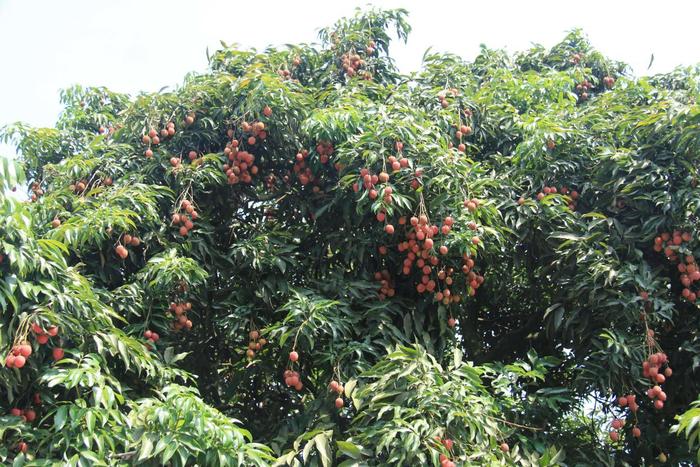
Core Viewpoint - The article highlights the growing popularity of Hejiang lychee, particularly due to the influence of the hit drama "Lychee of Chang'an," and emphasizes the financial support from Postal Savings Bank to local farmers and companies, facilitating the growth of the lychee industry in Hejiang [1][3][8]. Group 1: Industry Overview - Hejiang County is recognized as a significant production area for lychee, known for its unique geographical and climatic conditions that contribute to the fruit's desirable characteristics [1]. - The peak season for lychee harvesting in Hejiang is from mid-July to mid-August, during which farmers experience high demand and pressure to deliver fresh produce quickly [5]. Group 2: Financial Support and Impact - Postal Savings Bank has increased its financial support for lychee farmers and companies, addressing their funding needs and helping them expand their market reach [3][8]. - A local farmer, referred to as "Brother Luo," successfully secured a loan of 300,000 yuan from Postal Savings Bank, which significantly aided his operations during a critical period [5]. - Hejiang Zhongli Agricultural Development Co., Ltd. has benefited from multiple loans totaling 2.78 million yuan from Postal Savings Bank, enabling the company to grow and streamline its operations [8]. Group 3: Operational Insights - Hejiang Zhongli operates a comprehensive supply chain for lychee, including seedling cultivation, harvesting, storage, packaging, and distribution, with a capacity to sell up to 100,000 pounds of lychee daily [6][8]. - The bank's tailored financing solutions and efficient service have been crucial for local businesses, allowing them to navigate challenges and enhance their operational capabilities [8].


邮储银行发布“邮银财管+”系列服务 助力企业重塑财务价值链
Zheng Quan Ri Bao Zhi Sheng· 2025-08-04 09:07
Core Viewpoint - Postal Savings Bank of China (PSBC) is launching the "Postal Financial Management +" service to support enterprises in their digital transformation and enhance their financial value chain [1][2]. Group 1: Service Overview - "Postal Financial Management +" integrates various services such as Easy Finance, Easy Collection, Easy Payment, Easy Operation, Easy Connection, and Easy Management to provide a systematic financial and resource management service for enterprises [1]. - The service aims to establish a "system collaboration" that allows enterprises of all sizes and industries to achieve digital equality and extend service boundaries through ecosystem co-construction [1]. Group 2: Strategic Goals - PSBC's President Liu Jianjun emphasized the bank's commitment to integrating its development with national strategies, focusing on innovation-driven service, and aligning closely with the real economy [1]. - The bank plans to use the "Postal Financial Management +" service as a strategic tool to support rural revitalization, inclusive finance, and technological finance [1]. Group 3: Market Impact - PSBC has already served over 200,000 enterprise clients with the "Postal Financial Management +" service, indicating a strong market presence [2]. - The bank aims to continuously innovate and upgrade the intelligent experience of its services, optimizing processes and enriching functional scenarios to enhance efficiency in enterprise financial management [2].
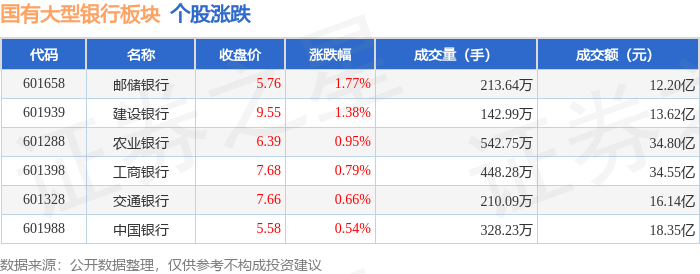
国有大型银行板块8月4日涨0.86%,邮储银行领涨,主力资金净流入8.14亿元
Zheng Xing Xing Ye Ri Bao· 2025-08-04 08:30
| 代码 | 名称 | 收盘价 | 涨跌幅 | 成交量(手) | 成交额(元) | | | --- | --- | --- | --- | --- | --- | --- | | 601658 | 邮储银行 | 5.76 | 1.77% | 213.64万 | | 12.20亿 | | 666109 | 建设银行 | 9.55 | 1.38% | 142.99万 | | 13.62亿 | | 601288 | 农业银行 | 6.39 | 0.95% | 542.75万 | | 34.80 Z | | 601398 | 工商银行 | 7.68 | 0.79% | 448.28万 | | 34.55 Z | | 601328 | 交通银行 | 7.66 | 0.66% | 210.09万 | | 16.14亿 | | 601988 | 中国银行 | 5.58 | 0.54% | 328.23万 | | 18.35 Z | 从资金流向上来看,当日国有大型银行板块主力资金净流入8.14亿元,游资资金净流出6.41亿元,散户资 金净流出1.73亿元。国有大型银行板块个股资金流向见下表: | 代码 | 名称 | 主力净流 ...




工行、农行、中行、建行、交行、邮储银行迅速表态!
Jin Rong Shi Bao· 2025-08-04 08:10
7月31日,国务院总理李强主持召开国务院常务会议,会议就实施个人消费贷款贴息政策与服务业经营 主体贷款贴息政策进行部署。 会议指出,对个人消费贷款和服务业经营主体贷款进行贴息,有利于通过财政金融联动的方式,降低居 民信贷成本和服务业经营主体融资成本,更好激发消费潜力、提升市场活力。要抓好贴息政策组织实 施,加强部门协同,简化办理手续,推动政策尽快落地,同时严格监管提高资金使用效益,确保财政资 金用好用到位。 业内专家认为,对个人消费贷款与服务业经营主体贷款进行贴息的政策,可以视作金融领域的"国 补"。"对于有切实消费需求的居民而言,能够有效减轻其信贷负担,而对于服务业经营主体贷款的贴息 政策,则是对服务型消费加大支持力度的重要体现。"素喜智研高级研究员苏筱芮认为。 中国银行相关负责人认为,两项贷款贴息政策将从需求和供给两端发力,强化与金融政策协同,进一步 助力提振消费、扩大内需。 "后续,中国银行将全力抓好贴息政策的组织实施,推动政策尽快落地,以高效、精准、优质的金融服 务,推动政策红利直达广大消费者和服务业经营主体,为激发国内消费潜力贡献金融力量。"上述负责 人说。 建设银行表示,该行认真贯彻落实党中央、国 ...

邮储银行申请数据的测试方法、装置、计算机程序产品和数据生成系统专利,解决生成的数据实用性差问题
Jin Rong Jie· 2025-08-04 08:05
本文源自:金融界 作者:情报员 金融界2025年8月4日消息,国家知识产权局信息显示,中国邮政储蓄银行股份有限公司申请一项名 为"数据的测试方法、装置、计算机程序产品和数据生成系统"的专利,公开号CN120408114A,申请日 期为2025年04月。 专利摘要显示,本申请提供了一种数据的测试方法、装置、计算机程序产品和数据生成系统。该方法包 括:获取源数据集;根据Kolmogorov‑Smirnov算法,确定源数据集的分布类型;采用rvs生成函数,根 据源数据集生成符合分布类型的标准测试数据集,其中,标准测试数据集的数据量大于源数据集的数据 量;采用标准测试数据集进行自动化测试,得到测试结果;将测试结果发送至金融机构,以使得金融机 构基于测试结果进行业务优化。 天眼查资料显示,中国邮政储蓄银行股份有限公司,成立于2007年,位于北京市,是一家以从事货币金 融服务为主的企业。企业注册资本9916107.6038万人民币。通过天眼查大数据分析,中国邮政储蓄银行 股份有限公司共对外投资了31家企业,参与招投标项目5000次,财产线索方面有商标信息1214条,专利 信息913条,此外企业还拥有行政许可98个。 ...
邮储银行申请软件系统非功能测试相关专利,解决现有技术中软件系统非功能测试方案局限问题
Jin Rong Jie· 2025-08-04 05:14
金融界2025年8月4日消息,国家知识产权局信息显示,中国邮政储蓄银行股份有限公司申请一项名 为"软件系统的非功能测试方法、装置和电子设备"的专利,公开号CN120407408A,申请日期为2025年 04月。 专利摘要显示,本申请提供了一种软件系统的非功能测试方法、装置和电子设备。该方案中,获取步 骤,获取待测试软件的系统信息;匹配步骤,将待测试软件的系统信息与RAG知识库中的非功能测试 规则进行匹配,得到非功能测试明细;生成步骤,根据非功能测试明细生成非功能测试用例;执行步 骤,执行非功能测试用例以对待测试软件进行非功能测试,且在进行非功能测试的过程中收集测试覆盖 率;补充步骤,基于测试覆盖率生成补充测试用例,并将补充测试用例补充至非功能测试用例中;重复 步骤,重复依次执行执行步骤和补充步骤至少一次,直到测试覆盖率高于预设测试覆盖率。本方案解决 了现有技术中关于软件系统非功能测试的方案仍有局限的问题。 本文源自:金融界 作者:情报员 天眼查资料显示,中国邮政储蓄银行股份有限公司,成立于2007年,位于北京市,是一家以从事货币金 融服务为主的企业。企业注册资本9916107.6038万人民币。通过天眼查大数 ...
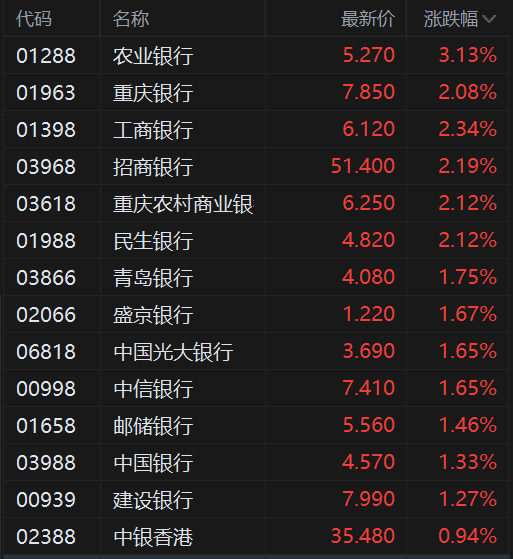
内银股拉升 农业银行涨超2% 工行、招行涨超2%
Jin Rong Jie· 2025-08-04 02:53
Group 1 - The core viewpoint of the news highlights a positive performance in the Hong Kong banking sector, with several banks experiencing significant stock price increases, particularly Agricultural Bank of China, which rose over 3% [1] - As of July 31, five A-share listed rural commercial banks, including Qingdao Bank and Ningbo Bank, reported positive growth in both operating income and net profit attributable to shareholders for the first half of the year, indicating stable asset quality [1] - According to a report by Zhongtai Securities, the overall asset quality of listed banks remains stable, and the industry's profit-generating capacity from provisioning is still strong, with expectations for continued positive profit growth in the sector [1] Group 2 - The net interest margin is supported by a decrease in funding costs and a larger reduction in deposit rates compared to loan rates this year, with a forecast that the decline in net interest margin for the entire year will be significantly smaller than in 2024 [1] - The recovery in scale expansion speed under a low base in the mid-year report will also support interest income [1]

邮储银行 护航荔枝产业全链条发展
Zheng Quan Ri Bao Zhi Sheng· 2025-08-03 15:10
Core Insights - Postal Savings Bank of China leverages its "four flows integration" resources to support the lychee industry, contributing to rural revitalization [1] Group 1: Financial Support and Services - The Postal Savings Bank of China provides a comprehensive financial service package to support lychee farmers and businesses, addressing their funding needs [3] - The bank's Maoming branch has issued loans totaling 863 million yuan to the lychee industry by June 2025, enhancing the financial ecosystem for local farmers [3] - A specific case highlights that a loan of 500,000 yuan enabled a farmer to build a cold storage facility, significantly improving both yield and income [4] Group 2: Operational Insights - Maoming City, a major lychee production area in Guangdong, has around 1.4 million acres dedicated to lychee cultivation, with one company selling approximately 75,000 pounds of lychee daily during peak season [2] - The bank's proactive approach includes direct engagement with farmers and businesses to understand their operational challenges and financial needs [2][3] - The bank collaborates with local agricultural authorities to train new farmers and promote rural e-commerce, with 560 individuals trained and 46 rural e-commerce leaders incubated [3] Group 3: Sales Channel Development - The Postal Savings Bank of China actively assists in expanding sales channels for lychee products by coordinating with local postal services to provide integrated logistics solutions [4] - The bank's efforts in combining financial services with e-commerce and logistics have facilitated the distribution of lychee products nationwide, benefiting local farmers [4]
邮储银行积极助力广东民营经济向新向好
Zheng Quan Ri Bao Zhi Sheng· 2025-08-03 15:10
Core Viewpoint - Postal Savings Bank of China (PSBC) is actively supporting private enterprises in Guangdong, enhancing their innovation and growth through financial services, particularly focusing on technology-driven companies like Wangsi Technology Group [1][2]. Group 1: Financial Support for Private Enterprises - Wangsi Technology Group received substantial credit support from PSBC's Guangzhou branch, which will aid in deepening technology research and expanding business areas [1]. - PSBC Guangdong branch is recognized as a key player in supporting the private economy, contributing to economic stability, job creation, and innovation [1][3]. Group 2: Technology Financing Initiatives - PSBC Guangdong branch has established a specialized team for technology finance, focusing on high-tech sectors such as artificial intelligence and digital twin technology [2]. - The bank has developed various financing products, including "Large Science and Technology Loans," to address the funding needs of technology enterprises, with over 8,100 technology companies served and a loan balance exceeding 36.7 billion yuan, reflecting a 37% year-on-year increase [3]. Group 3: Support for International Expansion - PSBC is facilitating the international expansion of quality enterprises in Guangdong by providing a comprehensive range of cross-border financial services, including trade financing and currency risk management [4]. - Specific case examples include a toy manufacturing company in Chaozhou that received a 10 million yuan credit line to explore new market channels, demonstrating the bank's responsiveness to market challenges [4]. Group 4: Future Focus - The bank plans to continue its focus on supporting private, small, and technology-driven enterprises, implementing initiatives to empower high-quality development in the private sector [5].
邮储银行赣州市分行 浇灌桃乡“甜蜜经济”
Zheng Quan Ri Bao Zhi Sheng· 2025-08-03 15:10
Group 1 - The core viewpoint of the articles highlights the significant role of Postal Savings Bank in supporting local agricultural development and rural revitalization through tailored financial services [1][2][3] - The success story of Ye Shifu, a local farmer, illustrates how access to loans from Postal Savings Bank enabled him to expand his peach orchard from 20 acres to over 60 acres, achieving annual sales of nearly 1 million yuan [1][2] - The bank has implemented a "three-level linkage + postal banking collaboration" service model to enhance efficiency in loan processing and provide comprehensive financial services to rural areas [2] Group 2 - As of now, the Postal Savings Bank has issued nearly 10 billion yuan in small loans to over 35,000 farmers in Longnan [3]