PSBC(01658)

Search documents
黄金巨震下的积存金:有人连续补仓12次,银行纷纷出手防风险
Jing Ji Guan Cha Wang· 2026-02-03 03:43
Core Viewpoint - The recent volatility in the gold market has led to mixed reactions among investors, with some viewing price drops as buying opportunities while others face significant losses due to high entry points. Group 1: Investor Behavior - A notable investor, referred to as "Golden Egg Fried Rice," has made 12 buying operations since January 29, when gold prices peaked at over $5500 per ounce, and has continued to buy during price declines, averaging down his cost to 920.05 yuan per gram by February 2 [1][2][3] - Another investor, identified as Tong Tong, entered the market at high prices between 1237 and 1248 yuan per gram, only to panic and attempt to average down her costs as prices fell, resulting in a total investment of 55,400 yuan with an approximate loss of 5,600 yuan by February 2 [3][4] Group 2: Market Reactions and Institutional Responses - The recent fluctuations in gold prices have prompted banks to issue risk warnings and adjust their gold accumulation policies, with Postal Savings Bank advising clients to enhance risk awareness and avoid impulsive trading [5] - Industrial and Commercial Bank of China has raised the minimum investment amount for gold accumulation from 1000 yuan to 1100 yuan and announced limits on transactions during non-trading days starting February 7 [5] - China Construction Bank has also increased the minimum amount for personal gold accumulation to 1500 yuan as of February 2 [6] Group 3: Market Outlook - According to Galaxy Securities, the long-term logic for a bull market in precious metals remains intact, driven by factors such as central bank gold purchases, a weakening dollar, and shifts in global economic policies [7] - The potential nomination of Kevin Warsh as the Federal Reserve Chair could lead to a more hawkish monetary policy, which may reduce the short-term appeal of gold as a safe-haven asset [8]

国有大行部署2026年经营工作,重点聚焦何处?
Xin Lang Cai Jing· 2026-02-03 01:29
Core Viewpoint - The recent meetings of major state-owned banks in China emphasized "high-quality development" as a key theme for 2025 and outlined strategic focuses for 2026, including enhancing credit issuance and effectively managing risks in key areas [1][3][4]. Group 1: High-Quality Development - Several banks, including Agricultural Bank and China Bank, reported successful completion of their targets for 2025, indicating progress in high-quality development [1][3]. - The banks plan to focus on five major financial initiatives and prioritize credit issuance while managing risks effectively in 2026 [1][3]. Group 2: Service Focus - Agricultural Bank highlighted its commitment to serving the "three rural issues" as a priority, while China Bank aims to consolidate and expand its global advantages [5][6]. - Construction Bank emphasized the integration of commercial and investment banking, as well as public and private banking, to enhance service adaptability [7]. Group 3: Risk Management and Innovation - The banks are focusing on enhancing their risk management frameworks through digitalization and intelligent systems to address credit risks in key sectors like local government debt and real estate [10][11]. - Agricultural Bank and Industrial and Commercial Bank are both committed to increasing loan support in critical areas, including rural finance and consumer sectors [4][10]. Group 4: Reform and Efficiency - The banks are targeting reforms to improve customer and employee satisfaction, with a focus on enhancing operational efficiency and reducing costs [8]. - Postal Savings Bank aims to leverage strategic opportunities during the 14th Five-Year Plan period to enhance its service capabilities and achieve sustainable growth [7].



2026年经营部署如何“划重点”?六大行全扫描
Xin Lang Cai Jing· 2026-02-03 00:48
Core Viewpoint - The major banks in China are transitioning from the "14th Five-Year Plan" to the "15th Five-Year Plan," focusing on serving the real economy and preventing financial risks while adapting to their own development needs [1][2]. Group 1: Transition from "14th Five-Year Plan" to "15th Five-Year Plan" - In 2025, banks aimed to complete the "14th Five-Year Plan" with a focus on risk prevention and stable performance [1]. - For 2026, banks are shifting their focus to the "15th Five-Year Plan," with institutions like ICBC and Bank of Communications outlining their strategic plans for this new phase [1]. Group 2: Support for Key Areas - Banks are increasing loan disbursements and bond investments, particularly in areas like domestic demand expansion, technological innovation, and support for small and micro enterprises [2]. - Agricultural Bank of China emphasizes serving rural areas and has reported a continuous increase in county loans, exceeding 1 trillion yuan for four consecutive years, with a total balance surpassing 10 trillion yuan [2]. Group 3: Risk Prevention Strategies - Financial institutions are prioritizing risk prevention, particularly in local government debt and real estate sectors, with specific measures outlined by Agricultural Bank and China Construction Bank [4]. - China Bank is focusing on centralized credit risk management and proactive trend risk control to maintain asset quality [4]. Group 4: Digital Transformation - Digital transformation is a common focus among state-owned banks, with initiatives aimed at enhancing operational capabilities and integrating AI into business processes [5][6]. - Postal Savings Bank is advancing a comprehensive upgrade strategy that includes digitalization and aims to create a "second growth curve" [6]. Group 5: Shift from Scale Expansion to Value Creation - In 2026, banks are moving from a focus on scale expansion to value creation, with institutions like Postal Savings Bank emphasizing a shift from scale-driven to value-driven strategies [7]. - The consensus among banks is to improve efficiency and reduce costs through digital transformation, especially in a low-interest-rate environment [7].

房地产融资协调“白名单”机制两周年:主办银行制成核心
Feng Huang Wang· 2026-02-03 00:41
Group 1 - The core viewpoint of the article highlights the establishment and implementation of a coordinated financing mechanism for urban real estate, which aims to streamline financing processes and ensure that reasonable financing demands are met by banks [1][3] - The "white list" mechanism has been in place for two years, with the main bank system being recognized as a key component for real estate project financing, ensuring that information sharing among banks is improved and reducing the risk of over-lending [2][3] - Recent data indicates that while the financing support for "white list" projects has been significant, the growth rate of new loans has slowed down considerably compared to the initial year of implementation [4][5] Group 2 - As of the end of last year, banks in Beijing had provided loans totaling 215.6 billion yuan for 219 "white list" projects, while Hunan province reported 1,830.9 billion yuan in loans for 1,386 projects, demonstrating the effectiveness of the financing coordination mechanism [4][5] - The overall loan amount for "white list" projects exceeded 7 trillion yuan, supporting nearly 20 million housing units, but the growth in loan amounts has significantly decreased, with only 1.4 trillion yuan added in the last six months of the previous year [4][5] - The recent adjustments to the "white list" financing mechanism include allowing for a five-year extension on loans for qualifying projects, which aims to alleviate short-term repayment pressures for real estate companies while maintaining cautious lending practices for new projects [6][7]
最新!黄金与白银价格新高后剧烈波动 多家银行紧急调整!
Sou Hu Cai Jing· 2026-02-03 00:05
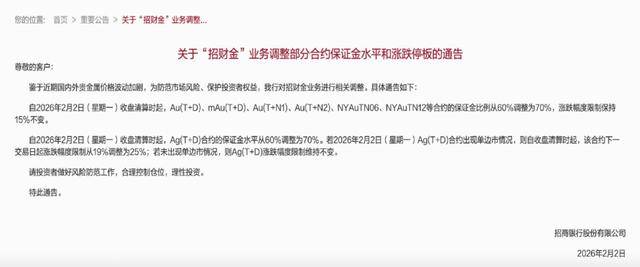
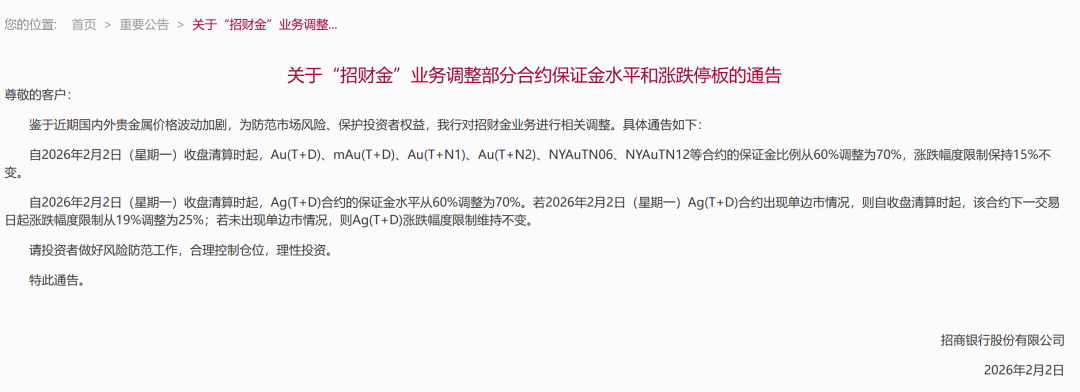
Core Viewpoint - Recent fluctuations in international gold and silver prices have prompted banks to adjust their operations and issue risk warnings to protect investors amid significant market volatility [1][2][4][5][6][7] Group 1: Market Fluctuations - On February 2, gold futures dropped below $4,500 per ounce, with silver prices experiencing a cumulative decline of approximately 40% from the peak on January 29, while gold prices fell by about 20% [1] - The recent volatility in precious metals is attributed to macroeconomic expectations, technical overbought conditions, and profit-taking by some investors, indicating a high volatility phase in the market [7] Group 2: Bank Responses - China Merchants Bank announced an increase in margin requirements for various gold and silver contracts from 60% to 70% to mitigate market risks [1] - The bank also suspended new account openings and new positions in its "Zhaocai Gold" business due to the changing market conditions [2] - Other banks, including Postal Savings Bank of China and Agricultural Bank of China, have issued similar warnings and adjusted their business practices to enhance risk management and protect client interests [2][4][5] Group 3: Risk Management Strategies - Banks are implementing a multi-layered approach to risk management, including increasing entry barriers, limiting leverage, and guiding rational investment behaviors [7] - The adjustments made by banks reflect a proactive stance in managing risks associated with precious metals trading, aiming to maintain market stability and protect investor interests [7]


金融活水“贷”来及时雨,邮储银行“产业贷”让临沂味道香飘全球
Qi Lu Wan Bao· 2026-02-02 23:33
Core Insights - The article highlights the rapid growth of Bibizhan (Shandong) Food Co., Ltd., which achieved a daily production capacity of 70 tons and an invoicing amount close to 500 million yuan within just one year of operation, having officially started in 2025 [1][3] - The support from Postal Savings Bank (PSB) has been crucial for the company's expansion, providing timely financial assistance that enabled the company to scale its operations and meet increasing demand [1][2] Company Development - Bibizhan Food has diversified its operations, engaging in brand supply, contract manufacturing, exports, and self-branded gift box sales, resulting in a consistently high order volume [1] - The company has integrated production, packaging, sales, and research and development, achieving a daily sales revenue of approximately 200,000 yuan and exporting to over 20 countries and regions [3] Financial Support - PSB's proactive approach included understanding the company's needs during its initial phase and providing a 2 million yuan loan through the "Food Cluster e-loan" product, which was crucial for purchasing raw materials before the Chinese New Year [2] - As the company plans to expand its production capacity by constructing a new factory, PSB is facilitating a 5 million yuan credit approval process tailored to the company's financial situation and growth plans [2] Industry Impact - PSB has been actively addressing the challenges faced by small and medium-sized enterprises (SMEs) by innovating financial products and optimizing service models, such as the "Food Cluster e-loan" and "Xinjie Loan" [3][4] - The bank's efforts have led to the development of specialized loans for various local industries, with a total of 89.52 million yuan disbursed to 38 enterprises in the region [3][4]
国有六大行密集强化黄金投资业务风险管控
Zheng Quan Ri Bao· 2026-02-02 16:43
Core Viewpoint - The recent volatility in gold prices has prompted major state-owned banks in China to adjust their gold-related business practices, enhancing risk management and guiding investors towards rational participation in the market [1][2][4]. Group 1: Adjustments by State-Owned Banks - Major state-owned banks, including ICBC, ABC, BOC, CCB, and others, have implemented changes to their gold-related business, including increasing entry thresholds, transaction limits, and risk assessment requirements [2][4]. - ICBC announced on February 1 that due to significant fluctuations in domestic and international precious metal prices, investors should maintain a rational investment mindset and avoid impulsive trading [2]. - CCB raised the minimum amount for personal gold accumulation to 1,500 yuan starting February 2, citing increased market risks [3]. Group 2: Market Analysis and Long-Term Value - Despite short-term price fluctuations, experts believe that gold and other precious metals still hold long-term investment value due to global risk aversion and changes in asset allocation logic [1][5]. - The precious metals market has shown an upward trend since 2026, with gold and silver performing particularly well, although recent price volatility has raised concerns about future market behavior [5]. - Analysts suggest that while short-term pressures may exist, long-term factors such as declining real interest rates and persistent inflation will continue to support gold prices [5][6]. Group 3: Investor Guidance - Investors are advised to focus on risk management, including understanding market volatility, monetary policy changes, and liquidity risks associated with investment products [6]. - It is emphasized that investors should assess their risk tolerance and avoid excessive leverage, choosing investment tools that align with their financial situations [6].
金银价格巨震,多家银行出手
Zhong Guo Zheng Quan Bao - Zhong Zheng Wang· 2026-02-02 15:20
Core Viewpoint - Recent adjustments by major banks in China, including China Agricultural Bank, China Merchants Bank, and Bank of China, are aimed at mitigating risks associated with significant fluctuations in precious metal prices, emphasizing the need for investors to manage their positions and invest rationally [1][2][5]. Group 1: Bank Adjustments - China Merchants Bank announced an increase in margin requirements for various gold contracts from 60% to 70% due to heightened volatility in precious metal prices, while maintaining a 15% limit on price fluctuations [1]. - Bank of China adjusted the margin for silver deferred contracts from 50.80% to 66.04% and increased the fluctuation limit from 19% to 25% if a unilateral market condition occurs [5]. - Agricultural Bank of China also indicated adjustments to the fluctuation limits for silver contracts, aligning with the Shanghai Gold Exchange's risk management guidelines [7]. Group 2: Market Implications - Industry experts suggest that these measures are intended to tighten risk controls, reduce trading leverage, and increase capital costs for investors, thereby curbing speculative behavior in the market [2][7]. - The adjustments are expected to enhance liquidity during extreme market conditions and reduce the probability of defaults, with other banks likely to follow suit in implementing similar risk management strategies [7]. - Banks are advising investors to carefully assess their risk tolerance and financial situation, urging a rational investment approach and close monitoring of market conditions to mitigate potential losses from price volatility [9][10].
最新!多家银行,紧急调整!
券商中国· 2026-02-02 14:43
Core Viewpoint - Recent fluctuations in international gold and silver prices have led to significant adjustments in banking operations and risk management strategies to protect investors amid heightened market volatility [1][9]. Group 1: Market Fluctuations - On February 2, gold futures dropped below $4,500 per ounce, with silver prices experiencing a cumulative decline of approximately 40% from the peak on January 29, while gold prices fell by about 20% [1]. - The current market environment reflects a high volatility phase influenced by macroeconomic expectations, technical overbought conditions, and profit-taking by investors [9]. Group 2: Banking Responses - China Merchants Bank announced adjustments to its "Zhaocai Gold" business, increasing margin requirements for various gold and silver contracts from 60% to 70% to mitigate market risks [2]. - The Agricultural Bank of China implemented a risk assessment requirement for clients engaging in gold accumulation services, mandating a cautious risk tolerance rating [7]. - The Bank of China adjusted margin requirements for silver contracts, increasing the margin from 50.80% to 66.04% in case of a one-sided market [7]. Group 3: Investor Guidance - Banks are advising investors to enhance their risk awareness, control their positions, and avoid impulsive trading behaviors in light of the current market uncertainties [3][8]. - Financial institutions are promoting a strategy of maintaining a rational investment mindset, suggesting that investors should consider long-term perspectives and diversify their asset allocations [9].

事关黄金,工行、农行、邮储、招行最新提示
Di Yi Cai Jing Zi Xun· 2026-02-02 14:32
Core Viewpoint - The recent volatility in gold and silver prices has prompted banks to increase their risk warnings and adjust risk control measures significantly [2][3][4]. Group 1: Price Volatility - On February 2, international gold prices fell to $4403.64 per ounce, with a maximum daily drop exceeding 9%, while silver prices hit a low of $71.33 per ounce, with a drop close to 15% [2]. - Banks are advising clients to assess their risk tolerance carefully and maintain a rational investment mindset to avoid impulsive trading behaviors [2][3]. Group 2: Risk Warnings from Banks - Industrial and Commercial Bank of China (ICBC) issued a warning on February 2 regarding the significant increase in volatility in the international precious metals market, urging clients to control their positions effectively [2]. - Agricultural Bank of China also highlighted the heightened uncertainty in the precious metals market and advised clients to evaluate their financial situations before engaging in trading [3]. Group 3: Margin Adjustments - ICBC announced an increase in the standard trading margin for personal clients' silver contracts from 60% to 66% effective February 2, following a previous increase from 43% to 60% for gold contracts [4]. - Other banks, including Agricultural Bank and China Merchants Bank, have also adjusted margin requirements and trading limits for gold and silver contracts in response to market conditions [5].