
PSBC(01658)

Search documents
邮储银行孟州市支行开展消防安全专项宣传活动
Huan Qiu Wang· 2026-02-05 06:06
Group 1 - The core viewpoint of the article emphasizes the proactive measures taken by the Postal Savings Bank of China in Mengzhou to enhance fire safety awareness and conduct hazard inspections in old residential communities [1] Group 2 - The bank organized a volunteer team to carry out fire safety promotional activities, including distributing educational materials and conducting door-to-door visits to address residents' concerns about fire safety [1] - Volunteers engaged in a "knock on the door" campaign to communicate with residents and inspect key areas such as public spaces, corridors, and fire exits for potential fire hazards [1] - The bank plans to collaborate with community and relevant departments to implement ongoing management of fire lanes, regulate the parking and charging of electric vehicles, and increase the availability of fire-fighting equipment [1] Group 3 - The bank aims to focus on public concerns and participate in grassroots governance, especially during the pre-Spring Festival period, to address urgent issues faced by residents and enhance their sense of safety and happiness [1]

白银金融监管分局核准杨璞邮政储蓄银行白银市分行副行长任职资格
Jin Tou Wang· 2026-02-05 03:29
Core Viewpoint - The approval of Yang Pu's appointment as the Vice President of the Baiyin Branch of China Postal Savings Bank has been granted by the Baiyin Financial Regulatory Bureau, emphasizing the importance of compliance with financial regulations and ongoing education in economic and financial laws [1] Group 1 - The Baiyin Financial Regulatory Bureau has reviewed and approved the request for Yang Pu's qualification as Vice President of the Baiyin Branch of China Postal Savings Bank [1] - The approved individual must assume the position within three months from the date of the regulatory decision, or the approval will become invalid [1] - The bank is required to ensure that the approved individual continuously learns and understands relevant economic and financial laws and regulations, and maintains a strong awareness of risk compliance [1]
资本加减法:透视中小银行差异化发展新逻辑
Zhong Guo Zheng Quan Bao· 2026-02-04 20:20
Core Viewpoint - The recent approval of capital increases for several small and medium-sized banks indicates a trend towards enhancing capital strength to support business expansion and meet regulatory requirements, while some banks are also reducing capital to improve capital allocation efficiency [1][3][6][7]. Group 1: Capital Increases - Qinghai Guinan Rural Commercial Bank's capital was increased from 60 million to 66 million yuan, with several other banks like Dongying Bank and Shijiazhuang Luquan Rural Commercial Bank also receiving approvals for capital increases [1][2]. - Dongying Bank's capital was raised by 447 million yuan, changing its registered capital from 4.396 billion to 4.843 billion yuan, while Hebei Jingxing Rural Commercial Bank's capital increased by 9.1641 million yuan, from 200 million to 209.1641 million yuan [2]. Group 2: Capital Reductions - Some banks, such as Shandong Yanggu Rural Commercial Bank and Beijing Mentougou Zhujiang Village Bank, have reduced their registered capital, indicating a strategic move rather than a sign of weakened capital strength [4][5]. - Since July 2025, several banks have been approved for capital reductions, including Hunan Yanling Rural Commercial Bank, which decreased its capital by 263 million yuan, and Yantai Fushan Zhujiang Village Bank, which reduced its capital by 7 million yuan [4]. Group 3: Industry Insights - Industry experts suggest that the current banking sector faces challenges such as narrowing net interest margins and insufficient internal capital accumulation, prompting banks to seek external capital to strengthen their financial base [3]. - The dual approach of increasing and reducing capital is seen as a way to optimize the overall capital structure of the banking industry, supporting high-quality development [6][7].

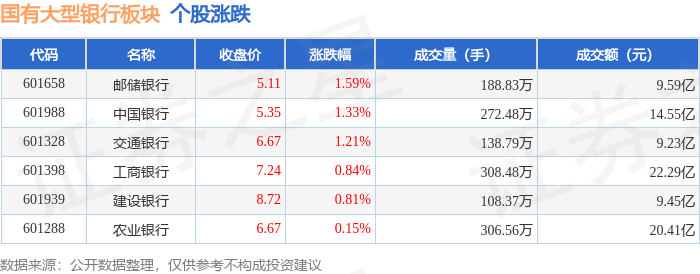
国有大型银行板块2月4日涨0.73%,邮储银行领涨,主力资金净流入3.99亿元
Zheng Xing Xing Ye Ri Bao· 2026-02-04 08:56
Group 1 - The core viewpoint of the news is that the state-owned large bank sector experienced an increase of 0.73% on February 4, with Postal Savings Bank leading the gains [1] - The Shanghai Composite Index closed at 4102.2, up 0.85%, while the Shenzhen Component Index closed at 14156.27, up 0.21% [1] - The main capital flow into the state-owned large bank sector was a net inflow of 399 million yuan, while retail investors saw a net outflow of 40.88 million yuan [1] Group 2 - Postal Savings Bank's stock closed at 5.11 yuan, with a rise of 1.59% and a trading volume of 1.8883 million shares, amounting to a transaction value of 959 million yuan [1] - China Bank's stock closed at 5.35 yuan, increasing by 1.33% with a trading volume of 2.7248 million shares, resulting in a transaction value of 1.455 billion yuan [1] - Agricultural Bank's stock closed at 6.67 yuan, with a slight increase of 0.15% and a trading volume of 3.0656 million shares, leading to a transaction value of 2.041 billion yuan [1] Group 3 - The main capital inflow for China Bank was 114 million yuan, accounting for 7.80% of the total, while retail investors had a net outflow of 32.22 million yuan [2] - Postal Savings Bank saw a main capital inflow of 90.38 million yuan, representing 9.42%, with retail investors experiencing a net outflow of 9.39 million yuan [2] - Construction Bank had a net capital outflow of 12.60 million yuan from main capital, while retail investors had a net inflow of 25.48 million yuan [2]





邮储银行(01658) - 截至2026年1月31日股份发行人的证券变动月报表
2026-02-04 08:30
本月底法定/註冊股本總額: RMB 120,095,053,492 FF301 2. 股份分類 普通股 股份類別 A 於香港聯交所上市 (註1) 否 證券代號 (如上市) 601658 說明 A股(上海證券交易所) 法定/註冊股份數目 面值 法定/註冊股本 上月底結存 100,238,886,492 RMB 1 RMB 100,238,886,492 增加 / 減少 (-) RMB 本月底結存 100,238,886,492 RMB 1 RMB 100,238,886,492 1. 股份分類 普通股 股份類別 H 於香港聯交所上市 (註1) 是 證券代號 (如上市) 01658 說明 H股 法定/註冊股份數目 面值 法定/註冊股本 上月底結存 19,856,167,000 RMB 1 RMB 19,856,167,000 增加 / 減少 (-) RMB 本月底結存 19,856,167,000 RMB 1 RMB 19,856,167,000 截至月份: 2026年1月31日 狀態: 新提交 致:香港交易及結算所有限公司 公司名稱: 中國郵政儲蓄銀行股份有限公司 呈交日期: 2026年2月4日 I. 法定/註 ...
丈量地方性银行(2):浙江163家区域性银行全梳理-20260203
GF SECURITIES· 2026-02-03 13:31
Investment Rating - The industry investment rating is "Buy" [2] Core Insights - The report provides a comprehensive analysis of 163 regional banks in Zhejiang Province, highlighting their asset and liability structures, profitability, and asset quality [6][20] - The asset growth rate for major city commercial banks in Zhejiang is 9.4%, which is lower than the 14.2% growth rate of listed city commercial banks, while major rural commercial banks show an asset growth rate of 8.0%, exceeding the 6.7% growth rate of listed rural commercial banks [6][25] - The report indicates that the loan-to-asset ratio for city commercial banks is projected to reach 55.5% in 2024, an increase of 95 basis points year-on-year, while rural commercial banks will see a decrease to 59.3%, down 19 basis points [31] - Profitability metrics show that the average Return on Assets (ROA) for city commercial banks in Zhejiang is 0.78%, slightly above the average of listed city commercial banks, while rural commercial banks have an average ROA of 0.82%, which is below the average of listed rural commercial banks [6][31] - The asset quality of regional banks in Zhejiang is reported to be better than that of listed banks, with non-performing loan ratios lower by 16 basis points for city commercial banks and 9 basis points for rural commercial banks compared to their listed counterparts [6][31] Summary by Sections Section 1: Economic Structure of Zhejiang Province - Zhejiang Province is focused on high-quality development and aims to become a model for common prosperity [13] - The province's GDP is heavily concentrated in cities like Hangzhou, Ningbo, and Wenzhou, with Hangzhou accounting for 24.3% of the total GDP in 2025 [15] Section 2: Overview of 163 Regional Banks - The report categorizes the banks into city commercial banks, rural banks, and others, with a total of 163 banks in the region [20] - The distribution of registered capital among these banks is relatively balanced, with 63 banks having over 500 million yuan in registered capital [22] Section 3: Asset and Liability Structure - The asset growth of major city and rural commercial banks has been declining since 2019, with city banks showing a growth rate of 9.4% in the first half of 2025 [25] - The liability structure indicates that customer deposits account for 77.5% of liabilities for city commercial banks, which is higher than the 66.2% for listed city banks [44] Section 4: Profitability and Asset Quality - The average ROE for city commercial banks in Zhejiang is 11.98%, slightly lower than the average of listed city banks [6][31] - The report highlights that the non-performing loan ratio for city commercial banks is lower than that of listed banks, indicating better asset quality [6][31]


前员工诈骗获刑储户向银行索赔 邮储银行呼伦贝尔市分行:将充分尊重并依法履行法院判决
Cai Jing Wang· 2026-02-03 10:20
Group 1 - A bank employee in Inner Mongolia was sentenced to 12 years in prison for fraud after transferring 2.2 million yuan (approximately 0.22 billion) from 11 depositors, which could not be recovered [1] - The Postal Savings Bank of China’s Hulunbuir branch has initiated a comprehensive investigation and confirmed that the employee was convicted of fraud and ordered to compensate all victims for their losses [2] - Some affected individuals believe that the bank should also compensate for the losses and have filed a civil lawsuit against the bank, which is currently under review [2] Group 2 - The bank has emphasized that it will not require customers to transfer personal funds to others' accounts for any reason and prohibits internal staff from operating on behalf of customers [2] - The bank encourages customers to report any suspicious activities by calling their customer service hotline [2]
邮储银行许昌市分行开展反诈宣教 守护群众财产安全
Huan Qiu Wang· 2026-02-03 09:15
Core Viewpoint - The article highlights the proactive measures taken by Postal Savings Bank's Xuchang branch to combat telecom and online fraud, emphasizing the importance of public awareness and education in protecting citizens' financial security [1] Group 1: Anti-Fraud Campaign - The campaign is themed "Anti-Fraud Protecting Livelihoods, Safeguarding Citizens' Wallets" and targets densely populated areas such as subway and bus stations [1] - Staff distributed a "Safety Knowledge Handbook on Preventing Telecom and Online Fraud" to educate the public about the ten most common fraud methods [1] - The initiative aims to enhance the public's ability to recognize and prevent fraud through face-to-face guidance on setting up mobile phone security features and identifying suspicious links [1] Group 2: Targeted Education - The campaign tailors its educational efforts to different demographics, including the elderly and commuters, addressing specific risks they face [1] - For the elderly, the focus is on scams like impersonating bank staff and high-interest retirement investment schemes, while younger individuals are warned about scams related to online shopping and gaming account transactions [1] Group 3: Reporting and Response - The staff introduced the 96110 hotline, which offers three main functions: fraud warning, consultation, and reporting [1] - The protocol for urgent situations is to call 96110 first for immediate assistance, followed by reporting the incident [1] Group 4: Future Initiatives - The campaign has deepened the community's understanding of fraud risks and reinforced the importance of anti-fraud measures [1] - The Postal Savings Bank's Xuchang branch plans to continue responding to anti-fraud initiatives by innovating their outreach methods and conducting targeted educational campaigns to protect citizens' financial safety [1]
邮储银行呼伦贝尔市分行:前员工犯诈骗罪已获刑 分行充分尊重并将依法履行相关民事诉讼判决
Xin Lang Cai Jing· 2026-02-03 07:58
来源:中国银行保险报 经查,日前,内蒙古呼伦贝尔市中级人民法院作出二审判决,孟某(扎兰屯市支行前员工)犯诈骗罪, 被判处有期徒刑并对全部受害人损失金额进行赔偿。此案涉及的部分人员认为损失金额及利息应由银行 进行赔付,故对该分行提起民事起诉。民事诉讼是厘清责任的必要程序,也是保障当事人合法权益、维 护社会公平正义的法律途径。目前,相关民事诉讼正在审理过程中,该分行将充分尊重并依法履行法院 判决。 近日,网络上出现了有关"内蒙古11名储户存款被转走,涉案员工获刑12年,多人状告银行索赔"相关讨 论。《中国银行保险报》记者从邮储银行呼伦贝尔市分行处获悉,该分行高度重视并迅速展开全面核 查。 邮储银行呼伦贝尔市分行表示,衷心感谢广大客户及社会各界的关注与监督,同时提示广大客户,邮储 银行不会以任何理由要求客户将个人资金转至他人账户,也严禁内部工作人员代客操作。如有相关情 形,请拨打95580客户服务热线进行投诉。 经查,日前,内蒙古呼伦贝尔市中级人民法院作出二审判决,孟某(扎兰屯市支行前员工)犯诈骗罪, 被判处有期徒刑并对全部受害人损失金额进行赔偿。此案涉及的部分人员认为损失金额及利息应由银行 进行赔付,故对该分行提 ...
220万元存款不翼而飞?邮储支行回应:前员工私下交易,与银行无关
Xin Lang Cai Jing· 2026-02-03 05:13
2月3日金融一线消息,近日有媒体报道称,内蒙古呼伦贝尔扎兰屯市11名储户相继发现,其在邮储银行 扎兰屯市支行的存款合计220余万元"不翼而飞",涉案资金指向该行原大堂经理孟某芝。 针对此事,金融一线咨询了上述支行,工作人员表示:"这是个人(孟某芝)私下交易的,是个人行 为,与银行没有任何关系,而且银行这边已经胜诉了。" 相关新闻:220余万元不翼而飞!邮储银行原职工将11名储户存款转走挥霍,获刑12年 责任编辑:潘翘楚 2月3日金融一线消息,近日有媒体报道称,内蒙古呼伦贝尔扎兰屯市11名储户相继发现,其在邮储银行 扎兰屯市支行的存款合计220余万元"不翼而飞",涉案资金指向该行原大堂经理孟某芝。 针对此事,金融一线咨询了上述支行,工作人员表示:"这是个人(孟某芝)私下交易的,是个人行 为,与银行没有任何关系,而且银行这边已经胜诉了。" 相关新闻:220余万元不翼而飞!邮储银行原职工将11名储户存款转走挥霍,获刑12年 责任编辑:潘翘楚 ...