INNOVENT BIO(01801)

Search documents
长城医药产业精选A三季度涨15%,加仓信达生物、三生制药,基金经理梁福睿:当前创新药个股极具性价比
Xin Lang Ji Jin· 2025-10-23 07:52
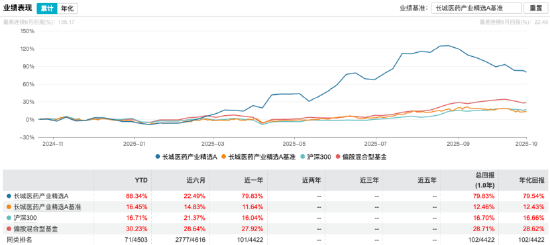
Core Insights - The report highlights the performance of the Changcheng Pharmaceutical Industry Selected Mixed A Fund, which has shown significant growth in equity scale, particularly in the technology sector, despite recent market adjustments [1][3]. Performance Analysis - As of October 22, 2025, the fund's unit net value is 1.7983, with a cumulative return of 79.83% since its establishment on October 22, 2024, and a year-to-date increase of 88.34% [1][3]. - The fund has experienced a notable decline of -8.81% over the past month and -14.29% over the last three months, indicating challenges faced by the pharmaceutical sector, especially in the innovative drug field during the third quarter [3][4]. Portfolio Composition - The top ten holdings of the fund have a combined market value of 1.313 billion, heavily concentrated in the innovative drug sector, which differs from the asset allocation logic of technology funds [4]. - The top three holdings include Innovent Biologics, 3SBio, and Hotgen Biotech, with a clear focus on biotechnology and innovative pharmaceutical companies [5]. Investment Strategy - The fund manager, Liang Furui, noted that the A/H market saw multiple sectors rise, primarily driven by technology and precious metals, with an average daily trading volume in the A-share market exceeding 2 trillion [5]. - Despite the strong performance of technology sectors, innovative drugs have entered a correction phase due to significant gains in the first half of the year and negative impacts from TMT-focused capital outflows [5][6]. - Liang Furui emphasized that many innovative drug stocks are now highly cost-effective, suggesting a shift towards selecting individual stocks with genuine competitive advantages as the sector moves into an "individual alpha phase" [6]. Future Outlook - The focus will be on increasing the weight of stocks with global competitiveness and scarcity in core pipelines, balancing long-term potential, drug certainty, and international market viability [6].


美银证券:升信达生物目标价至113港元 与武田合作属晋身跨国药企重要一步
Zhi Tong Cai Jing· 2025-10-23 07:49
Core Viewpoint - Bank of America Securities has raised the revenue forecasts for Innovent Biologics (01801) for 2026 and 2027 by 50% and 3% respectively, while also increasing the earnings per share estimates by 513% and 9% for the same years, and has adjusted the target price from HKD 106.9 to HKD 113, maintaining a "Buy" rating [1] Group 1 - Innovent Biologics has entered into a strategic collaboration with Takeda Pharmaceutical, involving three pipeline projects: IBI-363, IBI-343, and IBI-3001, with an upfront payment of USD 1.2 billion, including a USD 100 million equity investment from Takeda [1] - For IBI-363, both companies will co-develop the product globally and share the commercialization costs in the U.S. at a ratio of 40% for Innovent and 60% for Takeda, while Innovent retains the development rights in China and is entitled to royalties from sales outside of China and the U.S. [1] - The significant transaction underscores Innovent Biologics' research and development capabilities and asset value, marking an important step towards becoming a multinational pharmaceutical company [1]
美银证券:升信达生物(01801)目标价至113港元 与武田合作属晋身跨国药企重要一步
智通财经网· 2025-10-23 07:48
Core Viewpoint - Bank of America Securities has raised the revenue forecasts for Innovent Biologics (01801) for 2026 and 2027 by 50% and 3% respectively, reflecting confidence in the company's growth potential and strategic partnerships [1] Group 1: Financial Projections - The earnings per share forecasts for 2026 and 2027 have been increased by 513% and 9% respectively [1] - The target price for Innovent Biologics has been raised from HKD 106.9 to HKD 113, maintaining a "Buy" rating [1] Group 2: Strategic Partnerships - Innovent Biologics has entered into a strategic collaboration with Takeda Pharmaceutical, involving three pipeline projects: IBI-363, IBI-343, and IBI-3001 [1] - Innovent will receive a total of USD 1.2 billion in upfront payments, which includes a USD 100 million equity investment from Takeda, and could earn up to USD 10.2 billion in milestone payments for development and sales [1] Group 3: Product Development and Commercialization - For IBI-363, both companies will co-develop the product globally and share the commercialization costs in the U.S. at a ratio of 40% for Innovent and 60% for Takeda [1] - Innovent retains the development rights for IBI-363 in China and is entitled to receive royalties from sales outside of China and the U.S., potentially reaching high double-digit figures [1] - This significant transaction underscores Innovent's research capabilities and asset value, marking an important step towards becoming a multinational pharmaceutical company [1]
中信建投:信达生物与武田达成全球战略合作 维持“买入”评级
Zhi Tong Cai Jing· 2025-10-23 06:34
Core Viewpoint - CITIC Securities maintains a "Buy" rating for Innovent Biologics (01801), projecting revenues of 11.806 billion yuan, 15.382 billion yuan, and 21.092 billion yuan for 2025-2027, respectively, with a DCF valuation indicating a fair market value of 221.5 billion HKD and a target price of 129.61 HKD [1] Group 1 - The company has established a significant presence in the oncology sector, with high-value clinical products expected to enhance revenue and reduce marginal costs [1] - In non-oncology sectors, the company has made extensive investments in metabolism, autoimmune diseases, and ophthalmology, with competitive and advanced products both launched and in development [1] Group 2 - On October 22, Innovent Biologics entered a global strategic partnership with Takeda Pharmaceutical, which will pay 1.2 billion USD upfront, including a strategic equity investment of 100 million USD at a subscription price of 112.56 HKD per share, representing a 20% premium over the weighted average share price of the past 30 trading days [1] - The total value of the collaboration could reach 11.4 billion USD, with Innovent Biologics and Takeda jointly developing IBI363 (PD-1/IL-2α-bias) [1] - Innovent Biologics granted Takeda exclusive rights for IBI343 (CLDN18.2ADC) outside Greater China and exclusive options for IBI3001 (EGFR/B7H3ADC) outside Greater China [1]

中信建投:信达生物(01801)与武田达成全球战略合作 维持“买入”评级
智通财经网· 2025-10-23 06:30
Core Viewpoint - CITIC Securities maintains a "Buy" rating for Innovent Biologics (01801), projecting revenues of 11.806 billion, 15.382 billion, and 21.092 billion CNY for 2025-2027, with a DCF valuation suggesting a fair market value of 221.5 billion HKD and a target price of 129.61 HKD [1] Group 1: Financial Projections - Expected revenues for Innovent Biologics from 2025 to 2027 are 11.806 billion CNY, 15.382 billion CNY, and 21.092 billion CNY respectively [1] - The company's fair market value is estimated at 221.5 billion HKD based on DCF valuation [1] - Target price set at 129.61 HKD [1] Group 2: Strategic Developments - On October 22, Innovent Biologics entered a global strategic partnership with Takeda Pharmaceutical, which includes a 1.2 billion USD upfront payment [1] - The upfront payment consists of a 100 million USD strategic equity investment at a subscription price of 112.56 HKD per share, representing a 20% premium over the weighted average share price of the last 30 trading days [1] - The total value of the collaboration deal is up to 11.4 billion USD [1] Group 3: Product Pipeline and Market Position - Innovent Biologics has established a significant presence in the oncology sector, with high-value clinical products expected to enhance revenue and reduce marginal costs [1] - In non-oncology areas, the company has made extensive advancements in metabolism, autoimmune diseases, and ophthalmology, with competitive and advanced products both in the market and under development [1] - Innovent Biologics grants Takeda exclusive rights for IBI343 (CLDN18.2 ADC) outside Greater China and exclusive options for IBI3001 (EGFR/B7H3 ADC) outside Greater China [1]
大行评级丨摩根大通:重申信达生物为中国生物制药领域的首选 维持“增持”评级
Ge Long Hui· 2025-10-23 05:59
Core Insights - Morgan Stanley's research report indicates that Innovent Biologics has announced a global collaboration agreement with Takeda Pharmaceutical, involving an upfront payment of $1.2 billion and potential milestone payments of up to $11.4 billion, making it the second-largest out-licensing deal globally based on transaction value [1] Group 1 - The agreement involves the joint development of IBI363, with commercialization in the U.S. market, where research and profit/loss will be shared in a 60/40 ratio [1] - Innovent grants Takeda commercialization rights outside Greater China and the U.S., with Takeda responsible for potential development and sales milestone payments, as well as royalties [1] Group 2 - The arrangement is expected to strengthen Innovent's market position in the U.S. and develop the capabilities needed for independent global clinical development and commercialization [1] - Morgan Stanley reaffirms Innovent Biologics as a preferred choice in China's biopharmaceutical sector, setting a target price of HKD 110 and maintaining an "Overweight" rating [1]

大行评级丨美银:上调信达生物目标价至113港元 与武田合作属晋身跨国药企重要一步
Ge Long Hui· 2025-10-23 05:50
Core Viewpoint - The strategic collaboration between Innovent Biologics and Takeda Pharmaceutical involves three research projects, highlighting Innovent's research capabilities and asset value, marking a significant step towards becoming a multinational pharmaceutical company [1] Group 1: Strategic Collaboration Details - Innovent Biologics announced a strategic partnership with Takeda Pharmaceutical, involving three projects: IBI-363, IBI-343, and IBI-3001 [1] - Innovent will receive a total of $1.2 billion in upfront payments, including a $100 million equity investment from Takeda, and could earn up to $10.2 billion in development and sales milestone payments [1] - For IBI-363, both companies will co-develop the product globally, with Innovent retaining development rights in China and earning royalties on sales outside of China and the U.S. [1] Group 2: Financial Impact and Forecast Adjustments - The transaction validates Innovent's research capabilities and asset value, prompting a significant increase in revenue forecasts by 50% and 3% for 2026 and 2027, respectively [1] - Earnings per share estimates for 2026 and 2027 have been raised by 513% and 9%, respectively, with a target price adjustment from HKD 106.9 to HKD 113 [1] - The company maintains a "Buy" rating following these adjustments, reflecting confidence in future growth [1]
信达生物(01801):IBI363领衔,信达三款药物强势出海
Changjiang Securities· 2025-10-23 05:34
Investment Rating - The investment rating for the company is "Buy" and is maintained [8] Core Insights - On October 22, 2025, the company announced a global collaboration agreement with Takeda Pharmaceuticals for three products, with a total transaction value of up to $11.4 billion. The lead product, IBI363, is a globally innovative PD-1/IL-2α-bias bispecific antibody fusion protein, indicating its clinical value and market potential have been initially recognized [2][5] - The collaboration model is not a traditional overseas licensing agreement but a global co-development and commercialization approach, marking a new phase in the company's international strategy [2][5] - The partnership with Takeda is aimed at enhancing the company's participation in global innovative drug development, particularly in the areas of IO (Immuno-Oncology) and ADC (Antibody-Drug Conjugates) therapies [5] Summary by Sections Event Description - The company has entered into a global strategic cooperation with Takeda Pharmaceuticals to advance the global development and commercialization of three products: IBI363, IBI343, and IBI3001 [5] Event Commentary - The collaboration includes a $1.2 billion upfront payment, which consists of a $100 million premium strategic equity investment, and approximately $10.2 billion in milestone payments, with a total potential transaction value of up to $11.4 billion [10] - IBI363 is highlighted as a significant product due to its innovative design and strong clinical performance, which has led to this collaboration [10] - The partnership reflects the company's strategy to build its international R&D capabilities while sharing clinical development and revenue with Takeda, which views IBI363 and IBI343 as key growth drivers for its oncology pipeline post-2030 [10]
盘中重挫3.5%!港股通创新药ETF(520880)延续高溢价,或有巨量资金逢跌吸筹
Mei Ri Jing Ji Xin Wen· 2025-10-23 03:29
Core Viewpoint - The Hong Kong stock market's innovative drug sector is experiencing a decline, with the Hong Kong Stock Connect Innovative Drug ETF (520880) dropping over 3.5% as of the report, indicating a potential buying opportunity for investors despite the downturn [1] Group 1: Market Performance - The Hong Kong Stock Connect Innovative Drug ETF (520880) has seen a trading volume exceeding 200 million yuan, continuing to exhibit high premiums in the market [1] - The innovative drug sector faced a significant drop recently, with the ETF attracting over 75 million yuan in a single day, totaling over 120 million yuan in the last four days [1] Group 2: Recent Developments - The ESMO 2025 conference recently showcased positive data for several core projects of Chinese innovative drugs [1] - On October 22, Innovent Biologics announced a global strategic partnership with Takeda Pharmaceutical worth 11.4 billion USD, setting a record for the value of business development (BD) transactions in China's innovative drug sector, involving three product rights and pipeline development [1] Group 3: Future Outlook - Huafu Securities suggests that the recent adjustments in the Hong Kong innovative drug sector may present a significant opportunity for investment in late October [1] - The long-term outlook remains positive for companies with commercialization capabilities and rich pipelines, particularly in BioPharma, potential BD targets, and cutting-edge technology [1] - The innovative drug industry is expected to benefit from interest rate cuts, with performance anticipated to improve, and the end-of-year BD period may act as a catalyst for growth [1] Group 4: Index Composition - The Hong Kong Stock Connect Innovative Drug ETF (520880) and its linked fund (025220) passively track the Hang Seng Hong Kong Stock Connect Innovative Drug Select Index, which includes top ten weighted stocks such as BeiGene, China Biologic Products, Innovent Biologics, and others [1]


武田以12亿美元首付与中国信达生物共研抗癌药
日经中文网· 2025-10-23 02:54
Core Viewpoint - Takeda Pharmaceutical has signed a joint research contract with Innovent Biologics for cancer treatment drugs, with a total potential transaction value of up to $11.4 billion, including an initial payment of $1.2 billion [2][4]. Group 1 - Takeda may pay an additional $10.2 billion as potential milestone payments based on progress [2][4]. - The agreement grants Takeda global research and sales rights for the cancer drug candidates IBI363 and IBI343 outside of mainland China, Hong Kong, Macau, and Taiwan [4]. - IBI363 and IBI343 are in late-stage development, with IBI363 being co-developed and jointly marketed in the U.S. [4]. Group 2 - Takeda's global oncology division president, Teresa Bitetti, stated that IBI363 and IBI343 are expected to bring disruptive breakthroughs to Takeda's oncology pipeline and significantly enhance growth potential beyond 2030 [4].