
INNOVENT BIO(01801)

Search documents
114亿美元刷新纪录背后,信达生物“全球化”正在加速
Cai Jing Wang· 2025-10-23 11:08
Core Insights - The collaboration between Innovent Biologics and Takeda Pharmaceutical marks a significant milestone in the global pharmaceutical landscape, setting a new record for the transaction amount in the innovative drug sector [1][2] - The partnership focuses on deep collaboration in the fields of tumor immunology (IO) and antibody-drug conjugates (ADC), aiming to accelerate global development and commercialization of multiple investigational drugs [1] Transaction Details - Takeda will pay Innovent a total of $1.2 billion upfront, which includes a strategic equity investment of $100 million at a subscription price of HKD 112.56 per share, representing a 20% premium over the weighted average share price over the past 30 trading days [1] - Innovent is also entitled to receive up to approximately $10.2 billion in milestone payments related to research and sales, along with potential sales revenue sharing outside Greater China [1] Market Context - The total value of biopharmaceutical business development (BD) transactions in China reached $63.5 billion in 2024, reflecting a 22.59% increase from 2023, with a notable rise in high-value transactions [2] - The collaboration between Innovent and Takeda is seen as a strategic move towards building global capabilities, aligning with Innovent's long-term goal of establishing a global R&D and commercialization network by 2030 [2] Industry Trends - As of October 21, 2025, the total amount of external licensing for Chinese innovative drugs has surpassed $100 billion, marking a historic high for a single year [3] - Companies like Innovent are reshaping the landscape of BD transactions, introducing new transaction amounts and methods that present more opportunities and possibilities in the market [3]
海通国际:信达生物与武田制药达成114亿美元交易 合作商业化值得期待
Zhi Tong Cai Jing· 2025-10-23 11:03
Core Insights - Sinda Biopharma (01801) has entered a global strategic collaboration with Takeda Pharmaceutical, involving two late-stage therapies IBI363 (PD-1/IL-2α-bias) and IBI343 (CLDN18.2 ADC), as well as an early-stage project IBI3001 (EGFR/B7H3 ADC) [1] - The collaboration includes an upfront payment of $1.2 billion, which consists of a $100 million strategic equity investment, with potential milestone payments reaching up to $10.2 billion and potential sales sharing [1] - IBI363 is viewed as a next-generation cornerstone therapy for tumors, with a significant market potential, targeting a global immune-oncology (IO) responder population of approximately 1.5 million, corresponding to a $50 billion hot tumor market [1] Group 1 - IBI363 has accumulated over 1,200 patient clinical data, with plans to advance its global development in non-small cell lung cancer (NSCLC) and colorectal cancer (CRC), including first-line indications [2] - The first global Phase 3 clinical study (MarsLight-11) for IBI363 has received FDA approval, focusing on IO-resistant squamous NSCLC patients, comparing IBI363 at a 3 mg/kg dose to docetaxel [2] - The collaboration model is expected to enhance Sinda Biopharma's experience in building global clinical and commercialization teams, leveraging Sinda's domestic development efficiency and Takeda's international capabilities [2] Group 2 - Takeda invests approximately $5 billion annually in R&D and has a clinical team of 4,500, possessing extensive experience in oncology and immunotherapy [2] - This partnership is anticipated to help Sinda Biopharma expand its global footprint and gradually establish R&D and commercialization capabilities in key international markets, maximizing long-term sustainable value [2]
智通港股通活跃成交|10月23日





智通财经网· 2025-10-23 11:03
Core Insights - On October 23, 2025, Alibaba-W (09988), Pop Mart (09992), and SMIC (00981) were the top three companies by trading volume in the southbound trading of the Stock Connect, with trading amounts of 4.975 billion, 4.666 billion, and 3.522 billion respectively [1][2] - In the southbound trading of the Shenzhen-Hong Kong Stock Connect, Alibaba-W (09988), SMIC (00981), and Pop Mart (09992) also ranked as the top three, with trading amounts of 3.277 billion, 2.585 billion, and 2.360 billion respectively [1][2] Southbound Trading Highlights - **Top Active Companies in Southbound Trading (Hong Kong Stock Connect)** - Alibaba-W (09988): 4.975 billion, net inflow of 268 million - Pop Mart (09992): 4.666 billion, net inflow of 538 million - SMIC (00981): 3.522 billion, net inflow of 463 million - Meituan-W (03690): 2.699 billion, net inflow of 37.728 million - Huahong Semiconductor (01347): 2.359 billion, net outflow of 356 million - CNOOC (00883): 1.987 billion, net inflow of 529 million - Tencent Holdings (00700): 1.804 billion, net inflow of 102 million - Genscript Biotech (02367): 1.429 billion, net inflow of 279 million - Shandong Hi-Speed (00412): 1.359 billion, net inflow of 67.296 million - Xiaomi Group-W (01810): 1.350 billion, net inflow of 183 million [2] - **Top Active Companies in Southbound Trading (Shenzhen-Hong Kong Stock Connect)** - Alibaba-W (09988): 3.277 billion, net outflow of 115 million - SMIC (00981): 2.585 billion, net outflow of 37.824 million - Pop Mart (09992): 2.360 billion, net inflow of 255 million - Huahong Semiconductor (01347): 1.624 billion, net outflow of 659 million - Meituan-W (03690): 1.534 billion, net inflow of 487 million - Tencent Holdings (00700): 1.217 billion, net inflow of 163 million - CNOOC (00883): 1.167 billion, net inflow of 451 million - Xiaomi Group-W (01810): 1.054 billion, net outflow of 240 million - Genscript Biotech (02367): 826 million, net inflow of 80.645 million - Innovent Biologics (01801): 797 million, net outflow of 14 million [2]
图解丨南下资金加仓中海油、泡泡玛特,减仓华虹半导体
Ge Long Hui A P P· 2025-10-23 10:20
Group 1 - Southbound funds net bought Hong Kong stocks worth 5.345 billion HKD today [1] - The top net purchases included China National Offshore Oil Corporation (CNOOC) at 979 million HKD, Pop Mart at 793 million HKD, and Meituan-W at 524 million HKD [1] - Southbound funds have net bought Pop Mart for three consecutive days, totaling 2.15428 billion HKD, and have also net bought SMIC for three consecutive days, totaling 1.19602 billion HKD [1] Group 2 - Alibaba-W saw a net purchase of 268 million HKD despite a 1.7% decline [3] - CNOOC experienced a 2.2% increase with a net purchase of 529 million HKD [3] - Tencent Holdings had a net purchase of 163 million HKD with a 1.5% increase [3]


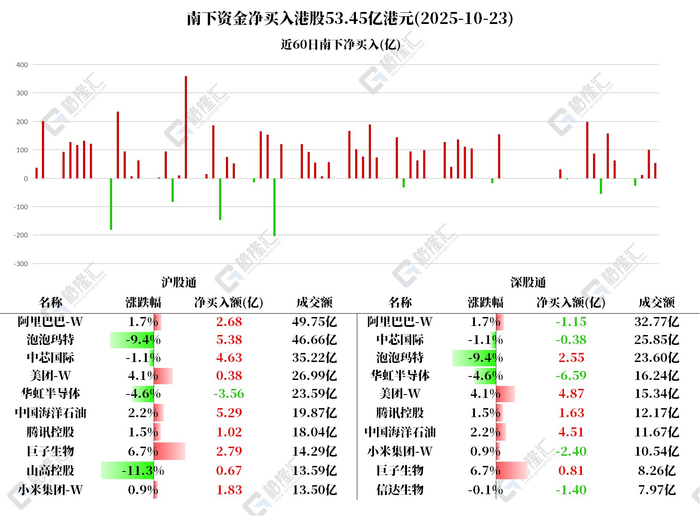
南向资金 | 中国海洋石油获净买入9.8亿港元
Di Yi Cai Jing· 2025-10-23 10:05
Group 1 - Southbound funds recorded a net purchase of 5.345 billion HKD today [1] - The top three net purchases were China National Offshore Oil Corporation (CNOOC) with 980 million HKD, Pop Mart with 793 million HKD, and Meituan-W with 524 million HKD [1] - In terms of net sales, Hua Hong Semiconductor faced a net sell of 1.014 billion HKD, followed by Innovent Biologics with 140 million HKD, and Xiaomi Group-W with 57 million HKD [1]
北水动向|北水成交净买入53.45亿 欧美加码制裁俄油 北水加仓中海油近10亿港元
智通财经网· 2025-10-23 10:03
Core Insights - The Hong Kong stock market saw a net inflow of 53.45 billion HKD from Northbound trading on October 23, with the Shanghai Stock Connect contributing 47.7 billion HKD and the Shenzhen Stock Connect contributing 5.75 billion HKD [1] Group 1: Stock Performance - The most bought stocks included CNOOC (00883), Pop Mart (09992), and Meituan-W (03690) [1] - The most sold stocks included Hua Hong Semiconductor (01347), Innovent Biologics (01801), and Xiaomi Group-W (01810) [1] Group 2: Individual Stock Details - CNOOC (00883) received a net buy of 9.79 billion HKD, driven by rising international oil prices due to sanctions on Russian oil companies [5] - Pop Mart (09992) saw a net buy of 7.93 billion HKD, with a reported sales growth of 245% to 250% in Q3, significantly exceeding Morgan Stanley's forecast [5] - Meituan-W (03690) had a net buy of 5.24 billion HKD, with strategic leadership changes indicating a focus on international expansion [6] - Semiconductor stocks showed divergence, with SMIC (00981) receiving a net buy of 4.25 billion HKD, while Hua Hong Semiconductor (01347) faced a net sell of 10.14 billion HKD due to concerns over its business sustainability [6] - Zai Lab (02367) received a net buy of 3.59 billion HKD following the approval of a new medical device [7] - Tencent (00700) and Alibaba-W (09988) had net buys of 2.65 billion HKD and 1.53 billion HKD, respectively, while Innovent Biologics (01801) and Xiaomi Group-W (01810) faced net sells of 1.4 billion HKD and 573 million HKD [7]

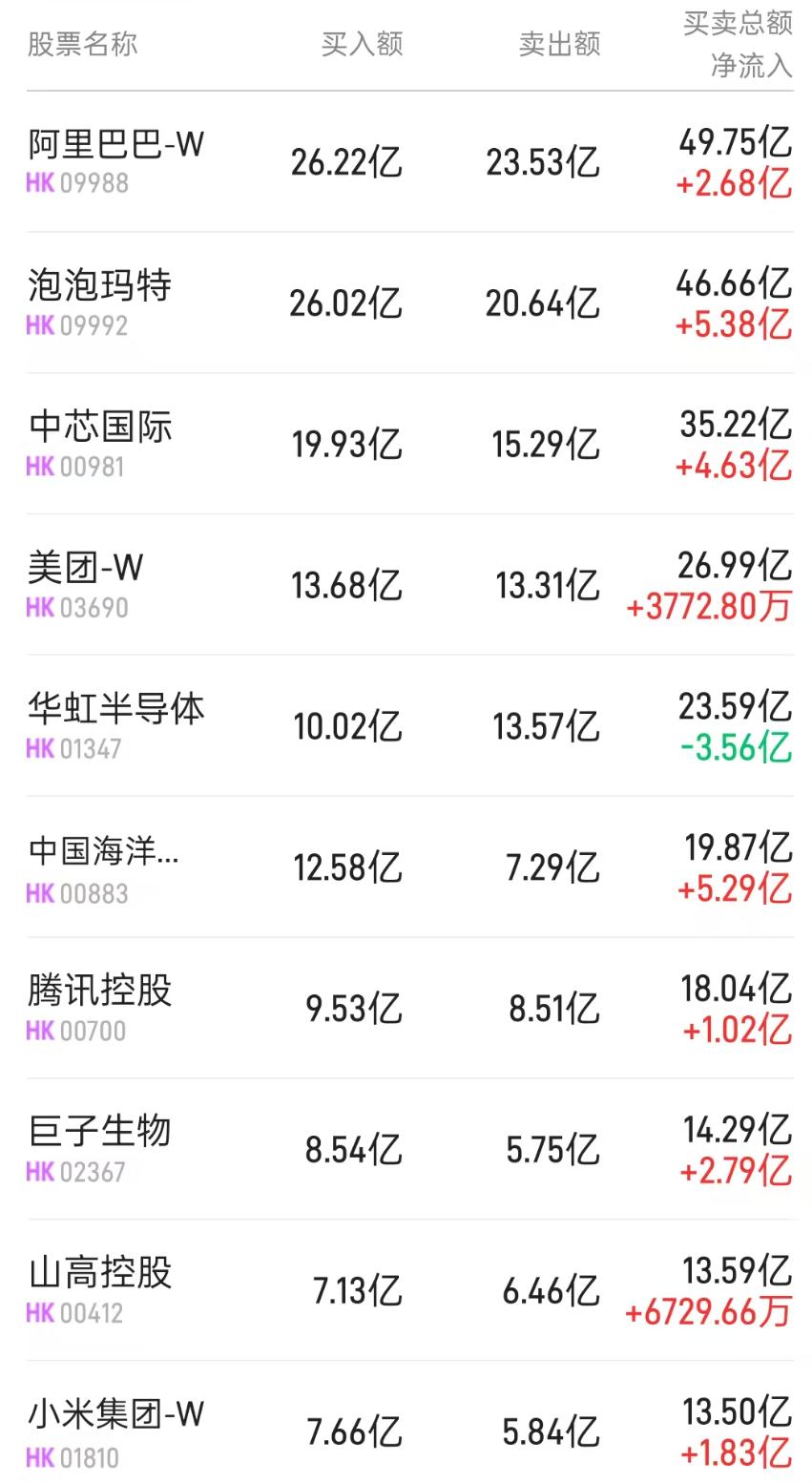
北水动向|北水成交净买入53.45亿 欧美加码制裁俄油 北水加仓中海油(00883)近10亿港元
智通财经网· 2025-10-23 09:56
Core Insights - The Hong Kong stock market saw a net inflow of 53.45 billion HKD from northbound trading on October 23, with the Shanghai-Hong Kong Stock Connect contributing 47.7 billion HKD and the Shenzhen-Hong Kong Stock Connect contributing 5.75 billion HKD [1] Group 1: Stock Performance - The most bought stocks included CNOOC (00883), Pop Mart (09992), and Meituan-W (03690) [1] - The most sold stocks included Hua Hong Semiconductor (01347), Innovent Biologics (01801), and Xiaomi Group-W (01810) [1] - CNOOC received a net buy of 9.79 billion HKD, driven by rising international oil prices due to sanctions on Russian oil companies [4] - Pop Mart saw a net buy of 7.93 billion HKD, with a reported sales growth of 245% to 250% in Q3, significantly exceeding Morgan Stanley's forecast [5] - Meituan-W received a net buy of 5.24 billion HKD, with strategic leadership changes indicating a focus on international expansion [5] Group 2: Sector Insights - Semiconductor stocks showed divergence, with SMIC (00981) receiving a net buy of 4.25 billion HKD, while Hua Hong Semiconductor faced a net sell of 10.14 billion HKD [5][6] - The demand for domestic advanced wafer foundry services is expected to rise due to the growth of AI applications and supportive policies [6] - Giant Biologics (02367) received a net buy of 3.59 billion HKD following the approval of a new medical device by the National Medical Products Administration [6]
海通国际:信达生物(01801)与武田制药达成114亿美元交易 合作商业化值得期待
Zhi Tong Cai Jing· 2025-10-23 09:28
Core Insights - Sinda Biopharma (01801) has entered into a global strategic collaboration with Takeda Pharmaceutical, which includes two late-stage therapies IBI363 (PD-1/IL-2α-bias) and IBI343 (CLDN18.2 ADC), as well as an early-stage project IBI3001 (EGFR/B7H3 ADC) [1][2] - The collaboration will provide Sinda Biopharma with an upfront payment of $1.2 billion, including a strategic equity investment of $100 million, with potential milestone payments reaching up to $10.2 billion and potential sales sharing [1][2] - IBI363 is viewed as a next-generation cornerstone therapy for tumors, with a significant market potential, targeting a global immune-oncology (IO) responder population of approximately 1.5 million, corresponding to a $50 billion hot tumor market [1] Group 1 - IBI363 has accumulated clinical data from over 1,200 patients, with plans to advance its global development in non-small cell lung cancer (NSCLC) and colorectal cancer (CRC), including first-line indications [2] - The first global Phase 3 clinical study (MarsLight-11) for IBI363 has received FDA approval, focusing on IO-resistant squamous NSCLC patients, comparing the efficacy and safety of IBI363 at a 3 mg/kg dose against docetaxel [2] - The collaboration model will help Sinda Biopharma build experience in global clinical and commercialization teams, leveraging its development efficiency in China and Takeda's international capabilities [2] Group 2 - Takeda invests approximately $5 billion annually in R&D and has a clinical team of 4,500, possessing extensive experience in oncology and immunotherapy [2] - This partnership is expected to enhance Sinda Biopharma's global footprint, gradually establishing R&D and commercialization capabilities in key international markets, maximizing long-term sustainable value [2]
里昂:信达生物与武田制药合作对推进产品研发正面 目标价升至120.1港元
Zhi Tong Cai Jing· 2025-10-23 08:09
Core Viewpoint - Cinda Biologics (01801) has entered a global strategic partnership with Takeda Pharmaceutical to co-develop the next-generation IO cornerstone therapy IBI363, along with licensing agreements for IBI343 and IBI3001 [1] Group 1: Financial Impact - According to the report by Credit Lyonnais, the sales and net profit forecasts for Cinda Biologics for the fiscal year 2026 have been raised by 48.5% and 172% respectively, while the net profit forecast for 2027 has been increased by 1.5% [1] - The target price for Cinda Biologics has been adjusted from HKD 111.4 to HKD 120.1, maintaining an "outperform" rating [1] Group 2: Product Development and Market Strategy - The collaboration is viewed positively for Cinda's global expansion and product development, particularly in advancing the core project IBI363 [1] - IBI363 received FDA approval in August this year to initiate a Phase III clinical trial for the treatment of squamous non-small cell lung cancer [1] - The plan for joint commercialization of IBI363 in the U.S. is expected to unlock market value, leveraging Takeda's strong commercial rights and experience in the U.S. market [1]
里昂:信达生物(01801)与武田制药合作对推进产品研发正面 目标价升至120.1港元
智通财经网· 2025-10-23 08:05
Core Viewpoint - Citibank reports that Innovent Biologics (01801) has entered into a global strategic collaboration with Takeda Pharmaceutical to jointly develop the next-generation IO cornerstone therapy IBI363, along with licensing agreements for IBI343 and IBI3001 [1] Financial Impact - Following this collaboration, Citibank has raised its sales and net profit forecasts for Innovent Biologics for the fiscal year 2026 by 48.5% and 172% respectively, and the net profit forecast for 2027 has been increased by 1.5% [1] - The target price for Innovent Biologics has been adjusted from HKD 111.4 to HKD 120.1, while maintaining an "Outperform" rating [1] Strategic Significance - The collaboration is viewed positively for Innovent's global expansion and product development, particularly in advancing the core project IBI363 [1] - IBI363 received FDA approval in August this year to initiate a Phase III clinical trial for the treatment of squamous non-small cell lung cancer [1] - The plan for joint commercialization of IBI363 in the U.S. is expected to unlock market value, with Takeda's strong U.S. commercial rights and extensive experience in the market being advantageous [1]