PING AN OF CHINA(02318)

Search documents
内险股表现强势 2026年开门红数据超预期 到期存款有望向保险配置转移
Zhi Tong Cai Jing· 2026-01-13 02:33
Core Viewpoint - The strong performance of insurance stocks is driven by better-than-expected data for the 2026 New Year sales, with leading insurance companies showing significant growth in new policies [1] Group 1: Stock Performance - China Ping An (601318) rose by 2.85% to HKD 70.45 [1] - China Pacific Insurance (02328) increased by 2.52% to HKD 16.66 [1] - China Life (601628) saw a rise of 2.32% to HKD 32.62 [1] - New China Life (601336) grew by 2.14% to HKD 62.15 [1] Group 2: Market Drivers - Huaxi Securities reported that the strong performance in new policy sales during the 2026 New Year period, with some leading insurers showing over 70% year-on-year growth in new policies, is a direct catalyst for the current rise in insurance stocks [1] - The low base from the previous year contributes to the strong momentum observed in the leading insurance companies this year [1] Group 3: Investment Trends - Insurance products are expected to attract part of the funds from savings due to their relative yield advantages [1] - Concerns regarding interest margin losses have significantly eased, leading to a gradual elimination of valuation pressures on the sector [1] Group 4: Future Projections - Guojin Securities anticipates that the shift of bank insurance will drive high growth in new policies and new business value (NBV) in 2026 [1] - Since 2020, residents have increased their precautionary savings, with new deposits consistently exceeding CNY 10 trillion, particularly in 2021, 2023, and 2024, with new deposits of CNY 9.9 trillion, CNY 16.67 trillion, and CNY 14.26 trillion respectively [1] - A significant portion of these high-interest deposits is expected to mature in 2026, with a potential shift of funds towards insurance products amid declining deposit rates and a shortage of medium to long-term deposit supply [1]



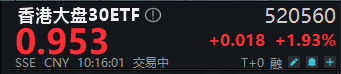
港股大爆发!阿里巴巴涨超4%,自带哑铃策略的——香港大盘30ETF(520560)跳空大涨,盘中拉升2%!
Xin Lang Cai Jing· 2026-01-13 02:32
Core Viewpoint - The Hong Kong stock market experienced a significant surge, with major indices rising over 1%, driven by a "technology + dividend" strategy, particularly highlighted by the Hong Kong Large Cap 30 ETF (520560) which saw a jump of over 2.1% during trading [1][8]. Group 1: Market Performance - The Hong Kong Large Cap 30 ETF (520560) recorded a price increase of 1.93% after a peak of 2.1% during the day [1][8]. - Key stocks such as BYD, Alibaba, China Life, and China Ping An saw gains exceeding 4% and 3%, respectively, while other companies like CNOOC and Li Auto also experienced increases of over 2% [1][8]. Group 2: Technology Sector Insights - The AI application sector witnessed a surge, with companies like MiniMax and Zhiyu Huazhang entering the capital market, leading to a focus on AI applications across the industry [2][9]. - Domestic AI hardware companies are leveraging capital market support to accelerate business growth, making AI a focal point in the market [2][9]. Group 3: Dividend Sector Developments - Several banks have launched new "asset enhancement activities" at the beginning of the year, allowing users to earn points and discounts upon participation, involving major state-owned and city commercial banks [2][9]. Group 4: Investment Rationale for Hong Kong Stocks - Global interest rate cuts are a prevailing trend, leading to increased liquidity in capital markets, which is expected to favor RMB assets, including A-shares and Hong Kong stocks [3][10]. - The net inflow of funds through the Hong Kong Stock Connect reached historical highs last year, indicating strong interest from mainland investors in Hong Kong stocks [3][10]. - Valuations for monopolistic or leading global stocks in Hong Kong are gradually increasing, as evidenced by significant premium rates for companies like CATL and MiniMax [3][10]. - The Hong Kong market is experiencing structural differentiation, with the Hang Seng Index projected to rise by 28% by 2025, driven by technology and high-dividend sectors [3][10]. Group 5: Investment Strategy - GF Securities recommends a "barbell strategy" for investing in Hong Kong stocks, suggesting a long-term allocation to stable value assets while also focusing on growth sectors with solid industrial logic [3][10]. - The Hong Kong Large Cap 30 ETF (520560) is highlighted as an ideal tool for long-term allocation, combining high-growth technology stocks with stable dividend-paying companies [4][11].






港股异动 | 内险股表现强势 2026年开门红数据超预期 到期存款有望向保险配置转移
智通财经网· 2026-01-13 02:31
Core Viewpoint - The strong performance of Chinese insurance stocks is driven by better-than-expected data for the 2026 New Year sales, with leading insurers showing significant growth in new policies [1] Group 1: Stock Performance - China Ping An (02318) increased by 2.85%, reaching HKD 70.45 [1] - China Pacific Insurance (02328) rose by 2.52%, reaching HKD 16.66 [1] - China Life Insurance (02628) gained 2.32%, reaching HKD 32.62 [1] - New China Life Insurance (01336) increased by 2.14%, reaching HKD 62.15 [1] Group 2: Market Drivers - Huaxi Securities reported that leading insurers saw a more than 70% year-on-year increase in new policy sales over the first three days of 2026, supported by a low base from the previous year [1] - The insurance sector is expected to attract part of the funds from savings due to the relative yield advantage of insurance products [1] - Concerns over interest margin losses have eased, gradually eliminating valuation pressures on the sector [1] Group 3: Future Growth Potential - Guojin Securities indicated that the shift of bank insurance is expected to drive high growth in new policies and new business value (NBV) in 2026 [1] - Since 2020, household savings have increased significantly, with new deposits consistently exceeding CNY 10 trillion, including CNY 9.9 trillion in 2021, CNY 16.67 trillion in 2023, and CNY 14.26 trillion in 2024 [1] - A significant portion of these early high-interest deposits is expected to mature in 2026, with two-thirds of 2/3/5-year deposits likely to shift towards insurance investments amid declining deposit rates and a shortage of medium to long-term deposit supply [1]
保险板块短线拉升,中国人保涨超2%
Mei Ri Jing Ji Xin Wen· 2026-01-13 02:12
每经AI快讯,1月13日,保险板块短线拉升,中国人保、新华保险、中国人寿、中国平安均涨超2%。 每日经济新闻 ...

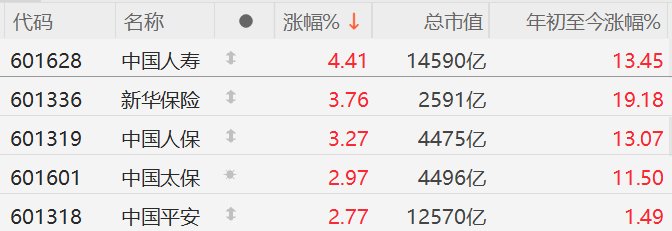
保险股集体走强,中国人寿涨超4%
Ge Long Hui· 2026-01-13 02:10
Core Viewpoint - The A-share market saw a collective rise in insurance stocks on January 13, with notable increases in major companies' stock prices [1] Group 1: Company Performance - China Life Insurance experienced a stock price increase of over 4% [1] - New China Life Insurance and China Pacific Insurance both saw stock price rises of over 3% [1] - China Insurance and Ping An Insurance recorded stock price increases of nearly 3% [1]
近期多重利好因素叠加,中国平安AH股均涨超3%
Ge Long Hui· 2026-01-13 02:04
Core Insights - China Ping An's A-shares rose by 3.4% to a peak of 69.84 yuan, while H-shares increased by 3.6% to a high of 71 HKD, following its inclusion in the "Top Ten Core Assets in Betting on China" list for 2026 by Gelonghui [1] Group 1: Market Performance - The insurance sector, represented by Ping An, has strengthened due to a combination of policy drivers, macroeconomic changes, fundamentals, and market liquidity [1] - The appreciation of the RMB has attracted foreign capital to reallocate towards core Chinese assets, with Ping An being a preferred choice due to its good liquidity and relatively low valuation [1] Group 2: Investment Appeal - In the context of a market shift towards value styles expected in 2026, Ping An's low valuation and high dividend yield provide a clear defensive value proposition [1] - The company's strategy of "comprehensive finance + ecosystem" aligns well with the aging economy and domestic demand themes, establishing a solid second growth curve [1] Group 3: Future Outlook - Continued investments in cutting-edge technologies like AI are enhancing customer experience, improving efficiency, and strengthening the company's competitive advantage [1] - Given the anticipated improvement in asset-side returns and external market catalysts, there is a clear potential for valuation recovery, maintaining an "outperform" rating [1]
保险板块短线拉升,中国人保等股涨超2%
Xin Lang Cai Jing· 2026-01-13 01:53
1月13日金融一线消息,保险板块短线拉升,中国人保、新华保险、中国人寿、中国平安均涨超2%。 责任编辑:王馨茹 1月13日金融一线消息,保险板块短线拉升,中国人保、新华保险、中国人寿、中国平安均涨超2%。 责任编辑:王馨茹 ...
标准先行破解新能源汽车“老大难”
Zhong Guo Qi Che Bao Wang· 2026-01-13 01:49
Core Viewpoint - The article discusses the challenges faced by electric vehicle (EV) owners regarding high repair costs and insurance premiums, highlighting the need for standardized repair and claims processes to improve the situation in the EV market [2][5][6]. Group 1: Industry Challenges - High repair and insurance costs for EVs have created anxiety among consumers, despite recent policies aimed at addressing these issues [2][5]. - The lack of standardized repair and claims processes has led to increased operational costs and disputes within the industry [2][5][11]. - The rapid growth of EVs has outpaced the existing automotive repair standards, necessitating new guidelines to address the complexities of modern EV technology [5][6][14]. Group 2: Regulatory Developments - The China Automotive Maintenance Industry Association has initiated the development of repair and claims standards for EVs, following a directive from multiple government agencies [2][11]. - The "Guiding Opinions" issued by regulatory bodies aim to enhance the repair capabilities of EV maintenance companies and establish a comprehensive standardization framework [5][6][9]. - The revised "Automotive Maintenance Technical Information Disclosure Management Measures" mandates that automakers provide independent repair shops with access to essential technical information [4][6]. Group 3: Insurance Market Dynamics - As of mid-2025, the total number of EVs in China reached 36.89 million, representing 10.27% of all vehicles, with insurance premiums for EVs projected to exceed 200 billion yuan, reflecting a growth of over 30% [7][8]. - The average risk cost for EV insurance is approximately 2.2 times that of traditional fuel vehicles, yet the premiums are only 1.7 times higher, indicating a mismatch that pressures insurance companies [8][9]. - Some insurance companies have begun to report improved profitability in EV insurance, with major players like Ping An and China Pacific Insurance showing positive trends in their EV insurance segments [9][10]. Group 4: Standardization Efforts - The establishment of a standardized framework for EV repair and claims is seen as essential for the high-quality development of the EV insurance market [11][14]. - The standards being developed will focus on safety, economic efficiency, and the integration with existing national standards to ensure practical applicability [13][14]. - Collaboration among various stakeholders, including automotive manufacturers, repair shops, and insurance companies, is crucial for creating effective standards that address the unique challenges of the EV market [12][15].




保险股接下来怎么看
2026-01-13 01:10
Summary of Conference Call on Insurance Sector Industry Overview - The insurance sector is currently experiencing low valuations, with China Pacific Insurance (CPIC) and Ping An Insurance (Group) Company of China, Ltd. (Ping An) having P/EV ratios of approximately 0.7 and 0.8 respectively for 2026, indicating rapid growth in intrinsic value [1][2] - China Life Insurance Company Limited (China Life) has a higher valuation in the A-share market at around 0.9 times P/EV, attributed to its faster growth in intrinsic value, but the Hong Kong-listed version is recommended due to significant discounts compared to A-shares [3][4] Key Insights and Arguments - The quality of pre-receipt data from late 2025 to early 2026 is strong, with a decline in bank deposit rates leading to increased funds flowing into insurance products. It is expected that premium growth will be high in the first quarter of 2026 but may face pressure in the third quarter [1][5] - Rising interest rates are beneficial for insurance companies' fixed-income investments, alleviating risks associated with interest spread losses. The yield on 10-year government bonds has risen to approximately 1.9%, an increase of 30 basis points from the previous year [5][7] - The proportion of equity assets in insurance companies is around 15.5%. A strong stock market will enhance insurance companies' earnings [5][7] Impact of Dividend Insurance Products - Dividend insurance products have a shorter effective duration, allowing insurance companies to be more flexible in their fixed-income asset allocation and increasing their risk appetite. It is anticipated that dividend insurance will constitute a significant portion of new premium growth [6][9] Investment Strategies and Profit Expectations - Insurance companies are focusing on increasing their equity allocation to benefit from stock market gains. Despite a solid profit outlook for 2025, the primary profit source is expected to be in the third quarter, with a relatively low profit base in the first half of 2026 [8] - The anticipated performance for the first quarter of 2026 is optimistic, with expectations that even if the market's growth in the third quarter is lower than the previous year, profits will remain stable [8] Market Performance and Forecasts - Recent performance of insurance stocks has been strong, with notable increases in share prices for Xinhua Insurance and CPIC at the start of 2026. However, Ping An's performance has been more volatile [2] - By the end of January, major insurance companies are expected to release profit forecasts. China Life and Xinhua Insurance are likely to announce forecasts, while Ping An's profit growth is projected to be lower than 50% for the year [11] Industry Valuation and Future Outlook - The overall outlook for the insurance industry in the first half of 2026 is optimistic, with no significant negative factors affecting the asset and liability sides. Valuations could reach 1.5 times PEV under favorable market conditions, while they may drop to 0.7 to 0.8 times PEV under poor conditions [12] - The policy environment remains supportive, and large listed companies are expected to continue outperforming smaller firms in premium growth, enhancing their market share [12]
报行合一”重塑财险半壁江山 五千亿非车险告别“野蛮生长
2 1 Shi Ji Jing Ji Bao Dao· 2026-01-13 00:52
Core Viewpoint - The rapid growth of China's non-auto insurance sector, with an average annual growth rate exceeding 10% over the past decade, has led to high costs and irrational competition, prompting regulatory measures to reshape the market dynamics towards risk pricing and service capability [2][3][12]. Group 1: Industry Growth and Challenges - Non-auto insurance premiums accounted for over 50% of total premiums, with a significant increase in the average annual growth rate of 14.4% from 2014 to 2024, compared to 5.2% for auto insurance [3][12]. - Major insurance companies, including PICC, Ping An, and Taiping, have reported that their average non-auto insurance comprehensive cost ratio has remained above 100% since 2019, indicating underwriting losses primarily offset by auto insurance profits [4][12]. - The industry faces challenges such as high expense levels, inadequate premium sufficiency, persistent underwriting losses, and high accounts receivable [2][3]. Group 2: Regulatory Measures - The China Banking and Insurance Regulatory Commission (CBIRC) has issued several notifications and guidelines to address irrational competition and high costs in the non-auto insurance sector, including the recent "Questions and Answers on Comprehensive Governance of Non-Auto Insurance" [2][4][12]. - The new regulations emphasize the principle of "reporting and operating in unison," requiring insurance companies to strictly adhere to approved insurance terms and rates, thereby enhancing market behavior regulation [4][11]. - The regulations aim to reduce the emphasis on premium scale and growth, shifting the focus towards compliance, quality, and consumer rights protection [6][12]. Group 3: Company Responses - Leading insurers like PICC, Ping An, and Taiping have proactively initiated product term filings and cost governance in response to regulatory changes, indicating a strong commitment to compliance [6][7]. - Companies are restructuring their business models to transition from cost competition to risk pricing and service capability, with a focus on enhancing internal management and product innovation [7][8]. - Smaller insurers are encouraged to focus on niche markets and specialized products to differentiate themselves and build competitive advantages [15][16]. Group 4: Market Dynamics and Future Outlook - The implementation of the "reporting and operating in unison" policy is expected to compress some business operations in the short term but will ultimately lead to a more sustainable competitive environment based on risk identification and service quality [10][12]. - The regulatory framework aims to clarify responsibilities and streamline processes, pushing the market towards a more structured and compliant operational model [10][11]. - The anticipated market concentration will favor larger, well-managed companies, while smaller firms may need to adapt by focusing on specialized areas to survive [15][16].