
China Life(02628)

Search documents
中国人寿拟与附属国寿启远成立合伙企业,专注于养老产业领域投资
Zhi Tong Cai Jing· 2026-01-24 02:21
合伙企业专注于养老产业领域投资,是本公司落实健康中国战略、支持实体经济发展的重要体现。合伙 企业投资采取轻重资产结合模式,坚持"战略配置、价值投资、长期投资"的核心投资理念,围绕存量养 老不动产项目并购以及新增养老不动产项目拓展两条主线,持续赋力国寿康养生态圈的构建。合伙企业 通过对养老不动产项目的投资将实现持续的资产管理和经营管理,获取运营收入和资产增值收益。同 时,合伙企业对存量养老不动产项目收购,有利于规范管理关系,提升管理效率,优化持股结构,实现 有效风险隔离。 集团公司为本公司的控股股东,目前持有本公司约68.37%的已发行股本,为本公司的关连人士。集团 公司间接持有国寿启远及国寿股权的全部股权,因此国寿启远及国寿股权均为本公司的关连人士。因 此,本次交易构成本公司在上市规则第14A章下的关连交易。由于本次交易适用的一个或多个百分比率 超过0.1%但少于5%,因此根据上市规则第14A章,本次交易须遵守申报及公告规定,但获豁免遵守独 立股东批准的规定。 中国人寿 中国人寿 分时图 日K线 周K线 月K线 45.73 -1.17 -2.49% 3.86% 2.58% 1.28% 0.00% 1.28% ...
2025年四季度非银板块基金持仓分析:保险券商均获增配,看好居民资金入市下的非银机会
GUOTAI HAITONG SECURITIES· 2026-01-23 14:12
Investment Rating - The report assigns an "Overweight" rating to the industry, indicating a positive outlook for investment opportunities in the non-bank financial sector [5][14]. Core Insights - The report highlights that the non-bank sector is currently underweight by 3.08 percentage points, despite an increase in holdings during the fourth quarter of 2025. It emphasizes the potential for profit improvement and low valuations in non-bank stocks due to the influx of household funds into the market [3][5]. - The report notes a significant increase in the allocation to the insurance sector, with the proportion rising from 1.03% to 2.13%, while the insurance index saw a substantial increase of 23.42% in the fourth quarter [5][8]. - The report suggests that the brokerage sector has also received increased allocations, with public fund holdings rising from 0.85% to 1.08%, although it remains underweight by 2.30 percentage points [5][8]. Summary by Sections Non-Bank Sector - The non-bank sector remains underweight overall by 3.08 percentage points, with a positive outlook for long-term capital inflows and wealth management opportunities [5][8]. - Specific recommendations include increasing holdings in companies such as Jiufang Zhituo Holdings, Tonghuashun, Guoxin Securities, and others, as they are expected to benefit from the ongoing market dynamics [5][8]. Insurance Sector - The insurance sector's allocation has increased significantly, with a focus on low-valuation stocks as capital continues to flow into the market. The report recommends increasing holdings in China Life, Ping An, and China Pacific Insurance [5][8]. Brokerage Sector - The brokerage sector has seen a rise in public fund holdings, with notable increases in individual stocks like CITIC Securities and Huatai Securities. The report suggests that the retail business share is likely to improve, making these stocks attractive [5][8]. Financial Technology and Diversified Finance - The report indicates a decrease in the allocation to diversified finance and financial technology sectors, but highlights potential investment opportunities in companies like Lakala and Yuexiu Financial Holdings due to ongoing policy support and technological advancements [5][8].




中国人寿:拟出资84.915亿元投资北京国寿养老产业股权投资基金二期
Zheng Quan Shi Bao Wang· 2026-01-23 13:43
Group 1 - The core point of the article is that China Life Insurance plans to establish a second phase of the Beijing Guoshou Pension Industry Equity Investment Fund by entering into a partnership agreement with Guoshou Qiyuan (Beijing) Pension Industry Investment Management Co., Ltd. by September 30, 2026 [1] - The total committed capital from all partners in the partnership is 8.5 billion yuan, with China Life contributing 8.4915 billion yuan and Guoshou Qiyuan contributing 8.5 million yuan [1] - Guoshou Equity Investment Co., Ltd. will act as the manager of the partnership [1]
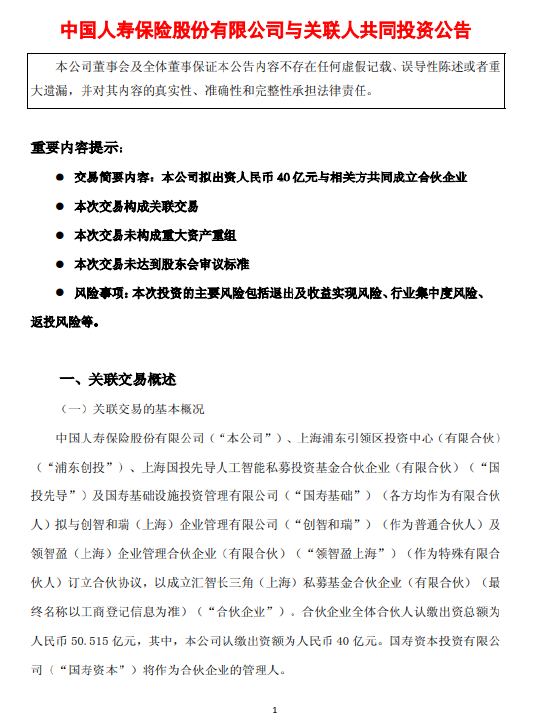
中国人寿:拟出资40亿元投向汇智长三角(上海)私募基金 投向人工智能、科技创新产业
Zheng Quan Shi Bao Wang· 2026-01-23 13:42
人民财讯1月23日电,中国人寿(601628)1月23日公告,公司与上海浦东引领区投资中心、上海国投先 导人工智能私募投资基金合伙企业及国寿基础设施投资管理有限公司(各方均作为有限合伙人),拟与创 智和瑞(上海)企业管理有限公司(作为普通合伙人)及领智盈(上海)企业管理合伙企业(作为特殊有限合伙 人)订立合伙协议,以成立汇智长三角(上海)私募基金合伙企业(有限合伙)。合伙企业全体合伙人认缴出 资总额为50.515亿元,其中,中国人寿认缴出资额为40亿元。国寿资本投资有限公司将作为合伙企业的 管理人。基金拟以人工智能引导"科技创新、产业升级"为主线,与上海市和浦东新区市区两级开展合 作,以参股型私募股权投资方式,重点投向人工智能技术和相关应用,以及包括集成电路、生物医药等 其他各类科技创新产业(300832),有助于提升保险资金投资收益,符合保险资金配置需求。 ...
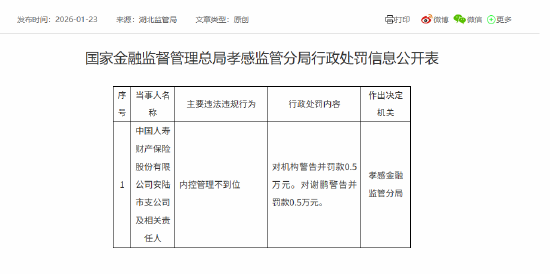
中国人寿财险安陆市支公司被罚0.5万元:内控管理不到位
Xin Lang Cai Jing· 2026-01-23 11:58
| 序 | 当事人名 | 主要违法违规行为 | 行政处罚内容 | 作出决定 | | --- | --- | --- | --- | --- | | 를 | 彩 | | | 机关 | | | 中国人寿 | | | | | | 财产保险 | | | | | | 股份有限 | | 对机构管告并罚款0.5 | 表感金融 | | 1 | 公司安陆 | 内控管理不到位 | 万元。对谢鹏智告并 | | | | | | | 监管分局 | | | 市支公司 | | 罚款0.5万元。 | | | | 及相关责 | | | | | | 任人 | | | | | 序 | 当事人名 | 主要违法违规行为 | 行政处罚内容 | 作出决定 | | --- | --- | --- | --- | --- | | 号 | 彩 中国人天 | | | 机关 | | | 财产保险 | | | | | | 股份有限 | | 对机构管告并罚款0.5 | 老感金融 | | 1 | 公司安陆 | 内控管理不到位 | 万元。对谢鹏智告并 | 监管分局 | | | 市支公司 | | 罚款0.5万元。 | | | | 及相关责 | | | | | | 任人 | ...

“寿险头雁”中国人寿拟出资40亿元参设私募基金 聚焦人工智能等领域
Hua Er Jie Jian Wen· 2026-01-23 11:33
Core Viewpoint - China Life Insurance Company is expanding its investment strategy by establishing a partnership to invest in strategic emerging industries, particularly in artificial intelligence, integrated circuits, and biomedicine [1][2]. Group 1: Partnership Structure and Investment Amount - The total committed capital for the partnership is 5.0515 billion yuan, with China Life contributing 4 billion yuan [2]. - The management structure will be led by Guoshou Capital, which will act as the manager of the partnership [2]. Group 2: Investment Strategy and Duration - The partnership will have a duration of ten years from the date of the first business license issuance, with an initial investment period of five years followed by a five-year exit period [2]. - At least 70% of the investment will be allocated to the artificial intelligence sector [2]. Group 3: Governance Structure - The partnership will establish an investment decision committee and an investment advisory committee, with specific member allocations from the involved parties [2]. Group 4: Related Party Transactions - The transaction is classified as a related party transaction under the listing rules, as China Life is the controlling shareholder of Guoshou Capital and has subsidiaries involved in the partnership [2][3]. Group 5: Exit Strategy and Historical Success - Guoshou Asset has a successful track record in alternative investments, exemplified by the recent successful exit through the restructuring of Guodian Power Nuclear Company, marking a significant achievement in its investment management capabilities [3].
智通港股通活跃成交|1月23日





智通财经网· 2026-01-23 11:01
Group 1 - On January 23, 2026, Alibaba-W (09988), Pop Mart (09992), and Tencent Holdings (00700) ranked as the top three companies by trading volume in the Southbound Stock Connect, with transaction amounts of 4.748 billion, 2.660 billion, and 2.614 billion respectively [1] - In the Southbound Stock Connect for the Shenzhen-Hong Kong Stock Connect, Alibaba-W (09988), Tencent Holdings (00700), and Pop Mart (09992) also held the top three positions, with transaction amounts of 3.322 billion, 1.798 billion, and 1.370 billion respectively [1] Group 2 - In the Southbound Stock Connect, the top active trading companies included Alibaba-W (09988) with a net buy amount of -0.595 billion, Pop Mart (09992) with a net buy amount of +0.480 billion, and Tencent Holdings (00700) with a net buy amount of +0.396 billion [2] - In the Shenzhen-Hong Kong Stock Connect, Alibaba-W (09988) had a net buy amount of -0.895 billion, Tencent Holdings (00700) had a net buy amount of -0.156 billion, while Pop Mart (09992) recorded a net buy amount of +0.268 billion [2]
中国人寿拟出资40亿元联合多方成立合伙企业
Xin Lang Cai Jing· 2026-01-23 10:55
Core Viewpoint - China Life Insurance Company plans to establish a private equity fund in partnership with Shanghai Pudong Leading Area Investment Center and others, focusing on investment in technology innovation companies in the Yangtze River Delta region, particularly in artificial intelligence, integrated circuits, and biomedicine [1][5]. Group 1: Investment Details - The total committed capital for the partnership is RMB 50.5 billion, with China Life contributing RMB 40 billion [1][5]. - The fund will be managed by Guoshou Capital Investment Co., Ltd., which constitutes a related party transaction [1][5]. Group 2: Investment Focus - The partnership aims to invest in growth-stage technology innovation enterprises within three leading industries: artificial intelligence, integrated circuits, and biomedicine [1][5][12]. - The investment strategy aligns with national policy directions and aims to enhance investment returns from insurance funds [12]. Group 3: Approval Process - The investment proposal was approved by the company's board of directors and relevant committees, with no objections from non-related directors [13]. - The transaction does not require shareholder meeting approval as it does not meet the threshold for significant asset restructuring [14][15]. Group 4: Historical Context - In the past 12 months, the cumulative amount of related party transactions between the company and its group has exceeded RMB 30 million but does not account for more than 5% of the company's latest audited net assets [16].
中国人寿拟出资84.915亿元成立合伙企业 专注于养老产业领域投资
Ge Long Hui· 2026-01-23 09:47
Core Viewpoint - China Life Insurance (02628.HK) plans to establish a partnership with Guoshou Qiyuan to invest in the elderly care real estate sector, with a total investment of RMB 8.5 billion [1][2] Group 1: Partnership Details - The partnership agreement is expected to be signed by September 30, 2026, with total contributions amounting to RMB 8.5 billion, where China Life contributes RMB 8,491,500,000 and Guoshou Qiyuan contributes RMB 8,500,000 [1] - Guoshou Qiyuan will act as the general partner, managing the partnership [1] Group 2: Investment Focus - The partnership will focus on investments in the elderly care industry, specifically through acquiring or establishing companies that operate elderly care real estate projects [1][2] - Investment strategies include (a) investing in and holding real estate, (b) leasing real estate, and (c) utilizing public-private partnerships for real estate [1] Group 3: Strategic Objectives - The partnership aims to enhance the construction of the Guoshou Kangyang ecosystem by focusing on both existing elderly care real estate acquisitions and new project developments [2] - The investment approach combines light and heavy asset models, emphasizing strategic allocation, value investment, and long-term investment [2] - Acquiring existing elderly care real estate projects is expected to improve management efficiency and optimize ownership structures, thereby achieving effective risk isolation [2]
中国人寿(601628) - 中国人寿关于董事辞任的公告
2026-01-23 09:45
本公司对王军辉先生在任职期间对本公司做出的贡献表示衷心 证券代码:601628 证券简称:中国人寿 公告编号:2026-002 中国人寿保险股份有限公司 关于董事辞任的公告 本公司董事会及全体董事保证本公告内容不存在任何虚假记载、误导性陈述 或者重大遗漏,并对其内容的真实性、准确性和完整性承担法律责任。 中国人寿保险股份有限公司("本公司")董事会于 2026 年 1 月 22 日收到辞任函,王军辉先生因工作调整辞去本公司非执行董事及 董事会提名薪酬委员会委员职务,该辞任于同日起生效。 二、董事辞任对本公司的影响 王军辉先生的辞任不会导致本公司董事会成员人数低于法定最 低人数要求。王军辉先生已确认,其与董事会并无任何意见分歧,亦 无任何有关其辞任之其他事项须提请本公司股东注意。王军辉先生已 按照相关规定做好交接工作。 2 1 一、董事辞任的基本情况 姓名 辞任职务 辞任时间 原定任期 到期日 辞任原因 是否继续在本 公司及其控股 子公司任职 具体职务 是否存在 未履行完 毕的公开 承诺 王军辉 非执行董 事、董事 会提名薪 酬委员会 委员 2026 年 1 月 22 日 第八届董事 会届满时 工作调整 是 中 ...