CHINARES PHARMA(03320)

Search documents
天风证券晨会集萃-20250918
Tianfeng Securities· 2025-09-17 23:44
Group 1: Macro Strategy and Market Overview - The report highlights a gradual convergence of overseas central bank policies, impacting asset allocation strategies [3][28] - In the A-share market, major indices saw significant gains in early September, with the CSI 100 and CSI 500 indices rising by 4.45% and 6.33% respectively [3][28] - The central bank's net cash injection was 196.1 billion yuan, maintaining a loose liquidity environment with DR007 staying below 1.48% [3][28] Group 2: Agricultural Bank of China - The Agricultural Bank of China is expected to benefit from the release of potential in county economies, with greater credit growth opportunities compared to peers [4] - The bank has the lowest non-performing loan ratio among its peers, with a strong ability to manage risks related to real estate exposure [4] - Future profit growth is projected at 1.98%, 3.94%, and 4.63% for 2025-2027, with corresponding BPS values of 7.69, 8.12, and 8.53 yuan [4] Group 3: Unmanned Forklifts Industry - The unmanned forklift market is experiencing rapid growth, with shipments increasing from 2,700 units in 2019 to an estimated 19,500 units in 2023, representing a penetration rate of 1.66% [6] - The market size for unmanned forklifts in China is projected to reach 2.385 billion USD in 2023, accounting for 45% of the global market [6] - Major players in the industry include Linde, Hangcha, and Geek+, with significant advancements in technology and market share [6][10] Group 4: Communication Sector - Runxin Technology - Runxin Technology reported a revenue of 1.358 billion yuan in H1 2025, marking a 16.42% year-on-year increase, with net profit rising by 18.23% [13][34] - The company is focusing on AIoT and automotive electronics, diversifying its revenue sources and enhancing long-term growth potential [34] - The firm has established strong partnerships with leading semiconductor suppliers, which bolsters its competitive edge in the market [34] Group 5: Semiconductor Testing Industry - Weicet Technology - Weicet Technology achieved a revenue of 634 million yuan in H1 2025, reflecting a 47.53% increase, with net profit soaring by 831.03% [36][39] - The company is expanding its testing capacity for high-end and reliable chips, with significant investments in new facilities [37] - The semiconductor market is expected to maintain optimistic growth, driven by advancements in AI and automotive electronics [39] Group 6: Pharmaceutical Sector - China Resources Pharmaceutical - China Resources Pharmaceutical reported a revenue of 131.867 billion yuan in H1 2025, a 2.5% increase, while net profit decreased by 20.3% due to impairment losses [21] - The company is focusing on external growth through acquisitions and innovation in its pharmaceutical business [21] - The firm has successfully launched 21 new products in H1 2025, with a robust pipeline of 476 projects under development [21]





华润医药(03320):收入表现稳健,外延+创新打开成长空间
Tianfeng Securities· 2025-09-17 11:44
Investment Rating - The investment rating for the company is upgraded to "Accumulate" [6] Core Views - The company achieved a revenue of 131.87 billion yuan in H1 2025, a year-on-year increase of 2.5%, while the net profit attributable to shareholders decreased by 20.3% to 2.08 billion yuan, primarily due to impairment losses from equity investments [1] - The pharmaceutical segment showed a revenue increase of 4.3% to 24.81 billion yuan, with steady growth across traditional Chinese medicine, biopharmaceuticals, and health products [2] - The company is focusing on external growth and innovative research and development, having completed acquisitions to enhance its blood products supply chain and improve its traditional Chinese medicine innovation capabilities [3] - The medical device business is expanding, with a revenue increase of 8% to 18 billion yuan in H1 2025, and the establishment of a regional inspection center [4] - Profit forecasts have been adjusted downwards for 2025-2027 due to impairment impacts, with net profit estimates revised to 3.75 billion, 4.66 billion, and 5.04 billion yuan respectively [5] Summary by Sections Revenue Performance - In H1 2025, the company reported a revenue of 131.87 billion yuan, reflecting a 2.5% increase year-on-year, while the net profit attributable to shareholders was 2.08 billion yuan, down 20.3% [1] - The pharmaceutical business generated 24.81 billion yuan in revenue, up 4.3%, with a gross margin of 59.3% [2] Business Segments - The pharmaceutical segment's gross margin decreased by 0.8 percentage points, while the medical distribution segment's revenue reached 108.33 billion yuan, a 2.3% increase [2] - The retail business within the medical distribution segment saw a significant revenue increase of 11.4% to 5.52 billion yuan [2] Growth Strategies - The company is pursuing external growth through acquisitions and innovative R&D, having launched 21 new products and currently working on 476 projects, including 178 new drug projects [3] - The medical device segment is being strengthened with new product introductions and the establishment of a regional inspection center [4] Profitability and Valuation - The net profit forecast for 2025 has been adjusted to 3.75 billion yuan due to impairment losses, with expectations of recovery in 2026 and 2027 [5]
中信里昂:内地医药行业尽管未转好但乐观 国药控股为首选
Zhi Tong Cai Jing· 2025-09-15 03:58
Group 1 - The core viewpoint of the article indicates a structural optimism for the pharmaceutical distribution industry in China despite the mid-term performance not turning profitable by the first half of 2025 [1] - Factors contributing to this optimism include potential relaxation of mainland medical insurance spending, possible optimization of volume-based procurement due to anti-involution measures in the healthcare sector, enhanced cash payment capabilities of medical insurance funds, and a domestic interest rate reduction cycle that may help distributors improve financial leverage [1] Group 2 - Citic Lyon raised the target price for China National Pharmaceutical Group (01099) by 22.5%, from HKD 20 to HKD 24.5 [1] - The target price for Shanghai Pharmaceuticals (02607) H-shares was increased by 15.4%, from HKD 12.3 to HKD 14.2 [1] - However, the target price for China Resources Pharmaceutical (03320) was lowered by 5.1%, from HKD 5.9 to HKD 5.6 [1] - The rating for all the mentioned companies remains "outperform the market," with China National Pharmaceutical Group being the preferred choice [1]

【干货】医药流通产业链全景梳理及成本结构价值分析
Qian Zhan Wang· 2025-09-14 06:12
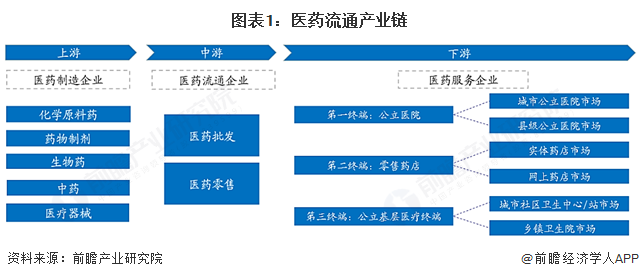
Industry Overview - The pharmaceutical distribution industry serves as a critical link between pharmaceutical manufacturers and end consumers, characterized by a specialized division of labor [2][5] - The industry consists of upstream manufacturers producing various types of pharmaceutical products, including Western medicine, traditional Chinese medicine, medical devices, and chemical reagents [1] Cost Structure Analysis - The primary cost in the pharmaceutical distribution industry is sales cost, which includes product and raw material costs, accounting for approximately 95% of total sales costs, while other costs make up about 5% [5] Profitability Factors - Key drivers of profitability in the pharmaceutical distribution sector include sales scale and growth, gross margin levels, expense ratios, and inventory turnover [7] - Companies maintain stable gross margins through scale advantages and product structure adjustments, while controlling costs through refined management practices [7] Internet Integration - The integration of "Internet+" in the pharmaceutical distribution industry helps reduce costs and improve efficiency, allowing pharmaceutical companies to analyze order demands and pharmacies to manage inventory effectively [9] - Patients benefit from the ability to compare prices and brands online, facilitating informed purchasing decisions [9]



启示2025:中国医药流通行业投融资及产业基金分析(附投融资事件、产业基金等)
Qian Zhan Wang· 2025-09-04 04:02
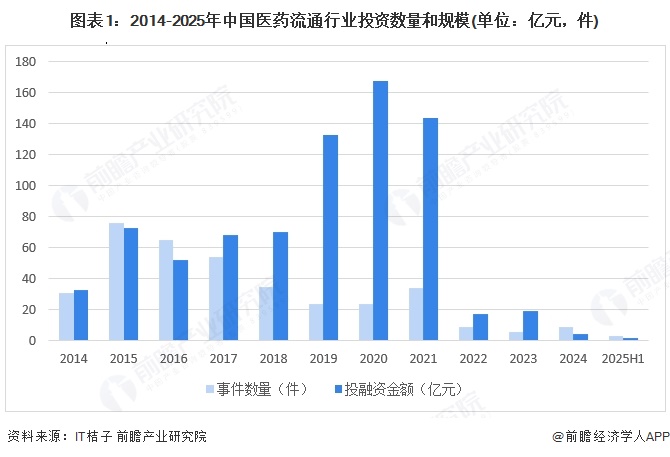
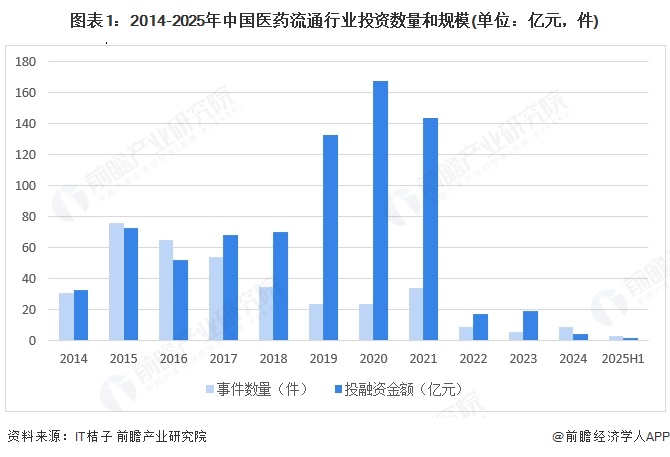
Investment Trends - The investment scale in the pharmaceutical distribution industry from 2014 to 2024 shows an initial increase followed by a decline, with the most active investment period being from 2014 to 2017 and the highest investment amount recorded between 2019 and 2021. Since 2022, both the number and amount of investments have decreased, with only 9 investments recorded in 2024 [1][17] - The single investment amount fluctuated from 110 million yuan per deal in 2014 to 700 million yuan per deal in 2020, then began to decline in 2021, with a rebound to 320 million yuan per deal in 2023 [3][17] Financing Rounds - Strategic investments are the primary financing round in the industry, accounting for 37% from 2021 to 2025, driven by companies accelerating business transformation and enhancing bargaining power through regional network integration [9][17] - A-round financing accounts for 17.7% of the total financing rounds [9] Investment Entities - Private Equity (PE) and Venture Capital (VC) account for 73% of the investment entities, while enterprises account for 17%, primarily for vertical investments in the supply chain [11][17] - Funds represent 8% of the investment entities [11] Investment Destinations - The majority of funds are directed towards Beijing, accounting for 27%, followed by Shanghai at 16%, and Guangdong and Zhejiang at 13% and 10%, respectively [13][17] Fund Management - Several funds are actively investing in the pharmaceutical distribution sector, with management scales exceeding 50 billion yuan, including the Shanghai Comprehensive Reform Fund and the National Mixed Ownership Fund [16][17]

【投资视角】启示2025:中国医药流通行业投融资及产业基金分析(附投融资事件、产业基金等)
Qian Zhan Wang· 2025-09-04 03:13
Core Insights - The investment scale in the pharmaceutical distribution industry has shown a trend of increasing and then decreasing from 2014 to 2024, with the most active investment phase occurring between 2014 and 2017, and the highest investment amount recorded from 2019 to 2021. Since 2022, both the number and amount of investments have declined, with 2024 seeing 9 investments totaling 420 million yuan [1][2]. Investment Trends - From 2014 to 2020, the average single investment amount increased from 110 million yuan to 700 million yuan, but began to fluctuate downwards from 2021, with a rebound to 320 million yuan in 2023. Investments in 2024 and 2025 are expected to be in the million yuan range [2]. Financing Events Summary - A summary of financing events from 2024 to 2025 shows various companies receiving investments, with notable amounts such as 150 million yuan for Zhengshe Pharmacy and 600 million yuan for Huaren Biopharma [6][7][8]. Financing Rounds - The majority of financing rounds from 2021 to 2025 are strategic investments, accounting for 37% of total investments, indicating a trend towards business transformation and enhanced bargaining power through regional network integration. A rounds account for 17.7%, while B and C rounds are also prevalent [9]. Investment Entities - Private Equity (PE) and Venture Capital (VC) firms dominate the investment landscape, making up 73% of the total investment entities, followed by enterprises at 17%. This trend is driven by the need for substantial capital to support chain expansion and acquisitions, as traditional bank loans are insufficient [10]. Investment Destinations - The primary destinations for investment in the pharmaceutical distribution sector are Beijing (27%), followed by Shanghai (16%), Guangdong (13%), and Zhejiang (10%). These regions are characterized by strong economic development and high demand for pharmaceutical distribution [12]. Fund Management Capabilities - Several funds are actively investing in the pharmaceutical distribution sector, including the Shanghai Comprehensive Reform Fund and the National Mixed Ownership Fund, with management scales exceeding 50 billion yuan. Most of these funds are backed by state and local government resources, indicating strong management capabilities [13][17].
华润医药(03320) - 截至二零二五年八月三十一日止月份之股份发行人的证券变动月报表
2025-09-01 09:15
第 2 頁 共 10 頁 v 1.1.1 股份發行人及根據《上市規則》第十九B章上市的香港預託證券發行人的證券變動月報表 截至月份: 2025年8月31日 狀態: 新提交 致:香港交易及結算所有限公司 公司名稱: 華潤醫藥集團有限公司 呈交日期: 2025年9月1日 I. 法定/註冊股本變動 不適用 FF301 第 1 頁 共 10 頁 v 1.1.1 FF301 II. 已發行股份及/或庫存股份變動 | 1. 股份分類 | 普通股 | | 股份類別 | 不適用 | | 於香港聯交所上市 (註1) | 是 | | | --- | --- | --- | --- | --- | --- | --- | --- | --- | | 證券代號 (如上市) | 03320 | 說明 | | | | | | | | | | 已發行股份(不包括庫存股份)數目 | | | 庫存股份數目 | | 已發行股份總數 | | | 上月底結存 | | | | 6,282,510,461 | | 0 | | 6,282,510,461 | | 增加 / 減少 (-) | | | | | | | | | | 本月底結存 | | | | ...
华润医药(03320.HK):业绩符合预期 创新产品引入加码
Ge Long Hui· 2025-08-30 03:15
Core Viewpoint - The company reported its 2025 first half performance, with revenue of RMB 131.87 billion, a year-on-year increase of 2.5%, and a net profit attributable to shareholders of RMB 2.08 billion, a year-on-year decrease of 20.3% [1] Performance Summary - The pharmaceutical business saw a revenue of RMB 24.81 billion, up 4.3% year-on-year, driven by growth in traditional Chinese medicine and biopharmaceuticals, with traditional Chinese medicine revenue increasing by 9.1% and biopharmaceuticals by 11.9% [1] - The overall gross margin for the pharmaceutical business was 59.3%, a decrease of 0.8 percentage points year-on-year [1] - The distribution business revenue was RMB 108.33 billion, a year-on-year increase of 2.3%, with a gross margin of 5.9%, remaining stable [1] - DTP revenue was approximately RMB 3.76 billion, showing a growth of about 14.1% year-on-year [1] Development Trends - The company completed the mergers and acquisitions of Tian Shili and Nanger, which are expected to strengthen its position in the traditional Chinese medicine sector and expand into the medical device field [1] - The establishment of two industrial funds aims to invest in chemical innovative drugs, biological products, high-end medical devices, and other sectors [2] - The company signed collaboration projects for innovative drugs, indicating a focus on enhancing its product portfolio [2] Profit Forecast and Valuation - The net profit forecasts for 2025 and 2026 were adjusted downwards by 8.1% and 8.4% to RMB 3.35 billion and RMB 3.65 billion, respectively, with expected growth rates of 0.0% and 9.0% [2] - The current stock price corresponds to a price-to-earnings ratio of 8.4 times for 2025 and 7.6 times for 2026, with a target price of HKD 7.0, indicating a potential upside of 43.1% [2]
2025年中国医药流通行业销售现状 医药流通销售收入超过3万亿元,同比增长4%
Qian Zhan Wang· 2025-08-29 09:05
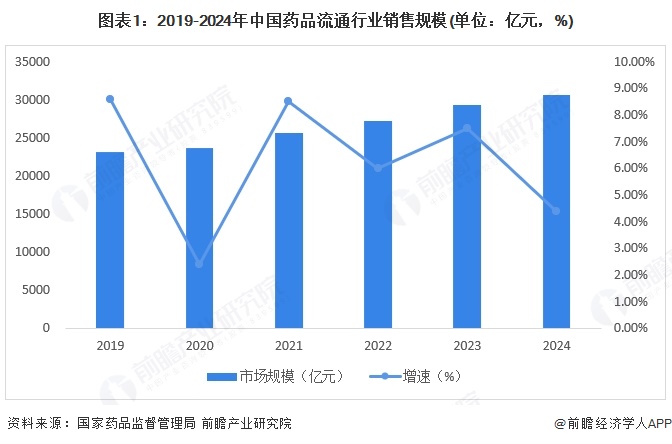
Core Insights - The pharmaceutical distribution market in China has shown steady growth, with a total sales scale exceeding 30 trillion yuan from 2019 to 2023, reflecting a year-on-year increase of 7.5% after excluding non-comparable factors [1][3]. Market Structure - The wholesale market dominates the pharmaceutical distribution sector, accounting for approximately 78% of the market share, while the retail market holds a 22% share [3]. Revenue Growth - The revenue of direct reporting pharmaceutical distribution enterprises reached 22,362 billion yuan in 2023, marking an 8% year-on-year increase after excluding non-comparable factors [5]. Accounts Receivable - The average accounts receivable days for pharmaceutical wholesale enterprises exceeded 150 days in 2023, with a reported average of 152 days, which is an increase of 2 days compared to 2022 [7]. Product Composition - Western medicine is the primary category in pharmaceutical sales, representing 68.7% of total sales, followed by traditional Chinese medicine at 15.5% and Chinese medicinal materials at 2.4%, collectively accounting for 86.6% of the market [9].
2025年中国咽喉中成药行业发展历程、市场政策、产业链图谱、销售额、竞争格局及发展趋势:市场集中度较高,CR5占比超50%[图]
Chan Ye Xin Xi Wang· 2025-08-29 01:54
Core Viewpoint - The increasing prevalence of throat diseases due to environmental pollution, lifestyle changes, and an aging population is driving the demand for throat traditional Chinese medicine (TCM), with the market expected to reach 7.4 billion yuan in 2024, reflecting a year-on-year growth of 7.49% [1][9]. Overview - Throat diseases are primarily caused by various factors such as wind-heat invasion and internal heat, leading to symptoms like sore throat and hoarseness. Throat TCM is made from traditional Chinese medicinal ingredients and is used to treat throat-related ailments, characterized by stable efficacy and minimal side effects [1][3]. Development History - The throat medicine industry in China began relatively late, with significant advancements in chronic pharyngitis research in the 1980s leading to the development of throat medications. The market was initially fragmented, but the introduction of products like Guangxi Jinsongzi's throat lozenges in 1995 marked a turning point, establishing a competitive landscape [4][5]. Market Policy - The Chinese government has implemented various policies to support the development of the TCM industry, creating a favorable environment for throat TCM growth. These include measures to enhance TCM regulation and promote innovation [5][6]. Industry Chain - The throat TCM industry consists of an upstream segment focused on medicinal herb cultivation, a midstream segment for manufacturing, and a downstream segment involving sales through medical institutions, pharmacies, and e-commerce platforms. The primary consumer groups include individuals who use their voices frequently and patients with chronic throat conditions [6][7][8]. Current Market Situation - The throat TCM market is experiencing rapid growth, with a projected sales figure of 7.4 billion yuan in 2024. Tablets represent the largest segment at 41.65%, followed by granules and pills [1][9]. Competitive Landscape - The throat TCM market is characterized by high concentration, with the top five companies holding over 50% market share in retail pharmacies. Guangxi Jinsongzi leads with a market share of 16.95% [10][11]. Key Companies - Guangxi Jinsongzi Group is a major player in the throat TCM market, with a projected revenue of 1.185 billion yuan in 2024 and a gross profit margin of 75.46% [12]. - Guilin Sanjin Pharmaceutical Co., Ltd. is another key player, with a projected revenue of 2.194 billion yuan in 2024 and a gross profit margin of 73.41% [12]. Future Trends - The throat TCM industry is expected to focus on improving the quality of raw materials and production processes to meet rising consumer demands for high-quality products. Additionally, there is potential for international market expansion, particularly in Southeast Asia, as awareness and acceptance of TCM grow [13].