BANK OF CHINA(03988)

Search documents
国机重装(601399.SH):中行德阳分行、中行镇江润州支行合计减持7213.55万股公司股份
Ge Long Hui A P P· 2025-11-26 09:13
Core Viewpoint - The company, GuoJi Heavy Industry (601399.SH), announced a significant share reduction by Bank of China branches, indicating a strategic shift in shareholder composition [1] Share Reduction Details - Bank of China, Deyang Branch, reduced its holdings by 58.1669 million shares from November 11 to November 24, 2025, accounting for 0.81% of the company's total share capital [1] - Bank of China, Zhenjiang Runzhou Branch, reduced its holdings by 13.9686 million shares during the same period, representing 0.19% of the total share capital [1] - The total shares reduced by both branches amounted to 72.1355 million shares, which is 1.00% of the company's total share capital [1] Post-Reduction Shareholding - After the reduction, Bank of China, Deyang Branch, holds 288 million shares, which is 3.99% of the total share capital [1] - Bank of China, Zhenjiang Runzhou Branch, now holds 6.9088 million shares, representing 0.96% of the total share capital [1] - The combined holdings of the aforementioned branches total 357 million shares, accounting for 4.95% of the company's total share capital [1]


外汇展业改革参与银行增至26家 三季度工行等4家入列
2 1 Shi Ji Jing Ji Bao Dao· 2025-11-26 07:00
Core Insights - The foreign exchange business reform has been positively received by commercial banks and the public, with 26 banks participating as of September 2025, covering various types of banks across the country [1][2] Group 1: Reform Implementation and Participation - As of September 2025, 26 banks are involved in the foreign exchange business reform, including 5 large banks, 9 joint-stock banks, 4 city commercial banks, and 8 foreign banks [1] - The newly added banks in the third quarter include Industrial and Commercial Bank of China, Deutsche Bank, Mizuho Bank, and Mitsubishi UFJ Financial Group [2] Group 2: Benefits of the Reform - The reform has reduced the burden on enterprises, allowing them to handle foreign exchange transactions more efficiently, with some businesses experiencing a significant reduction in processing time from days to minutes [3] - Banks have improved their customer identification and service capabilities, leading to a reduction in average processing time for transactions by over 50% [3] - The reform has enhanced regulatory quality, with banks establishing risk monitoring systems to better track cross-border transactions and identify abnormal activities early [3] Group 3: Future Directions - The State Administration of Foreign Exchange plans to further enhance the foreign exchange management system, focusing on convenience, openness, security, and intelligence [4] - Future efforts will include expanding the coverage of the reform to benefit more enterprises and integrating various facilitation policies [4] - The application of new technologies such as artificial intelligence and big data will be encouraged to improve efficiency in foreign exchange services [4]



中国银行取得测试环境搭建请求分配方法及装置专利
Sou Hu Cai Jing· 2025-11-26 04:09
声明:市场有风险,投资需谨慎。本文为AI基于第三方数据生成,仅供参考,不构成个人投资建议。 天眼查资料显示,中国银行股份有限公司,成立于1983年,位于北京市,是一家以从事货币金融服务为 主的企业。企业注册资本29438779.1241万人民币。通过天眼查大数据分析,中国银行股份有限公司共 对外投资了539家企业,参与招投标项目5000次,财产线索方面有商标信息1472条,专利信息5000条, 此外企业还拥有行政许可254个。 来源:市场资讯 国家知识产权局信息显示,中国银行股份有限公司取得一项名为"测试环境搭建请求分配方法及装置"的 专利,授权公告号CN 114020625 B,申请日期为2021年11月。 ...
中国银行将在11月28日进行系统升级
Jin Tou Wang· 2025-11-26 03:26
Core Points - The Bank of China (601988) announced a system upgrade scheduled for November 28, 2025, to enhance financial products and services [1] - During the upgrade, SMS services for overseas individual customers will be temporarily suspended for specific regions [1] Summary by Category System Upgrade - The system upgrade aims to provide richer and higher-quality financial products and services [1] - The upgrade will take place on November 28, 2025, at 02:00 to 02:20 Beijing time for the Asia-Pacific region [1] Service Suspension - SMS services will be suspended during the specified time for the Asia-Pacific, Europe, Africa, and Americas regions [1] - The Bank of China will strive to minimize the downtime caused by the system upgrade [1] - If the actual downtime is shorter than announced, the bank will process SMS service transactions normally during that period [1]
中国银行跌2.08%,成交额12.25亿元,主力资金净流出1.41亿元
Xin Lang Cai Jing· 2025-11-26 02:44
Core Viewpoint - China Bank's stock price has experienced fluctuations, with a current price of 6.13 CNY per share, reflecting a year-to-date increase of 16.36% [1] Group 1: Stock Performance - As of November 26, China Bank's stock fell by 2.08%, with a trading volume of 12.25 billion CNY and a turnover rate of 0.09% [1] - The stock's market capitalization stands at 19751.62 billion CNY [1] - Year-to-date, the stock has risen by 16.36%, with a 2.17% increase over the last five trading days, 9.46% over the last 20 days, and 8.30% over the last 60 days [1] Group 2: Financial Performance - For the period from January to September 2025, China Bank reported a net profit of 1776.60 billion CNY, marking a year-on-year growth of 1.08% [2] - The bank's total revenue for the same period was reported as 0.00 CNY [2] Group 3: Shareholder Information - As of September 30, 2025, the number of shareholders increased to 678,900, a rise of 10.32% [2] - The average number of circulating shares per shareholder decreased by 12.54% to 405,583 shares [2] - The bank has distributed a total of 9431.25 billion CNY in dividends since its A-share listing, with 2092.51 billion CNY distributed over the last three years [3] Group 4: Institutional Holdings - As of September 30, 2025, China Securities Finance Corporation is the third-largest shareholder, holding 7.941 billion shares [3] - Hong Kong Central Clearing Limited is the fifth-largest shareholder, with a holding of 0.888 billion shares, down by 0.762 billion shares from the previous period [3] - Various ETFs, including Huaxia SSE 50 ETF and Huatai-PineBridge CSI 300 ETF, have seen reductions in their holdings [3]
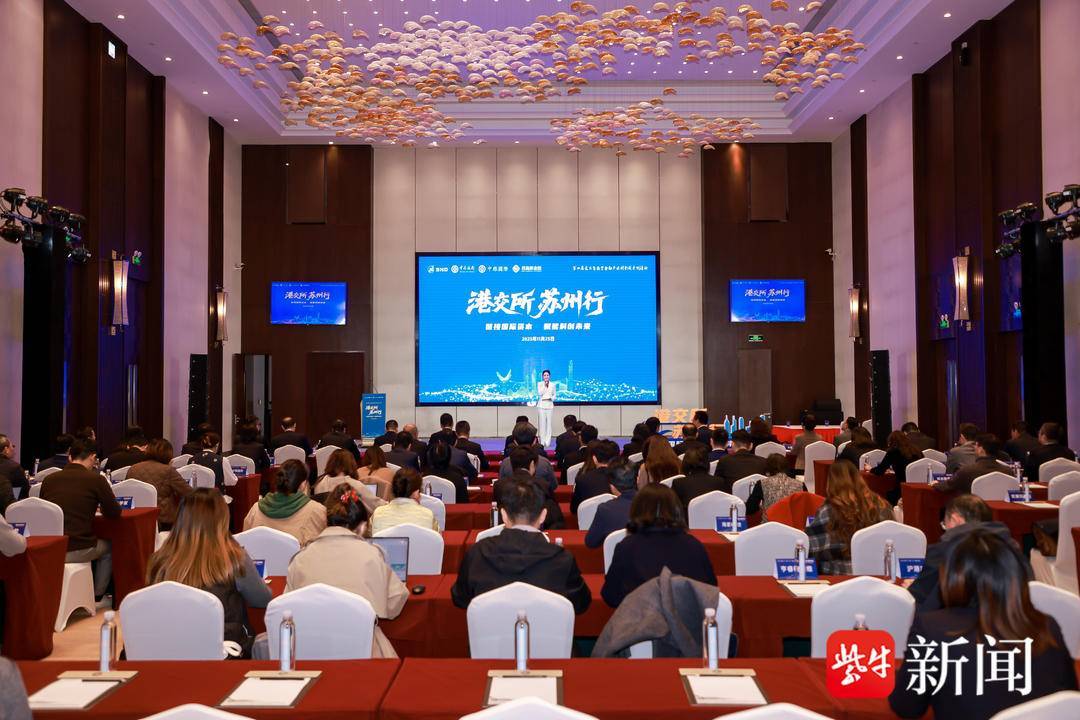
2025港交所‘苏州行’活动亮点纷呈: 加速苏港金融合作与科创企业上市步伐
Sou Hu Cai Jing· 2025-11-26 01:51
Core Insights - The "Suzhou Hong Kong" event aimed to enhance communication between technology innovation enterprises and the capital market through various formats such as keynote speeches, closed-door meetings, and company visits [1][4] - Suzhou and Hong Kong are key cities in the Yangtze River Delta and Guangdong-Hong Kong-Macau Greater Bay Area, accelerating the efficient flow of capital, technology, talent, and innovation [3] - Hong Kong serves as a crucial platform for mainland enterprises to connect with global capital and achieve international development, while Suzhou attracts technology innovation companies to the Hong Kong stock market [3] Event Highlights - The Hong Kong Stock Exchange (HKEX) presented the latest policies and market conditions for Hong Kong listings, while China International Capital Corporation (CICC) discussed key aspects of the listing mechanism and financial services [4] - Experts from the Bank of China shared insights on global market trends and enterprise risk management, providing comprehensive market insights [4] - HKEX and CICC engaged in in-depth discussions with over ten prospective listing companies to address challenges in the listing process [4] Company Initiatives - Suzhou Bank, as a co-host, leveraged the global advantages of the Bank of China Group to support technology enterprises with efficient and stable funding, achieving a technology finance loan balance exceeding 100 billion [5] - Through collaboration with CICC, Suzhou Bank has successfully assisted three local companies in listing on the Hong Kong stock market and is facilitating more quality technology enterprises in sectors like healthcare and intelligent manufacturing [5] Future Outlook - Suzhou Bank plans to strengthen cooperation with CICC and enhance financial support to help more Suzhou enterprises enter the international capital market [6] - These initiatives aim to set a vivid example of financial cooperation and collaborative development between Suzhou and Hong Kong, promoting high-quality local economic development [6]


打实打好金融稳外贸“组合拳”
Su Zhou Ri Bao· 2025-11-26 00:38
Core Insights - The Bank of China Suzhou Branch has played a crucial role in supporting regional foreign trade by leveraging its global advantages and optimizing financial services, contributing over 140 billion yuan in financing for import and export enterprises from January to October this year [1] Group 1: Credit Support and Financial Innovation - The Suzhou Branch has intensified its "Stabilizing Foreign Trade Special Visits" initiative, effectively addressing diverse financial needs of enterprises and continuously innovating financing products and services [2] - A manufacturing company in Suzhou received 100 million yuan in financing support for its overseas factory's raw material procurement through a customized cross-border RMB trade financing solution [2] - The "BOC Cross-Border E-Commerce Exclusive Loan" product was launched to assist small and micro enterprises in cross-border e-commerce, offering credit limits up to 30 million yuan and special interest rate discounts [2] Group 2: Risk Management and Service Enhancement - The Suzhou Branch has issued over 4.2 billion yuan in foreign-related guarantees to support enterprises in bidding for international projects, covering 61 countries and regions involved in the Belt and Road Initiative [3] - The bank has established multiple "Exchange Rate Risk Neutral Demonstration Outlets" to provide tailored hedging products, enhancing foreign trade enterprises' risk management capabilities [3] - The branch has processed cross-border RMB transactions exceeding 190 billion yuan and international settlement business for Belt and Road countries amounting to nearly 18 billion US dollars [4] Group 3: Support for Trade Stability - The bank has implemented a detailed action plan to stabilize foreign trade, serving nearly 600 high-quality enterprises involved in cross-border trade, ranking first among regional peers [6] - The Suzhou Branch has facilitated over 200,000 cross-border online product transactions, amounting to more than 22 billion US dollars from January to October [6] - The bank has organized various events to enhance trade connections, including cross-border e-commerce development forums and policy briefings for enterprises [7]
智通ADR统计 | 11月26日
智通财经网· 2025-11-25 22:22
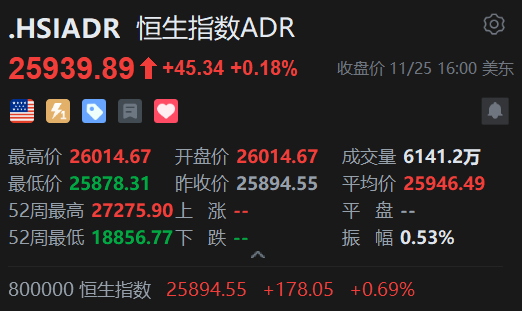
Core Viewpoint - The Hang Seng Index (HSI) showed a slight increase, closing at 25,939.89, up by 0.18% from the previous day, indicating a mixed performance among large-cap stocks in the Hong Kong market [1]. Group 1: Market Performance - The HSI closed at 25,939.89, with a daily increase of 45.34 points or 0.18% [1]. - The highest price during the day was 26,014.67, while the lowest was 25,878.31, resulting in a trading range of 0.53% [1]. - The average price for the day was 25,946.49, with a trading volume of 61.41 million shares [1]. Group 2: Individual Stock Performance - HSBC Holdings closed at 108.109 HKD, up by 1.23% compared to the previous close [2]. - Tencent Holdings closed at 622.043 HKD, down by 0.47% from the previous close [2]. - Alibaba Group's stock price increased by 2.14% to 157.800 HKD, while its ADR price was 152.624, reflecting a decrease of 3.28% [3]. - Other notable performances include Meituan, which rose by 0.10% to 98.250 HKD, and BYD, which increased by 0.95% to 95.750 HKD [3].





《2025中国银行业竞争力研究报告》在京发布
Xin Hua Cai Jing· 2025-11-25 14:23
Core Insights - The "2025 China Banking Industry Competitiveness Research Report" focuses on the high-quality development of the banking sector amid macroeconomic transformation and global financial changes, providing a professional and authoritative reference for understanding the industry's competitiveness [1][3]. Group 1: Overall Industry Trends - The report highlights the resilience of the Chinese banking industry, noting that by 2025, global economic growth will exhibit a "fragmented" characteristic, with increasing external uncertainties due to diverging central bank policies [1]. - Despite challenges such as insufficient effective demand, the domestic economy is expected to remain stable, with signs of stabilization in the net interest margin of listed banks and a rapid recovery in non-interest income [1]. - The financial regulatory framework is being enhanced under the guiding principles of "risk prevention, strong regulation, and promoting development," establishing a solid institutional foundation for the industry's steady growth [1]. Group 2: Competitiveness Rankings - The report includes a comprehensive ranking of the top 100 banks in China for 2025, based on four key indicators: scale, profitability, stability, and growth [2]. - The core ranking, "China Banking Industry Competitiveness Top 100," is supported by sub-rankings for scale, profitability, and growth, which assess banks based on total assets, total liabilities, operating income, ROA, and other critical metrics [2]. - The growth sub-ranking evaluates banks on revenue growth rate, core tier one capital adequacy ratio, and cost-to-income ratio, providing a multidimensional view of their growth capabilities [2]. Group 3: Sectoral Developments - The report covers five key areas: fintech, digital finance, pension finance, green finance, and inclusive finance, showcasing various advancements and practices within these sectors [3]. - It notes significant developments such as the upgrade of technology financial organizational structures in major banks, rapid growth in technology loans by small and medium-sized banks, and the entry of five banks into the "trillion club" for green credit [3]. - The report emphasizes the importance of high-quality development as a mainline for the banking industry to explore its core competitiveness in a complex environment [3].
增持不停歇!银行股成“香饽饽”,大股东、高管“真金白银”组团力挺
Bei Jing Shang Bao· 2025-11-25 13:37
Core Viewpoint - A surge in share buybacks by listed banks in China's A-share market is observed, driven by strong confidence from major shareholders and management teams in the banks' future prospects and the current undervaluation of bank stocks [1][5][6] Group 1: Share Buyback Activities - Numerous listed city commercial banks and rural commercial banks, including Nanjing Bank, Suzhou Rural Commercial Bank, Chengdu Bank, and others, have disclosed their share buyback progress since November [1][3] - Chengdu Bank reported that its major shareholders, Chengdu Industrial Capital Holding Group and Chengdu Xintianyi Investment, have cumulatively increased their holdings by 14.04 million shares, amounting to 253 million yuan [3][4] - Nanjing Bank's major shareholder, BNP Paribas, increased its stake by 128 million shares, raising its total holding from 17.02% to 18.06% [4] Group 2: Financial Performance and Market Sentiment - The banking sector's fundamentals remain robust, with commercial banks achieving a net profit of 1.9 trillion yuan in the first three quarters, and 24 listed banks announcing a total cash dividend of 263.79 billion yuan [5][6] - The stock prices of several banks have reached historical highs, with Agricultural Bank of China seeing a year-to-date increase of nearly 60% [6][7] - Analysts suggest that the current buyback trend reflects internal confidence in the banks' future and signals to the market that their value is underestimated [5][7] Group 3: Future Outlook - The ongoing recovery in the macroeconomic environment is expected to support the banking sector's performance, with analysts highlighting the importance of sustained economic recovery, interest rate changes, and long-term capital inflows for future stock performance [7][8] - Investors are advised to maintain a long-term perspective and focus on banks with strong fundamentals, emphasizing the importance of asset quality, profitability, and dividend policies [7][8]