
BANK OF CHINA(03988)

Search documents
2026年2月社融前瞻:预计社融增速8.1%
GF SECURITIES· 2026-03-04 07:26
Investment Rating - The industry investment rating is "Buy" [5]. Core Viewpoints - The report forecasts a social financing growth rate of 8.1% for February 2026, with a total social financing increment of 2.1 trillion CNY, which is a year-on-year decrease of 0.1 trillion CNY [4][7]. - It is expected that the total outstanding social financing will reach 451.1 trillion CNY by the end of February, reflecting a year-on-year growth rate of 8.1% and a month-on-month decline of 0.07 percentage points [4][7]. - The report highlights that credit growth is anticipated to be lower year-on-year due to the impact of the Spring Festival, with corporate credit demand expected to remain flat and retail loans likely to decrease year-on-year [4][7]. Summary by Sections Social Financing Estimates - The estimated social financing stock for February 2026 is 451.1 trillion CNY, up from 449.1 trillion CNY in January 2026 and 417.3 trillion CNY in February 2025, showing a month-on-month increase of 2.0% and a year-on-year increase of 33.8% [7]. - The report predicts a decrease in new RMB loans for February 2026, estimating an increment of 0.5 trillion CNY, which is a year-on-year decrease of 0.1 trillion CNY [4][7]. Credit and Bond Financing - The report anticipates a decrease in government and credit bond net financing for February, with government bonds expected to net finance 1.4 trillion CNY, down 0.3 trillion CNY year-on-year [4][7]. - The report also notes that the demand for bank bills is expected to remain strong, with a decrease of 1,000 billion CNY in discounted bank acceptance bills, reflecting a year-on-year decrease of 2,000 billion CNY [4][7]. Monetary Growth - The report emphasizes the importance of M2 growth, which is expected to remain high at around 9.0% in February, supported by strong government bond financing and improved corporate cash flow [4][7]. - M1 growth is projected to rise to approximately 5.1%, influenced by a low base effect and the reduced impact of deposit migration [4][7].



中国银行新任副行长落定:黄学玲获聘,待监管核准
2 1 Shi Ji Jing Ji Bao Dao· 2026-03-04 06:45
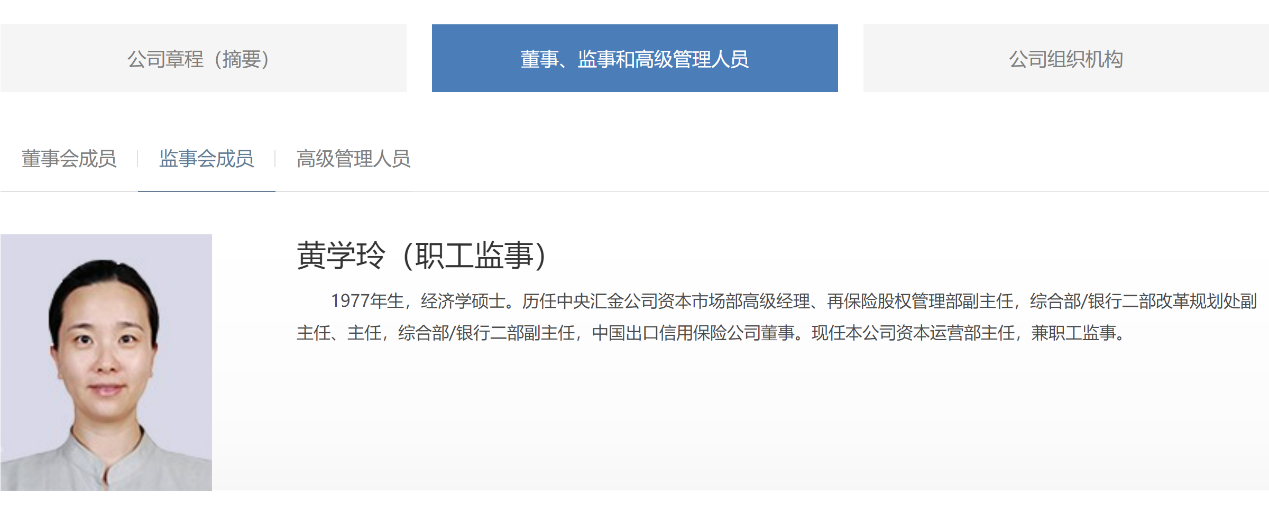
Group 1 - The core point of the article is the announcement of Huang Xueling's appointment as the vice president of the Bank of China, pending approval from the National Financial Regulatory Administration [1] - Huang Xueling, born in 1977, holds a master's degree in economics and joined the Bank of China in 2026 after a long career within the Central Huijin Investment Co., Ltd. [4] - Prior to her appointment, Huang served as the director of the Equity Management Department at Huijin Company and held key positions in capital operations and asset management [5] Group 2 - Huang Xueling has previously interacted with the Bank of China, attending a strategic cooperation agreement signing ceremony in November 2023 [6] - The appointment of Huang Xueling further strengthens the senior management team of the Bank of China, which currently includes several vice presidents and executive directors [6] - If her appointment is approved, she will become the third female vice president among state-owned banks, following Yao Hong from Postal Savings Bank and Han Jing from China Construction Bank [6]

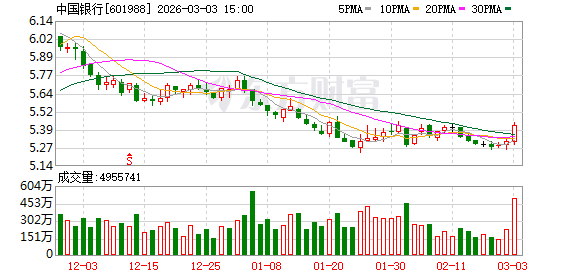
中国银行保险资产管理业协会:2026年险资重点关注战略性新兴产业
Jin Rong Shi Bao· 2026-03-04 02:52
Core Insights - The China Banking and Insurance Asset Management Association released a survey on the asset allocation outlook for the banking and insurance asset management industry in 2026, based on feedback from 127 insurance institutions, covering 36 asset management companies and 91 insurance companies, reflecting the industry's forward-looking judgment and strategic trends for asset allocation in 2026 [1] Group 1: Domestic Investment Preferences - Most insurance institutions maintain an optimistic outlook on the stock market for 2026, with a neutral stance on the bond market, and nearly half plan to slightly increase allocations to public funds [1] - The A-share market is favored, particularly indices related to the Sci-Tech 50, CSI 300, CSI A500, and the ChiNext, with sectors like electronics, non-ferrous metals, power equipment, computers, communications, pharmaceuticals, and basic chemicals being widely regarded as promising [2] - Strategic emerging industries and technological innovation are expected to be key focus areas for insurance funds in 2026, supported by regulatory guidance to direct funds towards these sectors [2] Group 2: Bond Market Outlook - The core variables influencing the A-share market in 2026 are expected to be corporate profit recovery and changes in liquidity conditions, with the bond market serving as a stabilizing force for insurance fund allocation [3] - Most institutions hold a neutral view on the bond market, with expectations for 10-year government bond yields to be in the range of 1.8% to 1.9% and 30-year yields between 2.2% and 2.4% [3] - High-grade industrial bonds, perpetual bonds, and convertible bonds are favored, with a cautious approach to duration strategies reflecting sensitivity to interest rate fluctuations [3] Group 3: Public Fund and Foreign Investment Strategies - Public funds remain an important investment channel for insurance institutions, with nearly half planning to slightly increase their allocation to public funds, favoring equity funds, secondary bond funds, mixed equity funds, and ETFs [3] - In terms of foreign investments, Hong Kong stocks are the most favored, with gold and US stock markets also receiving attention; about half of the asset management institutions plan to slightly increase their allocation to Hong Kong stocks [4]
中国人民银行决定授权中国银行股份有限公司科伦坡分行 担任斯里兰卡人民币清算行
Jin Rong Shi Bao· 2026-03-04 00:50
Group 1 - The People's Bank of China has announced the authorization of the Bank of China Colombo Branch as the Renminbi clearing bank for Sri Lanka [1] - This decision is based on the cooperation memorandum between the People's Bank of China and the Central Bank of Sri Lanka [1] - The establishment of a Renminbi clearing bank is expected to enhance financial cooperation between China and Sri Lanka [1]
中国银行迎来新任副行长
Zhong Guo Ji Jin Bao· 2026-03-03 16:20
Core Viewpoint - China Bank has appointed Huang Xueling, born in 1977, as its youngest vice president, pending approval from the National Financial Regulatory Administration, marking a significant addition to the leadership team of state-owned banks [2][3]. Group 1: Appointment Details - Huang Xueling is the first executive directly promoted from the Central Huijin Investment Co. to a vice president position in a state-owned bank, indicating deep involvement of major shareholders in governance structures [3]. - Huang has a master's degree in economics from Peking University and has held various positions within Central Huijin, including Director of the Equity Management Department and Chairman of Central Huijin Asset Management [2]. Group 2: Current Management Team - With Huang's appointment, China Bank now has the youngest vice president among its current executive team, joining two other female vice presidents in state-owned banks [4]. - The current senior management team of China Bank includes Chairman Ge Haijiao, Vice Chairman and President Zhang Hui, and several other executive directors and vice presidents [4]. Group 3: Financial Performance - As of the end of Q3 2025, China Bank's total assets reached 37.55 trillion yuan, an increase of approximately 2.49 trillion yuan, representing a growth of 7.10% [4]. - For the first three quarters of 2025, the bank reported total operating income of 491.204 billion yuan, a year-on-year increase of 2.69%, and a net profit attributable to shareholders of 177.66 billion yuan, up 1.08% [4]. - The bank's non-performing loan ratio was 1.24%, a decrease of 0.01 percentage points from the end of the previous year, while the provision coverage ratio was 196.60%, down by 4.00 percentage points [4].
中国银行(601988) - 中国银行股份有限公司董事会决议公告
2026-03-03 10:45
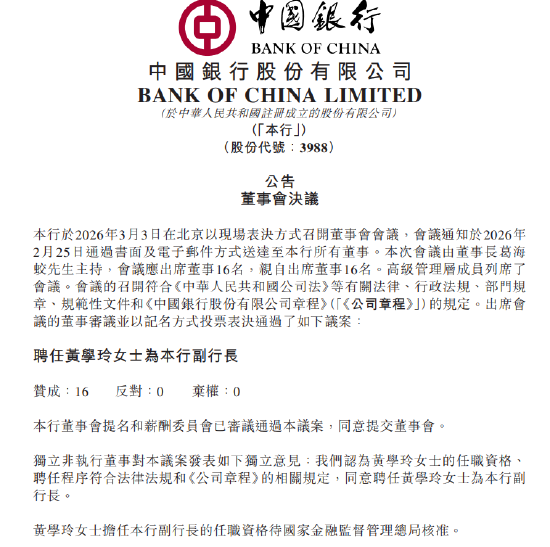
赞成:16 反对:0 弃权:0 本行董事会提名和薪酬委员会已审议通过本议案,同意提交董事会。 独立非执行董事对本议案发表如下独立意见:我们认为黄学玲女士的 任职资格、聘任程序符合法律法规和《公司章程》的相关规定,同意聘任 黄学玲女士为本行副行长。 证券代码:601988 证券简称:中国银行 公告编号:临 2026-003 中国银行股份有限公司董事会决议公告 中国银行股份有限公司董事会及全体董事保证本公告内容不存在任何虚假记 载、误导性陈述或者重大遗漏,并对其内容的真实性、准确性和完整性承担法律责 任。 中国银行股份有限公司(简称"本行")于 2026 年 3 月 3 日在北京 以现场表决方式召开董事会会议,会议通知于 2026 年 2 月 25 日通过书面 及电子邮件方式送达至本行所有董事。本次会议由董事长葛海蛟先生主 持,会议应出席董事 16 名,亲自出席董事 16 名。高级管理层成员列席了 会议。会议的召开符合《中华人民共和国公司法》等有关法律、行政法规、 部门规章、规范性文件和《中国银行股份有限公司章程》(简称"《公司 章程》")的规定。出席会议的董事审议并以记名方式投票表决通过了如 下议案: 聘任黄学 ...
中国银行:聘任黄学玲女士为本行副行长
Xin Lang Cai Jing· 2026-03-03 10:33
中国银行公告,中国银行股份有限公司董事会于2026年3月3日召开会议,决定聘任黄学玲女士为本行副 行长。黄学玲女士,1977年出生,2026年加入本行。此前,她曾担任中央汇金投资有限责任公司股权管 理二部主任,资本运营部主任,兼中央汇金资产管理有限责任公司董事长、总经理等职务。黄学玲女士 的任职资格尚待国家金融监督管理总局核准。 ...
中国银行聘任黄学玲为副行长 任职资格待监管核准
Jin Rong Jie· 2026-03-03 10:18
黄学玲出生于1977年,2026年加入中国银行,获北京大学经济学硕士学位,拥有丰富的金融领域管理从 业经历。2025年7月至2026年2月,其任中央汇金投资有限责任公司股权管理二部主任;2020年4月至 2025年7月,任中央汇金投资有限责任公司资本运营部主任,兼中央汇金资产管理有限责任公司董事 长、总经理。此外,黄学玲还曾任中央汇金投资有限责任公司综合管理部副主任,中央汇金资产管理有 限责任公司执行董事,中国出口信用保险公司董事,中央汇金公司综合管理部╱银行机构管理二部改革 规划处主任等职务。 银行频道更多独家策划、专家专栏,免费查阅>> 责任编辑:钟离 3月3日,中国银行在北京召开董事会会议,会议审议并表决通过议案,聘任黄学玲为副行长,相关任职 资格待国家金融监督管理总局核准。 本次董事会会议以现场表决方式召开,会议通知于2026年2月25日通过书面及电子邮件方式送达全体董 事,由董事长葛海蛟主持。会议应出席董事16名,实际亲自出席16名,高级管理层成员列席会议。会议 的召开符合《中华人民共和国公司法》等相关法律法规、部门规章、规范性文件以及《中国银行股份有 限公司章程》的规定。此次聘任议案经记名投票表决 ...
中国银行:聘任黄学玲为副行长
Xin Lang Cai Jing· 2026-03-03 09:57
3月3日金融一线消息,中国银行发布公告称,董事会会议同意聘任黄学玲为该行副行长,任职资格待国 家金融监督管理总局核准。 简历显示,黄学玲出生于1977年,2026年加入中国银行。2025年7月至2026年2月任中央汇金投资有限责 任公司股权管理二部主任。2020年4月至2025年7月任中央汇金投资有限责任公司资本运营部主任,兼中 央汇金资产管理有限责任公司董事长、总经理。此前曾任中央汇金投资有限责任公司综合管理部副主 任,中央汇金资产管理有限责任公司执行董事,中国出口信用保险公司董事,中央汇金公司综合合管理 部/银行机构管理二部改革规划处主任等职务。获北京大学经济学硕士学位。 责任编辑:王馨茹 3月3日金融一线消息,中国银行发布公告称,董事会会议同意聘任黄学玲为该行副行长,任职资格待国 家金融监督管理总局核准。 简历显示,黄学玲出生于1977年,2026年加入中国银行。2025年7月至2026年2月任中央汇金投资有限责 任公司股权管理二部主任。2020年4月至2025年7月任中央汇金投资有限责任公司资本运营部主任,兼中 央汇金资产管理有限责任公司董事长、总经理。此前曾任中央汇金投资有限责任公司综合管理部副主 ...
中国银行(03988.HK):拟聘任黄学玲为副行长
Ge Long Hui· 2026-03-03 09:48
格隆汇3月3日丨中国银行(03988.HK)发布公告,董事会决议通过议案,聘任黄学玲为本行副行长,黄学 玲担任本行副行长的任职资格待国家金融监督管理总局核准。 ...