
BANK OF CHINA(03988)

Search documents
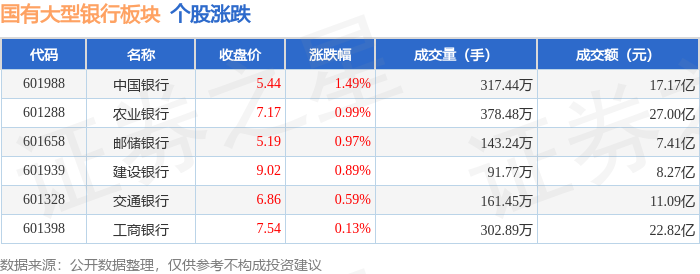
国有大型银行板块1月20日涨0.78%,中国银行领涨,主力资金净流入7.21亿元
Zheng Xing Xing Ye Ri Bao· 2026-01-20 08:56
Group 1 - The core viewpoint of the news is that the state-owned large bank sector experienced a rise of 0.78% on January 20, with China Bank leading the gains [1] - The Shanghai Composite Index closed at 4113.65, down 0.01%, while the Shenzhen Component Index closed at 14155.63, down 0.97% [1] - The trading performance of individual stocks in the state-owned large bank sector showed varied results, with China Bank closing at 5.44, up 1.49%, and Agricultural Bank at 7.17, up 0.99% [1] Group 2 - The net inflow of main funds into the state-owned large bank sector was 721 million yuan, while retail investors saw a net outflow of 177 million yuan [1] - The detailed fund flow for individual banks indicated that Agricultural Bank had a net inflow of 210 million yuan from main funds, while it experienced a net outflow of 140 million yuan from speculative funds [2] - Industrial and Commercial Bank had a net inflow of 181 million yuan from main funds, but a significant net outflow of 254 million yuan from speculative funds [2]





小摩:预计内银今年股价上升 惟流动性顺风中相对落后 升民行评级至“增持”
Zhi Tong Cai Jing· 2026-01-20 06:49
Core Viewpoint - Morgan Stanley predicts that China Bank (601988) will experience absolute stock price appreciation but may underperform the market by 2026 [1] Group 1: Bank Ratings - Morgan Stanley upgraded the rating of Minsheng Bank (600016) from "Neutral" to "Overweight" [1] - The rating of Agricultural Bank (601288) was downgraded from "Overweight" to "Neutral" [1] Group 2: Market Liquidity and Growth Expectations - Approximately 110 trillion RMB of fixed-term deposits are expected to mature by 2026, including around 7 trillion RMB of excess household savings, which may provide liquidity support to the capital market and boost market performance [1] - The recovery of net interest income and wealth management fees is expected to lead to moderate improvements in revenue and profit growth for domestic banks in 2026 [1] Group 3: Stock Performance Preferences - In the context of high dividend stocks, Morgan Stanley prefers Bank of Communications (601328), China Bank (03988), and China Construction Bank (601939) [1] - Banks such as Ningbo Bank (002142), Shanghai Pudong Development Bank (600000), Industrial Bank (601166), and China Merchants Bank (600036) are seen as having better growth potential [1] - Growth-oriented stocks are expected to outperform high dividend stocks [1]


小摩:预计内银今年股价上升 惟流动性顺风中相对落后 升民行(01988)评级至“增持”
智通财经网· 2026-01-20 06:48
Core Viewpoint - JPMorgan expects Chinese bank stocks to achieve absolute price increases but may underperform the market by 2026 [1] Group 1: Ratings Changes - JPMorgan upgraded the rating of Minsheng Bank (01988) H-shares from "Neutral" to "Overweight" [1] - JPMorgan downgraded the rating of Agricultural Bank of China (01288) H-shares from "Overweight" to "Neutral" [1] Group 2: Market Predictions - JPMorgan anticipates approximately 110 trillion RMB in time deposits maturing by 2026, including around 7 trillion RMB in excess household savings, which could provide liquidity support to the capital market and boost market performance [1] - The bank expects a moderate improvement in revenue and profit growth for domestic banks in 2026, driven by a recovery in net interest income and wealth management fees [1] Group 3: Stock Preferences - Among high-dividend stocks, JPMorgan prefers Bank of Communications (601328.SH), Bank of China (03988), and China Construction Bank (00939) [1] - Banks such as Ningbo Bank (002142.SZ), Shanghai Pudong Development Bank (600000.SH), Industrial Bank (601166.SH), and China Merchants Bank (03968)(600036.SH) are seen as having good growth potential [1] - JPMorgan predicts that growth-oriented stocks will outperform high-dividend stocks [1]
四部门:扩大设备更新贷款财政贴息支持范围
Bei Jing Shang Bao· 2026-01-20 05:08
Core Viewpoint - The Chinese government has announced a policy to optimize the implementation of financial subsidies for equipment renewal loans, aimed at supporting various industries and promoting technological innovation and modernization [1][2]. Group 1: Policy Details - The central government will provide a subsidy of 1.5% on the principal of fixed asset loans for equipment renewal projects, applicable for a maximum period of 2 years from the loan issuance date [1]. - The policy will include new technology innovation loans issued by banks starting in 2026, expanding the scope of financial support [1]. - The implementation of this policy is set to last until December 31, 2026, with the possibility of extension based on future evaluations [1]. Group 2: Supported Industries - The policy expands support beyond existing sectors such as industrial, energy, transportation, and tourism to include construction, municipal services, energy equipment, aviation materials, electronic information, safety production, and more [1]. - Additional focus areas for support include high-end, intelligent, green, and digital equipment updates, as well as sectors like artificial intelligence, elderly care, and waste recycling [1]. Group 3: Participating Banks - A total of 26 banks are designated to handle the subsidized loans, including major state-owned and commercial banks such as the China Development Bank, Agricultural Bank of China, and Industrial and Commercial Bank of China [2].
五部门发布实施中小微企业贷款贴息政策通知 支持以人工智能等为代表的新兴领域
智通财经网· 2026-01-20 04:27
Core Viewpoint - The Chinese government has announced a loan interest subsidy policy aimed at supporting small and micro enterprises in key industries, effective from January 1, 2026, with a subsidy rate of 1.5% for loans up to 50 million yuan per enterprise [1][4]. Group 1: Policy Content - The policy targets small and micro private enterprises involved in key industrial chains and their upstream and downstream sectors [3]. - Eligible industries include new energy vehicles, industrial mother machines, pharmaceuticals, medical equipment, software, civil aircraft, servers, mobile communication devices, new displays, industrial robots, and agricultural machinery [4]. - The subsidy will be provided for fixed asset loans and new policy financial tools used by small and micro enterprises [4]. Group 2: Subsidy Standards - The central government will provide a 1.5% annual interest subsidy for eligible loans, with a maximum loan amount of 50 million yuan per enterprise and a term not exceeding 2 years [4]. - The policy is initially set to last for one year, with the possibility of extension based on future evaluations [4]. Group 3: Implementation Mechanism - The policy will be executed through a "total-to-total" model, where financial departments will coordinate directly with banks [5][6]. - Banks will be responsible for loan approvals based on market principles and will manage the disbursement of funds [7]. - Monthly reporting on loan issuance and subsidy usage will be required from banks to ensure compliance and oversight [9]. Group 4: Supervision and Management - The Ministry of Finance will oversee the implementation and conduct audits to ensure proper use of subsidy funds [10]. - Banks are required to monitor the flow of loan funds to prevent misuse, such as investment in speculative activities [10].
河南金融监管局核准杨凤仙中国银行济源分行行长助理任职资格
Jin Tou Wang· 2026-01-20 03:49
Core Viewpoint - The Henan Financial Regulatory Bureau has approved the appointment of Yang Fengxian as the Assistant President of the Jiyuan Branch of the Bank of China, emphasizing the importance of compliance with regulatory requirements and ongoing education in financial laws and regulations [1] Group 1 - The approval of Yang Fengxian's qualification as Assistant President is officially recognized by the Henan Financial Regulatory Bureau [1] - The Bank of China is required to ensure that the approved personnel comply with regulatory provisions and report their appointment status within three months [1] - Continuous learning and adherence to risk compliance awareness are mandated for the approved personnel to effectively fulfill their responsibilities [1]
金隅冀东水泥集团股份有限公司 关于对唐山冀东启新水泥有限责任公司提供担保的进展公告
Zhong Guo Zheng Quan Bao - Zhong Zheng Wang· 2026-01-20 00:24
Group 1 - The company approved a financing guarantee of 98 million yuan for its wholly-owned subsidiary, Tangshan Jidong Qixin Cement Co., Ltd., during board meetings held on March 26, 2025, and the annual shareholders' meeting on April 29, 2025 [1][3] - The subsidiary has signed two loan contracts with the Bank of China, Tangshan Branch, totaling 95 million yuan, with a loan term of 12 months [2] - The guarantee amount is within the approved limit from the shareholders' meeting, thus no further approval is required [3] Group 2 - The subsidiary, Tangshan Jidong Qixin Cement Co., Ltd., has a registered capital of 460 million yuan and was established on March 30, 2009 [4] - As of December 31, 2024, the subsidiary reported total assets of 1.037 billion yuan, total liabilities of 837.63 million yuan, and a net profit of -51.96 million yuan [4] - As of December 31, 2025, the subsidiary's total assets were 971.63 million yuan, total liabilities were 649.60 million yuan, and it achieved a net profit of 13.53 million yuan [4] Group 3 - The guarantee contract specifies that the company provides a joint liability guarantee for the loans, covering principal, interest, penalties, and other related costs [5] - The guarantee period lasts for three years after the main debt is settled, or three years after the last installment if the debt is paid in installments [5][6] Group 4 - The board of directors stated that the asset quality of the subsidiary is good, and the risk associated with the guarantee is controllable, ensuring no harm to the company or minority shareholders [8] - As of the announcement date, the company has provided a total of 368.11 million yuan in financing guarantees for its subsidiaries, which is 1.33% of the latest audited net assets attributable to shareholders [9]

金价又创新高,银行保管箱“抢疯了”!
Xin Lang Cai Jing· 2026-01-19 10:45
Core Viewpoint - The international gold price has reached a historic high, exceeding $4,690 per ounce, leading to a surge in demand for gold and other precious metals, while the availability of bank safety deposit boxes has become critically low, especially in major cities like Beijing, Shanghai, Guangzhou, and Shenzhen [1][7]. Group 1: Gold Price and Demand - The spot gold price increased by approximately 70% in 2025, driving a significant rise in consumer investment demand for gold bars and other precious metals [2][8]. - As demand for gold rises, the difficulty in renting safety deposit boxes has become more pronounced, with reports of waiting times extending up to five to six years for certain banks [1][8]. Group 2: Supply Constraints of Safety Deposit Boxes - The supply of safety deposit boxes is characterized by static growth, as banks primarily view this service as a means to maintain high-net-worth clients rather than a profit center, leading to limited resource allocation [2][5]. - High renewal rates and slow turnover of safety deposit boxes exacerbate the supply shortage, creating a rigid gap in availability [3][9]. Group 3: Bank Strategies and Challenges - Banks face challenges in increasing the supply of safety deposit boxes due to low profitability, high operational costs, and the expensive nature of building new secure storage facilities [5][11]. - Current strategies include optimizing existing resources and implementing technology upgrades to improve space utilization, but these measures are gradual and unlikely to resolve the supply-demand imbalance in the short term [6][12].


聚力深耕江淮 服务“三地一区” ——中国银行安徽省分行交出“十四五”答卷
Zhong Guo Jin Rong Xin Xi Wang· 2026-01-19 10:37
Core Viewpoint - During the "14th Five-Year Plan" period, the Bank of China Anhui Branch has focused on political and people-oriented financial work, aligning closely with Anhui's strategic positioning and actively supporting major projects, industrial upgrades, rural revitalization, and opening up to the outside world [1] Group 1: Infrastructure Empowerment - The Bank of China Anhui Branch has injected financial momentum into major projects, such as the Changjing-Huang High-Speed Railway, which connects several famous tourist attractions across three provinces [2] - The bank has provided financial support for key transportation projects, including the G36 Ningluo Expressway and Wuyue Expressway, enhancing Anhui's geographical advantages for high-quality economic development [2] Group 2: Innovation in Science and Technology - The bank has supported over 15,000 manufacturing enterprises with more than 160 billion yuan in credit, focusing on strategic emerging industries and technology finance [3] - A notable case includes a private aerospace equipment company receiving 50 million yuan in equity investment and 100 million yuan in credit support through an innovative "small equity + large debt" financial service model [3] - The bank plans to launch an action plan to support the artificial intelligence industry chain and establish a direct investment pilot fund in Anhui [3] Group 3: Green Development - The Bank of China Anhui Branch has actively engaged in green finance, providing over 1.2 billion yuan in loans for ecological restoration projects in the Ma'anshan area [4] - The bank has integrated ecological governance with industrial development, promoting sustainable growth in the region [4] Group 4: Revitalizing Local Industries - The bank has tailored financial products to support local industries, such as the "Goose Industry Loan" in Huoqiu and the "Xuan Paper Loan" in Jingxian, facilitating the upgrade of local production chains [5] - These initiatives aim to enhance rural revitalization and promote regional economic strength [5] Group 5: Supporting International Trade - The bank has provided cross-border financial services to nearly 7,000 enterprises, with an external trade loan balance exceeding 65 billion yuan [6] - It has customized overseas loan solutions for companies expanding into international markets, such as a well-known automotive company entering Australia [6] - The bank emphasizes a tailored approach to meet the diverse needs of enterprises operating abroad [6]
固定收益专题报告:绿色债券浅析
BOHAI SECURITIES· 2026-01-19 09:26
Report Industry Investment Rating The provided content does not mention the report industry investment rating. Core Viewpoints - Green bonds are securities raised for green industries, projects, or economic activities, and have become an important financing tool. As of the end of 2025, the cumulative issuance scale in China reached 5.32 trillion yuan [2]. - The development of China's green bond market can be divided into three stages: the exploration and launch stage (2015), the standardization development stage (2016 - 2020), and the system improvement stage (2021 - present) [2][16]. - By the end of 2025, the annual issuance scale increased from 207.231 billion yuan in 2016 to 1.079283 trillion yuan, and the number of issuances rose from 89 to 834. The stock of green bonds was 2,014, with a market size of 2.464521 trillion yuan. Green bonds are suitable for long - term investment [3][109]. - Green bonds generally have a "green spread" over non - green bonds, which has weakened in the past three years but still supports pricing. They are more suitable as a stable portfolio base rather than a source of significant excess returns [4]. Summary by Directory 1. Green Bond Development 1.1 Green Bond Concept - Green bonds are securities that raise funds for green industries, projects, or economic activities. They are divided into four types according to the "China Green Bond Principles (2022)" and play an important role in global green finance [13]. 1.2 Policy Context - China's green bond market has established a relatively complete system. The development is divided into three stages: - Exploration and launch stage (2015): The People's Bank of China and the National Development and Reform Commission issued relevant documents, marking the official start of the green bond market [16][17]. - Standardization development stage (2016 - 2020): Multiple departments issued a series of policies to improve the regulatory mechanism, project catalog, and evaluation and certification mechanism [16][18]. - System improvement stage (2021 - present): Policies continued to be refined, the standard system was integrated with international standards, and cross - border green financing advanced steadily [16][25]. 2. Green Bond Value 2.1 Value to Issuers - Green bonds generally have a lower issuance interest rate than non - green bonds, showing a "green spread," which has weakened in the past three years. They can also access overseas ESG funds [34]. 2.2 Value to Investors - Green bonds are fixed - income tools. Their credit risk is mainly determined by the issuer's quality and credit enhancement. They are suitable as a stable portfolio base and can meet institutional ESG and sustainable investment goals. Their tradability has also improved [46]. 3. Green Bond Issuance Statistics 3.1 Green Asset - Backed Securities - Their issuance rhythm has different stages. From 2016 - 2018, it was in the start - up phase; 2019 - 2020 saw market expansion; 2021 entered the accelerated development stage; 2022 - 2023 maintained a high - level operation; 2024 - 2025 had a decline in scale. They are mainly short - term and ultra - long - term products, with concentrated underlying assets [48][49]. 3.2 Non - Asset - Backed Green Bonds - The issuance showed phased characteristics. It expanded steadily from 2016 - 2020, jumped significantly in 2021, reached a high in 2022, declined in 2023, and significantly increased in 2025. State - owned enterprises are the main issuers, and bank - to - bank market is the main trading platform. Their issuance interest rate has been declining, and the term is mainly medium - short term [59][61][71]. 4. Green Bond Stock and Transaction Analysis 4.1 Green Bond Stock Analysis - As of the end of 2025, the stock of green bonds was 2,014, with a market size of 2.464521 trillion yuan. Financial bonds accounted for nearly half of the stock, followed by medium - term notes and asset - backed securities. The stock was concentrated in short - and medium - term bonds, a few industries, and regions such as Beijing, Shanghai, and Guangdong [83][90][95]. 4.2 Green Bond Transaction Analysis - The secondary - market trading volume of green bonds has been rising with fluctuations, and the turnover rate has shown a trend of "falling from a high level, fluctuating in the central range, and weakening again in recent years." Compared with credit bonds and financial bonds, the turnover rate of green bonds is relatively low, but it has stable trading and periodic surges. The valuation of green bonds shows a clear stratification [100][101][105]. 5. Investment Viewpoint - Similar to the core viewpoints, green bonds have good development prospects, supply - side expansion, and are suitable for long - term investment and portfolio optimization [108][109][110].


